
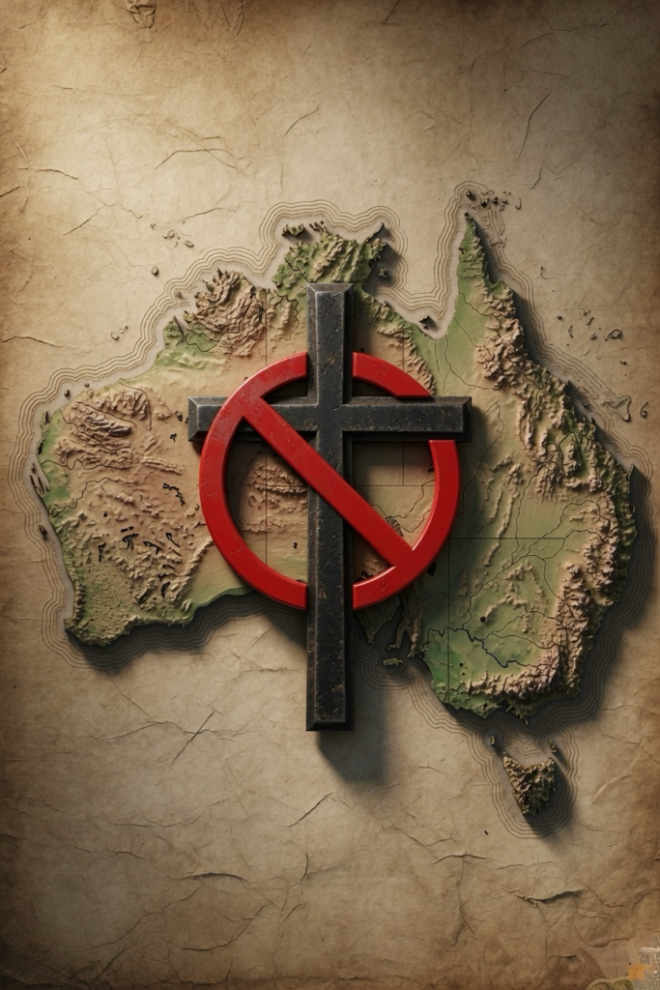
Barnaby Joyce’s contention that Australia is a Christian country, built on British civilisation, and Pauline Hanson’s related insistence that Australia should return to being a monoculture rather than remain multicultural, are the kind of claims that acquire authority through repetition rather than evidence. Said often enough, on programs watched by an audience genuinely anxious about immigration and social cohesion, the assertion begins to sound like settled history rather than contested opinion. It is neither. Nowhere does the Australian Constitution declare Christianity the national religion. Nowhere does the most authoritative measure of what Australians actually believe support the idea of a Christian nation in anything but a residual, plurality sense. And nowhere does the lived texture of contemporary Australia – its neighbourhoods, its workplaces, its intermarriages, its mosques and synagogues and temples standing beside its churches – resemble the monoculture Hanson called for at the National Press Club, or the vision Joyce endorsed when he said he does not believe in multiculturalism.
This essay makes four claims, each resting on different evidence. First, that the founding legal architecture of the Commonwealth was deliberately secular and remains so. Second, that the population Joyce and Hanson claim to speak for has, in the most comprehensive survey instrument available, been moving away from Christian identification for half a century and no longer forms a majority in any but a plurality sense. Third, that whether “Christian” in this rhetoric is doing genuine theological work or standing in, at least partly, for an ethnic preference is a live and contested question rather than a settled one – but that even the most generous reading of the claim must be tested against who is actually sustaining Christian practice in Australia today. Fourth, that the “monoculture” Hanson demanded and Joyce defended, in both its blunt and its later-clarified forms, is neither historically accurate nor, on the polling, politically popular, even among voters who want reduced immigration.
None of this requires erasing the British inheritance that shaped the colonies and, later, the Commonwealth. It requires refusing the leap from “Australia has British and Christian threads in its history” to “Australia is, constitutionally and demographically, a Christian British outpost today.” That leap is where the argument fails.
What The Constitution Actually Says
Section 116 of the Constitution of Australia is unambiguous: the Commonwealth shall not make any law establishing a religion, imposing religious observance, or prohibiting the free exercise of any religion, and no religious test may be required for public office. This was a deliberate drafting choice by the framers of Federation, made in a colonial context still saturated with sectarian rivalry between Protestant and Catholic institutions. The founders did not carve out an exception for Christianity generally, nor for Protestantism in particular. They built a secular Commonwealth on top of colonies that, individually, had inherited an established Church of England. That inheritance is real. It is also the thing the Constitution deliberately declined to federate.
Australia today has no official religion. It never adopted one at Federation, and nothing in the 125 years since has changed that constitutional fact. Public holidays around Easter and Christmas are frequently cited as evidence of Christian character, and they are evidence of something – an administrative calendar shaped by nineteenth-century British settlement patterns. They are not evidence of an established religion, a constitutional identity, or a legal preference for Christian belief over any other. Plenty of officially secular and religiously plural nations retain calendars shaped by a dominant historical tradition without that tradition amounting to state religion. Conflating the two is either a category error or a rhetorical convenience.
What The Census Actually Says
If constitutional silence on religion leaves room for a “Christian nation” argument to be made on cultural rather than legal grounds, the census closes even that door. The 2021 Census – the most recent full national count, with the 2026 Census still to report – recorded 43.9 per cent of Australians identifying as Christian and 38.9 per cent declaring no religion at all. That Christian figure has been in freefall for half a century: 61.1 per cent in 2011, 52.1 per cent in 2016, 43.9 per cent in 2021. “No religion” has moved in the opposite direction just as sharply, from 22.3 per cent in 2011 to 38.9 per cent a decade later – very nearly doubling. The Australian Bureau of Statistics has been asking this question, in some form, in every census since 1911, which makes the trendline unusually reliable rather than a one-off artefact of the pandemic year in which the 2021 data was gathered.
A plurality is not a majority, and a shrinking plurality trending toward parity with “no religion” is not the empirical basis for declaring a national religious identity. Add the remaining minority faiths – Islam at 3.2 per cent, Hinduism at 2.7 per cent, Buddhism at 2.4 per cent, Sikhism, Judaism, and the array of “other religions” – and well over half the country either professes no religion or professes one other than Christianity. On the numbers Australians themselves supplied, voluntarily, to their own statistical agency, “Christian country” is a description of a fading plurality, not a national identity that a returned parliamentarian or a minor party leader is entitled to assert on the nation’s behalf.
A fair reading of the census figures has to concede a limit on what they show. “No religion” is a self-identification, not a measure of cultural formation, and plenty of Australians who tick that box were raised inside Christian schooling, mark Christmas and Easter as family occasions, and carry an ethical vocabulary – conscience, forgiveness, the equal worth of persons – that has Christian roots whether or not they would name it that way. Census non-affiliation understates residual cultural Christianity in the same way it overstates active religious decline; the two are related but not identical, and an honest argument should not collapse them for convenience in either direction. What the census figures do settle, cleanly, is the narrower and more relevant claim: that Christianity is not a majority religious affiliation, and that no government has a demographic mandate to treat it as the state’s default belief system.
The internal composition of that Christian plurality tells its own story. Catholicism (20.0 per cent) and Anglicanism (9.8 per cent) remain the largest denominations, but every long-established Christian institution in the country is contracting in real terms, not merely as a share of a growing population. The steepest declines between 2016 and 2021 were recorded in precisely the denominations most associated with Anglo-Celtic settler Australia – the Salvation Army, the Uniting Church, Presbyterian and Reformed congregations, Anglicans, and Lutherans all lost members. The denominations losing ground slowest, or in Catholicism’s case barely at all, are disproportionately sustained by post-war and more recent migrant congregations. The Christianity that survives and grows in Australia is increasingly a migrant Christianity – Filipino, Vietnamese, South Sudanese, Samoan, Indian – rather than the Anglo-Celtic Christianity the “Christian country” argument implicitly pictures. That fact matters again in the next section.
Christian As Code: A Contested Reading
A harder question, and one this essay should not resolve more cleanly than the evidence allows, is whether “Christian country” is doing theological work at all, or whether it functions, at least some of the time, as a more socially acceptable way of naming an ethnic preference – for an Anglo-Celtic Australia – than “white Australia” would be today.
The case that it is not should be made properly. Joyce has said directly, more than once, that heritage – Vietnamese, Chinese, African – is not the issue, and that what matters is acceptance of a shared Australian culture and, in his phrase, guardrails that apply to everyone regardless of background. Taken at face value, that is a claim about cultural transmission and civic assimilation, not ancestry: the position that a country can hold a coherent common culture – language, law, certain shared expectations – that people of any background are free to join, and that Albanese cited the multi-ethnic Socceroos squad the objection is to non-assimilation, not to skin colour. Hanson’s own defence of “monoculture” points the same way. When Anthony Albanese cited the multi-ethnic Socceroos squad – including two players born in African refugee camps – as evidence Australia was not a monoculture, Hanson did not concede the point or retreat to a narrower racial claim. She said the squad represented her vision of a monocultural Australia: people of varied backgrounds united under one set of rules, one team, one set of expectations. Whatever else is true of Hanson’s record, that is a definition built on shared conduct and identity, not blood. Treating it as automatically insincere is circular. A disclaimer is evidence of nothing on its own; it has to be tested against conduct.
Tested against their most recent statements, the cultural-transmission reading is currently the better-supported one. Joyce has repeatedly said that heritage is not the barrier provided people accept shared Australian culture and guardrails. Hanson has defined her “monoculture” vision through the multi-ethnic Socceroos example – people of varied backgrounds united under one set of rules. Both have framed the issue in civic and behavioural terms throughout 2026. Hanson’s earlier statements (1996 and 2016) used language centred on numbers and origin, which justifies continued scrutiny. However, those statements are now decades old. On the evidence available here – their current positions and the one clear recent exchange – the essay finds no documented recent instance of either speaker excluding migrant Christian communities from “Christian Australia” or embracing them. The racial reading therefore remains a possibility worth naming, but it is not yet a demonstrated pattern in their 2026 rhetoric.
What can be established more solidly is narrower. Even the strongest, most generous version of “Christian country” rests on an empirical claim – that Christian belief and practice define Australia’s shared culture – and that claim must be tested against who is actually sustaining Christian practice today. The steepest declines in Christian affiliation between 2016 and 2021 were concentrated in the historically Anglo-Celtic denominations: the Salvation Army, the Uniting Church, Presbyterians, Anglicans, Lutherans. Migrant-sustained Christianity – Filipino, South Sudanese, Samoan, and Indian congregations among them – is doing comparatively more to keep the “Christian” figure in the census from falling further. A “Christian country” argument genuinely about belief and observance, rather than heritage, would treat those congregations as its strongest evidence. Whether Joyce or Hanson have done so is not something this essay can document either way; it is simply the test a sincere version of their own argument would need to pass.
The British Inheritance, Acknowledged And Superseded
It would be dishonest to pretend the British thread is not there. The common law, the Westminster parliamentary system, the English language, the institutions of the courts and the public service: these arrived with the First Fleet and were built on, deliberately, by colonial and then Commonwealth governments. Acknowledging that inheritance is not the same as accepting that Australia remains a British outpost, culturally frozen at Federation. A country’s founding institutions describe its starting conditions, not a ceiling on what it may become. The United States retains a common-law inheritance from Britain too, and nobody seriously argues that this makes contemporary America a British outpost rather than its own distinct national culture, shaped since by everyone who has ever arrived on its shores. Australia is no different in kind, only in the specific mixture of who has arrived and when – Southern European postwar migration, Indochinese resettlement after the Vietnam War, decades of subcontinental and East Asian migration, and, older than any of it and prior to it, the continuous presence of First Nations peoples whose sovereignty was never ceded and whose culture the British inheritance did not create and does not own.
Monoculture: A Contested Word The Country Has Mostly Refused
Hanson’s National Press Club address stated plainly that Australia cannot be a multicultural society and must be monocultural. She has since clarified what she means by the term rather than abandoning it: pointing to the multi-ethnic Socceroos squad as her own preferred example of monoculture in practice – people of many backgrounds united under a single set of rules and a shared identity – after Anthony Albanese cited the same squad as proof Australia was not monocultural. Joyce has offered a similar clarification of his own position, framing his rejection of “multiculturalism” as opposition to a policy of parallel or separately maintained cultures rather than to ethnic diversity itself, and insisting that heritage is not the barrier to belonging. Those clarifications deserve to be recorded; a fair account of the debate has to include the version of the argument its proponents actually settled on.
Recorded, and still tested against the polling, the clarified argument has not persuaded the electorate it was aimed at. Newspoll and Redbridge surveys taken within a fortnight of the address already showed Hanson’s popularity declining. The clearer measure came three weeks on: a Resolve Political Monitor survey conducted 6–11 July recorded her preferred prime minister rating falling eight points, from 33 per cent in June to 25 per cent, with a parallel DemosAU poll recording a six-point fall in her net favourability into negative territory – even as a majority of the same respondents said they wanted immigration substantially reduced. That combination is the important finding, whichever version of “monoculture” is on the table: a country can hold serious, legitimate anxieties about the rate and management of immigration – a policy question worth arguing about on its own terms – without endorsing “monoculture” as the organising description of what it wants Australia to be, whether that word is meant culturally or ethnically. A clear majority of voters rejected the monoculture proposition outright, even in the same polls that showed appetite for a tighter immigration policy.
None of this should be read as dismissing the underlying policy debate. Australia’s turn to multiculturalism after 1973 was a deliberate and, at the time, contested policy choice, not an inevitability, and reasonable people continue to dispute how well it has worked in particular respects – the rate of immigration, the adequacy of settlement and language support, and documented friction over gender norms, free speech, and expectations of legal parallelism in a minority of cases involving some religious communities. These are legitimate empirical and policy questions, open to evidence and disagreement. The point this essay is making is narrower: those are arguments about integration outcomes and policy settings, and they do not, on their own, establish that Australia is constitutionally, demographically, or culturally a Christian nation, nor that a return to ethnic or religious monoculture – however defined – is what most Australians, immigration-sceptic or not, actually want.
What Pluralism Actually Threatens
None of this requires treating Christianity as a target. Accepting the reality of religious and ethnic pluralism in contemporary Australia does not mean pretending that rapid demographic change and variable integration outcomes carry no costs. Legitimate questions remain about the pace of immigration, the effectiveness of settlement support, language acquisition, and friction over issues such as gender norms, free speech, and expectations of legal equality in some communities. These are empirical policy matters, not matters of constitutional or demographic destiny.
Australia already acknowledges Christianity in its calendar, its inherited institutions, and its civic landscape. That acknowledgment is real and does not need to be erased. But it is not, on its own, a sufficient description of the country most Australians now inhabit, nor does the census suggest that most Australians want it to become one. A nation that has moved within two generations from a Christian majority approaching two-thirds to a Christian plurality approaching parity with no religion, while building substantial communities of other faiths, has already moved beyond the simpler identity the “Christian country” claim assumes.
Conclusion
Australia’s Constitution never established a religion. Its census shows a Christian plurality in structural decline, not a Christian majority to be defended. Whether its political rhetoric is using “Christian” to describe belief or to gesture at ethnicity is a genuinely open question that this country’s political culture has not resolved. On the evidence of their stated 2026 positions, the cultural-transmission reading currently has stronger support, but a sincere version of that argument would still need to reckon with the fact that migrant congregations are now doing a disproportionate share of sustaining Christian affiliation and practice in Australia. Its British institutional inheritance is real but is not a ceiling on what the country has become. And its electorate, when directly offered the choice of monoculture over multiculturalism, chose multiculturalism – not out of a naive refusal to discuss immigration policy, which remains a legitimate subject of debate, but because it recognises, more clearly than some of its politicians, that the country it lives in and the country Joyce and Hanson describe are no longer the same place. Whatever Australia is becoming, it is not the Christian British outpost of the nineteenth century, and the honest response to that fact is to argue about immigration and integration policy on the merits – not to dress the argument up as a claim about the nation’s religion that neither the Constitution nor the census supports.
Sources consulted
Constitution of Australia s.116
Australian Bureau of Statistics, 2021 Census religious affiliation data and media release (28 June 2022)
ABS, “Religious affiliation in Australia” (4 July 2022)
Barnaby Joyce, ABC 7.30 and Sky News interviews, 2026
Pauline Hanson, National Press Club address, 17 June 2026 (reported by The Nightly)
Hanson’s Socceroos “monoculture” remarks, reported by The New Daily, June 2026
Resolve Political Monitor and DemosAU polling reported by AAP/Neos Kosmos and The Canberra Times, 13 July 2026
Historical record of Hanson’s 1996 and 2016 parliamentary speeches.
– – –
Bakchos is the founder of Blak and Black, an Australian media and advocacy platform established in 2010. Bakchos writes from the intersecting perspectives of Wiradjuri heritage, Jewish identity, and humanism.
© Bakchos, July 2026


Pauline Hanson and Barnaby Joyce will say whatever it takes to cause division in the community. Hanson is essentially Gina’s voice to parliament.
One Nation is a blight being distributed by a callous oligarch. Hanson refuses to look beyond her nose to understand anything. Joyce is a malcontent since leaving the Nationals looking for relevance in political vacuum where there’s so few politicians genuinely in touch with or interested in the people they actually represent.
Hello Watershedd, Pauline Hanson is an avaricious fool, and Barnaby Joyce, is at best, a parody of Christianity.
A decision was made when the constitution was being drafted to have no state religion. Things have been changed. Australia does not have a state religion. Australia is not a Christian country, however Australia is a country that allows everyone to embrace their own spiritual beliefs or to have no spiritual beliefs at all. That’s the way it should be in a democracy.
Australia needs to stop importing American culture wars and fake Christianity.
Christian affiliation has fallen from 61% to 44% of the population in a decade — but the denominations losing members fastest are the historically Anglo-Celtic ones, while migrant congregations (Filipino, South Sudanese, Samoan, Indian) are doing disproportionate work to sustain what’s left. That complicates any simple reading of “Christian country” as either sincere theology or ethnic code — and the essay tries to be honest about which reading the current evidence actually supports.
The world would be a better place without religion.