
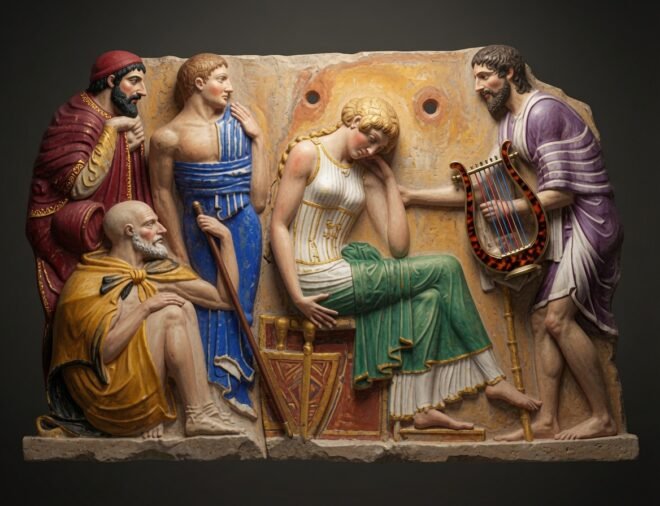
A Scene Most Readers Pass Over
There is a moment early in the Odyssey that most readers pass over without registering its violence. Penelope comes down from her chamber into the great hall of her own house and asks the bard to sing a different song. The song he is singing – of the Greeks’ bitter homecoming from Troy – is unbearable to her, waiting as she is for a husband who has not returned. It is a small request, made in her own home, of a servant in her own household. Her son Telemachus cuts her off. Speech, he tells her, is the business of men. She is to go back upstairs, to her loom and her weaving, and leave discourse to those who have the right to it. She goes.
I have read the Odyssey in the original and in every language I can manage well enough to read Homer in, and for years I passed over that scene as nothing more than the social furniture of its era – an unremarkable hierarchy, ancient and unlovely but beside the point of the poem’s larger business. It was Mary Beard who taught me otherwise. In 2017 she published Women & Power: A Manifesto, a small book that does something rare: it takes a moment everyone has read past and makes it impossible to read past again.
Beard’s point is not that Telemachus is a villain, or that the Odyssey is uniquely misogynist among ancient texts. Her point is that this is the first recorded instance in the Western canon of a man telling a woman to shut up because her speaking in public is not her prerogative – and that the instruction has been echoing, in one register or another, for very nearly three thousand years. What looked to me like background noise was, in fact, the founding chord.
The Template
Beard traces the pattern forward with a classicist’s patience. In republican and imperial Rome, women who spoke in the forum were not described as making arguments; they were described as making noise. Their voices were categorised, rhetorically and legally, as something other than logos – as disorder rather than discourse, the sound of a woman rather than the sense of a citizen. In the medieval and early modern periods, women who claimed public authority beyond the domestic sphere risked a different but related charge: not that their speech was noise, but that it was unnatural, occult, dangerous – the accusation of witchcraft functioning, among other things, as a mechanism for disciplining women who spoke, healed, gathered, or led with an authority the culture had not licensed them to hold. Even Elizabeth I, sovereign in her own right, ruler of a nation, could not simply speak as a monarch; she had to rhetorically fashion herself – the body of a weak and feeble woman, but the heart and stomach of a king – into something borrowed from masculine authority in order to be heard as one.
This is the core of Beard’s argument, and it is more unsettling than a simple chronicle of historical sexism. Her claim is that the template of what public authority looks like, sounds like, and is permitted to do – the deep cultural software running underneath every subsequent argument about whether a given woman is “suited” to lead – was built by men, over centuries, before women were admitted to public life at all. When a woman today enters a boardroom, a parliament, a newsroom, a pulpit, and is found somehow to grate, to overreach, to lack gravitas, to be shrill or strident or simply not quite convincing as an authority, the fault very often does not lie in her. It lies in a template that was never drafted with her in mind, and in some cases was drafted specifically to exclude her. The solution Beard proposes is not coaching: not teaching women to drop their voices half an octave, to perform masculine cadences of command, to imitate the template more skilfully. The solution is to admit that the template itself is the problem, and to rebuild, from the ground up, what power is allowed to look like.
It is worth sitting with how much cultural machinery has been devoted, across those three thousand years, to keeping the template intact. It is not simply that women were excluded from the forum, the pulpit, and the parliament by custom or by law, though they were. It is that an entire vocabulary was built to make the exclusion feel like a description of nature rather than an act of politics – a vocabulary in which a man’s anger is authority and a woman’s anger is hysteria, in which a man’s certainty is conviction and a woman’s is stridency, in which a man raising his voice is passionate and a woman raising hers is out of control. Beard’s genius is to show that this vocabulary is not a neutral by-product of some real underlying difference between men and women; it is the mechanism of exclusion itself, doing its work so smoothly that most of us, most of the time, mistake it for common sense. I include myself in that most: I read the Telemachus scene a dozen times before I saw it for what it was, precisely because the vocabulary in which it is written had trained me not to.
This is where the essay must leave the seminar room and the seminar text, because the argument only matters if it explains something happening now, in this country, this month.
Homer On The Big Screen
This week the Odyssey returns to Australian cinemas in the least academic form imaginable: Christopher Nolan’s IMAX epic opens nationally on Friday, 17 July, with Matt Damon as Odysseus and Anne Hathaway as Penelope. I do not know whether Nolan’s script preserves the scene with Telemachus – the film has been guarded about how faithfully, and how selectively, it renders three thousand years of accumulated poem – and in a sense it does not matter. Whether or not that particular exchange survives the adaptation, the pattern it names has survived everything else. It has survived translation into every language I read the poem in. It has survived three thousand years of retelling. The question worth asking this week is not whether Nolan keeps the scene, but whether the culture watching the film has moved past what the scene describes. The evidence, unfortunately, is close at hand and considerably less mythic than Troy.
The Ledger
Australian Femicide Watch confirmed this month that thirty-seven women have been killed in Australia so far in 2026. The figure was reached with the death of Jana Armstrong, a thirty-year-old mother from Toowoomba, Queensland, reported missing on 7 July after last being seen at a home in Newtown. Her body was located five days later in bushland, and a man known to her has been charged with her murder in a case police are treating as domestic violence. She leaves behind a four-month-old son. In the same short span of days that claimed Jana, Australian Femicide Watch also recorded the deaths of thirteen-year-old Layla Jeffery, an unnamed seventeen-year-old girl, and thirty-nine-year-old mother of two Lavanya Chappa – four femicides in three days, each allegedly at the hands of a male known to the victim.
These are not abstractions and they should not be permitted to become them. Every one of these women had a name before she had a number, and it is worth resisting the numbing effect of statistics for exactly as long as it takes to say them: Jana Armstrong. Layla Jeffery. Lavanya Chappa. A seventeen-year-old girl whose name has not yet been made public. Thirty-seven women and girls in a little over six months, in a wealthy, stable liberal democracy that considers itself, not unreasonably, a good place in the world to be a woman.
The figure matters because it is the concrete, present-tense terminus of an argument that can otherwise sound abstract when it is conducted in the register of classical scholarship. Beard’s thesis is that the silencing of women – the denial of their voice, their authority, their claim to equal standing in public and private life – is not a historical curiosity confined to Homer, Rome, and the witch trials. It is a live current running under the present, and it does not stop at silencing. Where the culture around a man teaches him, implicitly or explicitly, that a woman’s voice does not carry the same authority as his, that her wishes are subordinate to his will, that her body and her choices are ultimately his business rather than hers – that culture does not produce mere rudeness. In its most extreme and most common expression, it helps sustain exactly the ledger Australian Femicide Watch is keeping in 2026.
Killing is the visible peak of a much larger structure, and the structure beneath it is measured, less dramatically but no less damningly, in hospital admissions. In 2023–24, the Australian Institute of Health and Welfare recorded 6,751 women aged fifteen and over hospitalised for injuries caused by family and domestic violence – an average of eighteen women a day, every day of the year, admitted for treatment after violence inflicted by someone who was supposed to love them. Children are not spared the same arithmetic. In that same year, 560 children aged under fifteen were hospitalised for family-violence-related assault, and family violence was identified as the cause in almost two in three of all assault hospitalisations for that age group – a higher share than for any other age bracket in the country, including adults. A parent was the most common perpetrator. Beneath even the hospitalisations sits a wider layer again: more than 42,000 Australian children were the subject of a substantiated finding of maltreatment in 2023–24, well over half of it recorded as emotional abuse, a category that includes children whose primary injury is having grown up inside a house where this violence was simply how disagreements were resolved.
Not Only At Home
It would be a mistake, too, to treat this as a problem that stays within Australia’s borders, as though the template only operates on domestic soil. In June this year, Simon Peter Carman, a forty-six-year-old Australian man from Ballarat, Victoria, was arrested at Bangkok’s international airport attempting to leave Thailand and was subsequently charged with the murder of seventeen-year-old Tunchanok Donhomla in the resort town of Pattaya. Police allege the two met in the early hours of the morning, that a violent struggle followed, and that Carman later strangled her, put her body in a suitcase, and left it beside a railway line. He has denied the murder charge, offering shifting and self-serving accounts – that she vanished from his room, that she threatened him with a knife – while CCTV shows him leaving the building alone that night with the suitcase and returning without it. In a video recorded in custody, he told her grieving family he “felt bad,” and asked them, extraordinarily, to “tell other girls to be not – just to be careful,” as though the danger he posed to a seventeen-year-old were a fact of weather rather than a fact about him.
The specifics of the Carman case will be decided by a Thai court, and it would be wrong to draw sweeping conclusions from any single prosecution before it has run its course. But the pattern the case sits inside is not confined to one man’s alleged conduct on one night in Pattaya. Australian men have long travelled to South-East Asia in numbers, and a subset of that travel has always been organised around the assumption that a poorer country, a different language, and a transactional arrangement with a much younger local woman somehow places her outside the ordinary claims of personhood – that what would be recognised instantly as coercion, exploitation, or violence at home becomes merely a holiday story once the border is crossed. Whatever the truth of what happened in that Pattaya condominium, the impulse that put an Australian man alone in a room with a seventeen-year-old girl on a commercial footing is not a foreign impulse imported for the occasion. It is the same disregard the Femicide Watch ledger documents at home, travelling with a passport.
Manufacturing Telemachus
It would be convenient, and false, to treat this as a problem inherited passively from antiquity – something ambient in the culture rather than something actively produced and distributed. It is being produced and distributed, today, at scale, and I have watched it happen inside my own household.
My nephew has lived with my family since my brother, his father, took his own life. He and his friends are deep into MMA culture, and – as is true of a great many young men in that world at the moment – they hold Andrew Tate in something close to reverence. Around Susan and me and the girls, they are unfailingly polite. But polite is not the same as unaffected, and when they think no adult is listening, the attitudes seep through: the casual contempt, the transactional view of women, the conviction that male dominance is not a problem to be interrogated but a natural order to be reclaimed. I do not know Andrew Tate personally, and I am wary of the kind of certainty about a stranger’s inner life that I would object to in others. But it is not necessary to diagnose the man to observe the effect of the message. Listened to on his own terms, he presents as a committed and articulate misogynist, and whether or not that is an accurate account of his private character, it is an entirely accurate account of what he is teaching a generation of impressionable young men. That message is not a harmless personality quirk circulating in the attention economy. It is doing real work in Australian homes, and it is not helping the domestic violence situation here or anywhere else it reaches.
This is Beard’s template argument made flesh and delivered by algorithm. Telemachus did not invent the idea that speech is the business of men; he inherited it from a culture that had already built the household, the assembly, and the poem itself around that assumption, and he simply repeated the lesson to his mother because it was the lesson he had been given. Andrew Tate’s audience is a modern equivalent, minus even the excuse of ignorance: young men are being taught, explicitly and with commercial precision, that women exist to be managed, that emotional and physical control over women is a mark of masculine competence, and that resistance to this control is a problem to be engineered around rather than a boundary to be respected. No serious account of male violence pretends culture is the only variable at work – alcohol, untreated mental illness, intergenerational trauma, and economic stress all shape who acts on contempt and who does not, and it would be dishonest to flatten those factors into a single story about influencers. But acknowledging a multifaceted cause is not the same as declaring the cultural one negligible. It is not a coincidence that a culture saturated in this messaging runs alongside both a rising rate of casual contempt in teenage boys and a body count of thirty-seven women in six and a half months. Culture is not the whole explanation, but it is the part of the explanation most within our power to change, because unlike a man’s private psychology it is manufactured in public, distributed on purpose, and could in principle be un-manufactured the same way.
A Senior In Year 12
The trajectory is visible, right now, in the experience of a teenage girl Susan and I know only through her mother, a friend of Susan’s. The girl is in her final year of high school. She has been the target of threats of rape and murder from boastful young men at her own level of education – schoolboys, not anonymous adults on the far side of the world, using the language the manosphere supplies to make explicit threats against a specific, named, real girl. Her mother went to the police. She was told the young men involved would be warned. That is the extent of the available response. Taking the matter further would require a formal complaint, a potential court appearance, and the considerable personal and social fallout that accompanies both – costs her mother is only now beginning to understand the weight of. The school, for its part, is limited in what it is able or willing to do. And this girl is not uniquely at risk: other girls at the same school are exposed to the same young men, the same normalised rhetoric of threat treated as a joke, the same institutional shrug.
Set this alongside Beard’s Telemachus for a moment. His mother was told to be quiet and go upstairs. This girl has been told, in effect, that her fear is real but not quite real enough to warrant more than a warning – that the machinery which exists to protect her will, at most, have a word with the boys who threatened to rape and kill her. The register has changed from myth to bureaucracy, but the underlying transaction is disturbingly familiar: a woman’s or girl’s voice, her safety, her claim on the institution’s serious attention, is treated as secondary to the convenience, the futures, the untested potential of the young men making the threats. A police warning is not nothing, but it is a very small thing to set against a rape and murder threat, and it tells a frightened seventeen-year-old exactly how much weight her voice carries against theirs.
There is also a quieter failure buried inside the visible one. Threats of this kind rarely arrive as an isolated act by an isolated boy; they arrive inside a peer culture that has already normalised them as a register of humour, a way of performing status among other boys rather than a genuine statement of intent to a genuine listener. That normalisation is precisely the terrain Andrew Tate and his imitators have spent years cultivating – a discourse in which threats, contempt, and control are recast as banter, as edge, as a joke that only the humourless would take literally. When police tell a mother that the boys will be “warned,” they are not simply weighing one case on its merits; they are, whether they intend to or not, ratifying the idea that this register of threat is a normal adolescent excess rather than a warning sign the culture has been actively manufacturing. The girl at the centre of it, and the other girls at her school exposed to the same young men, are left to manage a risk that the adults around them have already decided is not quite serious enough to interrupt.
A Template Under Pressure, Not A Monolith
None of this is to say the template has stood still for three thousand years, or that Australia has made no progress at all. It would be dishonest to write otherwise. The national female domestic homicide rate has fallen by more than half since the late 1980s, from 0.91 to 0.35 per 100,000 women, on the Australian Institute of Criminology’s own figures – a real decline, achieved over decades, through a combination of refuges, apprehended violence orders, changed policing practice, and a slow shift in what the culture is willing to tolerate in public. Coercive control, long invisible to the law because it leaves no bruise, is now a standalone criminal offence in New South Wales and Queensland, with other states moving toward the same reform, precisely because campaigners insisted that control of a woman’s voice and movements is itself a form of violence rather than a prelude to it. Respectful-relationships education is now mandatory or near-mandatory in schools in most states, and the National Plan to End Violence against Women and Children has, for the first time, put family violence prevention on a ten-year funded footing rather than treating it as a series of one-off announcements. These reforms remain uneven in implementation and enforcement across jurisdictions, yet they constitute clear evidence that the template Beard describes is being actively contested, not passively inherited – which matters, because a template under pressure is one that further pressure can still move.
Rebuilding The Template
Even with these advances, the underlying pattern persists, and I do not think Mary Beard would be surprised by any of this, which is perhaps the most damning thing that can be said about her book. Women & Power was written as a diagnosis of a pattern already three millennia old, and every fact assembled above – the Femicide Watch tally, the eighteen women hospitalised every day of the year, the death of a Thai teenager at the hands of an Australian man far from home, the manosphere-fluent teenagers in my own house, the year 12 girl and her mother navigating a system built to absorb her fear rather than act on it – is simply the pattern continuing to run, in 2026, in a country that likes to think of itself as having largely solved this problem.
It has not solved it, and the solution Beard offers is worth taking seriously precisely because it refuses the easy version of the fix. The easy version says: teach women to be more assertive, more confident, better at commanding a room; teach police to take a slightly harder line on warnings; wait for Andrew Tate’s various court cases in Romania, the United Kingdom and the United States to run their course and assume the problem departs with him. All of that may help at the margins. None of it touches the template. What does touch it tends to be less glamorous than a court verdict: New South Wales’ recognition of coercive control as a criminal offence in its own right, rather than a precursor waved through until it turns physical, names the thing Telemachus was actually doing to his mother – not violence, but control of her voice – as a harm in law. Respectful-relationships education, now embedded in most state curricula, is an attempt to reach boys like my nephew’s friends before the algorithm does, in a classroom rather than a feed. Neither is a complete answer, and both will be tested and revised for years yet. But together they gesture at what rebuilding the template actually looks like in practice: not a single policy, but a series of deliberate interventions at the points – the law, the school, the platform – where the old assumption is currently allowed to pass as common sense. The template is the deeper assumption – inherited from Telemachus, refined through Rome and the witch trials and Elizabeth I’s borrowed masculine rhetoric, and now re-manufactured for teenage boys by a business model built on engagement metrics – that male speech, male will, and male control are the natural order of things, and that a woman’s contrary voice is at best a noise to be managed and at worst an obstacle to be removed. Until that assumption is dismantled rather than merely worked around, the ledger Australian Femicide Watch keeps will go on adding names, the boys in my nephew’s circle will go on absorbing a curriculum in contempt disguised as strength, and girls like the one in year 12 will go on being told that a warning is the most the system has to offer them.
Homer’s poem, read carefully, already anticipates the correction. When Odysseus finally returns, Penelope does not simply accept him on his own word, on Telemachus’s word, or on the strength of twenty years’ longing. She tests him – orders her bed moved from the room it has stood in for two decades, knowing that only the real Odysseus, who built that bed himself around a living olive tree, will know it cannot be moved without destroying it. It is a small, exact, devastating piece of judgment, staged entirely on her own initiative and by her own design, and it is Penelope’s intelligence, not any man’s vouching, that finally identifies her husband and restores the household. The poem that opens with a son silencing his mother closes with that same woman’s discernment as the arbiter of truth in her own house. Whether Christopher Nolan’s cinema audiences leave the theatre this week having registered that arc, or having registered only spectacle, will not by itself change anything. But the poem’s oldest lesson and Beard’s newest argument point in the same direction: the template was built by men, it was built to exclude, and only a deliberate act of rebuilding – in policing, in schools, in the algorithms that decide which men get amplified to impressionable boys, and in the ordinary conversations that happen around Australian dinner tables – will finally set it down.
– – –
Bakchos is the founder of Blak and Black, an Australian media and advocacy platform established in 2010. Bakchos writes from the intersecting perspectives of Wiradjuri heritage, Jewish identity, and humanism.
© Bakchos, July 2026




Well Bakchos, again I really enjoyed reading this post. I’m not sure if it’s going to resonate with many people. The Odyssey isn’t standard reading for the majority of the population, and probably not many from the part of the population you’re trying to reach have ever heard of Homer. They most likely have never heard of the Odyssey and would have no idea what you’re talking about. That doesn’t mean that you shouldn’t keep trying. It just means that perhaps you’re using the wrong vehicle to get your message out. Talking about messages , you’re the only person I’ve met who reads the Wine Song poets in original Arabic, the prophets in Hebrew and Homer in Ancient Greek. I think you’re an ancient spirit reincarnated in the wrong time. Maybe you don’t believe in reincarnation anyway? Back to the post. It’s a good post, the messages is important. I’m just not sure that you’re going to get your message through with the architecture you’re using to send your message out.
Bill, many of the people who have never read Homer are also those claiming a cultural foundation for their vies. I rest easy in my belief that Hanson is oblivious to the Odyssey and more so in her vicious indignation when it is pointed out that in her ignorance she is wrong about Australian values. The fact that the earliest of writing includes clear demonstration of the diminution of a woman’s voice, highlights an important ancient aspect of the culture upon which Western tradition is built. Hanson harks back to a mythical “better time” when all the world was white and people knew their place. What she’s ignoring is that the place of women was in the kitchen not the office. That women were not permitted to work after marriage – my own mother had to give up her nursing career when she married. I have not read Mary Beard’s account, something I will need to rectify, but it seems to me that the argument is sound and the audience has a responsibility to fill that void of cultural knowledge with a little self-education!
Bill did you forget, I’m Bakchos, god knows of plonk, orgies and chaos 🙂
It’s taken 3000 years to get to where we are.
Everything old, is new again, even in the subjugation of women.
And if anyone wants to read an alternative account of the Odyssey from the point of view of a women, I quite enjoyed Madeline Miller’s Circe.
3000 years of the patriarchy silencing women’s voices.
A scene in the Odyssey: Penelope asks the bard for a different song. Her son tells her speech is the business of men, and sends her back upstairs. Mary Beard said that moment is the first recorded instance of a woman being told her voice isn’t hers to use in public — and that we’ve been living inside that instruction for three thousand years.