
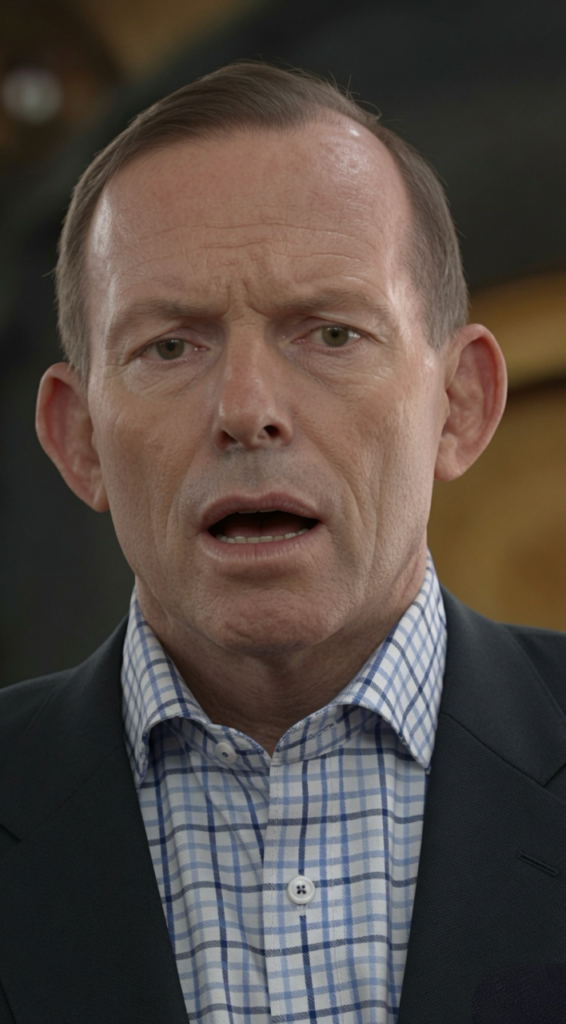
Tony Abbott’s return to the assimilation argument, a fortnight after Angus Taylor’s ascension, tests whether the Liberal Party can out-argue One Nation without becoming it.
A Change of Guard, and an Old Argument
In the second week of February 2026, the Liberal Party changed its leader for the third time in four years. Angus Taylor defeated Sussan Ley in a party room ballot, inheriting a party trailing both Labor and Pauline Hanson’s One Nation in the published polling of the day. Within days, Tony Abbott – prime minister a decade earlier, and by mid-2026 elected unopposed to the largely ceremonial post of Liberal Party federal president – appeared on the ABC’s 7.30 program and used the moment to relitigate a question the Liberal Party has never fully settled: whether Australia’s postwar experiment in multiculturalism has drifted from its founding purpose, and whether the party of Menzies and Howard should say so plainly.
Abbott’s message to the new leader was supportive in tone but unambiguous in substance. He backed Taylor’s ascension while urging him toward a markedly smaller migration intake, invoking the Howard-era benchmark of roughly one hundred thousand net arrivals a year against what he characterised as recent intakes approaching half a million. He wants, in his own words reported from that interview, “smaller numbers and a much bigger emphasis on Australian values.” Around that single verified line, Abbott built a broader case: that decades of policy settings had allowed diversity to be prized over unity, that the expectation of integration had weakened, and that the Liberal Party’s response to Hanson’s polling should be conviction rather than imitation.
The remarks did not stay contained to the studio. Within days a critic writing on social media had labelled elements of the interview a “white supremacy speech”; others read the same words as an unremarkable restatement of conservative orthodoxy on immigration that has circulated in Liberal circles since at least the Howard government. Both reactions are worth taking seriously, and neither should be allowed to stand in for the other. This essay sets out what is actually known about Abbott’s intervention, places it inside the century-long argument Australia has been having with itself about who belongs and on what terms, and weighs the case his supporters make against the case made by his critics – without pretending that either side has a monopoly on the facts.
From White Australia to “United In Diversity”
To understand why a comment about immigration numbers can detonate into an argument about the character of the nation, it helps to recall how far Australian policy has travelled. Federation in 1901 was accompanied almost immediately by the Immigration Restriction Act, the legislative engine of what became known as the White Australia policy. Enforced through devices such as the dictation test – an applicant could be handed a passage in any European language chosen by an immigration officer, guaranteeing failure for anyone the officer wished to exclude – the policy was designed to keep the new Commonwealth demographically and culturally British.
That settlement held, with adjustments, until the postwar decades. The “populate or perish” era brought assisted-passage migrants from Britain and then, in growing numbers, from continental Europe – Italians, Greeks, Poles, Ukrainians, and others displaced by war. Government expectation in this period was frankly assimilationist: newcomers were expected to learn English quickly, adopt local customs, and blend into an existing Australian type rather than transplant their own institutions. The scale of non-British migration nonetheless made assimilation harder to sustain as policy fiction, and by the mid-1960s the racial machinery of the Restriction Act was being dismantled in practice under the Holt government, a process completed formally when the Whitlam government renounced White Australia outright in 1973 and adopted a non-discriminatory, skills-and-family-based migration program.
It was Whitlam’s government, through immigration minister Al Grassby, that gave Australia its first official multicultural policy document in 1973, and Whitlam himself who described the country as a “multicultural nation” by 1975 – the same year the Racial Discrimination Act passed federal parliament. The Fraser government that followed did not reverse this trajectory but entrenched it, commissioning the 1978 Galbally Report and building the institutional architecture of multiculturalism: ethnic community grants, multicultural education, SBS. Labor and Coalition governments alike have since issued their own restatements of the multicultural compact – Multicultural Australia: United in Diversity in 2003 among them – each affirming cultural pluralism as a public good while insisting it sits beneath, not above, a shared framework of law.
The philosophical shift embedded in this history is real and consequential. Assimilation-era policy expected convergence toward an existing national type; multicultural policy, in its mature form, treats the maintenance of distinct cultural and religious identities as compatible with, even generative of, national cohesion. Reasonable people have disagreed about that wager for fifty years. Its defenders point to Australia’s comparatively high rates of intermarriage across ethnic lines, its low levels of the kind of parallel-legal-system tension seen in parts of Western Europe, and its consistently strong social-cohesion indices relative to other high-migration democracies. Its critics – Abbott prominent among a long line of them – argue that the policy’s success has depended on an unspoken assimilationist undertow that official rhetoric no longer acknowledges, and that this undertow is precisely what is now eroding.
Net overseas migration figures give this argument its statistical spine. Through most of the Howard years, annual net migration ran in the vicinity of one hundred thousand, occasionally higher. The post-pandemic recovery produced numbers of an entirely different order: a record net intake above half a million in 2022–23, easing to figures in the region of three hundred thousand in the years since – still roughly triple the Howard-era baseline Abbott invokes. Housing affordability, rental vacancy rates, and infrastructure strain in Sydney and Melbourne have all been argued, by economists across the spectrum, to bear some relationship to intake at this scale, even as the same economists disagree sharply about how much weight migration deserves relative to planning failures, interest rates, and construction bottlenecks.
What Abbott Actually Said – And What Can Be Verified
It is worth being precise about the evidentiary status of Abbott’s remarks, because reporting on live political interviews is not always uniform, and a searchable trail exists for only some of what has been attributed to him. The clearest documented statement – reported contemporaneously and consistent across coverage – is his declaration that Liberal immigration policy should mean “smaller numbers and a much bigger emphasis on Australian values.” Around that anchor, multiple outlets reported that Abbott urged a return to something like Howard-era intake levels, linked elevated migration to downward pressure on wages and upward pressure on housing and infrastructure costs, and described multiculturalism as having, in substance, “run off the rails.”
Abbott has also been reported, both in this interview and in commentary around it, describing Australia’s foundational character in explicitly Anglo-Celtic and Judaeo-Christian terms, and arguing that new arrivals committed to incompatible political or religious systems – he has named Sharia governance and deference to the Chinese Communist Party as examples – would struggle to “fit in.” The precise wording attributed to him on these points varies somewhat between reports, which is a reminder that direct quotation from live broadcast interviews should be handled with some caution; the substance of the argument, however, is corroborated across independent accounts and is continuous with positions Abbott has held publicly for two decades.
That continuity matters. Abbott did not improvise a new doctrine on 7.30. He has long described Australia through a tripartite formula – an Indigenous heritage, a British institutional foundation, and an immigrant character built on top of both – a framing that appears in his own writing, including his 2025 history of the nation. Read against that formula, his Anglo-Celtic and Judaeo-Christian language is best understood not as a claim about the ancestry of individual Australians but as a claim about which legal and cultural inheritance – common law, parliamentary government, a broadly secular Christian ethical vocabulary – he believes has structured the institutions migrants are joining. Whether that is a fair or sufficient account of Australian identity, given the country’s Indigenous history predates British settlement by tens of thousands of years and its migrant communities have shaped the culture as much as adapted to it, is precisely where his critics part company with him.
On the party-political register, Abbott was equally direct in urging the new leader away from imitation of One Nation. He wants the Liberal Party to remain, in substance, “the Liberal Party of Menzies and Howard” – engaging the grievances driving voters to Hanson without adopting her party’s platform wholesale. This is a strategically coherent position even for those unpersuaded by its policy content: it is an argument for taking a rival’s diagnosis seriously while rejecting its prescription.
The Case His Defenders Make
Abbott’s supporters, inside and outside the Liberal Party, make a case that does not depend on hostility to migrants as such. Their argument runs, broadly, as follows. First, the sheer scale of recent net migration – several multiples of the Howard-era average, arriving into housing and infrastructure systems that were not built to absorb it – has produced measurable strain, and it is not xenophobic to say so; it is the kind of claim treasury officials and reserve bank economists have made in more technical language for several years. Second, postwar assimilation-era migration is remembered, not unreasonably, as a policy success: European migrants of the 1950s, 60s and 70s integrated at a pace that produced high intermarriage rates and rapid intergenerational mobility, and defenders of Abbott’s position argue this was assisted rather than hindered by clear expectations of participation in a shared civic culture.
Third, they argue that naming specific incompatible commitments – a caliphate, Sharia governance imposed as binding law, foreign one-party allegiance – is a values argument rather than an ethnic or religious one, since Abbott has consistently paired it with explicit acknowledgment that the great majority of Muslim Australians hold none of these commitments and are, in his words, “wonderful Australians.” On this reading, the criticism that his remarks amount to a hierarchy of cultures mistakes an argument about political loyalty for an argument about heritage. Finally, defenders point to comparable integration debates surfacing across other liberal democracies confronting similar migration pressures, suggesting the concern is a response to real demographic pace rather than a peculiarly Australian or peculiarly right-wing pathology.
The Case Against Him
His critics do not accept that the distinction between values and heritage survives contact with the language actually used. Describing the nation’s character as “essentially Anglo-Celtic and Judaeo-Christian” – even if intended institutionally – lands, they argue, as an ethno-cultural claim in a country whose largest cities are now among the most linguistically diverse on earth, and it does so in a political moment already primed by One Nation’s more explicit ethnonationalism. On this view, the timing is not incidental: an intervention pitched two days after a leadership change, designed to shape the new leader’s positioning against Hanson, cannot be read in isolation from the electoral competition it was clearly meant to influence.
Critics further note that singling out Sharia governance and Chinese Communist Party allegiance as the illustrative incompatible ideologies – rather than, say, any number of illiberal political traditions with European origins – reads to many as a values framework calibrated to land on two specific migrant communities, whatever the intent behind it. They also dispute the historical nostalgia embedded in the assimilation argument: the postwar European migration experience, they point out, coexisted with substantial discrimination against those same migrants in employment and housing, and its later success owed as much to policy investment – English-language programs, migrant settlement services, anti-discrimination law – as to any absence of multicultural accommodation. Finally, they argue that treating housing and wage pressure as primarily a migration-numbers problem understates the role of decades of planning failure, slow approvals, and construction-sector capacity constraints that predate the post-pandemic migration surge and would persist even at Howard-era intake levels.
A Familiar Argument, Not a Uniquely Australian One
Abbott’s critics sometimes write as though this argument were a peculiarly Australian regression. It is not. Versions of the same debate have played out across Western Europe for two decades, from the Netherlands’ post-2000 turn toward mandatory civic-integration courses, to Denmark’s explicitly assimilationist “ghetto” legislation targeting areas of concentrated migrant settlement, to France’s long-standing insistence on republican laïcité as a precondition of full civic belonging. In each case, governments of varying political complexions concluded that a purely accommodationist multiculturalism had allowed parallel institutions to grow at the expense of a shared civic culture, and moved to reassert integration requirements more forcefully than official multicultural rhetoric had previously allowed.
That international pattern lends some empirical weight to the diagnosis Abbott is making, even for readers unpersuaded by his specific language. It does not, however, settle the Australian case, because Australia’s migration system differs from continental Europe’s in important respects: a points-tested skilled program that screens heavily on economic criteria before arrival, a relative absence of the large, decades-old, low-skilled guest-worker cohorts that shaped the German and French experience, and settlement patterns that, while producing identifiable ethnic precincts in Sydney and Melbourne, have not produced the scale of concentrated disadvantage documented in parts of the Parisian banlieues or Scandinavian public housing estates. Importing the European diagnosis wholesale risks treating a genuinely different migration system as though it faced identical pressures, and Abbott’s own comparison is selective: it invokes European integration failures without engaging the evidence, from the OECD and from Australia’s own census data, that second-generation migrant outcomes on employment, education and intermarriage remain considerably stronger here than in the European cases his framework implicitly gestures toward.
This is the empirical crux any serious reader has to sit with: the housing and infrastructure pressure Abbott points to is real and quantifiable, but the social-cohesion failure he implies is running alongside it is, on the comparative evidence available, considerably less advanced in Australia than in the European contexts most often cited in support of his argument. Whether that gap reflects better underlying policy design, a shorter runway before the problem fully materialises, or simply more forgiving starting conditions is a genuinely contested empirical question, not one this essay can resolve on the evidence to hand.
Where This Leaves The Liberal Party
The immediate political question is less about the truth of Abbott’s historical account than about whether his intervention helps or hinders Angus Taylor. The new leader inherits a party polling behind both major rivals, squeezed between a Labor government it must dislodge and a One Nation insurgency it must out-argue without echoing. Malcolm Turnbull’s public criticism of the shift in tone – that no leader alone solves a positioning problem, and that the party’s task is to rebuild economic credibility in the political centre rather than drift rightward – represents the opposing wing of Liberal opinion, and it is not a fringe view within the party.
Abbott’s own framing anticipates this tension without resolving it. He wants a Liberal Party distinctive from One Nation, but the policy content he is urging – sharply reduced intake, an explicit values test, a rhetorical return to assimilation over multiculturalism – overlaps substantially with positions Hanson has advocated for three decades. Whether that overlap represents principled convergence on a genuine problem or a strategic drift toward a rival’s territory is a judgment call the Liberal party room, and eventually the Australian electorate, will have to make. It is not a judgment this essay can settle, and it should be treated as an open political question rather than a foregone conclusion in either direction.
Conclusion: An Old Question, Newly Urgent
Tony Abbott’s February intervention was not a rupture with anything he has said before; it was a restatement, delivered at a moment of maximum leverage, of an argument he has made in one form or another since at least Battlelines two decades ago. What has changed is the context in which it lands: net migration running at multiples of the historical baseline, a housing crisis with genuine and contested causes, and a minor party to Abbott’s right already occupying the rhetorical ground of cultural anxiety. In that context, language that might once have registered as conventional conservative caution now carries a heavier charge.
The honest position is that both halves of the argument contain something true. Migration at recent scale has coincided with real strain on housing and services, whatever share of the blame it ultimately bears alongside planning and construction failures. And a formula that describes the nation’s character as essentially Anglo-Celtic and Judaeo-Christian, however carefully hedged with praise for individual migrants, will read to many Australians – including many whose families have called this continent home for far longer than the Anglo-Celtic settlers Abbott invokes, and many more recently arrived Australians who have built full and loyal lives here – as a description that does not include them. A serious accounting of Australian identity has to hold the country’s Indigenous history, its British institutional inheritance, and its immigrant present in the same frame without letting any one of the three stand for the whole. Whether the Liberal Party under Angus Taylor can find language that does that, rather than language that simply relitigates 1975, will say a great deal about what kind of opposition – and what kind of country – emerges from this argument.
– – –
Bakchos is the founder of Blak and Black, an Australian media and advocacy platform established in 2010. Bakchos writes from the intersecting perspectives of Wiradjuri heritage, Jewish identity, and humanism.
© Bakchos, July 2026



Tony Abbott is back in the headlines — this time backing new Liberal leader Angus Taylor while pushing for a return to Howard-era migration numbers and “Australian values.” Is this a fair reckoning with real housing and cohesion pressures, or a rhetorical drift toward One Nation’s territory?
All this goes to show is that the Liberal Party is caught in a Howard era rut. No new blood, no new ideas.
Tony Abbott is yesterday’s man, trying to resurrect the ghosts of John Howard and Robert Menzies.
According to Tony Abbott we blackfullas don’t even rate in terms of what Australians are. Go figure.
Tony Abbott is caught in a 1950s time warp. It’s time to move on from Menzies and Howard.
The Liberal Party is lost, One Nation is the beneficiary.