
A Cycle of Protest, and the Question of Endurance
I. Queensland, 1998: The Template
The scenario is worth restating as a template, because it recurs with real force in 2026, if not an exact fidelity. In 1998, a tired Coalition government facing a restless electorate created space for a new protest vehicle. Hanson’s One Nation absorbed grievances that the National Party could no longer contain – regional economic anxiety, resentment of native title, and a broader sense that both major parties had become interchangeable custodians of an unresponsive state. The result was a record vote for a new minor party, an ideologically confused Coalition preferencing strategy that backfired, and eleven seats won on a wave of protest sentiment that the party itself was structurally unequipped to manage.
The unwinding that followed was organisational, not principally a matter of scandal. The One Nation member for Mulgrave resigned in November 1998, and Labor retook the seat at the resulting by-election in December – the first sign that the bloc of eleven was already thinning, leaving ten. In August 1999 the Queensland Supreme Court ruled that One Nation had been invalidly registered as a political party in the state and it was deregistered. Of the ten remaining MPs, four broke away to sit as independents in protest at the tight centralisation of party affairs under Hanson, David Ettridge and David Oldfield, while the other six eventually joined a new grouping, the City Country Alliance, formed in December 1999. By the time Hanson’s own electoral-funding prosecution reached court in 2003 – a conviction later quashed on appeal – the Queensland parliamentary party had already been extinct for four years. Hanson’s legal troubles mattered to the party’s national reputation, but they were not what broke the Queensland bloc: it came apart because it had almost no institutional glue holding elected members to the centre, well before any court reckoning arrived.
That collapse is the shadow hanging over every subsequent One Nation surge. The question worth asking of 2026 is not simply whether the party can win seats – the evidence increasingly says yes – but whether this iteration has solved the organisational fragility that undid the last one.
II. Federal Politics, 2025–2026: A Different Kind of Surge
The current federal moment differs from 1998 in one structural respect: this time the protest vote is being fed not only from below, by disaffected voters, but from above, by a defection out of the political establishment itself. Following Hanson’s return as leader, the party won four Senate seats at the 2016 federal election and retained representation across the following three federal elections, despite several high-profile defections, before experiencing increased popularity in and following the May 2025 federal election. After the Liberal Party’s leadership challenge and its falling-out with the Nationals, Barnaby Joyce defected from the Nationals and joined One Nation in December 2025, and Gina Rinehart has provided funding to the party since then.
This is a genuinely new phenomenon for One Nation: a former deputy prime minister and three-time National Party leader crossing the floor, bringing with him both institutional credibility in rural seats and access to serious money. Going into the 2025 election, One Nation held just two Senate seats, both in Queensland (Hanson and Malcolm Roberts); it emerged from that election with four, adding seats in New South Wales and Western Australia. The party has held a New South Wales Senate seat before, briefly and turbulently, through Brian Burston; the real novelty of 2025 is not entry into a new state but a Senate presence now spread durably across several states, combined for the first time with an elected member in the House of Representatives. By May 2026, the party had gone further still: David Farley won the Farrer by-election as One Nation’s first elected member of the House of Representatives, in what was reported as a historic result ending 77 years of Liberal Party control of the seat. Several nationwide opinion polls were ranking One Nation ahead of the Coalition as the highest-polling party on the political right by February 2026.
The 1998 wave was a rural and outer-suburban revolt against both major parties simultaneously. Part of the 2025–26 wave looks like a more targeted raid on the Coalition’s right flank, engineered partly through elite defection and mining-wealth patronage rather than purely grassroots protest – though, as the next sections show, it is not only the Coalition that is bleeding support, which complicates a purely one-sided reading of what is happening.
III. Victoria: The Same Grievances, a Different Electoral Machine
If the federal story is a novel elite-defection dynamic, Victoria in 2026 shows the clearest sign of the same protest energy that produced Queensland in 1998 – but the electoral machinery translating that energy into seats is not the same, and the difference matters. Queensland in 1998 was a unicameral parliament elected by single-member optional preferential voting, a system in which a 23% protest vote could, and did, convert into eleven districts outright. Victoria’s Legislative Assembly is single-member full preferential voting, where preferences must ultimately consolidate behind a two-candidate result; its Legislative Council is proportional. A primary vote in the twenties can look like an earthquake in the polls and still translate poorly into lower-house seats – a gap the Nepean by-election result, discussed below, already hints at.
The underlying pressure, though, is real. By early 2026, One Nation’s polling had risen considerably, with many national polls showing the party on a higher primary vote than the Liberal Party, and One Nation had already outpolled the Liberal Party at the 2026 South Australian state election, winning four seats to the Liberals’ five. In South Australia, One Nation won three Legislative Council seats – one more than the Liberal Party – and four seats in the House of Assembly, its strongest result in that state, against a collapsed Liberal vote.
Victoria is heading toward its own version of this. Victoria’s state election on 28 November will pass judgment on a Labor government – now led by Ben Carroll after Jacinta Allan’s departure – after twelve years of Labor rule, and recent polls have shown a three-way split between Labor, the Coalition and One Nation, several with One Nation recording the highest primary vote, an extraordinary result in a state where two-party politics has traditionally been strongest and One Nation’s support historically weakest. Antony Green’s own analysis notes the strangeness of this: One Nation’s ratings were remarkable given that, for a long stretch, the party had no state leader, no announced state policies, only one upper house member, and just one confirmed lower house candidate – a level of organisational hollowness that would ordinarily be fatal to sustaining a poll lead.
That hollowness has since been partly addressed – Warren Pickering was announced as leader of One Nation Victoria on 3 August 2026 – but the sequencing itself is telling: the polling surge preceded the organisation needed to capitalise on it, inverting the normal order of party-building. Polling since Pickering’s appointment has been volatile: Roy Morgan’s February survey put One Nation on 26.5% of the primary vote, ahead of both majors, while its August survey – also a primary-vote reading, not the separate three-party-preferred figure Roy Morgan reports alongside it – had the party narrowed to 23.5%, behind a levelled Coalition and Labor on 26% each. Roy Morgan’s August seat modelling projected the Coalition and One Nation together winning a majority of at least 21 of the Legislative Council’s 40 seats, against a combined 11 for Labor and the Greens – which, if realised, would hand One Nation genuine balance-of-power leverage in Victoria for the first time. A lower house by-election test in April produced a far more modest result: in the safe Liberal seat of Nepean, One Nation’s candidate ran third with 24.5% of the primary vote, well behind the Liberal winner. Same protest energy; a different, and so far much less generous, translation into seats.
IV. Same Grievances, Different Vehicle – and Not the Same Strategic Error
The through-line from 1998 to 2026 is a durable one: declining trust in the major parties, a sense that regional and outer-suburban Australia is not being heard, and a protest impulse converted into support for a party positioned as the anti-establishment alternative. But the grievance stack is similar in shape, not identical in content, on both sides of the comparison. Native title, after the Wik decision, was central in the bush and on the Coalition side of politics in 1998, but the statewide vote was never only about that – it also drew on tariff cuts, farm debt, gun laws, immigration, and a broader anti-politics mood. In 2026, immigration, housing affordability, and crime – particularly in Victoria – sit at the front of that same mix, and arguably press with more immediate, everyday force across a wider cross-section of voters than native title ever did outside specific rural disputes.
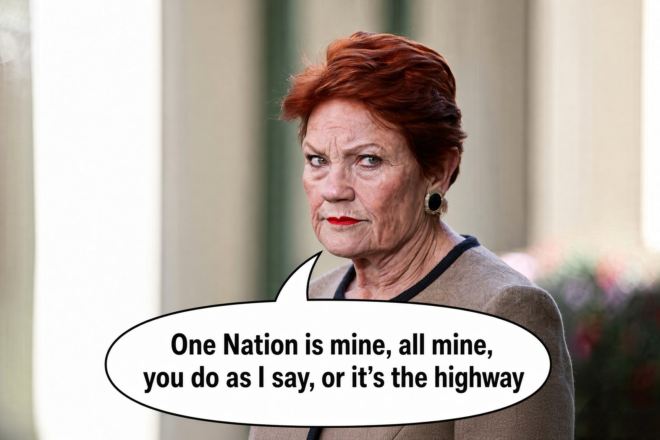
The party vehicle carrying that discontent has also changed in kind. In 1998, One Nation was an insurgent outsider party built almost entirely from below. In 2026 it is increasingly also an elite vehicle – endorsed by a Nationals defector with decades of parliamentary standing and bankrolled by the country’s richest individual. Yet the 1998 parallel is not simply a story of the Coalition being raided from within: South Australian and Victorian polling both show Labor bleeding support as well, which places the current moment closer to 1998’s two-sided revolt against both major parties than to a clean, one-directional raid on the Nationals. The strategic response also differs in an important way. In 1998, the Coalition’s error was tactical: most National and Liberal candidates preferenced One Nation ahead of Labor, hoping to hurt Beattie, and instead lost city seats to Labor as Liberal voters recoiled. Today’s Coalition is not repeating that specific mistake – it is instead unresolved on a more basic question, arguing internally over whether to treat One Nation as a rival to be fought, a partner to be preferenced, or a contamination risk to be kept at arm’s length. That is a different, more existential, strategic problem than the one Borbidge’s Coalition faced.
V. Will It Hold? The Historical Case for Scepticism
This is where the 1998 precedent becomes most instructive, and most cautionary. One Nation’s post-1998 collapse was not caused primarily by voters changing their minds; it was caused by the party’s own structure. It was – and largely remains – a personal vehicle built around Hanson, with limited internal democracy, weak preselection processes, and a leadership culture prone to expelling or losing members who develop independent standing. The 1998 Queensland bloc of eleven had lost its first member within six months and had disintegrated entirely within about eighteen months of the by-election defeat, well before the party’s registration troubles were resolved one way or the other. Nationally, a related pattern has repeated across three different Senate terms: Rodney Culleton, Brian Burston, and Fraser Anning each left or were pushed out during the party’s federal Senate years, and Malcolm Roberts was disqualified from parliament before later being reinstated.
Early signs in 2026 deserve to be read as warnings rather than as a parallel already fully in motion – the timelines are not yet comparable. David Farley has faced reported speculation, including from Crikey, about tensions that could lead him to quit One Nation and sit as an independent; Barnaby Joyce has publicly denied any such split is imminent. Farley has been in the House of Representatives for only around four months, against the roughly eighteen months it took for the bulk of the 1998 Queensland bloc to actually walk out the door. The comparison is premature as evidence of collapse, though it is a legitimate flag that the same underlying dynamic – friction between an elected member and the party centre – has already appeared this early. Joyce himself has separately acknowledged hostility from his former National Party colleagues since his defection, a dynamic that cuts both ways: it may harden his commitment to One Nation, or it may leave him an uneasy fit inside a party culture very different from the one he spent three decades in. And Victoria’s own poll surge arrived well before the party had a state leader, policies, or a full slate of candidates – the same hollow-centre problem that made the 1998 Queensland bloc so brittle once elected. Pickering’s installation, followed by a slate that reportedly includes sitting councillors and mayors, is a real improvement on the largely amateur 1998 Queensland candidates; but recruiting people who already hold public office also means importing whatever existing factional habits and loyalties they carry with them, which is not obviously a cure for a party whose central problem has always been managing internal disagreement.
Underlying all of this, One Nation’s policy positions continue to be shaped primarily by its leader, a pattern sometimes referred to as “Hansonism” – meaning the party’s cohesion still depends heavily on Hanson personally, with limited evidence of a durable institutional structure beneath her that could survive serious internal disagreement.
Against that, there are real differences that could make 2026 more durable than 1998. Rinehart’s financial backing gives the party a resourcing base 1998’s One Nation never had – the ability to run professional campaigns, pay staff, and manage disputes without the whole structure collapsing for want of money. But that needs to be stated precisely: resources of that kind delay organisational collapse; they do not repeal the underlying personal-vehicle problem. Money solves campaign logistics. It does not, by itself, solve candidate quality, branch-level factional fights, or what happens when Joyce’s interests and Hanson’s eventually diverge, as interests inside personality-led parties usually do. Joyce brings retail political skill and an existing base that doesn’t depend on Hanson’s personal following. And the sheer breadth of the current surge – federal Senate gains, a lower-house by-election win, a strong result in South Australia, and now a genuine three-way contest in Victoria – suggests a deeper realignment of protest-vote loyalty than 1998 achieved on its own, rather than a single-state flash in the pan.
On balance, the evidence points to a party more electorally successful than at any point since 1998, but not yet demonstrably more structurally sound – it is simply too early in this cycle to say either way with confidence. The likeliest outcome, on current trends, is that One Nation wins meaningful representation in Victoria in November and consolidates its recent federal gains, while Victoria’s own electoral system likely blunts how far that primary-vote strength converts into Legislative Assembly seats. Whether it can hold that representation together as a disciplined, unified parliamentary party over a full term remains the open question it has always posed, and on the 1998 record the risk sits mainly on the far side of the election, once members have seats, staff, and independent standing of their own. The 1998 experience suggests winning seats has never been One Nation’s real weakness; keeping them has.
– – –
Bakchos is the founder of Blak and Black, an Australian media and advocacy platform established in 2010. Bakchos writes from the intersecting perspectives of Wiradjuri heritage, Jewish identity, and humanism.
© Bakchos, September 2026