
Prologue: An Exile’s Lament
Jocasta: This above all I long to know: What is an exile’s life? Is it great misery?
Polyneices: The greatest; worse in reality than in report.
Jocasta: Worse in what way? What chiefly galls an exile’s heart?
Polyneices: The worst is this: the right of free speech does not exist.
Jocasta: That’s a slave’s life – to be forbidden to speak one’s mind.
Polyneices: One has to endure the idiocy of those who rule.
The exchange comes from Euripides Phoenician Women, performed in Athens at the end of the fifth century before Christ. Polyneices has been driven out of Thebes by his brother and has returned in secret to speak with their mother before the war that will destroy them both. Jocasta asks him the question any parent would ask, what the exile’s life is really like, and she expects to hear of hunger, cold and poverty. His answer is none of these. The greatest misery of exile, he says, is the loss of the right to speak freely. The word Euripides gives him is parrhesia. Jocasta understands him at once, and her reply is the sharpest line in the scene: to be forbidden to speak one’s mind is a slave’s life.
It is worth lingering over how strange, and how modern, that answer is. Polyneices does not complain of lost property or lost rank. What he cannot bear is the silence imposed on a man who must smile at his betters, nod at the folly of those who govern him, and keep his judgment to himself. The Athenians who watched the play knew precisely what he meant, because the free citizen was defined against the slave by his voice. A person who may not say what he thinks is not fully a person in the city’s eyes, whatever his legal status.
I open with this scene because I think a great many people in the supposedly free West now know something of that condition, even though no one has banished them. There is no decree forbidding speech. There is only the quieter machinery of consequence: the career that ends, the reputation that is managed away, the institution that pretends not to hear, and the endless din of commentary in which no single honest voice can be distinguished from the noise. One can live at home and still feel like an exile, enduring, in Polyneices’ words, the idiocy of those who rule. And it is a humbling thing to recall that the speaker is no saint. Polyneices is about to march an army against his own city, and the play does not end well for him. Euripides does not offer us a hero, but something more useful: a plain demonstration that the loss of free speech is felt as a wound by the good and the flawed alike, and that a civilisation which forgets this has forgotten something essential about what it is to be free.
The Mess of the World
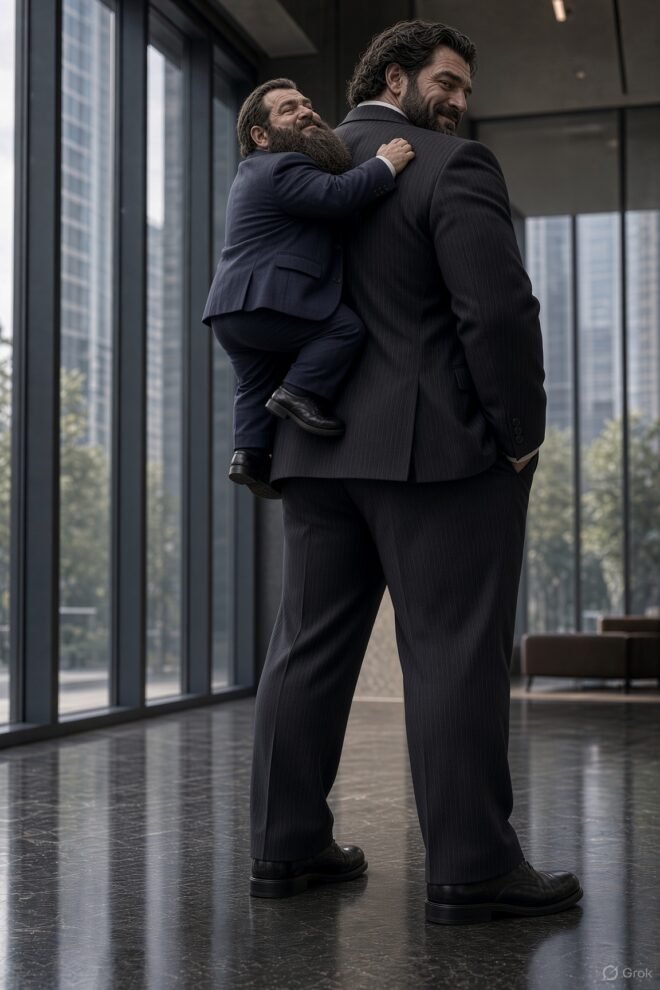
The world is a mess. Perhaps every generation has said as much, and I will come to that objection shortly, but when I stare into the harsh depths of the present it is hard to find a more fitting image than that of dwarfs straining to reach even the armpits of giants. How far the mighty West has fallen from the ideals we inherited from our forefathers.
The Metaphor Turned Upside Down
The image is a deliberate inversion of one of the oldest and most generous metaphors in Western thought. Around the middle of the twelfth century, the scholar Bernard of Chartres is said to have told his students that we are like dwarfs perched on the shoulders of giants. We see more and farther than they did, not because our own sight is keener or our bodies taller, but because we are carried high by the gigantic stature of those who came before. John of Salisbury recorded the saying in 1159, and it has been repeated, polished and borrowed ever since, most famously by Newton, who in a letter of 1676 conceded that if he had seen further, it was by standing on the shoulders of giants.
What gives the original its force is that it is a metaphor of gratitude as much as of progress. It asks the living to be humble about their achievements and honest about their debts. It says that knowledge, law, art and decency are not self-generating, that each generation inherits a height it did not build, and that the proper response to such an inheritance is care. The dwarf is not despised in this picture. He is lifted, and his only duty is not to wriggle free and fall.
My inversion asks what happens when the dwarf forgets that he was ever carried. He climbs down, congratulates himself on his independence, and then spends his days craning upward at a distance he can no longer close, mistaking the noise he makes for stature. That, I think, is the condition of much of the modern West: a civilisation surrounded by the monuments of its own greatness, unable to remember what they were for.
The Charge Every Generation Makes
I should be honest about the obvious objection. The complaint that the present is a degraded copy of a nobler past is among the most durable in human literature. Hesiod, writing perhaps seven centuries before Christ, described the decline of humanity from a golden race to a race of iron, among whom shame and righteousness would vanish and men would honour the evildoer. Horace, in the third book of his Odes, put the matter in a single devastating line: the age of our parents, worse than our grandparents’, bore us, who are baser still, and will bring forth offspring more corrupt than ourselves. Cato the Elder railed against the luxury and laxity of Rome while Rome was busy conquering the Mediterranean. If the lament of decline were a reliable prophecy, civilisation would have ended some time before the invention of the alphabet.
A serious person must therefore hold two thoughts at once. The first is that nostalgia is a liar. The past that we mourn is always edited, its cruelties trimmed and its virtues enlarged, and the golden age has a habit of receding at exactly the pace we walk towards it. The second is that the pessimists were sometimes right. Rome did decline. Republics do die, usually not in a single dramatic night but through the slow erosion of the habits that sustained them. Horace was complaining in the age of Augustus, and what he feared was less the collapse of roads and aqueducts than the loosening of the moral fibre that had made the Republic a thing worth defending.
So the useful question is not whether every generation complains, but whether a given complaint is accurate about the thing it names. And the thing I am naming is not material. By almost every measure of wealth, longevity, comfort and technical capacity, we are richer than any generation that has ever lived. We hold in our pockets more information than the library of Alexandria ever did. The decline I mean is of another kind: a decline in the quality of our institutions, in the honesty of our public language, in our capacity for sustained thought, and in our willingness to be bound by the ideals we still recite.
What the Giants Actually Left Us
It is worth being precise about the inheritance, because vague lamentation is its own form of intellectual laziness. The giants did not leave us a mood. They left us particular things, each of them won at heavy cost.
From Athens we inherited the radical notion that a community might govern itself by public argument, and that the unexamined life, as Socrates is reported to have said at his trial, is not worth living. Athens also gave us the word parrhesia, the courage to speak the whole truth freely to those with power over you, and understood that a city without such speech is a city on its way to tyranny. From Rome came the architecture of law: the idea that even the powerful stand beneath rules they did not write, and that justice is something owed to persons rather than a favour dispensed by rulers. From the long grind of medieval England came Magna Carta and the principle, imperfectly honoured for centuries, that the king too is under the law and that no free man may be imprisoned without lawful judgment. From the Enlightenment came the claim that reason, not inherited status, is the proper basis of political authority, and that certain rights belong to human beings simply because they are human.
And from the ashes of the twentieth century, from the camps and the bombed cities, came the Universal Declaration of Human Rights, a document written by people who had seen what a world without its principles looks like. It is worth remembering that these were not abstractions to those who wrote them. They were scars. Habeas corpus exists because men were once dragged into cellars and forgotten. The prohibition on torture exists because torture was once routine. The separation of powers exists because the concentration of power was understood, by people who had suffered it, to be the oldest threat to human liberty.
This is what stands behind the image of the giants. They are not simply the famous men of the past. They are the accumulated, hard-bought answers to the question of how people might live together without devouring one another.
Foucault and The Revival of Parrhesia
Of all the giants’ gifts, parrhesia is the one most in need of recovery, and in the twentieth century it found an unlikely champion in the French philosopher Michel Foucault. Known above all as the analyst of how power works through institutions, knowledge and discipline, Foucault turned in the last years of his life to the ancient world and to the question of what it means to tell the truth. In his final lecture courses at the Collège de France, beginning with The Government of Self and Others in 1982–83 and continuing with The Courage of Truth the following year, as well as in his Berkeley lectures of 1983, he retrieved parrhesia from the margins of classical scholarship and made it a subject of living philosophical concern. Much of the modern interest in the concept descends from those lectures, and among the texts he examined was the very scene from Euripides with which this essay began.
Foucault’s achievement was to refuse the thin definition. Parrhesia is not merely frankness, still less the licence to say whatever one pleases. It is a critical mode of discourse and, at the same time, an ethical way of living. The parrhesiast speaks the truth as he understands it, to someone who holds power over him, in circumstances where the speech carries a real risk: of offending a friend, losing a position, being exiled, or in the extreme case being killed. Foucault was insistent that the risk is part of the definition. The flatterer speaks safely and the rhetorician speaks to persuade, but the parrhesiast stakes himself on what he says, and in doing so enters into a kind of pact with his own words. He declares, in effect, that he is the one who said this, and that he will answer for it.
That is why Foucault treated parrhesia as something more than a rhetorical technique. It is an act that aims to transform the relation between truth and power. When the philosopher tells the tyrant what the tyrant does not wish to hear, the truth-telling does not simply inform: it exposes the ruler to a reality he has arranged to avoid, and it unsettles the settled pattern of who may speak and who must listen. Foucault traced the lineage through figures who will be familiar to any reader of the giants: the citizens of Athens who spoke openly in the assembly, Plato’s dangerous journeys to the court of Syracuse, Socrates before his judges, and the Cynics, who carried the practice out of the council chamber and into the street, shaming the powerful by living in open contradiction of their pretensions. In each case the speech was bound to a life. The truth told and the life led had to agree, or the speech was worth nothing.
There is, of course, scholarly argument about how faithfully Foucault read the ancient texts, and he left these lectures unfinished when he died in 1984. But the analytical value of the idea does not depend on settling every philological dispute. What he gave us was a precise instrument for measuring our own condition, and the measurement is not flattering. A great deal of what passes for truth-telling in modern public life is parrhesia’s opposite: speech designed to carry no risk, uttered from behind the shelter of an office, a script or an anonymous source. We have an abundance of commentary and a scarcity of courage. The institutions that should invite uncomfortable truths instead train their members to survive them, and the individual who speaks plainly from within is treated as a problem of management rather than as a resource of the republic.
The lesson is also a hopeful one, because Foucault located the practice not in institutions but in persons. Parrhesia cannot be legislated into existence or delegated to a committee. It exists only when someone decides that the truth matters more than their comfort, and says so to those with the power to make them pay. In that sense the giants’ most precious inheritance is not a monument at all but a standing invitation, which any dwarf, however small, is free to accept.
The Shrinking
Against that inheritance, the diminishment is visible wherever one cares to look, and it is rarely a matter of open repudiation. Almost no one in public life says that the rule of law is unimportant. Instead the ideals are retained as ceremonial language while the practices that gave them life quietly lapse. We keep the vocabulary of accountability but have grown expert at its simulation: the inquiry that reports after the interest has faded, the review commissioned to be survived rather than heeded, the media release that treats the public as an audience to be managed rather than a body of citizens to whom an answer is owed. Institutions built to constrain power learn, over time, to protect themselves, and those who work inside them learn that candour is a career risk and that the safest sentence is the one that commits to nothing.
The same hollowing afflicts our language. When the words that name public virtue are used to describe their opposite, when concealment is called transparency and evasion is called engagement, ordinary people lose the means to say what has gone wrong. George Orwell understood that the corruption of language precedes and enables the corruption of politics, and a public square in which every phrase has been focus-grouped is one in which nothing can be said plainly enough to be refused.
Then there is the matter of attention. The giants thought in long arcs. Augustine wrote The City of God across thirteen years in response to the sack of Rome, and Thucydides composed his history of a war while it was still being fought, hoping, in his own phrase, to leave a possession for all time. We have built an economy that profits from the reverse: from the fragment, the outrage, the thirty-second verdict. A people trained to react rather than to reflect cannot sustain the slow, unglamorous labour of self-government, and it grows dependent on those who promise to do its thinking for it. This, more than any single policy failure, is what it means to be a dwarf: to see only what is directly in front of one’s face.
The Honest Inheritance
But an essay that mourns the fall from the giants without confronting the giants’ own failings would be exactly the kind of flattering nostalgia I warned against above, and it would not survive contact with a single honest witness. Athens, the cradle of democracy, was a slave-owning society that denied citizenship to women. The Enlightenment proclaimed the equal rights of man while its patrons ran plantations and carved up continents. In my own country, a legal order that prided itself on liberty and the rule of law was imposed on a continent already governed by the oldest continuing legal traditions on earth, on the fiction that the land belonged to no one. For those whose ancestors were dispossessed under that fiction, whose families were shifted onto missions and managed by the stroke of a protector’s pen, the story of Western progress has never been a simple tale of ascent.
So if I say that we have fallen from the ideals of our forefathers, I must say which forefathers, and which ideals. The truth is that the giants were rarely as large as their monuments suggest, and that the ideals were always bigger than the people who professed them. That is not an argument against the ideals. It is the very reason they are worth keeping. Principles that were only ever the instruments of the powerful would have died with the powerful. These have survived because the excluded seized hold of them and insisted that they meant what they said.
This is the pattern one finds again and again. William Cooper and the Aboriginal petitioners of the 1930s wrote to the King in the language of loyalty and legal right. The Day of Mourning in 1938 demanded citizenship and equality from a nation that celebrated its own freedom on the very same date. The long campaign that ended in the Mabo decision turned on a court, at last, being made to reckon with the principle that law must answer to truth. In each case, those denied the benefit of the Western inheritance were its most faithful readers. They took the ideals more seriously than their custodians did, and they held them to the standard of their own words.
The fall, then, is not from a perfect past, which never existed. It is a failure to carry forward the one genuine achievement of the giants, which was not their conduct but their criteria: the standards by which their own conduct could be judged and found wanting. A civilisation that retains those standards can repent, repair and improve. One that has let them wither can only repeat its errors in better lighting.
Climbing Back Up
If the diagnosis is right, the cure cannot be a return to some imagined age of virtue, and it certainly cannot be the resentful sneer of those who confuse contempt for the present with wisdom about the past. It has to begin with the less glamorous task of climbing back onto the shoulders we abandoned.
That means, first, education in the old sense: not the acquisition of credentials but the formation of a mind that can hold a long argument, read a difficult text, and tell a good reason from a fashionable one. The classics are not a museum of dead white men, as their casual critics and their casual defenders both too often suppose. They are a training ground in the permanent problems: what justice is, why power corrupts, how a city can fall to its own cleverness. Anyone who has read Thucydides on the revolution at Corcyra, where words changed their meaning to suit the deeds of faction, recognises the world outside the window.
It means, second, the recovery of institutional courage. Every inherited ideal depends in the end on a person willing to say the unwelcome thing from within a structure that would prefer silence: the public servant who puts the truth on the record, the lawyer who advises that the conduct cannot lawfully be defended, the journalist who refuses the comfortable version. Parrhesia is a personal risk before it is a civic virtue, and a society that punishes it will soon have none left to punish.
And it means, finally, a change of posture. The dwarf who strains upward at the armpit of the giant is measuring himself against what he cannot be. The dwarf who climbs, and stands, and looks outward from that height, has the more honest relation to his inheritance: he is small, but he is carried, and what he sees is not his own achievement but his responsibility. The world may well be a mess. But a mess is something one can begin to clear, provided one remembers who built the house, and why.
The giants are still there. We have only to stop pretending we have outgrown them, and start the long climb up.
Polyneices: One Has to Endure the Idiocy of Those Who Rule.
The exile endures it because he has no choice. We do. He is silenced by distance and decree, while we are silenced, where we are silenced at all, only by habit, and habit can be broken. The right Polyneices mourned is still ours to use, and each time one of us tells the truth plainly and stands by it, a dwarf takes a step up towards the shoulders of the giants.
– – –
Bakchos is the founder of Blak and Black, an Australian media and advocacy platform established in 2010. Bakchos writes from the intersecting perspectives of Wiradjuri heritage, Jewish identity, and humanism.
© Bakchos, October 2026