
Rieu’s Odyssey, a Canberra courtroom, and the language that decides whose dead are mourned
A Sixteen-Dollar Find
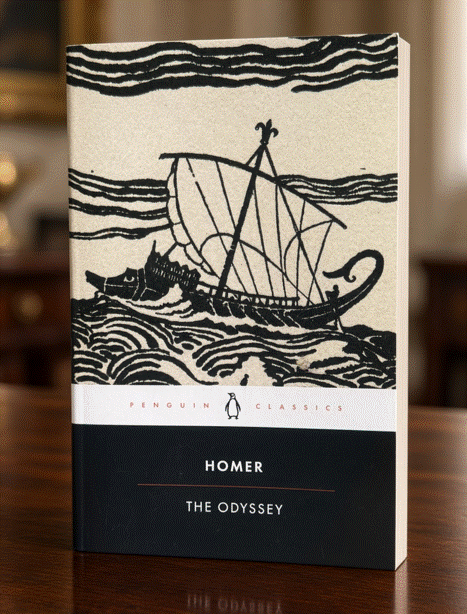
I was walking through Kmart earlier today when I came across a copy of E. V. Rieu’s translation of The Odyssey: a Penguin Classic, a reprint of the original 1946 edition, priced at sixteen dollars. It is not where one expects to meet Homer, wedged somewhere between homewares and school stationery, and I bought it partly out of amusement and partly out of a faint sense of rescue. I took it home and read it again, and I have been thinking about it ever since. I have not changed my mind about it. I am a traditionalist, and it is not the translation I would put in a student’s hands. What has stayed with me is what it shows about the way language carries ideas across time, and what happens to those ideas once they have been carried far enough that nobody remembers who first set them down.
I should say plainly what this piece is not. It is not another contribution to the old and rather pleasant argument over which English Odyssey is the best, although a few words about that argument are needed, because it is the doorway into everything else. Rieu’s version was the first volume in the Penguin Classics, the series he went on to edit, and it renders Homer’s hexameter into plain, brisk prose. Its virtues are readability and pace; its costs are those that any prose rendering of oral epic must pay. The repeated epithets and stock phrases that made the poem memorable in performance are thinned out, the rhythm of the line disappears, and the English that remains can sound to a modern ear like a well-mannered official dictating a report. Even the word that introduces the hero, polytropos, which folds together turning, wandering, versatility and cunning, becomes something safer and flatter in Rieu: ‘resourceful’. Readers who want the structure of the Greek tend to prefer Richmond Lattimore; those who want drama reach for Robert Fagles, those who want lyricism for Robert Fitzgerald, and those who want clear modern verse that stays close to the original line count for Emily Wilson.
That is the argument I am declining to have here. What interests me is the translation as a historical artefact and, behind it, a larger question about how ideas and concepts filter through literature and other media until they are almost universally accepted. That filtering is where stereotypes come from. I know of no better way to explain what I mean than to describe something that happened to me.
A History in Motion
I have read The Odyssey in every translation I could find in the languages I read well enough to attempt it, which means English, French, German and Italian, and I have also read it in the original Greek. Laid side by side, the English versions of the last eighty years make an unexpectedly vivid record. From Rieu’s prose of 1946 to Wilson’s verse of 2017, one can watch the language change, and with it the questions the translators think the poem is asking. Rieu smooths and softens because his task, as he saw it, was to make an alien text feel familiar to a new mass readership. The later translators, each in a different manner, are more willing to let it be strange, and some are more willing to let it be uncomfortable.
The clearest example comes near the end of the poem. When Odysseus has killed the suitors, Telemachus, on his father’s orders, hangs twelve of the household’s enslaved women who were judged to have been disloyal, and the poem tells us that they kicked their feet for a little while and then were still. Many earlier translators, in a variety of phrasings, turned these women into ‘maids’ or ‘servants’, words that shrink an institution and hide it behind a domestic gentleness. Wilson calls them slaves, because that is what they were. The Greek was always there. The English changed because the readers changed, and what had been rendered invisible became visible.
This is what I mean by a history in motion. Societies do grow in their understanding of the past and in their sensitivity to language, and a shelf of Odysseys can be read as a measure of that growth. But I have noticed that the growth is not even. Some groups of people are looked at again and described anew. Others remain, generation after generation, exactly where the older vocabulary left them.
How an Idea Becomes Furniture
Ideas do not usually travel as arguments. They travel as stories, phrases and stock figures, and after enough repetition they stop looking like ideas at all and start looking like the way things are. A stereotype is an idea that has been told so often that nobody remembers who put it in the room. The ancient Greeks give a neat demonstration. Their word for foreigners, barbaros, appears to have begun as an imitation of the sound of speech they could not understand, a bar-bar of babble, so that a whole category of humanity was defined at the level of vocabulary by the fact that it did not speak Greek. The word passed into Latin, then into French and English, and the contempt it carries has outlasted the city-states that coined it by some two and a half thousand years. Nobody who calls an act ‘barbaric’ today is consciously making an argument about Persians.
Australia has its own long shelf. For well over two hundred years Aboriginal people have appeared in Australian print, painting, photography and screen as menace, as relic, as comic figure, as victim and as problem, and far less often as neighbours, citizens or authors of their own stories. The Chant of Jimmie Blacksmith, Thomas Keneally’s 1972 novel, which I have written about before, tells of a part-Aboriginal man whose story ends in killing and pursuit. Whatever its author intended, and intentions in literature are slippery, it belongs to a tradition in which the Aboriginal man is finally the danger. The tradition, rather than any single book, is the point. Generations of readers, jurors, public servants, police officers and prosecutors absorb it without ever deciding to.
The Opening Address
I come to this from experience rather than theory. In the court case I have often spoken of, the prosecutor’s opening statement to the jury, as I remember it and have carried it for the last eight and a half years, was that the defendant was an Aboriginal man, that all of those lined up against him were white public servants, and that the jury should take the word of the white public servants over the word of the Aboriginal defendant.
Consider what kind of statement that is. It makes no claim about the evidence, the documents or the law. It says nothing about what happened. It invites the jury to reason from the identity of a person to the credibility of that person, and it does so on the premise that there is a hierarchy of believability and that the jury shares it. A prosecutor makes a statement like that only if he thinks it will work, and it can work only if the jurors have inherited a picture of Aboriginal Australians that predisposes them against the man in the dock. That picture is the product of two centuries of print and screen. The prosecutor was counting on the library.
It has stuck in my mind for several reasons. It annoyed me greatly, and I would be lying if I said otherwise. The judge let him get away with it, which I thought then and think now was appalling. And the prosecutor went on to run a second line: that the defendant was trying to make the case about racism when it was simply about white public servants doing a job that an Aboriginal man had found not to his liking. In truth the whole matter was about racism, and it turned in large part on the Marina letter of 9 May 2002. Howard Ronaldson, the Chief Executive of ACT Treasury at the time, has stated on multiple occasions, to the AFP, the DPP and others, that he received that letter while he held the position, and that he remembers it distinctly because of the racism in it. He confirmed that the signature at the top was his, that the notation was the way documents were marked for sending on to various people, and that he had no doubt this was the document he received.
The shape of the thing is worth noticing. A defence that said the case was about racism; a prosecution that said the defence was merely making it about racism; and a documentary record, confirmed by its recipient, in which racism was the very subject. The prosecutor’s second line works exactly as his first did. It treats an allegation of racism made by an Aboriginal person as presumptively a tactic.
What the Jury Saw
The jury was drawn from the Canberra community, which has a popular reputation as being about as Anglo-Australian and as public-service-minded as any community in the country. If the prosecutor was reading the room, it was a room in which his appeal should have found a friendly audience. It did not. The jury set aside what the prosecution put forward and found in my favour on every count, acquitting me of all sixteen charges. I take that as a form of hope. It shows that an inherited stereotype is not a sentence, and that ordinary people, when documents and testimony are put in front of them, can look past what they have been taught to expect.
What has been overlooked is the opening address itself. In my view it was racist in its own right, and the judge did not call him up on it. I have long thought that it arguably offended against section 18C of the Racial Discrimination Act, which concerns public acts reasonably likely to offend, insult, humiliate or intimidate a person because of race, though I leave to others the question of whether a statement made in the course of proceedings is reached by it. What I find more instructive than the legal question is the judge’s silence. I cannot read the judge’s mind and I do not claim to. But I suspect the remark passed without challenge in part because it did not sound remarkable. It sounded like what the general Australian community thinks or, more precisely, like what people in authority assume the general community thinks. A statement that is not noticed as racist by those whose job is to notice has become furniture.
I know the objection: that this is one small, isolated case. As evidence of a pattern it is, and I do not offer it as more. I offer it as an illustration of a mechanism, seen from the inside by the person at whom the mechanism was aimed.
Whose Dead Are Mourned
Back to the Odyssey, then, because the poem has something to say here that I did not expect when I picked Rieu off the shelf. Societies, I said, grow in their understanding of the past and of language, but they do not grow evenly. Palestinians today seem to be treated as a people who are not entitled to be grieved. Indigenous Australians remain a people who are not entitled to be grieved. Judith Butler’s phrase for this is grievable lives: the observation that in any society some lives are held to matter, so that their loss is a loss, while others are held not to, so that their deaths become statistics or side effects. Many other examples spring immediately to mind. To say this of one people is not to deny it of another. Grief is not a scarce resource, and the argument is at its weakest when it is made as though it were.
The ancient poems understood this better than we often do. In the last book of The Iliad, Achilles gives the body of Hector back to Priam, and the two enemies weep together, one for his father and one for his son. In The Odyssey, the hero sits at the Phaeacian court, hears a singer tell of Troy, and covers his face to hide his tears, although the fall of Troy was his own victory. When he meets his dead companion Elpenor in the underworld, a nobody who fell drunk from a roof, he promises him burial, and on his return to Circe’s island he keeps the promise. The tradition at the root of Western literature begins with an insistence that the enemy’s dead, and the nobody’s dead, are owed grief.
And yet the same poem draws a line. The twelve enslaved women hanged in the courtyard receive no mourning at all, and the poem moves on within a few verses. It knows its own hierarchy, and the translator’s vocabulary either exposes that hierarchy or hides it. A reader who meets ‘maids’ feels a small domestic discipline; a reader who meets ‘slaves’ feels a killing. Where the language softens, the grief is withheld; where the language is exact, grief becomes possible.
An Honest Objection
I should give the other side its due, because the argument I have been making is easy to overstate. It can be objected that stereotypes serve interests before they serve ideas: that the dispossession of Aboriginal people was driven by land and labour rather than by novels, and that Greek contempt for barbarians was useful to those who wished to rule them. It can be said that literature follows power rather than leading it, and that most of the people who held the views I am describing never read Keneally, or Homer, or anyone. All of that is true, at least in part, and I do not claim that books alone produce injustice.
My claim is narrower. Interest requires a story, and a story requires words. Once those words enter common use they outlast the interest that first called for them. The land was taken; the language that justified taking it remained in the schoolroom, the newspaper and the idiom, and it was available to a prosecutor generations later, long after the original motive had ceased to be anyone’s conscious motive. The causation runs both ways, as it usually does. But of the two, the artefact is the one we can still pick up and examine, which is some reason to examine it.
The Specimen on the Desk
Why are some groups of people perpetually targeted and discriminated against while others are not? I do not think there is a single answer, and economic and political explanations carry real weight. But I believe a large and underrated part of the answer lies in historical artefacts such as books, phrases and habits of speech, which remain in common usage in a society long after the circumstances that produced them have gone.
The encouraging corollary is that artefacts can be revised. The distance from the older renderings to Wilson’s ‘slaves’ is some seventy years, and it was covered by translators who decided, in the end, to say what the Greek said. The language moved because people moved it. The remedy, then, is not to burn the old books, which would be both futile and philistine, but to read them knowing what they are: records of how a society once saw, and failed to see, itself.
The Penguin from Kmart now sits on my desk. I do not keep it as a model. I keep it as a specimen, a very readable one, of the English of 1946 and of everything that English took for granted. Sixteen dollars was a fair price for a fossil that explains so much.
– – –
Bakchos is the founder of Blak and Black, an Australian media and advocacy platform established in 2010. Bakchos writes from the intersecting perspectives of Wiradjuri heritage, Jewish identity, and humanism.
© Bakchos, October 2026