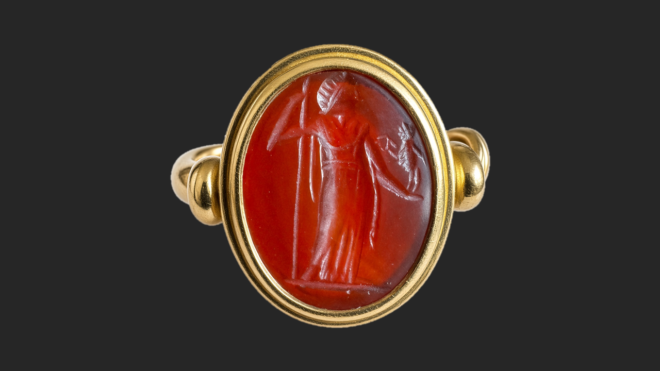
When I began my campaign to hold the ACT government and the Australian Federal Police legally accountable for their racism, I did not think very much about symbols. I thought about evidence, about procedure, about the long grind of litigation against institutions with effectively unlimited resources and no personal stake in the outcome. But somewhere in the middle of that campaign my wife, Susan, gave me a gift that came to hold more meaning than I could have anticipated at the time. It was a gold ring, made to resemble an ancient Roman signet, and set into its centre was a genuine Roman intaglio. The tiny carved figure showed Nobilitas holding Fortuna. Around the outside of the band, Susan had engraved two Latin words: Sapere aude.
I wore that ring every day of my Supreme Court trial in the ACT in 2017, a trial in which I was acquitted on all sixteen charges. I have always maintained that the prosecution was racially motivated and fraudulent, and the verdict, sixteen to nil, remains for me the most complete answer I could have been given. But the ring was never really about the verdict. It was about what it takes to arrive at a verdict like that, and about what the fight was for. In this essay I want to explain what the ring meant to me then, what it means to me now, and why I think the two small words around its edge contain the most practical political programme I know.
An Object From a Very Old Conversation
There is something humbling about wearing an object that was made two thousand years ago. An intaglio is a gem engraved in reverse, cut into the stone rather than raised from it, so that when it is pressed into warm wax it leaves a positive image behind. Romans used them as seals. A man’s ring was his signature, his guarantee that the letter or the contract or the sealed jar had passed through his hands and carried his authority. Someone, in a workshop somewhere in the Roman world, bent over a piece of hard stone with a fine tool and spent hours cutting a figure small enough to sit beneath a fingernail. Then someone else wore it, pressed it into wax, signed their name to the world with it, and eventually lost it, or died, or was buried with it. And then, nearly two millennia later, it ended up on my hand while I stood before a court and tried to hold two powerful institutions to account.
I do not think I am sentimental about antiquities, but I confess that I found the continuity moving. The classics were where my formal education began; I first studied them at the University of Sydney, and what I took from them was not a set of dead languages so much as a sense that the problems of power, justice and human weakness are very old indeed. The Romans knew about prosecutors who served the powerful. They knew about the way a state can dress up persecution in the language of law. They also knew a great deal about what it takes to stand against it. To wear their ring into a courtroom felt like taking a seat in a very long line of people who had been in the same position and had refused to flinch.
Nobilitas Holding Fortuna
The image on the stone is allegorical, and the allegory is a rich one. Fortuna was the Roman goddess of fortune and chance, usually shown with a wheel that turns without regard for anyone’s merit, or with a rudder, or a cornucopia, depending on whether she was being feared, steered or thanked. The Romans never quite agreed on whether Fortuna was a friend. She could raise a man to the consulship and cast him down in a season. Nobilitas, in the sense that matters here, is not mere aristocratic birth but nobility as quality: virtue, merit, excellence of character. To see Nobilitas holding Fortuna is to see virtue taking hold of chance, and refusing to be its plaything.
That image mirrors a cluster of Roman sayings that I have loved for a long time. Virtus fortunae comes, virtue is the companion of fortune, suggests that good character and good luck travel together, and that the first tends to attract the second. Fortes fortuna adiuvat, fortune favours the brave, carries the same thought in blunter form. Read carelessly, these proverbs can sound like cheap motivation, the sort of thing printed on a poster above a gym. But read properly they say something harder and more interesting. They do not claim that the brave will never suffer misfortune. They claim that courage changes the terms on which misfortune is met. A person who has decided in advance what they will stand for is no longer simply a leaf on the wheel. They have a hand on the rudder.
This matters enormously to anyone who finds themselves on the weaker side of a contest with the state. When the AFP and the ACT Government are on one side, and one individual is on the other, the odds are plain to see. The resources are unequal, the access to information is unequal, the capacity to absorb delay and expense is unequal. Anyone who tells you that fortune will favour you in such a contest is selling something. What Nobilitas holding Fortuna offers is a different promise: that while you cannot control the odds, you can control whether you meet them with integrity, and that integrity is the only thing that holds up when the luck runs out.
Two Words Around the Edge
If the intaglio is the heart of the ring, the engraving is its argument. Sapere aude translates most naturally as “dare to know”, or, in the form made famous in the eighteenth century, “have the courage to use your own understanding”. The phrase comes from the Roman poet Horace, who wrote it in the first book of his Epistles, published around 20 BC. The full line reads Dimidium facti, qui coepit, habet: sapere aude, incipe! He who has begun is half done: dare to know, begin.
It is worth lingering on how the line is built. Horace does not simply say that knowledge is good. He says that to know requires daring. The verb is not “learn” or “study” but “dare”, a word you would use for crossing a river or confronting an enemy. And he sets it directly beside the command to begin, as if the greatest obstacle to understanding were not difficulty but inertia, the quiet temptation to leave the question unasked because the answer might demand something of us.
That is precisely right, and it is a truth that powerful institutions understand very well. The comfortable position, for almost everyone, is not to know. It is easier to accept that the police are the police and the courts are the courts, that prosecutions are brought because crimes were committed, that complaints of racism are exaggerations, that things are as they appear in the press release. Not knowing is cheap. Knowing carries obligations. Once you have read the documents, followed the chain of decisions and understood who benefited from what, you can no longer pretend. Many people, quite rationally, prefer not to start.
I think this is the real engine of institutional injustice. We tend to picture it as the work of villains, but in my experience it depends far more on the failure of ordinary people, in the public service, in the media, in the community, to dare to know. Racism in an institution rarely survives on the strength of its defenders. It survives on the silence of those who would rather not look.
Sixteen to Nil
When my trial came, I wore the ring every day for a number of reasons, and the principal one was to remind myself what the fight was about. It was about standing firm for what you believe in the face of the grinding oppression that only the powerful can bring to bear on the weaker. I do not consider myself weak. But there is a difference between being weak and being outgunned, and in 2017 I was very much outgunned. The weight of a prosecution is not merely legal. It presses on your finances, your relationships, your sleep, your sense of who you are. It is designed, whether by intention or by the mere momentum of institutions, to make resistance feel exhausting and pointless. In those moments, to look down at a small carved figure of virtue gripping fortune, and at the instruction to dare, was a way of reminding myself that exhaustion was not the same as defeat.
I should be careful here to separate what is documented from what is my own conviction. The documented fact is that I faced sixteen charges in the ACT Supreme Court and was acquitted on every one. My contention, which I have made consistently and which I stand by, is that the prosecution was racially motivated and fraudulent. A verdict of not guilty does not by itself prove motive, and I would not ask a reader to treat it as though it did. What the verdict does establish is that a body of evidence which was presented as sufficient to ruin a man did not survive contact with a courtroom. The rest is a matter for the continuing work of accountability, and that is the work I have devoted myself to since.
What I will say plainly is that the ring did what a good symbol should do. It did not win the case; the evidence and the law did that. But it helped me to remain the person who could do the work that winning required. The spirit in the ring held true, and I emerged victorious. Yet there is more to the story than this, and the rest of the story is the part that matters most.
Beyond One Victory
It would be a mistake, and a self-indulgent one, to treat a personal acquittal as the end of anything. A single person prevailing against a single prosecution is not justice for a system. It is, at best, a proof that the system can be resisted, and at worst a lucky escape. The institutions I fought are still there. The habits of mind that make racism tolerable inside them are still there. And beyond them lies a world in which injustice is so vast, so various and so pervasive that no one person could possibly comprehend it, let alone confront it at the coal face of accountability.
This is a genuine problem, and I do not want to wave it away with slogans. If you let yourself look honestly at the scale of suffering produced by human cruelty, prejudice and greed, it can feel paralysing. There are the injustices in our own backyard, in the cells and the courtrooms and the child protection systems of this country. There are the injustices of occupation and displacement, of persecuted minorities and silenced journalists, of governments that have learned that nobody will hold them to account. There are more of them than any one mind can hold. The natural response to that realisation is to retreat into whatever small corner of life feels manageable, and to leave the rest to someone else.
I understand that response. I do not think it is contemptible. But I also do not think it is necessary, because there is a different way to think about the problem. We cannot each solve every injustice. What each of us can do is make a difference, and the difference we make is through education.
The Practice of Knowing
I mean education in the widest sense, not simply schooling, though schooling matters, but the ordinary, daily, unglamorous work of helping people to know things. It is explaining a law to a neighbour who thought it did not apply to her. It is publishing the documents that an institution hoped would stay buried. It is telling a story accurately, and refusing to tell it in the way that flatters the powerful. It is reading a book that complicates your assumptions and then recommending it to someone who will be irritated by it. All of these are acts of sapere aude, and all of them are available to anyone.
The reason education is so powerful is that it changes what a person is capable of feeling. This is a point that is often missed. We tend to think of empathy as a matter of temperament, as something people either have or lack. But a great deal of empathy is simply knowledge. It is hard to feel for people whose circumstances you cannot picture. When you actually know what happened on a mission, what a removal policy did to a family, how a pattern of policing falls on one community and not another, the abstraction becomes a person, and the person becomes someone you cannot easily ignore. Empathy follows knowledge as naturally as a shadow follows a body.
Knowledge does a second thing, which is to protect us from manipulation. In every era there have been people who exploit situations of fear and difference for their own political and economic ends. They are very skilled at it. They know that a frightened audience is a pliable one, and that blame directed at a vulnerable group is the cheapest form of political capital there is. Against this, the only durable defence is a public that knows enough to see through the self-serving propaganda. An informed person can hear a slogan and ask who benefits from it. An uninformed person can only decide whether they like how it sounds.
This is why those who benefit from bigotry have always been so suspicious of education. It is not an accident that regimes of every kind have sought to control what is taught, what is published and what may be asked. The command to dare to know is, in practice, a threat to anyone whose power depends on people not knowing. Immanuel Kant understood this when, in 1784, he took Horace’s phrase as the motto of the Enlightenment itself, defining enlightenment as humanity’s emergence from a self-imposed immaturity, the inability to use one’s own understanding without direction from another. He added, tellingly, that the cause of this immaturity lies not in a lack of understanding but in a lack of courage. That is Horace’s point exactly, and it is as true in Canberra today as it was in Königsberg then.
Standing Up to Bigotry
There is a corollary to all this. Once you know, you can challenge. Once enough people are able to see through the manipulations of those who trade in prejudice, it becomes possible to stand up to those people and to say, publicly and without apology, that their claims do not hold. This is not a matter of shouting. It is a matter of patient, accurate, unembarrassed contradiction. It means correcting the record each time it is falsified. It means asking the police, and the public servants, and the ministers, the questions that have been left unasked. It means declining to accept that an institution’s account of itself is the same thing as the truth.
That challenge is the beginning, I believe, of being able to address the vast majority of the injustices that are the hallmarks of twenty-first century human society. I say the beginning advisedly. Challenge on its own does not rebuild a legal system or heal a wounded community. But it is the precondition for everything that does. No institution reforms itself while the public is content to look away, and no reform survives a public that has forgotten why it was needed. The work of accountability, however technical its mechanisms, rests finally on a population willing to know.
The Long Game
I am under no illusions about speed. None of this can happen quickly. Education is slow work, and the change it makes is generational, often arriving long after the people who began it have ceased to be able to take any credit. Nor can any of it happen without the desire for it to happen. Knowledge cannot be forced on those who do not want it. The most a person can do is to make it available, to make the case, and to hope that curiosity and conscience will do the rest.
But I am an optimist about the outcome, for a reason that comes straight from the figures on the ring. Nobilitas holding Fortuna does not describe a world in which fortune has been abolished. It describes a person who has decided that fortune will not have the last word. The same is true of a society. We cannot abolish chance, or tyranny, or the persistent human appetite for someone to blame. We can build a people who are harder to fool and harder to frighten, who have the courage to know what is being done in their name and to say so. That can eventually happen, and when it does, it will happen for the benefit of the whole of humanity, not only for those on whom the old systems smiled.
Susan gave me the ring as a gift, and I wore it as a talisman. I now understand it as something closer to a charge. Two thousand years ago, a poet told a friend that the hardest part of any undertaking is the beginning, and that the beginning consists of a decision to know. I took that decision in the ACT Supreme Court in 2017. It is a decision available to every reader of this essay, in whatever corner of the world’s injustices they happen to occupy. Dare to know. Then begin.
– – –
Bakchos is the founder of Blak and Black, an Australian media and advocacy platform established in 2010. Bakchos writes from the intersecting perspectives of Wiradjuri heritage, Jewish identity, and humanism.
© Bakchos, November 2026