
For as long as democracies have existed, their critics have feared that wealth would eventually learn to purchase what it could not persuade people to give freely. Plato worried about oligarchy, the rule of the few who are rich, and Aristotle thought a polity captured by property had ceased to be a polity at all. The modern version of the fear is that a single fortune, deployed through super PACs, saturation advertising, owned media platforms and quiet funding of political parties, can drown out the voices of ordinary citizens. It is a serious fear, and anyone who dismisses it has not been paying attention.
In the first week of November 2026 there is fresh evidence, from three countries and from very different kinds of politics, that voters are not as purchasable as the wealthy hope and the cynical fear. In Texas, the most expensive Senate race in American history ended in a defeat for the candidate the world’s richest man had backed. In New York, the mayor read the national result as a rejection of a politics that defers to wealth. In Australia, a billionaire has now tried three times to buy an election and failed each time. This essay sets out what happened, what it shows, and, because Blak and Black holds itself to the discipline of separating documented fact from inference, what it does not prove.
Texas: The Most Expensive Lesson
Elon Musk spent more on the 2026 midterms than any political donor in American history. The precise figure depends on what is counted: one tally puts his spending at roughly $446 million, another at at least $474 million, including about $224 million in Texas, according to campaign finance records. Public Citizen identified him as the largest super PAC contributor of the cycle. Texas is the state his companies call home, and the money was spent there with open purpose, chiefly behind Ken Paxton’s Senate bid. The race became the most expensive Senate contest in United States history.
Then the people voted. Texans elected the Democrat James Talarico to the Senate, and the Democrat Gina Hinojosa was projected to unseat Governor Greg Abbott in the same election. Nationally, Democrats won both chambers of Congress. One trade publication summed up the record by noting that nearly all of the candidates Musk preferred had lost. Musk himself took it with a joke on X, writing that his “election-interfering space lasers” had not worked this time.
What gave the result its moral force was the way Talarico framed it. His campaign had been built around the contrast between a candidate funded by tens of thousands of small donors and an opponent propped up by a trillionaire’s cheques. On the morning after, he told Texans they had sent a message to the world’s richest man: “Texas is not for sale.” The power in the state and the country, he added, belongs to the people. It is a sentence that democratic thinkers have been writing for centuries, and it is rare to see it vindicated so cleanly by a ballot count.
The same night carried a quieter but related message. Ballotpedia tracked 41 data-centre measures across ten states for 3 November, and at least ten communities approved bans or restrictions. Whatever one thinks of artificial intelligence, those communities were telling the industry funding the boom that its money could build the servers but could not buy the consent to put them in people’s neighbourhoods. The pattern is the same in both cases. Capital can finance the ads, but it cannot manufacture legitimacy.
New York: A Referendum on Deference
On the Wednesday after the election, New York Mayor Zohran Mamdani described the night as “a referendum on politics at large across this country.” His diagnosis was pointed. Too many politicians, he said, have told working people that their needs are unrealistic while doing whatever the wealthiest people in the country ask of them. That is a claim about who politics serves, and it sits close to the heart of the matter. A politics that treats the demands of the very rich as realistic and the demands of working people as fantasy is exactly where a donation begins to look like a purchase.
Mamdani’s alternative was ambitious rather than defensive. The task, he said, is not to manage decline better but to lift the country to heights it has never reached, with working people at the centre of its politics. He pointed to the breadth of the Democratic result, with states such as South Carolina, Kansas and Iowa even in question, as proof that the country is ready for a politics that means something in people’s lives. His shorthand was that Americans want change they can feel in their wallets, and he described the practical shift as one from defence to offence: from trying to stop New Yorkers losing SNAP benefits and health insurance to making life more affordable.
The one place he spoke directly about money was in praising Abdul El-Sayed’s Michigan Senate victory, which came despite what Mamdani called the extraordinary amount of money spent to oppose him, and the racism and slander he faced. That is a narrower point than a verdict on Musk, and it should not be inflated into one. But it fits the pattern: a candidate outspent by very large sums who prevailed anyway. Mamdani also speaks from a position worth noting. He is the product of an insurgent campaign that the establishment wrote off, and he is describing the national result as a rejection of deference to wealth. That much the evidence supports, and no more should be claimed on his behalf.
Australia: The Billionaire Who Cannot Buy a Result
Australians have watched this drama before, and in our version it has been performed three times by a single protagonist. Clive Palmer is often described as having tried twice to buy an Australian election. The record shows three attempts. His parties declared expenditure of $89 million in 2019, $123 million in 2022 and $53 million for the Trumpet of Patriots in 2025. In 2019 and 2022 the United Australia Party won no seats in the House of Representatives, and its only parliamentary reward was a single Victorian Senate seat in 2022. In 2025 the failure was complete. The Trumpet of Patriots did not win a single seat, although Palmer’s company Mineralogy was the biggest third-party spender and sent almost $200 million out the door in the financial year. The same election gave Labor 94 seats in the lower house against 43 for the Coalition.
The most telling feature of the 2025 comparison is what happened to the party that did not spend. One Nation won three Senate spots despite spending about $3 million. Palmer’s own explanation, offered when he was asked about the comparison, was disarming: “Money doesn’t do it, it’s ideas.” It is as clear a statement of the democratic principle as any political scientist could wish for, and it came from the man who spent a fortune trying to prove the opposite. There is some irony, too, in his decision to take his case to the High Court, where he is challenging political donation caps on the ground that they impinge on freedom. The freedom he invokes is not trivial, and I return to it below. But the ballot box has now ruled on the practical effect of his spending three times.
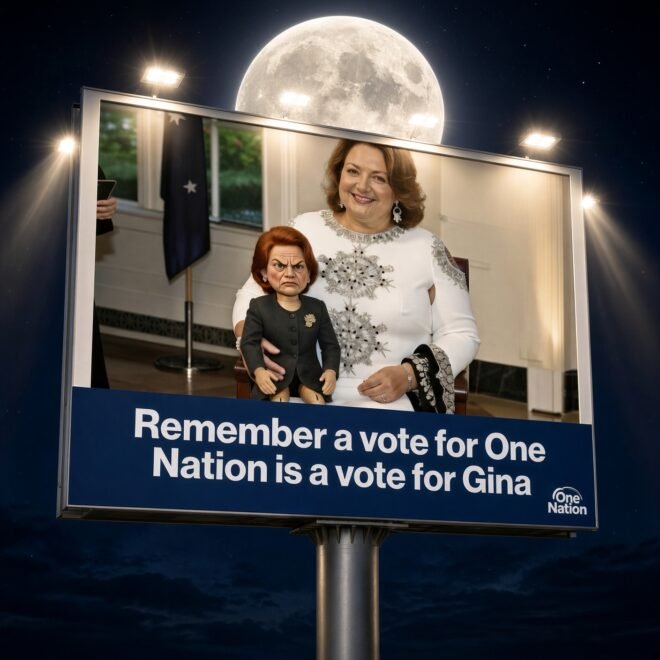
The Quiet Lease: One Nation and Gina Rinehart
Palmer’s story is reassuring precisely because his spending was loud, visible and easy for voters to see through. The harder problem for any democracy is influence that is quiet. This week the Sydney Morning Herald and The Age have reported on covert recordings of Sean Black, One Nation’s former national campaign director, who served the party for eight years and ran its campaigns from 2023 until April 2026. The claims that follow are those of one insider, made on tape. They are allegations, they have not been tested, and they are reported here as such.
On the recordings, Black is reported to say that Gina Rinehart, One Nation’s biggest funder, holds outsized influence over the party, and particularly over its chief strategist James Ashby. In one passage relayed by The Klaxon, he says that policy comes from Rinehart or her acolytes “and that is it.” He is also reported to warn that rampant nepotism could place Rinehart proxies, or inexperienced party insiders such as Pauline Hanson’s daughter Lee, in key political or policy roles, and even in the vice-regal office of governor-general should the party ever form government. Black further says that he kept working for One Nation after Hanson publicly removed him, and that his family firm was to keep a cut of the money it raised for the party’s Victorian branch ahead of the 28 November state election. His summary of the party he served is stark: “They don’t have a clue what democracy is.”
It matters that the reported money trail is not confined to the tapes. Adam Giles, the former Northern Territory Chief Minister who now runs Rinehart’s Hancock Agriculture, gave One Nation $500,000 earlier this year, as did the Rinehart-employed geologist Ian Plimer. Giles has said his donation came out of his bonus from Hancock. None of this establishes wrongdoing, and large donations to parties are lawful in Australia. Ashby and Hanson have also denied earlier financial allegations made against them. I have not seen a response from Rinehart, or from Ashby to these particular claims, and an essay that wants to be believed should say so.
Even so, the allegations describe the real danger, and it is subtler than a Palmer-style advertising blitz. The risk is not that a billionaire buys votes on the open market. It is that a billionaire acquires a party, or a controlling share of its attention, so that voters who think they are choosing a populist insurgent against the establishment are in fact choosing a vehicle steered by one of the richest people on earth. Voters cannot reject what they cannot see. The remedy for this kind of influence is therefore not primarily the ballot box but disclosure, journalism and the willingness of insiders to speak. In this case the system has worked in the only way it can: an insider spoke, newsrooms checked, and the public has something to weigh before it votes.
What the Evidence Does Not Prove
Placed side by side, these episodes suggest a common thread. In Texas, in Palmer’s three campaigns, and potentially in the story now unfolding around One Nation, voters have shown considerable resistance to being told who to elect by a person of enormous wealth. Where the spending was visible, people tended to treat it as a reason for suspicion rather than trust. Talarico made the opposing money part of his argument and won. Palmer’s blitz of texts and billboards persuaded almost nobody. It is a hopeful finding, and it fits a long tradition in political thought which holds that citizens are not simply the sum of the messages they receive.
A careful reader should resist overreading it. The Texas result does not establish why individual voters chose as they did. A Republican who lost in a national environment that went badly for his party might have lost with or without Musk’s help, and some of the reporting is explicit that the money went through an outside committee rather than to the candidate’s own campaign, and that the outcome does not isolate its effect. A defeat in one cycle does not prove that money is ineffective in others, and Musk’s heavy spending in 2024 was followed by a very different result. Money may also work in quieter ways than headline totals suggest, by shaping which candidates run, which issues are raised and which policies are quietly dropped.
The strongest argument on the other side deserves its hearing in full. Palmer and others contend that spending on political speech is itself an exercise of freedom, and that caps on donations restrict the ability of citizens, including wealthy ones, to take part in public debate. Defenders of looser rules can add, with some force, that the Texas result shows voters cannot be bought, which suggests the danger of big money has been overstated. The difficulty with that second claim is that it proves too much. If spending is harmless because it fails, there is no reason to fight caps on it. If it is worth fighting for, it must sometimes work. Many democracies, and the courts of several of them, have struggled for decades to balance free political expression against political equality, and reasonable people land in different places.
The Vigilance That Remains
The honest case for optimism is more modest and more durable than a slogan. It is not that money never matters, but that it matters least when it is most visible and most openly aimed at telling people how to think. Texas voters, who were given every reason to feel the weight of a fortune pressing on their choice, chose otherwise, and Talarico’s declaration that Texas is not for sale was earned at the ballot box. Mamdani offered the wider reading, that the country is ready to reject a politics which defers to the very rich while telling working people to expect less. Australians chose otherwise in 2025, as they had in 2019 and 2022.
The vigilance required now is directed at the influence that does not announce itself: the donor who is never on the ballot, and the party that borrows the voice of the people while taking its policy elsewhere. If the claims in this week’s reporting are borne out, they show exactly where the next fight lies. Democracy cannot be bought outright at the ballot box, but it can be quietly leased, and only citizens who are informed, sceptical and organised can stop the lease from being signed.
A note on sources. Figures on Elon Musk’s spending are drawn from US campaign finance reporting as relayed by several outlets and vary by tally. Mayor Mamdani’s remarks are from WABC-TV’s report of 4 November 2026. Senator-elect Talarico’s statement is as reported by ANI. Material on Sean Black comes from The Age and Sydney Morning Herald report of 7 November 2026 as relayed by The Klaxon and others, and remains allegation until the people named have responded on the record. Australian spending figures are from AEC disclosures as reported by Grattan Institute, AAP and SBS.
– – –
Bakchos is the founder of Blak and Black, an Australian media and advocacy platform established in 2010. Bakchos writes from the intersecting perspectives of Wiradjuri heritage, Jewish identity, and humanism.
© Bakchos, November 2026



The subtle influence Gina Rinehart is trying to assert on our lives via that fool Pauline Hanson is a real threat to our democracy.
American democracy is definitely not for sale. We need to get trillionaire and billionaires money out of our democracy. The only reason it’s there is to manipulate the population into voting for things that are generally against their better interests but are definitely in the interest of the trillionaire and billionaire class.