The Bones on the Shore
Du Fu, the army carts, and what Remembrance Day asks of us
Tomorrow at eleven o’clock, Australians will fall silent for two minutes. The ritual is among the few we still share, and it asks something hard of us: to hold the dead in mind without using them. The silence is also exposed to a temptation, which is to let grief turn into decoration, so that the dead become a backdrop for speeches. There is an older and plainer way of remembering, and it can be found in a poem written some twelve hundred years ago, on the other side of the world, by a man who had watched an army leave.
Du Fu wrote “Ballad of the Army Carts” around 751 CE, in the last years of a Tang dynasty that still looked magnificent from the outside. Its capital, Ch’ang-an, was among the largest cities on earth. Its poets were celebrated and its borders were wide. Beneath the glitter, the empire was feeding its young men into frontier campaigns, among them the costly wars against the kingdom of Nanzhao in the south-west, in which, by most accounts, tens of thousands were conscripted and many died, a great number of them to disease in country their own officers did not know. Du Fu did not write about generals or strategy. He wrote about the sound of the carts and the dust.
What the poem sees
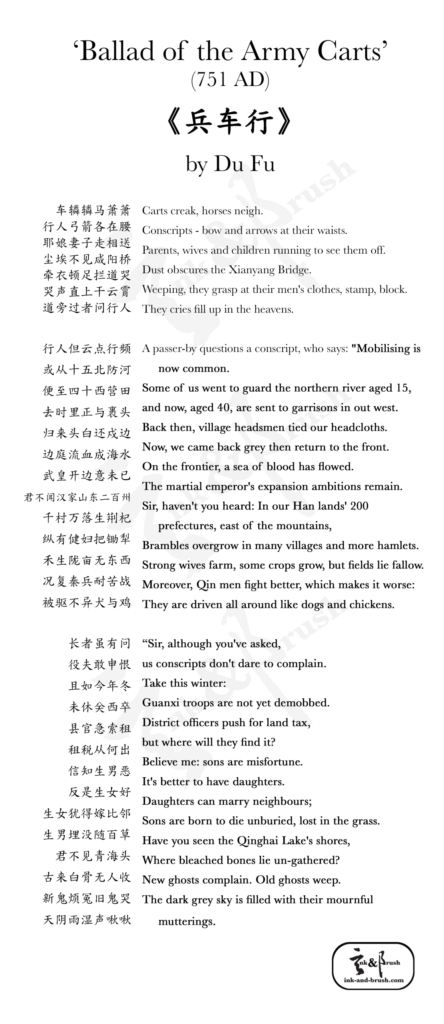
The poem opens with noise: “The war-chariots rattle, the war-horses whinny.” It is the noise of an institution in motion, and the next lines turn from the machine to the people it is running over. Father, mother, son and wife stare at the departing men “till dust shall have buried the bridge beyond Ch’ang-an.” Du Fu does not describe the conscripts’ courage. He describes the families who run alongside, tugging at sleeves, and a grief so loud that it “goes up to the clouds.” Then he adds the detail that gives the poem its weight. When a bystander asks a conscript what is happening, he can only say that he has to go.
That sentence is worth lingering on, because it is the grammar of every conscript army in history. The man does not say that he wants to go, or that the cause is just, or that the enemy must be stopped. He says he has to. The poem places the whole moral weight of the war not on the soldier’s choice but on the absence of one. Anyone who has stood at a railway platform, a wharf or an airport gate while someone they love departed for a war they did not start will recognise it.
Du Fu then widens the frame from the departure to the duration. Some of these men were sent north at fifteen and west at forty, and “with their turbaned hair white now, they are still at the border.” A war that consumes a boy’s adolescence and a man’s middle age is no longer an episode in anyone’s life. It becomes the life, taken from the person who lived it and from the village that should have held him. Meanwhile, the poem says, “the heart of Emperor Wu is beating for war.” The poet is careful here. Emperor Wu of Han had been dead for some eight centuries, and everyone reading understood that the ruler being criticised sat on the Tang throne. The device is an old poet’s protective cover, but it is still candour. The man who sends the carts is named, and his appetite is set against everyone else’s cost.
The cost behind the front
What makes the poem more than a lament for dead soldiers is that its eye keeps turning to the people the front line does not show. East of the mountains, in two hundred districts and thousands of villages, “nothing grows but weeds.” The war that is fought at the border is also fought in the fields, which are left unploughed, and in the household accounts, which are emptied by the tax collector. Women bend to the plough, but the furrows are “all broken down.” A war is never confined to the place where the shooting happens. It reaches back through the economy and the family and empties the countryside of the labour that makes a country a country.
Then comes the most bitter passage, which has the least to do with armies and the most to do with how states treat their own people. The men, Du Fu says, are able to face the stiffest battle, “but their officers drive them like chickens and dogs.” They cannot complain, and they are still taxed. The state demands bodies for the war and money for the war from the same households, so the war’s cost is borne at both ends by the people with the least power to refuse it.
The poem’s reversal of ordinary values follows from that. Parents have learned that to have a son is bad luck, and that it is far better to have a daughter, who can marry into a neighbour’s house, “while under the sod we bury our boys.” In a society that prized sons above almost everything, Du Fu records parents who have come to prefer daughters, because daughters are not conscripted. A war long enough overturns the oldest instincts a society has. Parents come to dread the birth of the child they once prayed for, and that is hard to hear and harder to answer.
The last four lines carry the poem beyond politics:
“Go to the Blue Sea, look along the shore at all the old white bones forsaken. New ghosts are wailing there now with the old, loudest in the dark sky of a stormy day.”
The dead are not honoured here. Nobody has gathered them or named them, and no stone has been set over them. They are bones on a shore, and the new dead are added to the old ones. The ghosts are loudest when the weather is worst, which is Du Fu’s way of saying that the suffering does not end when the fighting does. It goes on in the dark, in the keening of those who were never properly mourned.
Remembrance, and what we owe the dead
It would be easy to say that Du Fu’s world is remote from ours, that Tang conscription and Australian volunteering are different things. It is true that the Australians who embarked in 1914 and 1915 mostly volunteered, and that the nation twice refused, in the referendums of 1916 and 1917, to conscript its young men for overseas service. We are proud of that, and we should be. But a volunteer force is not exempt from the poem’s questions. The recruiting posters, the pressure of mates and the white feathers pressed on men in the street did their own kind of conscripting. Nearly sixty thousand Australians died in a war whose causes most of them could not have explained, out of a nation of fewer than five million people. Every one of those deaths left a household with a chair no one sat in, and every town had its Ch’ang-an bridge.
There is also a part of our history the poem forces us to look at squarely. Aboriginal and Torres Strait Islander men enlisted in the First World War despite rules that discouraged or excluded them, and they served alongside white Australians, often receiving equal pay and equal respect in the trenches and neither at home. They returned to a country that did not count them in the census, in many places did not allow them to vote, and, after the war, largely excluded them from the soldier-settler land schemes given to their white comrades, in some cases on the very country their families had been dispossessed of. It would be hard to design a purer illustration of Du Fu’s complaint, that the state takes what it needs from those without power and then forgets them. And the wars fought on this continent itself, the frontier wars in which Aboriginal people died defending their country, have long been marginal to the national story of Australia at war, and remain contested in how the nation’s principal memorial tells it. The bones on the shore are not only on foreign shores.
None of this diminishes the dignity of those who served. It is the reverse. Du Fu’s poem is the clearest possible demonstration that anti-war writing and remembrance are not enemies. He has the deepest sympathy for the soldier, which is why he is so angry on his behalf. The conscripts in his poem are brave: they can face the stiffest battle. What he refuses is the lie that the bravery of the dead justifies the decisions of the living who sent them. The soldier’s courage is real, and so is the failure of the officials who spent it. We honour the first by being honest about the second.
That is the discipline Remembrance Day asks of us, and it is harder than it sounds. We can say “lest we forget” and mean only the names. Or we can mean the whole of it: the dust on the bridge, the white hair at the border, the weeds in the fields, the parents who learned to wish for daughters. To forget these is to make the next war easier to start. Governments find it easy to send the carts when the public remembers only the glory of those who rode in them. They find it harder when the public remembers the sound of the families running behind.
A silence worth keeping
Tomorrow, as the two minutes of quiet close, it is worth asking who in the world is standing at a bridge right now, watching the dust. There are always some. The wars of this decade have their conscripts, their emptied villages and their unburied dead, and the families who understand, as Du Fu’s did, that “you have to go” is the saddest sentence a government can compel a person to speak.
If remembrance means anything, it means refusing to let that sentence become ordinary. We owe the dead the truth about why they died, and we owe the living a politics in which fewer people have to say it. Du Fu could not stop the carts. He could do something that has outlasted the dynasty and the empire and the emperor whose appetite he named: he could set down what he saw, in plain words, so that no one after him could claim not to know. That is still the task, and a poem more than twelve centuries old has already shown us how to do it.
Lest we forget, and lest we be told that remembering is the same as consenting.
– – –
Bakchos is the founder of Blak and Black, an Australian media and advocacy platform established in 2010. Bakchos writes from the intersecting perspectives of Wiradjuri heritage, Jewish identity, and humanism.
© Bakchos, November 2026