
Abstract
In an era defined by globalisation and accelerating information exchange, the persistence of broad, negative stereotypes about entire populations remains a profound barrier to mutual understanding and peaceful coexistence. This essay interrogates the claim that the world’s 2.06 billion Muslims are inherently uniform in their beliefs and collectively antagonistic toward rational thought and tolerance. Drawing on historical, sociological, and comparative religious analysis, the essay argues that such generalisations are not only intellectually indefensible but also politically manufactured. By examining parallel dynamics in American evangelical Christianity, Zionist Jewish exceptionalism, and the fearmongering surrounding Sharia law, the essay reveals how selective religious interpretation across traditions can undermine tolerance – and how identifying who benefits from perpetuating such narratives is essential to dismantling them. The conclusion affirms that nuanced, cross-cultural understanding is both possible and necessary for building an equitable world.
I. Introduction
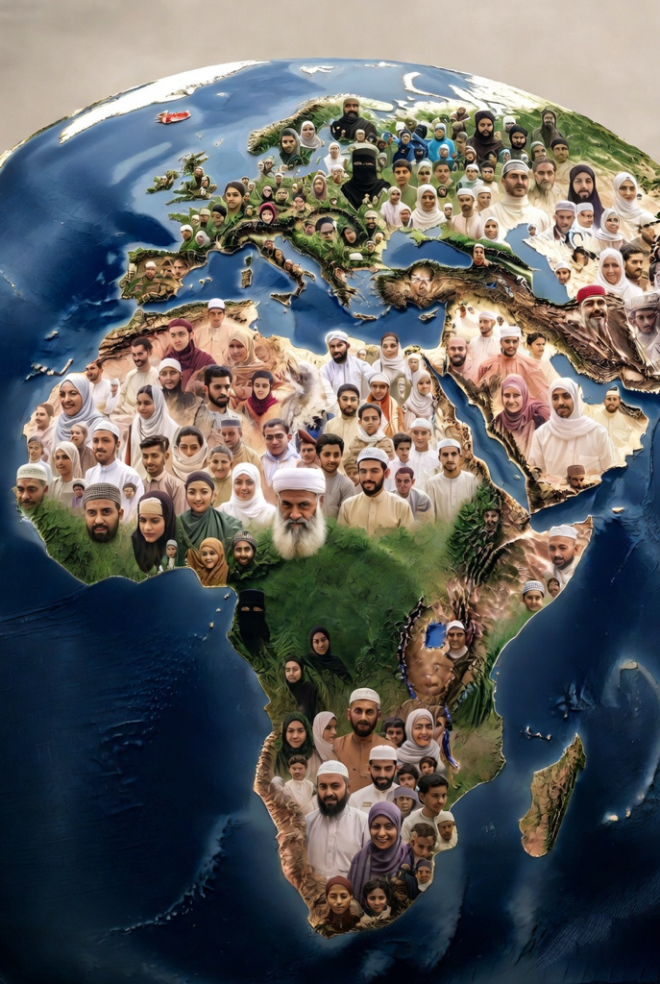
One of the most enduring intellectual distortions of the contemporary era is the assertion that a quarter of humanity shares a monolithic worldview defined by irrationality and hostility to liberal values. With the global Muslim population estimated at over 2.06 billion in 2026, such a claim encompasses not merely a religion but a civilisation of staggering diversity – spanning Indonesian coastal villages, Turkish megacities, West African market towns, and European university campuses. To reduce this heterogeneity to a single caricature is not a neutral analytical error; it is a political act with measurable consequences for social policy, international relations, and the safety of Muslim individuals around the world.
This essay argues that generalising Muslim belief and behaviour is as intellectually bankrupt as condemning all Christians for the excesses of American evangelical literalism, or all Jewish people for the maximalist claims of Zionist exceptionalism. The essay proceeds in five parts. First, it maps the internal diversity of Islam across doctrinal, geographic, and political dimensions. Second, it recovers the rationalist tradition of the Islamic Golden Age as a corrective to ahistorical stereotypes. Third, it examines parallel challenges to rationality and tolerance within evangelical Christianity, with specific attention to reproductive rights and LGBTQ+ equality. Fourth, it analyses the exceptionalism strand within Zionist thought and its implications for tolerance. Finally, it deconstructs the fearmongering around Sharia law, exposing the economic and political interests served by anti-Islamic narratives. Throughout, the essay insists that critique of religious extremism within any tradition must be symmetrical and grounded in evidence – not deployed selectively to stigmatise a single faith community.
II. The Internal Diversity of Islam
The global Muslim community, or ummah, is constituted by a diversity so profound that the phrase “Muslim world” functions more as geopolitical shorthand than as an accurate descriptor. Sunni Muslims constitute between 75 and 90 percent of the total, while Shia Muslims represent approximately 10 to 13 percent, and smaller branches – Ahmadiyya, Ibadi, Ismaili, and Sufi orders of various orientations – add further layers of doctrinal and cultural distinction. These are not merely theological footnotes; they represent divergent histories, legal schools, devotional practices, and political philosophies that have shaped entire civilisations.
Geography compounds this diversity. Indonesia, home to the world’s largest Muslim population at over 229 million, has long cultivated a syncretic, moderately democratic tradition of Islamic practice, in which organisations such as Nahdlatul Ulama and Muhammadiyah have promoted pluralism and modern education for over a century. Contrast this with the state-enforced orthodoxy of Saudi Arabia, or with the post-Ottoman secular nationalism that shaped Turkish Islam through most of the twentieth century. In sub-Saharan Africa, Islam has merged with indigenous spiritual traditions; in South Asia, it has been inflected by centuries of interaction with Hindu and Sikh cultures; in Western Europe and North America, Muslim communities navigate the tensions between minority identity, civic integration, and transnational religious solidarity.
Political orientations are equally varied. Muslim-majority countries include parliamentary democracies (Tunisia, Malaysia), constitutional monarchies (Morocco, Jordan), republics shaped by military tradition (Pakistan, Algeria), and theocratic states (Iran, Saudi Arabia). Within each, vigorous debates about the relationship between faith, governance, gender, and individual liberty are ongoing. To flatten this landscape into a single image of uniformity is not simplification; it is falsification.
III. Islam’s Rationalist Tradition: The Evidence of History
Perhaps the most damaging dimension of the anti-Muslim stereotype is its implied claim that Islam and rational inquiry are inherently incompatible. This claim collapses under the weight of historical evidence. From roughly the eighth to the fourteenth centuries, Islamic civilisation produced one of the most sustained periods of scientific and philosophical creativity in human history – a period often designated the Islamic Golden Age.
The institutional centre of this achievement was the House of Wisdom (Bayt al-Hikma) in Baghdad, founded under Caliph Harun al-Rashid and expanded by his son al-Ma’mun. Here, scholars of multiple faiths – Muslims, Christians, Jews, Zoroastrians – collaborated in translating and extending the intellectual heritage of Greece, Persia, India, and China. Far from being a passive preservation exercise, this project generated original knowledge across virtually every domain of inquiry.
In mathematics, Muhammad ibn Musa al-Khwarizmi’s foundational treatise gave the world both the term “algebra” (from al-jabr) and the concept of the algorithm (from his Latinised name). His popularisation of the Hindu-Arabic numeral system, including the concept of zero, transformed European commerce and science centuries later. Omar Khayyam advanced algebraic geometry and contributed to calendar reform of remarkable precision; al-Battani refined trigonometric functions in ways that would influence Copernicus; and Thabit ibn Qurra developed original theorems while producing landmark translations of Euclidean geometry.
Astronomy was equally distinguished. Al-Biruni calculated the Earth’s radius with extraordinary accuracy using trigonometry and conducted early comparative studies of world religions with a scholarly detachment rare for his era. Nasir al-Din al-Tusi established the Maragha Observatory and devised the Tusi couple, a geometric construction that resolved internal inconsistencies in the Ptolemaic model and left a demonstrable imprint on Copernicus’s heliocentric theory. In medicine, Ibn Sina’s Canon of Medicine remained a standard European university text until the seventeenth century; al-Razi distinguished measles from smallpox and championed empirical method over scholastic authority; Ibn al-Nafis described pulmonary circulation centuries before European medicine caught up; and al-Zahrawi’s surgical encyclopaedia shaped European operative medicine through the Middle Ages.
Philosophy during this period demonstrated that reason and faith were considered complementary rather than opposed. Al-Kindi argued for the compatibility of Greek philosophy and Islamic theology; al-Farabi envisioned rational governance in his political philosophy; and Ibn Rushd’s commentaries on Aristotle were so authoritative that Scholastic thinkers in European universities debated “the Commentator” for generations. Jabir ibn Hayyan’s experimental chemistry, Ibn al-Haytham’s empirical optics – which anticipated the scientific method in its insistence on hypothesis and verification – and al-Idrisi’s cartographic masterwork for the Norman court of Sicily all testify to a civilisation defined not by obscurantism but by intellectual curiosity and interfaith collaboration.
Today’s progressive Muslim movements carry this tradition forward. Feminist scholars in Malaysia and Morocco reinterpret sacred texts to advocate for gender equality. Indonesian clerics lead global interfaith dialogue initiatives. Muslim intellectuals in Europe and North America engage in sophisticated debate about pluralism, secular governance, and human rights, speaking from within the tradition rather than against it. These voices are not marginal; they represent millions of Muslims whose daily lives are organized around family, education, community, and ethical aspiration – not the grievances that make headlines.
IV. Evangelical Literalism and Its Challenges to Tolerance
The critique of religious extremism must, if it is to carry intellectual credibility, be applied with consistency across traditions. American evangelical Christianity offers a revealing parallel case. Representing approximately 25 percent of U.S. Christians, evangelicalism encompasses a wide spectrum of practice and belief, but its most politically influential strand is characterised by biblical inerrancy – the insistence that scripture, read literally, constitutes the authoritative guide to all matters of faith, morality, science, and governance.
The tension between this literalism and empirical science is well documented. Surveys conducted over the past decade indicate that significant proportions of self-identified evangelicals reject Darwinian evolution and anthropogenic climate change, not on empirical grounds but on theological ones. Creationist curricula and Young Earth cosmology continue to find support in evangelical educational networks, and opposition to stem cell research and evidence-based sex education reflects a pattern in which scriptural interpretation is privileged over scientific consensus. During the COVID-19 pandemic, several prominent evangelical leaders discouraged mask-wearing and vaccine acceptance as contrary to faith or as indicators of insufficient trust in divine providence, with measurable epidemiological consequences in highly evangelical communities.
The most consequential area of evangelical policy engagement, however, concerns reproductive rights and LGBTQ+ equality – domains where the application of biblical literalism has restricted the freedoms of millions of Americans. Approximately 65 percent of white evangelicals believe abortion should be illegal in most or all circumstances, a position grounded in literal readings of passages such as Psalm 139 and Jeremiah 1:5, understood as establishing personhood at conception. This theological position has driven legislative campaigns resulting in six-week abortion bans, near-total prohibitions, and the absence of exceptions for rape, incest, or critical maternal health risk. The public health consequences are severe: states with the most restrictive abortion laws also exhibit elevated maternal mortality rates, particularly among Black women, who already face systemic barriers to reproductive healthcare. Economic research consistently finds that forced continuation of pregnancy exacerbates poverty cycles, reduces workforce participation, and increases household debt. The framing of these policies as religious freedom claims effectively renders invisible the freedom claims of the women affected.
On matters of sexual orientation and gender identity, approximately 62 percent of white evangelicals oppose same-sex marriage, and evangelical advocacy organisations have consistently lobbied against anti-discrimination protections, supported conversion therapy, and sought to limit LGBTQ+ individuals’ access to adoption, foster care, and public accommodation. The psychosocial toll is well-established: LGBTQ+ youth raised in strongly anti-gay religious environments exhibit suicide attempt rates four to five times the general adolescent population, and LGBTQ+ individuals account for approximately 40 percent of homeless youth in the United States, often as a direct consequence of family or community rejection rooted in religious conviction.
These are not casual observations but serious critiques of how a particular interpretation of a religious tradition can cause measurable harm to vulnerable populations. They are offered here not to condemn evangelical Christianity as a whole – the tradition contains multitudes, including Christians who affirm both faith and human rights – but to illustrate that the dangers of religious literalism are neither unique to Islam nor disproportionately concentrated there. Symmetry in critique is the minimal condition of intellectual honesty.
V. Zionist Exceptionalism and the Limits of Chosen-ness
A comparable dynamic of exceptionalism – one that similarly strains the norms of tolerance and equal dignity – can be observed in certain currents of Zionist thought. The concept of Jewish chosenness, rooted in biblical covenant theology, has been interpreted across a wide spectrum, from a purely ethical vocation of service to humanity to a territorial claim of exclusive divine right. It is the latter interpretation, amplified by certain strands of political Zionism and settler ideology, that poses the most direct challenges to equal treatment under international law.
The founders of modern political Zionism, responding to a genuine and murderous European anti-Semitism culminating in the Holocaust, constructed a framework in which Jewish historical suffering justified the establishment and defence of a Jewish state in historic Palestine. This is a historically intelligible claim. What is more contestable is the extension of this framework into a doctrine of Israeli exceptionalism – the notion that the singular magnitude of Jewish suffering, and Israel’s unique status as a Western democratic outpost in a hostile region, exempts it from the standards of international humanitarian law applied to other states and peoples.
This exceptionalism has practical consequences. Settlement expansion in the occupied West Bank has displaced Palestinian communities, created a two-tiered legal system in which settlers and Palestinians living in geographic proximity are subject to radically different rights regimes, and has been consistently found in violation of international law by bodies including the International Court of Justice. When critics of these policies are systematically characterised as anti-Semitic – regardless of whether they are Jewish, Palestinian, or otherwise – legitimate political discourse is suppressed and the cause of genuine tolerance is undermined. Conflating criticism of a state’s policies with bigotry against an ethnic or religious group has always been a powerful silencing mechanism, and its deployment in this context mirrors the way accusations of Islamophobia are sometimes weaponised to foreclose critique of specific political actors in Muslim-majority societies.
It bears emphasising that Zionism, like Islam and evangelical Christianity, is internally diverse. Many Jewish voices – including Israeli citizens, diaspora scholars, and human rights advocates – contest maximalist exceptionalism and insist on equal dignity for Palestinians as a condition of genuine peace. The critique here is directed not at a people or a faith, but at a political ideology that, in its most absolutist form, privileges one group’s claims at the expense of another’s humanity.
VI. The Fearmongering Around Sharia: Anatomy of a Manufactured Crisis
No element of contemporary anti-Muslim discourse has been more systematically distorted than the question of Sharia law. In the political rhetoric of several Western countries over the past two decades, Sharia has been constructed as an imminent civilisational threat – an alien legal code poised to displace constitutional democracy, impose medieval punishments, and subjugate women. Legislative campaigns to ban “foreign law” – transparently aimed at Sharia – have been advanced in multiple American states and several European countries, despite the absence of any credible evidence that Sharia governance is sought by Muslim communities in these jurisdictions.
The distortion begins with a fundamental misrepresentation. Sharia – derived from the Arabic for “path to water,” suggesting life and sustenance – is not a fixed, codified legal statute but a vast, internally contested tradition of ethical and jurisprudential reasoning grounded in the Quran, the Hadith, and centuries of scholarly interpretation. Its applications range from devotional practice and dietary guidelines to family law, inheritance, and commercial ethics. In most Muslim-majority countries, only specific domains – typically family and personal status law – are governed by Sharia-derived codes, while criminal, commercial, and constitutional law follow civil systems inherited from colonial or post-colonial legal frameworks.
The penal provisions that dominate Western fearmongering – amputation for theft, stoning for adultery – are prescribed under specific classical interpretations requiring evidentiary standards so stringent that historical application has been far rarer than contemporary rhetoric implies. More significantly, progressive scholars within the Islamic legal tradition have produced extensive, sophisticated arguments for contextual reading of these provisions, emphasising the Quranic commitment to justice (adl), welfare (maslaha), and the prevention of harm. These voices are systematically excluded from the fearmongering narrative because their inclusion would undermine its premise.
One must then ask: who benefits from the perpetuation of Sharia panic? The answer is not difficult to identify. Defence contractors and private security firms profit directly from the geopolitical posture that “the Muslim world” represents an existential threat requiring massive military expenditure. The post-September 11 transformation of the U.S. national security state generated trillions of dollars in procurement contracts, intelligence infrastructure, and private military services. Politicians of various ideological colourations have found that anti-Muslim sentiment reliably mobilises electoral bases and distracts attention from domestic policy failures in healthcare, economic inequality, and infrastructure. Media organisations whose business models depend on emotional engagement have discovered that Islamophobic content – framed as hard truths others are afraid to speak – generates clicks, subscriptions, and advertising revenue. Think tanks and advocacy organisations funded by identifiable networks of donors have produced a cottage industry of anti-Islamic pseudo-scholarship that circulates through social media and enters mainstream political discourse.
The human costs of this manufactured crisis fall on Muslim communities. Studies consistently document elevated rates of workplace discrimination, hate crimes, and mental health burden among Muslims in Western societies, correlated with spikes in anti-Islamic political rhetoric. The fearmongering does not merely misrepresent a religion; it materially harms millions of people whose daily lives have nothing to do with the extremism they are made to represent.
VII. Conclusion: Toward a Symmetrical and Evidence-Based Tolerance
The intellectual and moral case against generalising 25 percent of humanity as irrational, intolerant, or inherently threatening is overwhelming. The global Muslim community is constituted by a diversity of doctrine, practice, culture, and political orientation that renders any monolithic characterisation absurd on its face. The history of Islamic civilisation testifies to a deep and productive engagement with reason, science, and interfaith collaboration that directly contradicts the stereotype of anti-rational obscurantism. And the contemporary landscape of Muslim intellectual and political life includes robust progressive movements, feminist theology, democratic activism, and interfaith dialogue that receive far less coverage than the extremism they actively contest.
Equally important is the recognition that the challenges posed by religious literalism to reason and tolerance are not uniquely Islamic. American evangelical Christianity has mobilised its interpretation of scripture to restrict reproductive autonomy, criminalise same-sex relationships, and resist scientific consensus in ways that have caused documented harm to women, LGBTQ+ individuals, and public health. Zionist exceptionalism has deployed the language of chosenness and historical suffering to justify policies that violate international law and deny equal dignity to Palestinians. The fearmongering around Sharia has been manufactured and sustained by actors with identifiable financial and political interests in maintaining a climate of civilisational anxiety.
Tolerance, genuinely practiced, demands consistency. It requires the willingness to apply the same standards of critique across traditions – to resist the temptation to treat one community’s extremists as representative of the whole while regarding another’s as marginal aberrations. It demands engagement with the internal diversity of each tradition, attention to the progressive and humanist voices within each faith, and an honest accounting of the political and economic interests served by fearmongering.
The path forward is neither the false universalism that erases difference nor the defensive identitarianism that forecloses critique. It is the harder and more rewarding work of genuine encounter: learning enough about another tradition to recognise its complexity, holding those with power accountable regardless of their religious identity, and insisting that the universal norms of human dignity apply equally to all 2.06 billion Muslims, all evangelical Christians, all Jewish people, and all others navigating the ancient questions of faith, reason, and how to live well together on a shared and fragile planet.
References
Al-Khalili, J. (2011). The house of wisdom: How Arabic science saved ancient knowledge and gave us the renaissance. Penguin Press.
Asad, M. (1980). The message of the Quran. Dar al-Andalus.
Esposito, J. L., & Mogahed, D. (2007). Who speaks for Islam? What a billion Muslims really think. Gallup Press.
Haddad, Y. Y., & Smith, J. I. (Eds.). (2002). Muslim minorities in the West: Visible and invisible. AltaMira Press.
Huntington, S. P. (1996). The clash of civilisations and the remaking of world order. Simon & Schuster.
Kumar, D. (2012). Islamophobia and the politics of empire. Haymarket Books.
Mamdani, M. (2004). Good Muslim, bad Muslim: America, the Cold War, and the roots of terror. Pantheon Books.
Morey, P., & Yaqin, A. (2011). Framing Muslims: Stereotyping and representation after 9/11. Harvard University Press.
Pew Research Centre. (2017). The changing global religious landscape. Pew Research Centre.
Pew Research Centre. (2023). Religion and politics in America. Pew Research Centre.
Said, E. W. (1978). Orientalism. Pantheon Books.
Salahi, A. (2002). Muhammad: Man and prophet. The Islamic Foundation.
Scott, J. W. (2007). The politics of the veil. Princeton University Press.
Smith, C. (1998). American evangelicalism: Embattled and thriving. University of Chicago Press.
Turner, B. S. (2011). Religion and modern society: Citizenship, secularisation and the state. Cambridge University Press.



Pauline Hanson is supported by a band of mindless racists. Neither she, nor them have any understanding of the world beyond an Ipswich fish and chip shop and Gina’s instructions for the day. Independent thinking and far right politics are mutually exclusive. Pauline Hanson and her billionaire backers have no interest in helping struggling Aussies, it’s all about them. It always has been.
Pauline Hanson is a blight on Australia and an enemy of the Australian people.
Pauline Hanson’s Islamophobia is the root cause of much of what is wrong with contemporary Australian society.
I’m a Muslim and I’m not a threat to anyone. I’m not a terrorist, I’m not a troublemaker, I respect the law. Pauline Hanson needs to get out a bit more, and meet some real Muslims.
Anyone who says that 25% of the world’s population are unworthy are themselves foolish. Fools and the extreme right are destroying the world. Why? For the profit of a greedy few!
The reason I left Australia is because of Pauline Hanson’s ignorance, bigotry and her constant attacks on the very fabric of Australian society. Hanson, rather than being a patriot, is a blight on Australia’s social cohesion.