
I. THE ANNIVERSARY AND THE ANNOUNCEMENT
There is a particular cruelty in timing. On Tuesday, 26 May 2026 – one day before the first anniversary of his death – Northern Territory Police Commissioner Martin Dole announced that no charges would be laid against the two plainclothes officers who restrained 24-year-old Warlpiri man Kumanjayi White inside an Alice Springs Coles supermarket. The announcement did not come through a considered press release circulated in advance, allowing the family time to gather and grieve together. Instead, a police air wing flew to the remote community of Lajamanu, landed without invitation, and delivered the news to Kumanjayi’s mother with the Acting Director of Public Prosecutions, Patrick Williams, in tow.
The family’s statement, released through the ABC, speaks with an anguish that defies bureaucratic language: ‘We have got no hope. When will we have our justice? How can we keep living like this?’ They described police arriving ‘with hardly any notice, without asking permission,’ in their plane. For the family, and for many who have followed this case, the image carried its own meaning: the instruments of state power that failed Kumanjayi White in his final moments were the same instruments deployed to inform his family that failure carried no legal consequence.
“We have got no hope. When will we have our justice? How can we keep living like this?” – Kumanjayi White’s family
This essay does not pretend to be a neutral account. It is written from the conviction that what happened to Kumanjayi White – in life and in the year of institutional process that followed his death – represents something that demands not just lamentation but analysis. The question is not merely whether two officers should face charges. It is what the entire sequence of events – the death, the investigation, the resistance to independence, the concealment of footage, the announcement timed to wound – reveals about the structural relationship between the Australian state and First Nations peoples.
II. WHO WAS KUMANJAYI WHITE
Kumanjayi White was 24 years old. He was a Warlpiri man from Yuendumu, a small community of roughly 870 people located some 293 kilometres north-west of Alice Springs. He lived with a disability – a cognitive impairment that placed him under a guardianship order – and had come to Mparntwe, as Alice Springs is known in Warlpiri, to access care and services. He was, by any ordinary measure of human life, a person in need of support.
On the afternoon of 27 May 2025, he was shopping at the Coles supermarket in the Alice Springs CBD when an alleged altercation occurred with a security guard. Two plainclothes police officers, one of whom has since been identified as court liaison officer Steven Haig, intervened. They restrained Kumanjayi White on the floor of the supermarket. He subsequently stopped breathing. He died in custody.
His grandfather, Warlpiri Elder Ned Jampijinpa Hargraves, spoke for the family in the immediate aftermath: ‘The young Warlpiri man who died in police custody in Coles in Alice Springs on Tuesday May 27 is my Jaja.’ That word – Jaja, grandson – carries in it the whole texture of kinship, of intergenerational responsibility, of a world in which a young man with a disability was still someone’s beloved grandson, still tethered to a community that will now grieve him forever.
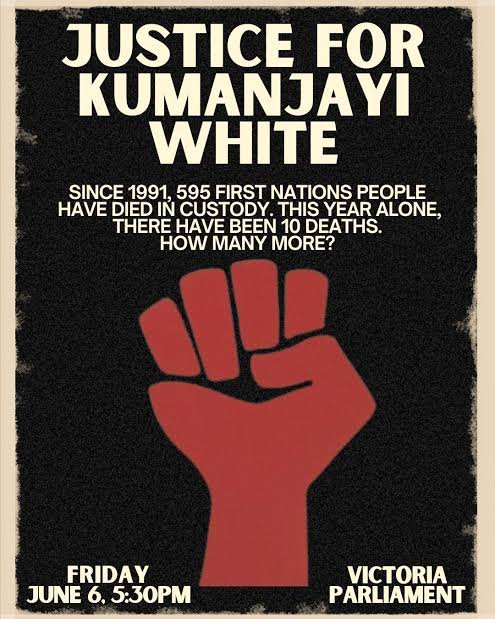
His death was the tenth death of a First Nations person in custody in Australia in 2025 up to that point – the tenth marker on a tally that, since the Royal Commission into Aboriginal Deaths in Custody handed down its 339 recommendations in 1991, has now exceeded 634 people. The Australian Institute of Criminology has recorded that 2023–24 saw the highest number of Aboriginal and Torres Strait Islander deaths in custody since 2000–01. The tally is not a statistic. It is a procession of funerals, of grandsons and grandmothers and sons who will never come home.
III. THE INVESTIGATION THAT WASN’T INDEPENDENT
From the beginning, the investigation into Kumanjayi White’s death was marked by a refusal of independence that became its defining characteristic. Commissioner Dole initially declined to bring in any external body, claiming – improbably – that no organisation in Australia was capable of conducting such an investigation, and suggesting, without elaboration, that external scrutiny might compromise ‘further action being taken.’ This position was backed by Chief Minister and Police Minister Lia Finocchiaro, who described an internal NT Police investigation as ‘entirely appropriate.’
Family lawyers described the refusal as ‘just nonsense,’ pointing out that independent oversight of police-involved deaths is standard practice in most Australian jurisdictions. The Northern Land Council, the Central Land Council, and the federal Minister for Indigenous Australians, Malarndirri McCarthy, all called for independent investigation. All were refused. When Commissioner Dole eventually relented – in a partial concession that was never clearly explained – he declined to specify which independent body had been engaged or what its terms of reference were.
The CCTV footage from inside the Coles supermarket has never been released publicly. Despite calls from the family, from Aboriginal advocacy organisations, and from commentators across the political spectrum, the footage remains withheld. In a matter where the central question is what happened during a physical restraint that ended in death, the visual evidence – captured by a major supermarket’s extensive surveillance infrastructure – has been kept from the people most directly affected.
CCTV video of the incident has never been released publicly, despite calls from the family. The instruments of accountability remain in the hands of those whose conduct is being scrutinised.
Commissioner Dole provided an initial brief of evidence to the Director of Public Prosecutions in September 2025. The DPP then requested an independent use-of-force expert report, which was not returned until April 2026. Legal advice followed at the end of that month. By the time the announcement was made – on 26 May 2026, one day before the anniversary – nearly a full year had elapsed. The two officers remain employed by NT Police and continue to draw salaries from the state while Kumanjayi White’s family waited a full year for an outcome.
IV. THE LOGIC OF NO REASONABLE PROSPECTS
Acting DPP Patrick Williams stated that the matter would not proceed to prosecution because ‘the legal threshold required has not been met’ and that there were no ‘reasonable prospects of a successful prosecution.’ He added that the decision was made ‘independently of government, based only on the evidence and the law,’ and declined to elaborate further on specific evidence.
This decision followed review of an independent use-of-force expert report commissioned by the DPP itself.
This is the point at which the language of legal process and the experience of those most affected diverge most sharply. For a legal system to function as a source of legitimacy – to generate outcomes that communities can accept even when those outcomes are not what they sought – it must be seen to operate with transparency and genuine independence. When the investigation is conducted internally, when the evidence is not made public, when the official cause of death has still not been disclosed, and when the family learns the outcome from a state plane arriving unannounced in their remote community, the legal threshold question becomes almost secondary. What has already been extinguished is the possibility of trust.
This is not a new problem. In 2019, 19-year-old Kumanjayi Walker was shot dead by NT Police Constable Zachary Rolfe in Yuendumu – the same Warlpiri community connected to Kumanjayi White. Rolfe was charged with murder and acquitted in 2022. The coronial inquest into Walker’s death was still proceeding as White died. The community of Yuendumu has now been asked to absorb two police-related deaths within six years, and to accept two outcomes – acquittal and no charges – as the full measure of justice that the state is prepared to deliver.
These are the same people now tasked with investigating Kumanjayi White’s death. That’s unacceptable.
These words, from the Foundation for Young Australians’ Roxanne Moore, capture the structural impossibility of the situation. A system investigating itself – even with the procedural scaffolding of DPP review and use-of-force experts – cannot produce outcomes that carry moral weight for those who have learned, through repeated experience, that the system’s internal logic consistently produces impunity.
V. THE NORTHERN TERRITORY AS LABORATORY
The NT Greens have described Kumanjayi White’s death as occurring in a context of ‘unprecedented expansion of policing and imprisonment of First Nations communities,’ driven by punitive policies under successive Labor and Country Liberal Party governments. The numbers substantiate the claim. Aboriginal adults constitute 84 per cent of the incarcerated adult population in the Northern Territory, despite representing only 25.9 per cent of the adult population. One hundred per cent of young people imprisoned in the NT are Aboriginal. Since December 2024, an average of 40 Aboriginal people are taken into custody every single day – nearly double the daily rate of 23 recorded in January 2020.
Chief Minister Lia Finocchiaro’s government has, in recent months, revoked the legal requirement that judges treat imprisonment as a measure of last resort – a requirement that was itself one of the 339 recommendations of the 1991 Royal Commission. The dismantling of that recommendation is not incidental to the broader pattern; it is the pattern. The Royal Commission’s recommendations exist in a state of permanent deferral, each one a promise the state has found reasons to not quite keep.
Kumanjayi White was in Alice Springs accessing care and services. He was living with a disability under a guardianship order. He was, in the language of every policy framework the Australian state has endorsed across three decades, precisely the kind of vulnerable person whose interaction with state systems should be characterised by support, cultural safety, and the recognition of his humanity. Instead, he encountered security guards and plainclothes police in a supermarket and died on the floor.
Kumanjayi White’s death fell during Reconciliation Week. The decision not to charge the officers involved was conveyed to his family by a police plane that landed uninvited in Lajamanu the day before the anniversary of his death.
The Aboriginal and Torres Strait Islander Social Justice Commissioner, Katie Kiss, renewed her call for deaths in custody to be independently investigated, stating plainly: ‘Police should not be investigating other police.’ Her office has called for the establishment of First Nations community-controlled disability justice hubs to provide early intervention and crisis de-escalation – a recognition that the encounter between Kumanjayi White and state authority need not, and should not, have taken the form it did. A different kind of state, with different institutions and different priorities, might have meant Kumanjayi White is alive today.
VI. THE CORONIAL PROCESS AND WHAT IT CANNOT GIVE
Commissioner Dole confirmed that the matter will proceed to a coronial inquiry, with a directions hearing scheduled for June 2026. The coroner’s process will, at minimum, provide a public forum in which evidence can be examined, though the cause of death – a fundamental fact – has still not been publicly disclosed more than a year after the event. Dole declined again on the day of the announcement to provide that information, citing the coronial process as grounds for continued silence.
Coronial inquests serve important functions. They can establish factual records, make recommendations, and provide families with some account of what happened to their loved ones. But they cannot impose criminal liability. They cannot undo the decision that two officers, who restrained a disabled Warlpiri man until he stopped breathing, will face no charges. The coronial process is not a substitute for accountability; it is, at this point, the only form of scrutiny that remains available.
Leanne Liddle, the NT Police Executive Director of Cultural Reform, acknowledged that ‘trust between police and Aboriginal communities is fragile in many places, particularly after deaths in custody.’ This acknowledgement is accurate and insufficient in equal measure. Trust is not fragile in the abstract; it is fragile because specific, documented events have made it fragile. It is fragile because the family of Kumanjayi White was told, with insufficient notice and in a manner they experienced as disrespectful, that the state had decided their son’s death carried no criminal consequence. The language of cultural reform cannot absorb that experience without being changed by it.
VII. WHAT THE NUMBER MEANS\
Six hundred and thirty-four. That is the number of First Nations people who have died in custody since the Royal Commission reported in 1991, as of May 2026. The Australian Institute of Criminology reports that 24 Aboriginal and Torres Strait Islander peoples died in custody in 2023–24 alone – the highest figure since 2000–01. In 2026, as of the anniversary of Kumanjayi White’s death, 16 Indigenous people have died in custody.
These numbers exist within a legal and political framework that has, consistently and across governments of different colours, failed to implement the mechanisms that might reduce them. The Royal Commission made 339 recommendations. Governments have cited figures for implementation, but the deaths continue to rise. The NT has stripped from its statute books the very requirement – imprisonment as a last resort – that the Commission identified as foundational.
Kumanjayi White is not an abstraction. He was a 24-year-old Warlpiri man who came to Alice Springs for care. He was someone’s Jaja. He had a name. He had a community that mourned him during Reconciliation Week – that most institutionally optimistic of Australian calendrical moments – while the state apparatus around his death ground slowly toward an outcome his family now describes with the words: ‘We have got no hope.’
That sentence – four words – is the truest account of what the decision of 26 May 2026 means for the people closest to it. It does not mean they have lost hope in the sense of abandoning their grief or their love. It means they have received, once again, the message that Australian institutions reliably deliver to First Nations families in these circumstances: that the life of a young Warlpiri man with a disability, restrained on a supermarket floor until he stopped breathing, does not, in the judgement of the law, generate ‘reasonable prospects of a successful prosecution.’
VIII. WHAT MUST COME AFTER
The coronial inquest into Kumanjayi White’s death will eventually deliver its findings. Perhaps it will recommend systemic changes. Perhaps it will call for greater accountability, for mandatory crisis de-escalation training, for the creation of community-controlled disability services in central Australia. These would be worth having.
But the deeper question – one that coronial recommendations cannot resolve – is whether Australian institutions are capable of self-transformation on a matter where the pattern of failure is so long, so documented, and so resistant to the remedies that commissions and inquests have already prescribed. The 1991 Royal Commission was not ignorant. Its commissioners were not naive. They made 339 recommendations because they understood the architecture of the problem. What has been lacking, across more than three decades, is not knowledge but political will.
The two officers who restrained Kumanjayi White remain employed members of the Northern Territory Police. The CCTV footage of the incident remains withheld. The official cause of death remains undisclosed. The family received their news from a police plane that landed, uninvited, in Lajamanu. And the anniversary of Kumanjayi White’s death passed with the addition of his name to a tally that should never have grown this long.
‘We are sick of being treated unequally.’ – Family of Kumanjayi White
The Australian Human Rights Commission has called for independent investigation of deaths in custody as a structural requirement – not a case-by-case concession. It has called for real-time public reporting of deaths and serious incidents, disaggregated by Indigeneity and disability. It has called for Northern Territory policing practice to align with Closing the Gap Priority Reforms. These are achievable things. They require political will, institutional courage, and a willingness to subordinate the self-protective instincts of state agencies to the legitimate claims of communities that have, for too long, been asked to grieve in silence.
Kumanjayi White came to Alice Springs for care. The state gave him restraint. It has since given his family an announcement, timed to wound, and a plane that arrived without permission. It owes them – and the 634 others, and the communities that mourn them – something better than the weight of no charges.
© Bakchos, May 2026


The essay is a compelling, passionately written piece of advocacy journalism/opinion writing that effectively humanizes Kumanjayi White and frames his case within Australia’s long-running crisis of Indigenous deaths in custody. It is structurally tight, rhetorically powerful, and factually accurate on the core events, timeline, family statements, investigation process, and broader statistics. However, as an analysis, it is limited by its openly partisan lens: it prioritises moral outrage and systemic indictment over engagement with the legal realities, evidentiary gaps, and complex root causes that make outcomes like “no charges” both predictable and defensible under rule-of-law standards. It reads more like a strong activist brief than a balanced critique.
Is there balance in the legal system, Kelly? Is exposing the fallacy of equality unreasonable? “One hundred per cent of young people imprisoned in the NT are Aboriginal.” That is a damming statistic. Combined with the harsher direction to jail offenders, it’s clear that the Northern Territory had no interest in delivering equitable outcomes for Indigenous people.
.
On a broader, national level, accountability by police, seniority and & custodial staff for deaths in custody is appalling. Mr Ward in WA, Kumanjayi Walker and Kamanjayi White in the NT, Doomadgee in Queensland, Tanya Day and Veronica Nelson in Vic … the list goes on. Blak and Black has its origins in Indigenous rights. A balanced critique isn’t going to help when the authorities are so opaque and unaccountable. Pointing out the glaring imbalances and expecting a cogent and verifiable explanation is.
Good morning Watershedd,
The deeper tragedy is not just individual deaths or “no charges,” but the failure — across governments, commissions, and communities — to close the gap on the underlying drivers of over-representation. The essay shines a necessary light on one family’s grief; a fuller analysis would also illuminate why the system keeps producing these heartbreaking, legally constrained results.
Hi Kelly, this was clearly written as an advocacy piece by Bakchos. Yes there are other things that might be discussed, but those are for the police to address. Indigenous people have few people speaking up for them, those that do, are entitled to express their feelings openly and forcefully.
Fuck the oink cunts!
Hyppolite, mate, straight to the point as usual. You forgot to include your oink song 😉
Sorry cuz, my bad
An oink, oink here,
An oink, oink there,
Here an oink, there an oink,
Everywhere an oink,
But never an oink in the direction of allegations of oink wrong doing?
Oink oink have a nice day everyone!
This is excellent advocacy that will resonate with readers already concerned about Indigenous justice and police accountability. It rightly demands better transparency, cultural safety, and sensitivity in remote notification.
First Nations people in Australia are still treated as non people by the police.