
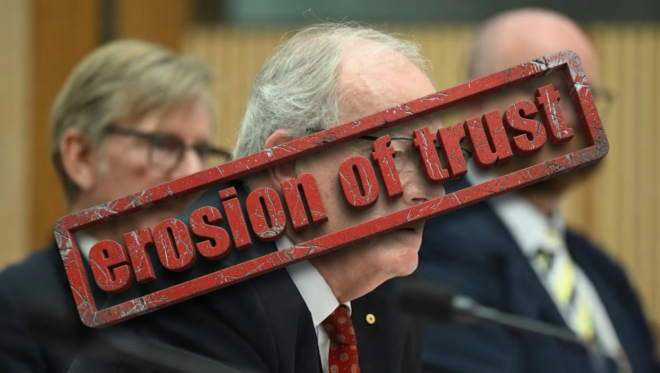
Something has shifted in Australian politics, and it is not subtle. Months after Labor won a comfortable second term in May 2025, multiple polling firms have placed Pauline Hanson’s One Nation at or near the top of primary support, reaching 28 to 31 per cent in some national samples (Roy Morgan, June 2026; YouGov/Sky News, May 2026; Redbridge, June 2026). A party once dismissed as a regional protest movement is, for the first time in its history, polling ahead of both major parties. Hanson herself has registered competitively as preferred prime minister among specific demographics. Whatever your view of One Nation, these numbers demand explanation rather than contempt.
The explanation is not mysterious. It is built from two decades of accumulated failures, broken promises, and a political class that has perfected the art of accountability-avoidance. The Robodebt scandal is the starkest example. The National Anti-Corruption Commission’s subsequent handling of that scandal is an illustration of the problem compounding itself. Together, they illuminate why a growing number of Australians have concluded that the two-party system no longer works for them.
The Long Retreat of the Majors
Australian democracy has always relied on a quiet compact: voters would accept the constraints of compulsory preferential voting in exchange for governments that, broadly, delivered. For most of the post-war era, that compact held. Labor and the Coalition routinely captured 80 to 90 per cent of first-preference votes between them. By the 2025 election, that combined share had fallen to somewhere between 65 and 70 per cent – and for the first time in modern Australian political history, minor parties and independents collectively outpolled the Coalition primary vote.
The 2025 Australian Election Study (AES) recorded its highest-ever proportion of voters – roughly 25 per cent – feeling close to no political party at all. Trust data tells the same story: only about one-third of Australians trusted the federal government to do the right thing even some of the time (AES 2025). Satisfaction with democracy itself has declined from earlier peaks. None of this is uniquely Australian; comparable trends are visible across most Western liberal democracies. But the Australian version has its own particular drivers, and they are worth naming plainly.
Economic reform agendas from the 1980s and 1990s delivered aggregate growth alongside real dislocation for working-class and regional communities. High net overseas migration, sustained by both Labor and Coalition governments, intensified housing affordability pressures in major cities without commensurate investment in infrastructure or social housing. Post-pandemic cost-of-living pressures, energy price volatility, and the fractious politics of net-zero transition sharpened the sense that government was managing the economy for some Australians more attentively than others. Cultural and identity debates – around multiculturalism, Indigenous policy, gender – have polarised public conversation, with a significant constituency feeling their concerns are dismissed by both sides of politics as reactionary or embarrassing.
This is the soil in which One Nation grows. The Greens have consolidated inner-urban progressive voters. Teal independents have peeled away moderate Liberals on climate and integrity grounds. On the right, Clive Palmer’s successive vehicles have come and gone. Hanson has stayed. Her 1996 breakthrough in Oxley, the 1998 Queensland surge, the 2016 Senate return, and ongoing state-level presence spanning three decades constitute a political durability that demands to be taken seriously rather than explained away.
The Anatomy of Hanson’s Appeal
Hanson’s constituency is identifiable and consistent: older Australians, regional and outer-metropolitan communities, voters without university qualifications. Many formerly supported the Coalition; others have drifted from Labor. What they share is not a coherent policy programme – One Nation’s economics have always been vague – but a set of grievances: that immigration has been too high for too long; that cultural change has been imposed rather than chosen; that the people who make decisions live in a different Australia from the people who bear the consequences.
Hanson positions herself as outside the system. This is, in important respects, fiction – she has served in the Senate for years and her party receives the same public funding as any other. But the persona works because there is a genuine gap between it and the reality of major-party behaviour. When a prime minister can preside over a scheme that illegally terrorises welfare recipients and then argue, successfully, that he bore no personal responsibility, the outsider narrative does not need much embellishment. The system has done the work for her.
Critics are not wrong to point to One Nation’s baggage: the party infighting, the past controversies, the policy vagueness on complex economic questions. The structural barriers to One Nation winning lower-house seats federally are worth understanding, because they explain a persistent gap between primary vote and governing capacity. Australia’s preferential system means that second and third preferences from Greens, teal and other minor-party voters flow overwhelmingly to Labor or the Coalition – effectively containing One Nation’s lower-house footprint regardless of its primary total. The party’s candidate base is thin outside Senate contests; it lacks the local organisational networks, candidate quality, and incumbency advantages needed to win and hold individual seats. The 2025 election demonstrated this precisely: Labor won comfortably on two-party preferred even as primary fragmentation hit record levels. In a voluntary first-past-the-post system, One Nation’s primary vote might translate into dozens of seats. Under Australian preferential voting, it translates into Senate crossbench leverage and policy influence over the majors – real, but constitutionally limited. But electoral outcomes and political momentum are different things. A party polling at 28 to 31 per cent shapes what the major parties can say, forces them to respond on migration and related issues, and permanently narrows their room to manoeuvre on anything that can be framed as elite consensus.
Robodebt: What Impunity Looks Like
No episode in recent Australian political history better illustrates the systemic failure driving dealignment than Robodebt. The scheme was launched in 2015 under the Abbott-Turnbull Coalition governments and continued into the Morrison era. Its logic was simple and its execution catastrophic: automated data-matching between Centrelink and ATO records would identify alleged welfare overpayments, with recovery proceeding automatically. The crucial methodological flaw – treating annual income as evenly distributed across fortnights – was identified internally as legally problematic and statistically unreliable. The warnings were overridden.
Hundreds of thousands of debts were raised, many of them inaccurate or unlawful. Recipients – predominantly people on low incomes, in many cases already under significant stress – faced garnisheed tax refunds, clawed-back Centrelink payments, and aggressive debt collection. The scheme was linked to documented suicides. It was eventually abandoned in 2020, with a class-action settlement and widespread debt waivers amounting to billions of dollars. The government had, in the pursuit of budget savings, implemented an illegal system, continued it after internal legal advice flagged the risks, and recovered money it was not entitled to from people who could least afford to lose it.
The 2023 Royal Commission, chaired by Catherine Holmes SC, delivered one of the most damning findings in the history of Australian public administration. The scheme was unlawful. It was implemented despite clear internal warnings. A culture existed within relevant departments – and extended to ministers – that prioritised fiscal targets over legal compliance and basic fairness. Cabinet had been misled about the scheme’s legal basis. Oversight mechanisms had failed. Holmes described the harm to public confidence as potentially irreversible.
Scott Morrison, as Minister for Social Services when key elements were developed and as Prime Minister through the scheme’s continuation, attracted particular scrutiny. He has consistently rejected the adverse findings, describing the Commission’s process as politically motivated and arguing that he relied on departmental advice in good faith. This defence – that senior ministers bear no personal responsibility for what their departments do in pursuit of their stated political objectives – deserves to be examined rather than simply accepted or rejected. It raises a profound question about the nature of ministerial accountability in modern government: if a minister sets the political objective, and a department implements it illegally, and the minister claims not to have known about the illegal method, who is responsible? The Royal Commission answered that question one way. The NACC, ultimately, answered it another.
The NACC and the Limits Of Accountability
The National Anti-Corruption Commission was established by the Albanese government in 2023, partly in direct response to the integrity failures Robodebt had exposed. Its establishment was presented as a break with the past – an independent body with real powers, free from the political pressures that had allowed misconduct to go unexamined. The Royal Commission referred six individuals to the NACC for assessment: five former senior public servants and Scott Morrison himself.
What followed was a damaging sequence. The NACC initially decided, in mid-2024, not to investigate the referrals, citing limited public value in doing so. The backlash was significant and warranted. An investigation by the NACC Inspector subsequently found that Commissioner Paul Brereton’s initial decision had been affected by apprehended bias – he had a declared association with one of the referred individuals. The decision was reconsidered by an independent delegate, and a full investigation proceeded.
The Operation Myrtleford report, published in March 2026, found that two public servants – Mark Withnell and Serena Wilson – had engaged in serious corrupt conduct: intentionally misleading others in the preparation of Cabinet material and in responses to the Ombudsman. The remaining four individuals, including Morrison, were cleared of corrupt conduct. The NACC concluded that Morrison’s failure to detect the misleading departmental advice did not constitute corrupt conduct; responsibility was attributed to systemic departmental shortcomings rather than to personal dishonesty or bad faith.
Morrison welcomed the findings. His supporters argued they demolished the Royal Commission’s adverse conclusions. Critics – including victims’ advocates and parliamentarians – argued that the outcome confirmed their worst fears: that serious systemic misconduct at the political level produces accountability only for mid-ranking officials, while senior figures escape through the gap between “policy failure” and “corrupt conduct.” Both reactions contain truth. The NACC was applying its statutory mandate, not a moral one. Corrupt conduct, as legally defined, requires elements – dishonesty, misuse of position – that are difficult to establish against ministers who can credibly claim reliance on advice. That is a structural problem with the accountability architecture, not necessarily evidence of institutional bad faith. But for the many Australians watching, the distinction is hard to make and harder to care about. The net result is that no senior political figure has been held personally accountable for a scheme that drove vulnerable people to suicide.
Intersecting Grievances
Robodebt does not stand alone. It functions as a crystallising episode within a broader pattern of perceived elite impunity. The scheme was Coalition policy; Labor established the Royal Commission and the NACC but has faced criticism for the new body’s early stumbles and for what victims’ advocates describe as insufficient redress. For voters already sceptical of both parties, this symmetry is confirmation: neither side delivers justice when the cost is borne by the other side’s political allies.
This perception intersects with immediate material grievances. High net overseas migration amid a housing crisis that has made home ownership inaccessible for a generation of younger Australians. Stagnating real wages and a cost-of-living crunch that has eaten into household budgets regardless of employment status. Energy policy debates that have produced neither affordability nor certainty. Cultural arguments in which a significant portion of the electorate feels characterised as prejudiced for holding views on migration or social change that were mainstream a decade ago.
Hanson and One Nation articulate these frustrations in a register that the major parties have largely abandoned: plain, adversarial, unhedged. Whether or not her policy prescriptions would work – and there is ample reason for scepticism – her diagnosis of a political class that protects itself while ordinary people absorb the consequences resonates because it maps onto lived experience. Robodebt is not an abstraction to the people who received debt notices for money they did not owe. The NACC’s outcome is not a legal technicality to people who watched the process unfold and saw senior figures walk free.
The data confirm the connection. Voters who feel the system is unresponsive are more likely to support protest options. One Nation’s recent polling gains have drawn from both Coalition and – to a lesser extent – Labor bases, which is the classic signature of partisan dealignment rather than ideological realignment. The preferential system will continue to contain these votes at the final count; Labor’s 2025 victory demonstrated that. But sustained primary fragmentation signals structural instability that electoral outcomes alone cannot paper over.
What Comes Next
The counterarguments deserve acknowledgment. Australia has not yet experienced the degree of democratic breakdown visible elsewhere – the January 6 moment, the mainstreaming of authoritarian parties into coalition governments. Compulsory voting encourages broad participation and limits the advantage that mobilising an angry minority can provide in voluntary systems. One Nation itself carries significant baggage: limited governing experience, a track record of internal dysfunction, and a policy offer that does not survive serious scrutiny on economic questions. And the Robodebt accountability process, however imperfect, did eventually produce findings – a Royal Commission, a public report, a corruption finding against two officials – that would not have occurred in a system with no accountability mechanisms at all.
These are not trivial points. But they are also insufficient responses to a genuine crisis of confidence. The question is not whether Australia has worse problems than some other democracies. It is whether the major parties can rebuild the trust that has been eroding for decades – trust that Robodebt specifically damaged, and that the NACC process did not repair.
The answer to that question will not come from integrity reform alone, though integrity reform is necessary. It will not come from addressing migration alone, or housing alone, or cost of living alone. It requires a coherent account of why government failure occurs, who bears responsibility for it, and what has changed to ensure it does not recur. That account has not yet been offered, by either side. In its absence, the Pauline Hanson question – why are so many Australians willing to give their first preference to a party that has never governed federally – will remain unanswered in the way that actually matters: not analytically, but politically.
Trust, once eroded, demands specifics to rebuild it. What would those specifics look like? A minister whose department implements an illegal scheme resigning before being referred to a Royal Commission, rather than after. An integrity body that investigates referrals without requiring a bias finding to force it into action. A government that proactively compensates scheme victims rather than waiting for class-action litigation. A public service culture where departmental secretaries who override legal advice face professional consequences, not retirement packages. None of these things happened in the Robodebt sequence. Until something like them does happen – visibly, and at a level of seniority that matches the scale of the harm – the argument that the system self-corrects will remain unpersuasive to the people it most needs to persuade. Pauline Hanson did not create that credibility gap. She simply moved into it. And she will stay there until the major parties give voters a concrete reason to believe otherwise.
– – –
Bakchos is the founder of Blak and Black, an Australian media and advocacy platform established in 2010. Bakchos writes from the intersecting perspectives of Wiradjuri heritage, Jewish identity, and humanism.
© Bakchos, June 2026



The ALP and the Coalition only have themselves to blame for the trust gap.
The rise of Pauline Hanson was built from two decades of accumulated failures, broken promises, and a political class that has perfected the art of accountability-avoidance.
Aussies have finally seen through the political duopoly, and it stands exposed for what it is, and has been rejected by the public.
James Ashby – Pauline Hanson’s chief-of-staff Is the real mastermind behind the rise and rise of Pauline Hanson.
Pauline Hanson is racist, she has built a career on racism. If she became Prime Minister she would destroy the country.
The slow rot of Australian democracy started with Paul Keating, sped up with John Howard, and has finally rotted through with Anthony Albanese.