
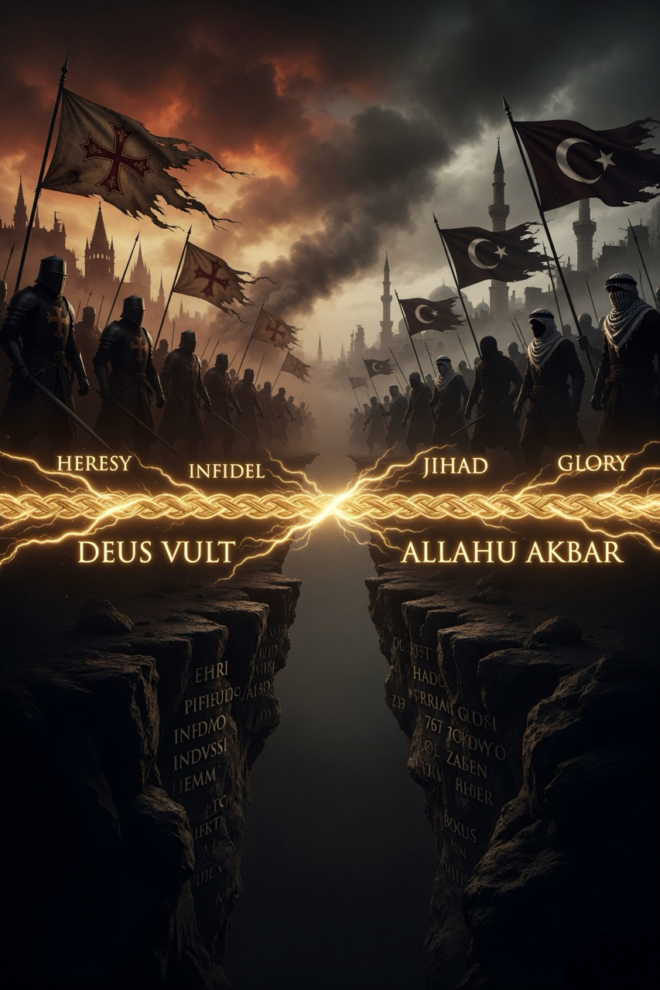
I. Bloch’s Warning
Marc Bloch did not live to see the millennium he half-anticipated. He was captured by the Gestapo in March 1944, tortured, and shot in a field outside Lyon, one more body in the ditch of a continent that had decided, again, that certain people did not get to live. He left behind, unfinished, a manuscript called The Historian’s Craft – a meditation on what it means to study the past honestly, written by a man who understood better than most historians ever will what happens when the past stops being past. His observation that once an emotional chord has been struck, chronology loses its grip on a culture’s imagination was not an abstraction for him. It was diagnosis. He died inside a chord that medieval hatreds had struck and that modern technology had merely amplified.
Bloch’s insight is the only honest place to begin an essay on the Crusades, because the Crusades are not, in any meaningful sense, over. They ended militarily with the fall of Acre in 1291, when the last Crusader stronghold on the Levantine coast fell to the Mamluks and the great fall of Acre in 1291armed pilgrimages of Western Christendom petered into memory. But as cultural grammar – as a reservoir of language, symbol, and emotional structure that communities reach for when they want to explain themselves to themselves – the Crusades have never stopped. They surface wherever a civilisation wants to narrate a conflict as cosmic rather than political, wherever violence needs the alibi of sanctity. We are approaching the nine-hundred-and-thirtieth anniversary of Urban II’s sermon at Clermont, and the chord he struck in November 1095 is still audible, still being plucked by presidents, preachers, and the men who fly planes into buildings.
II. Before Clermont: A War That Did Not Begin There
It is tempting, and convenient, to treat Urban II’s sermon as an act of pure invention – a Western pope conjuring holy war out of theological ambition and territorial appetite. That account is incomplete, and an essay arguing that crusading language survives by stripping conflicts of their actual causes should not itself commit that error. Clermont had a proximate, specific, political occasion, and it deserves to be named honestly before anything is said about the symbolism it generated.
By 1095, the Byzantine Empire had spent two decades absorbing catastrophic territorial loss. The Battle of Manzikert in 1071 had shattered Byzantine military power in Anatolia and opened the imperial heartland to Seljuk Turkish advance; within a generation the empire had lost most of Asia Minor, the recruiting ground that had supplied its armies for centuries. This was itself the latest chapter in a much longer process. Beginning in the seventh century, the armies of the early Islamic conquests had taken Byzantine Syria, Palestine, and Egypt, and had pushed across North Africa and into Iberia, ending nearly a thousand years of Roman and then Byzantine rule over the entire eastern and southern Mediterranean littoral. By the eleventh century, the lands in which Christianity had been born and had first flourished – Jerusalem, Antioch, Alexandria – had been under Muslim political rule for three centuries or more, the product of genuine military conquest, not myth. None of this is offered to relitigate the morality of seventh-century conquest, which was unremarkable by the standards of the age in which every neighbouring empire, Christian and Zoroastrian alike, expanded by the sword whenever it could. It is offered because the Byzantine emperor Alexios I Komnenos, watching the Seljuk frontier creep toward Constantinople itself, sent genuine, urgent appeals westward for mercenary assistance – appeals that historians broadly agree reached Urban II and informed, however selectively he chose to use them, the sermon at Clermont.
Urban did not respond to Alexios’s request for hired soldiers with hired soldiers. He responded with an army of penitents, and in doing so transformed a Byzantine request for military aid into something the Byzantines themselves had neither asked for nor, in the end, entirely wanted: a vast, semi-autonomous, ideologically charged expedition that marched east burning as much goodwill with the Greek Christians it was nominally rescuing as it did hostility toward the Turks it was meant to fight.
Urban’s transformation of the request was not accidental, and it did not arise from the Byzantine appeal alone. He came to Clermont already carrying a project of his own: a papacy engaged in the long contest with the German emperors known as the Investiture Controversy, anxious to assert the moral primacy of Rome over a fractious Western nobility, and drawn to the possibility of healing the Great Schism with Constantinople under Roman rather than Byzantine leadership. A war that could discipline Europe’s restless knights, demonstrate papal authority over kings, and place Rome at the head of a reunified Christendom was, for Urban, attractive on its own institutional terms, independent of whatever the Byzantines specifically needed. Alexios supplied the occasion; Urban supplied the architecture, and the architecture served ends that were his before they were Constantinople’s. This is the first and perhaps most important distinction this essay needs to hold onto throughout: there is a difference between the real, contestable, often violent grievances that make a martial appeal plausible in the first place, and the rhetorical machinery a leader builds on top of those grievances once he has decided to mobilise a society around them – machinery that is frequently shaped at least as much by the leader’s own prior ambitions as by the grievance itself. Manzikert was real. The loss of Antioch and Jerusalem to Muslim conquest centuries earlier was real. Alexios’s appeal was real. None of that required Urban II to promise plenary remission of sin to anyone who took up the cross, to fuse warfare with pilgrimage, or to authorise the massacres of Rhineland Jewish communities and Levantine Muslims and Eastern Christians that followed in the Crusaders’ wake. The provocation and the frame built upon it are not the same thing, and collapsing them – in either direction – is exactly the kind of error this essay is trying to diagnose in others.
III. Clermont and the Architecture of Holy War
What Urban II did at Clermont was, then, neither pure invention nor simple response. It was rhetorical engineering performed on genuine raw material. He took the existing Christian concept of just war – defensive, regrettable, a necessary evil, with deep roots in Augustine’s writing on the conditions under which Christians might licitly fight – and fused it with the concept of pilgrimage, an act of devotion that earned spiritual merit. The result was something genuinely new: a war that was not merely permitted but meritorious, an act of violence that functioned as a sacrament. Die in this war and you went straight to heaven. The crusading indulgence was, in essence, a plenary pardon purchased with someone else’s blood as much as your own.
This fusion mattered because it solved a problem that every society organised around the discipline of armed men eventually faces: how do you direct martial energy outward, toward a sanctioned enemy, rather than inward, where it tears the society apart? Europe in the late eleventh century was a continent of restless, landless younger sons and feuding petty lords. Urban gave them Jerusalem, a destination with centuries of devotional weight already attached to it, and an enemy increasingly defined not by the specific politics of Seljuk expansion but by category – the infidel, the unbeliever, the one whose very existence was framed as an offence against God. Once an enemy is defined theologically rather than politically, the normal mechanisms that end wars – negotiation, compromise, exhaustion, treaty – become harder to invoke, because what is being fought is no longer only a grievance but an absolute.
This is the architecture that has outlived its original cathedral, and outlived the Byzantine emergency that gave it its first occasion. Strip away the indulgences and the relics and the specific geography of the Levant, and what remains is a template: an enemy defined by category rather than conduct, a war framed as defence of the sacred, and a promise that death in the cause is not loss but transcendence. That template has been picked up and put down by parties on more than one side of more than one conflict ever since, which is precisely Bloch’s point – the chord, once struck, does not require the original instrument, or the original grievance, to keep ringing.
IV. Bush, Graham, and the Slip of the Tongue That Wasn’t
When George W. Bush stood on the South Lawn on 16 September 2001, five days after the towers fell, and told reporters that “this crusade, this war on terror, is going to take a while,” his advisers reportedly winced. Within days the word was scrubbed from the official lexicon, replaced by the more anodyne “war on terror.” Administration officials insisted it had been an unscripted slip, a colloquialism, nothing more. But the speed and intensity of the diplomatic damage control – urgent calls to Muslim allies, statements of clarification – testified to something the administration understood even as it tried to walk the word back: language carries freight that intention cannot fully unload. Bush did not mean to declare a religious war. But the word he reached for, under pressure, in an unscripted moment, was not arbitrary. It was the word sitting closest to hand in the American Christian imagination for righteous, total, divinely sanctioned conflict against a religiously coded enemy. That it surfaced involuntarily is, if anything, more revealing than if it had been deliberate. Bloch would have recognised it instantly: the chord struck itself.
Franklin Graham’s contribution removed any ambiguity that remained. Where Bush stumbled into the word, Graham walked into the theology open-eyed. To describe Islam as “a very evil and wicked religion” and to deny that its God was the God of Christians and Jews was not a diplomatic gaffe; it was a doctrinal claim, delivered by a man whose father had built a global ministry on the word “crusade” itself – the Billy Graham Crusades, the great stadium revivals that filled American sporting arenas with hymns and altar calls for half a century. The son inherited the brand and, in that moment, something closer to the medieval content as well: the conviction that the enemy’s god is not really God, that the war is therefore not between nations or ideologies but between truth and a wickedness wearing the mask of religion. This is structurally the same rhetorical move Urban II made at Clermont, where over the course of the campaign and its retellings the Muslim adversary, originally a specific political and military actor occupying specific contested territory, increasingly became a defiler of sacred space whose religion was treated as itself the crime.
The significance of Graham’s remarks lies not in their shock value, but in their reach within a particular and influential current of American evangelical Christianity. He was not summoned from the fringe; he prayed at presidential inaugurations and led an organisation with genuine national standing, and the language of spiritual warfare against Islam was, within the circles he led and spoke to, closer to Tuesday-night Bible study than to extremist rhetoric. This is not to claim he spoke for evangelicalism as a whole, or that his framing went unchallenged within it – other evangelical leaders at the time publicly distanced themselves from his characterisation of Islam, and the tradition is and was theologically various, not a monolith awaiting his cue. What can be said with more confidence is narrower and, for this essay’s purposes, sufficient: the crusading register was sufficiently available, sufficiently pre-built within at least one major and well-resourced strand of American Christianity, that a man of Graham’s prominence could reach for it without having to invent it, and without it costing him his platform. The crusading impulse in American political Christianity did not need 9/11 to exist, even if it remained, then as now, a contested current rather than a consensus. It needed 9/11 only to find an occasion – and it is worth being precise about what kind of occasion 9/11 was. Nearly three thousand civilians had been murdered in a deliberate, unprovoked attack on non-combatants. That fact is not rhetoric, and it placed real, urgent, legitimate grievance in American hands in exactly the way Manzikert and the long prior history of conquest had placed real grievance in Byzantine and Western Christian hands nine centuries earlier. The question this essay is interested in is not whether the grievance was real – it plainly was – but why the response to it was reached for, by some, in crusading register rather than in the register of conventional just war or criminal justice, and what that choice of register made possible that the alternative would not have.
V. Bin Laden and the Asymmetry Within the Symmetry
What makes this moment in modern history so instructive is not simply that an American president reached, however briefly, for crusading language, but that Osama bin Laden had been waiting for exactly that vocabulary, and had built years of ideological argument on the anticipation that the West would eventually supply it. That argument did not originate with the Gulf War or with American troops on Saudi soil, real and inflammatory as that grievance was to him; it drew on a longer Salafi-jihadist intellectual lineage running through Sayyid Qutb and the Egyptian Islamist movements of the 1950s and 1960s, which had already cast the modern Muslim world as living under a state of civilisational siege by an irreligious West well before any specific American policy gave that thesis a contemporary face. Bin Laden’s break with the Saudi monarchy, his prior project of repositioning himself as defender of the faith rather than mere veteran of the Afghan war against the Soviets, gave him independent reasons to want a totalising, theologically absolute enemy on offer before 1990 ever supplied him with troops to point at. For years before 2001, his communiqués described a “Jewish-Crusader alliance” assaulting the Islamic world. This framing predates Bush’s slip by a decade; it cannot be explained as a reaction to it. It was a deliberate act of historical reconstruction, designed to collapse nine centuries of distance between the Levantine campaigns of Godfrey of Bouillon and the foreign policy of the Clinton and Bush administrations, so that American troops stationed in Saudi Arabia after the Gulf War, and American support for Israel and for autocratic Arab regimes, could be narrated not as contestable contemporary policy but as a recurrence – the latest wave of an assault that began at Clermont and had never truly ceased. As with Urban, the grievance and the man’s prior investment in a particular theological architecture arrived together and reinforced one another; neither fully explains bin Laden’s rhetoric without the other.
Here the symmetry this essay has been tracing needs to be qualified rather than simply asserted, because the two invocations of crusading language were not doing equivalent work. Bush’s was a slip, immediately and energetically disowned by its own speaker; American state policy after 2001, whatever its other failures, was never officially organised around a theological war against Islam as such, and the administration’s own scramble to suppress the word testifies to that. Bin Laden’s was the opposite: a load-bearing, years-long, deliberately constructed ideological architecture, the central organising premise of a transnational movement that explicitly framed its violence – including violence against civilians – as righteous warfare in a centuries-old religious conflict. Graham’s theology and bin Laden’s theology are genuinely comparable as instances of crusading logic; the official American war effort and al-Qaeda’s stated war aims are not equivalent in the degree to which each was actually built on that logic rather than merely brushing against it. An honest essay on rhetorical symmetry has to hold both things at once: the structures invoked were strikingly similar, and the extent to which each side’s actual conduct was governed by those structures was not.
What was genuinely symmetrical was the use each side made of the other’s rhetoric. When bin Laden responded to the invasion of Afghanistan by invoking “Richard from Britain, Louis from France, Barbarossa from Germany,” naming Richard the Lionheart, Louis IX, and Frederick Barbarossa in the same breath as George W. Bush, he was doing to Bush’s slip exactly what he needed it to do: collapsing chronology, refusing to let nine hundred years separate the Third Crusade from a NATO bombing campaign, and presenting a single sentence from an American president as confirmation of a thesis he had been arguing for a decade. Bush’s slip became, in bin Laden’s telling, proof that the War on Terror was exactly the religious war al-Qaeda had always claimed it to be – a single unguarded word doing propaganda work in al-Qaeda’s hands that years of careful disclaimer from the State Department could not undo. Bin Laden’s invocation of the Crusades became, in turn, usable by those in the West who wished to characterise the entire conflict as a civilisational clash rather than a set of contestable, addressable political grievances about troops, sanctions, and support for autocratic regimes. Samuel Huntington’s “clash of civilisations” thesis, published in 1996, found in the rhetoric of 2001 an eerie, almost obliging confirmation – not because civilisations are in fact destined to clash, but because a small number of men on each side, for different reasons and to different degrees, had found it useful to perform the clash into being, and each performance handed the other fresh material.
VI. The Persistence Beneath the Performance
It would be a mistake to treat all of this as merely rhetorical theatre, language without consequence. The crusading frame does work in the world, regardless of how central the frame actually was to either side’s formal war aims. A conflict narrated as defence of civilisation against a category of evil enemy permits forms of conduct – indefinite detention, extrajudicial killing, mass surveillance, the suspension of the very legal protections the civilisation claims to be defending – that a conflict narrated as a response to specific, named grievances does not so easily permit. Guantánamo Bay’s legal architecture rested in part on the claim that detainees were not combatants in an ordinary state conflict with whom one might one day negotiate or sign a treaty, but something closer to an undifferentiated category of enemy for whom the normal apparatus of law was deemed not to apply. The theological architecture Urban II built at Clermont – enemy as category, not only as actor; war as potentially sacred, not only as policy – survived nine centuries because it remains useful to anyone who wishes to wage war without the inconvenience of an endpoint. A crusade, properly understood, has no peace treaty. It has only victory or apocalypse, and a society does not need to be formally fighting a crusade for that logic to seep into how it treats people it has decided not to recognise as ordinary adversaries.
On the other side of the ledger, al-Qaeda’s “Crusader-Zionist” framework served a more central, more explicitly load-bearing version of the same function: it converted a set of specific political grievances – American troops on Saudi soil, support for Israel, support for Arab autocracies – into a single undifferentiated civilisational assault, against which the only conceivable response was equally undifferentiated and equally eternal. The Islamic State would later make this explicit and total, structuring its entire eschatology, in its self-published magazine Dabiq, around an apocalyptic final battle at a town in northern Syria against “the Crusaders,” a place name chosen specifically because medieval prophetic tradition had marked it as the site of the last battle before the end of days. ISIS did not stumble into crusading language. It built a state, however briefly and brutally, on the explicit premise that the Crusades were still happening and that it was the eschatological terminus of a nine-hundred-year war – which is to say, of the three groups discussed in this essay, ISIS is the one whose self-understanding least resembles a frame layered opportunistically over real grievance and most resembles the thing Urban II actually built at Clermont: total, sacralised, without an exit.
VII. Why the Frame Endures
The persistence of crusading language is not simply a failure of historical literacy, though it is partly that – most of those invoking the Crusades on either side know the medieval history only as a set of usable symbols, stripped of the actual complexity of a phenomenon that included Christian-Muslim alliances of convenience, Crusader massacres of Eastern Christians, internal Crusader-state pragmatism toward Muslim neighbours, and centuries of coexistence in Outremer alongside the violence. The frame endures because it answers a need that has nothing to do with historical accuracy and everything to do with political utility, even when – as with Bush, and unlike with bin Laden or ISIS – the speaker reaching for it has no intention of building a theology around it.
Crusading language offers three things that ordinary political language cannot. First, it offers moral clarity in place of moral complexity: an enemy defined by category requires no negotiation with grievance, no examination of one’s own conduct, because the conflict is no longer only about anything either side did, but about what each side fundamentally is. Second, it offers permanence: a political grievance can in principle be resolved, but a category cannot be reconciled with, only defeated or endured until the end of time. Third – and this is perhaps the most psychologically potent – it offers meaning to death. A soldier who dies in a war against terrorism has died in a tragedy. A soldier who dies in a crusade, or its mirror image, a martyrdom operation framed as defence against Crusader aggression, has died in a drama with cosmic significance. Urban II understood this when he promised the remission of sins to anyone who fell at Jerusalem. Bin Laden understood it when he framed every al-Qaeda operative’s death as martyrdom in a war stretching back to Richard the Lionheart. Franklin Graham understood it, in his own register, when he described the conflict as one between the true God and a wicked counterfeit. None of these men needed to believe themselves to be reenacting the eleventh century. They needed only to reach for the most powerful available language to make a contemporary war feel cosmically necessary – some of them reaching for it as a passing instinct quickly regretted, others building their entire movement’s architecture upon it – and that language, in both the Christian and Islamic worlds, still runs through Clermont.
VIII. Conclusion: Living Inside Bloch’s Chord
Marc Bloch wrote that the limit between past and present, once an emotional chord is struck, is no longer regulated by mathematically measurable chronology. He wrote this as a historian’s caution, a warning about the seductions of anachronism. But he also wrote it, unmistakably, as a man who had watched the chord strike and kill – who understood that the past does not stay past when powerful people find it useful for it to return. The Crusades ended in 1291 by any calendar. They have not ended in the only chronology that ultimately matters for understanding how violence gets justified, which is the chronology of usable symbol and inherited grammar. The grievances that gave the frame its first occasion at Clermont were real, as the grievances of 11 September 2001 were real; the frame itself, with its promise of cosmic stakes and bloodless conscience, was something built on top of those grievances by men who in both cases brought their own prior ambitions to the building. George W. Bush reached for it without meaning to and could not take the word back. Franklin Graham reached for it deliberately and meant every word. Osama bin Laden had been waiting nearly a decade for the West to supply him with exactly that vocabulary, because he needed it as much as Urban II’s audience at Clermont needed Jerusalem – and Urban himself had needed Alexios’s appeal, and the long memory of conquered Christian cities, and his own contest with the German emperors and ambitions for Rome, before he could build anything at all. Neither man’s frame can be explained by grievance alone; neither can be explained away as cynicism that owed nothing to grievance. Both things were true at once, and that simultaneity is the essay’s whole subject.
What this should teach us, nine hundred and thirty years on from Clermont, is not that history repeats itself in some mystical sense, but something more precise and more disquieting: that certain rhetorical structures, once built, remain available for reuse indefinitely, waiting only for someone with sufficient power and sufficient need to reach for them again, regardless of whether the underlying grievance is genuine, manufactured, or some unstable mixture of both. The work of the historian, and perhaps especially the work of anyone writing in the tradition Bloch died defending, is to keep the two things distinct even while tracing how thoroughly they become entangled in practice – to insist that the crusade is never simply the past returning of its own accord, and never simply rhetoric without cause, but the present taking real grievance and choosing, again and again, to dress it in the past’s sacred clothes.
There is, finally, a reason this distinction matters beyond the academic satisfaction of tracing a lineage. Structures that go unnamed go unchallenged; rhetoric that is allowed to pass as common sense rather than identified as inherited theology retains its power precisely because it appears natural rather than constructed. When a president speaks of crusade, or a televangelist speaks of a false god, or a movement invokes Richard the Lionheart, each is relying on the audience not noticing the machinery – relying on the chord striking before the listener has time to ask what grievance is real, what has been built on top of it, and in whose interest that construction continues to be played. Bloch’s life’s work, cut short in that field outside Lyon, was an argument that the historian’s task is precisely to interrupt that automatic resonance: to hold up the instrument, name its maker, weigh what was genuine provocation against what was rhetorical opportunity, and ask the listener to choose, with full knowledge of where the sound comes from, whether they still wish to dance to it. Nine hundred and thirty years after Clermont, the choice remains exactly that available, and exactly that urgent.
– – –
Bakchos is the founder of Blak and Black, an Australian media and advocacy platform established in 2010. Bakchos writes from the intersecting perspectives of Wiradjuri heritage, Jewish identity, and humanism.
© Bakchos, June 2026




The crusades are still with us in spirit if not in actual warfare.
The crusades, the war that keeps on giving.
Marc Bloch was shot by the Gestapo in a field outside Lyon in 1944 — mid-sentence, almost, on a manuscript about how the past stops being past once an “emotional chord” is struck.
Nine hundred years after Clermont, that chord is still ringing. New essay on the Crusades, Bush, bin Laden, and the architecture of holy war.
Bush’s “crusade” slip in 2001 wasn’t a gaffe. It was the word sitting closest to hand in the American Christian imagination — and bin Laden had spent a decade waiting for the West to say it.
Good afternoon Kemple,
In 1095, Urban II took a genuine Byzantine plea for military help and built something no one had asked for: a war framed as sacrament, with an enemy defined by category rather than conduct.
Nine centuries later, that same architecture surfaced — almost involuntarily — in a presidential press conference five days after 9/11, and was waiting, fully built, in Osama bin Laden’s rhetoric a decade before anyone said the word “crusade” out loud.