
There is a particular kind of courage that history rarely knows how to honour. It is not the courage of the resistor, the prisoner, or the martyr – the courage that produces clean, luminous narratives of suffering redeemed. It is the courage of the man who holds power and chooses, deliberately, to give it away. Frederik Willem de Klerk was such a man, and his story remains one of the strangest in the twentieth century’s long catalogue of political transformation: a son of the system, raised in its inner sanctum, who became the instrument of its unmaking.
To understand de Klerk is to sit with an uncomfortable truth. He was not born a reformer. He was born an heir. His father, Jan de Klerk, was a cabinet minister and a president of the Senate – a man whose life was woven into the very architecture of Afrikaner nationalism. The young Frederik grew up breathing the air of apartheid orthodoxy, absorbing its theology of racial hierarchy as though it were simply the shape of the world. He studied law at Potchefstroom University, an institution steeped in Reformed Calvinist tradition, and by every visible measure of his early life, he was destined to become exactly what he became for the first three decades of his career: a capable, unremarkable custodian of white minority rule.
He entered Parliament in 1972 as a National Party representative, and for the better part of two decades, he rose through the ranks of a government dedicated to the systematic subjugation of the Black majority. He held the portfolios of mines and energy, internal affairs, and national education – positions from which he administered, rather than questioned, the apparatus of separation. Colleagues and biographers alike have noted that de Klerk was, for most of this period, regarded as a conservative even within the National Party, a man who did not distinguish himself as a liberal voice or a secret dissenter. This matters enormously for how we understand what came after. De Klerk’s transformation was not the slow-dawning conscience of a lifelong sceptic finally finding his voice. It was something rarer and more difficult to categorize: a pragmatist’s recognition, arrived at from deep within the machine, that the machine could no longer run.
The Accidental Successor
History turns, often, on illness and vacancy. When P.W. Botha suffered a stroke in January 1989, the National Party had to choose a new leader, and it chose de Klerk – not because he was the reformist wing’s candidate, but because he commanded the party’s largest and most powerful provincial base in the Transvaal. He was, in other words, an establishment choice, elevated by the very structures he would go on to unravel. When Botha attempted to cling to the presidency after his recovery, de Klerk outmanoeuvred him, and by September of that year, he stood as head of state.
It would have been entirely possible – indeed, it was what most observers expected – for de Klerk to govern as a more efficient version of his predecessors: a manager of decline, someone who might loosen a few restrictions while preserving the essential architecture of white supremacy. South Africa in 1989 was a nation under siege from itself. International sanctions had hollowed out its economy. Township uprisings had made ordinary governance a matter of curfews and armoured vehicles. The security establishment had grown into a shadow government, waging a dirty war against its own citizens. And yet the National Party’s traditional response to all of this had been more of the same: more repression, more denial, more insistence that reform was a betrayal rather than a rescue.
De Klerk chose otherwise. And the choice he made was not incremental. It was total.
February 2, 1990: The Day The Ground Moved
There are speeches that adjust the temperature of a room, and there are speeches that alter the trajectory of a nation. De Klerk’s address to Parliament on February 2, 1990, belongs to the second, rarer category. In the space of a single afternoon, he announced the unbanning of the African National Congress, the Pan-Africanist Congress, the South African Communist Party, and dozens of other organisations that the state had spent decades trying to erase from public life. He lifted restrictions on the press, imposed a moratorium on executions, and announced that Nelson Mandela – the most famous political prisoner on Earth, a man whose face South Africans had been forbidden even to look upon for twenty-seven years – would be released.
What makes this moment so difficult to fully reckon with is the sheer velocity of it. De Klerk did not test the waters with a single conciliatory gesture and wait to see how the country absorbed it. He did not release Mandela first and study the reaction before unbanning the ANC. He moved on every front simultaneously, as though he understood something that his predecessors had refused to understand: that apartheid could not be reformed in instalments. It could only be ended, all at once, or it would metastasise indefinitely, consuming the country that sustained it.
Nine days later, Mandela walked out of Victor Verster Prison, and the image of his raised fist became one of the defining photographs of the century. But it is worth pausing on the fact that Mandela’s walk to freedom was not a spontaneous eruption of justice. It was a negotiated act, made possible by a president who held every institutional lever of power and who chose to loosen his grip on them. This is the paradox that sits at the centre of de Klerk’s legacy: he was simultaneously the last defender of a dying order and the man who signed its death warrant.
The Architecture Of Undoing
What followed February 1990 was not a single triumphant gesture but years of grinding, dangerous, often thankless negotiation. De Klerk’s government spent 1990 and 1991 systematically dismantling the legal scaffolding of apartheid – repealing the Group Areas Act, which had dictated where people of different races could live; the Population Registration Act, which had classified every South African by race at birth; the Land Acts, which had confined Black ownership to a fraction of the country’s territory. These were not symbolic gestures. They were the load-bearing walls of the entire system and removing them meant that there could be no retreat, no return to the old order, regardless of how violently the process threatened to unravel.
And it did threaten to unravel, repeatedly. The early 1990s in South Africa were not a peaceful glide toward democracy but a period of ferocious, often orchestrated violence – clashes between the ANC and the Inkatha Freedom Party, killings whose origins remain disputed to this day, a right-wing Afrikaner backlash that included assassination attempts and bombing campaigns designed to derail the entire negotiation process. De Klerk faced a mutiny from within his own political tribe: the Conservative Party, which accused him of betraying everything Afrikanerdom had built, and elements of the security establishment whose loyalty to the old order ran deeper than their loyalty to their president. That de Klerk called a whites-only referendum in March 1992 – a stunning act of political risk – and won nearly 69 percent support for continuing reform tells us something important. It tells us that he was not simply imposing his will unilaterally from above; he was, in his own calculated way, building a mandate, forcing his own constituency to look directly at the choice before them and to choose, however reluctantly, a future without apartheid rather than a war to preserve it.
Two Men, Two Histories, One Table
It is impossible to write about de Klerk without writing about Mandela, and it is impossible to write about their partnership without acknowledging how asymmetrical, how fraught, and how genuinely strange it was. These were not natural allies. Mandela had spent twenty-seven years in prison at the hands of the party de Klerk led. De Klerk had spent those same twenty-seven years as a rising star within the system that imprisoned him. When they sat across the table from one another in the early 1990s, they were not two statesmen meeting as equals in the ordinary sense; they were a jailer’s political heir and his prisoner, attempting to build a nation neither of them could build alone.
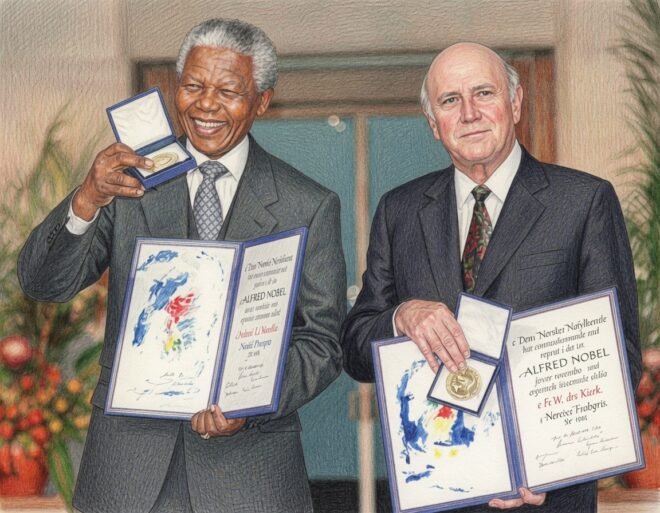
Their relationship, by every honest account, was one of mutual respect shot through with real friction and real distrust. Mandela publicly and repeatedly accused de Klerk’s government of failing to rein in the security forces’ role in fomenting township violence – accusations de Klerk contested, but which have never been fully resolved even by South Africa’s own Truth and Reconciliation Commission. At the ceremony where they jointly accepted the 1993 Nobel Peace Prize, Mandela’s own remarks were notably less effusive toward his co-laureate than the occasion might have suggested; there was no pretence between them that this was a friendship built on warmth. It was, instead, something more difficult and in some ways more instructive: a partnership of necessity between two men who recognised, independently and from radically different vantage points, that South Africa’s only path forward required them to negotiate with, rather than annihilate, one another.
This is perhaps the truest lesson embedded in de Klerk’s story – more instructive, in some ways, than the more familiar redemptive arc we associate with Mandela’s journey from prisoner to president. Reconciliation, as de Klerk and Mandela enacted it, was not a feeling. It was a discipline. It did not require the two men to like each other, to fully trust each other, or to agree on the moral reckoning of the past. It required them to keep returning to the table, year after volatile year, because the alternative – a South Africa fractured by civil war – was unthinkable to both of them, for their own distinct reasons.
The Weight Of An Unfinished Reckoning
Any honest essay about de Klerk must resist the temptation to flatten him into a simple hero of history, because de Klerk himself resisted that flattening throughout his life, sometimes in ways that undercut his own legacy. He never fully reckoned, in his lifetime, with the moral totality of apartheid’s crimes. He acknowledged, before the Truth and Reconciliation Commission, that apartheid was wrong and issued apologies for the pain it caused, but he drew careful, legalistic lines around his own personal culpability, and he resisted characterisations of apartheid as a crime against humanity in the fullest sense international law would later assign to it. Investigations into state-sponsored violence during his presidency – death squads, covert operations, the murky machinery of counterinsurgency – left unanswered questions that shadowed him for the rest of his life and that many South Africans, including senior figures in the ANC, never accepted he had adequately answered. The Truth and Reconciliation Commission’s own final report went further than a mere absence of resolution: it found that de Klerk had failed to make a full disclosure of what he and his cabinet knew about gross human rights violations committed by the security forces under his authority. De Klerk contested that finding so forcefully – through legal action – that a South African court ordered specific passages naming him struck from the report before publication, leaving the rest of the Commission’s findings intact but excising its direct conclusions about his own disclosure. That outcome itself became a lasting point of contention rather than closure.
It would be dishonest to write around this. De Klerk was not a man who arrived at moral clarity and then acted upon it in a straight line. He was a man who acted, decisively and at real political risk, in ways that produced moral progress far beyond what his own private reckoning with the past ever fully achieved. His public apologies were, by the account of many who worked alongside him, genuinely felt but also incomplete – arriving in fragments across decades, revised and expanded only shortly before his death in 2021, when he released a video, recorded in the last weeks of his life, offering what he called an apology “without qualification” for the pain apartheid had caused. That such a full acknowledgment came only at the very end, rather than at the outset, is itself a kind of testimony to how difficult it remains, even for the men who dismantle unjust systems, to fully inhabit the moral weight of what those systems did.
What Made The Turn Possible
If we ask what made de Klerk’s transformation possible – what allowed a lifelong insider of a brutal system to become its liquidator – the honest answer resists sentimentality. It was not, primarily, a conversion of conscience in the way that word is usually meant. It was a convergence of pragmatism, isolation, and a genuinely rare form of political nerve. De Klerk understood, with a clarity that eluded many of his predecessors, that apartheid had become economically catastrophic, internationally isolating, and militarily unsustainable. The Cold War calculus that had once allowed the National Party to present itself to Western allies as a bulwark against communism was evaporating with the fall of the Berlin Wall in 1989, just months before de Klerk assumed the presidency. The world that had tolerated apartheid as a lesser evil no longer needed to make that calculation.
But structural pressure alone does not explain de Klerk’s choices, because other leaders facing similar pressures have chosen repression, denial, and collapse rather than negotiated transition – the twentieth century offers no shortage of examples. What set de Klerk apart was his willingness to act on the recognition that the old order was finished before it had fully finished collapsing around him – to move, in other words, ahead of the catastrophe rather than merely reacting to it once it arrived. This is a rarer trait among those who hold power than we like to admit. Most rulers cling to the architecture of their authority until it is stripped from them by force. De Klerk, whatever his limitations and however incomplete his personal moral reckoning, chose to begin the demolition himself.
The Limits Of Insider Reform
It is also worth naming plainly what de Klerk’s project did not do, because the gap matters as much as the achievement. Ending statutory apartheid meant repealing the laws that classified people by race and confined them by decree – but it did not, and by the nature of the process could not, undo the decades of land dispossession, wage suppression, and unequal investment in education and infrastructure that those laws had been built to entrench. De Klerk negotiated a constitutional settlement; he did not negotiate a redistribution of the wealth, land, and economic power that apartheid had spent generations concentrating in white hands. Whether this was a deliberate limit – a boundary he and his party fought hard in the negotiations to protect, particularly on questions of property rights and compensation – or simply the outer edge of what he was capable of imagining as a man of his background, is a question his own record does not fully answer. What is clear is that the South Africa his reforms made possible inherited apartheid’s economic architecture largely intact, even as it dismantled apartheid’s legal one. The statute books changed hands in 1994. The land and the wealth mostly did not – and that unfinished business remains, three decades later, at the centre of the country’s political life.
The Uncomfortable Necessity Of Imperfect Reformers
There is a reason de Klerk’s legacy remains contested in a way that Mandela’s, for all its own complexities, does not. Mandela’s moral authority was forged in suffering; de Klerk’s political authority was inherited from the system that caused it. We are, understandably, more comfortable extending our admiration to those who suffered under injustice than to those who administered it before choosing, at some cost to themselves, to end it. And yet history’s actual mechanics rarely offer us the luxury of choosing only the purest actors to do the necessary work of change. Apartheid was not going to be dismantled solely by its victims, however righteous their cause; it required someone with the institutional authority to order the army back to its barracks, to release the political prisoners, to repeal the laws – someone, in short, who sat inside the machine and had the standing to shut it down.
This is the discomfort de Klerk’s story asks us to sit with, and it is a discomfort worth sitting with rather than resolving too quickly. He was neither the moral hero that some retrospective accounts want him to be, nor merely the reluctant liquidator of a system he’d quietly opposed all along, as some of his own later self-presentation suggested. He was something more complicated: a man of his time and his tribe who nonetheless recognized, at the decisive moment, that the only route to a liveable future for his country ran through the surrender of the power his own people had built for themselves at such enormous cost to others. He did not do this alone, and he did not do it perfectly, and he did not do it with the full moral reckoning that many who suffered under apartheid rightly believed he owed them. But he did it – decisively, at real risk to his own life and his own political tribe’s cohesion – and the South Africa that exists today, imperfect and still wrestling with apartheid’s long shadow, exists because he did.
Conclusion: The Undertaker And The Architect
In the end, perhaps the most useful way to understand F.W. de Klerk is not as Mandela’s equal partner in some symmetrical moral drama, nor as a cynical operator managing decline, but as something history offers only rarely: an insider who became an undertaker for the very system that made him. He buried apartheid using the authority apartheid itself had given him, and in doing so, he demonstrated something essential about how entrenched injustice sometimes actually ends – not only through the righteous pressure of those who resist it from outside, but through the defection, however partial and however late, of those who once held its levers from within.
The 1993 Nobel Peace Prize that de Klerk shared with Mandela has always sat uneasily with some observers, precisely because it seemed to grant equal moral standing to the prisoner and the president who had imprisoned him. That unease has not settled with time; if anything, contemporary South Africa – still contending with the land and wealth that statutory reform alone was never going to restore – has kept the question of what de Klerk deserves credit for, and what he owes still unaccounted, very much open. Peace, in South Africa’s case, was not achieved by moral symmetry. It was achieved by two profoundly unequal men, carrying profoundly unequal histories, choosing again and again to remain at the same table rather than to retreat to the certainties of war. De Klerk was never Mandela’s equal in suffering, and he never claimed to be. Whether he was, in the end, a genuine partner in peace or merely the last administrator of a system negotiating the terms of its own survival is a judgment history – and South Africans living with what came after – are still in the process of making.
– – –
Bakchos is the founder of Blak and Black, an Australian media and advocacy platform established in 2010. Bakchos writes from the intersecting perspectives of Wiradjuri heritage, Jewish identity, and humanism.
© Bakchos, July 2026



This piece doesn’t offer a tidy hero’s story. It asks what we owe to imperfect reformers, what de Klerk’s reforms left untouched (the land and wealth apartheid had concentrated stayed largely where they were), and why his own full reckoning with the past came only in the final weeks of his life.
The reality is de Klerk only gave up what was already lost. He took the path of least resistance.
Abolishing the legal framework of apartheid—by repealing the statutes that classified people by race and imposed legal restrictions on where they could live, work, and access services—did not, and by its very design could not, reverse the cumulative damage of generations of land dispossession, wage suppression, and systematically unequal spending on education and infrastructure that those laws had been crafted to protect and deepen. De Klerk negotiated a constitutional transition; he did not negotiate any redistribution of the wealth, land, and economic power that apartheid had concentrated in white hands over many decades.
The discomfort in de Klerk’s story is worth sitting with. He wasn’t a moral hero or sellout. A man of his time and tribe, he saw surrendering power as the only route to a livable future for South Africa. He did it decisively, at real risk. South Africa exists because he did.