
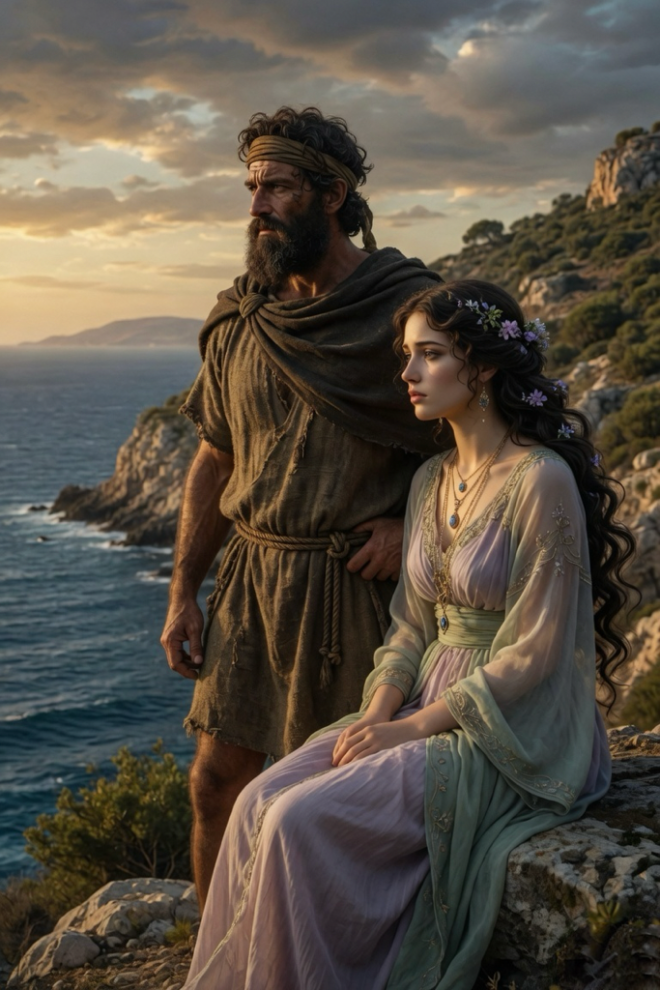
Most of what appears on this site concerns itself with the present tense of injustice – the ACT, the AFP, the slow grinding machinery of institutions that would rather forget than answer. Today I am going to indulge myself in something else. Apart from my wife and my family, my truest and longest loves have been classical literature and art, both of which I studied at university and neither of which I have ever really put down since. So permit me a departure of my own, and let me write about a departure that is older than any of us: the Odyssey.
It is a commonplace, and none the worse for being one, that the Odyssey is a metaphor for life. Shakespeare said something adjacent to this, though not quite what is usually attributed to him: “All the world’s a stage, and all the men and women merely players; they have their exits and their entrances, and one man in his time plays many parts.” Odysseus is the proof of the line before anyone had written it. Across twenty years and twenty-four books he makes entrance after entrance – as soldier, as beggar, as castaway, as stranger at a foreign hearth, as husband unrecognised in his own hall – and exit after exit, from Troy, from the cave, from the witch’s island, from the arms of a goddess who could have made him immortal and chose instead to let him go. He plays many parts because life demands many parts of us, and the man who insists on playing only one is the man who never comes home.
Ithaca And The Necessity Of Departure
The poem does not begin with the fall of Troy but with a man who has already been gone ten years from a war that itself took ten. This is the first metaphor, and it is easy to miss because it is so structural: life is not one departure but a chain of them, each opening onto the next before the last has finished closing. Odysseus does not get to go home after Troy. He gets to go home after the storm that follows Troy, and after Ismarus, and after everything else that intervenes between a man’s intention and its fulfilment. Anyone who has ever thought they were nearly finished with a difficult year, only to discover the year had further plans for them, will recognise the shape of it.
The Lotus-Eaters: The Temptation Of Forgetting
The first real test is not a monster but a flower. On the island of the Lotus-Eaters, Odysseus’s men eat the honeyed fruit and lose, along with their memory, their will to return. They do not want to be rescued. This is one of the most quietly disturbing episodes in the poem precisely because it contains no violence – only the offer of a comfortable oblivion. It is the metaphor for every anaesthetic we reach for when the road home looks too long: the drink, the scroll, the distraction, the soft narcotic of simply not thinking about where we were supposed to be going. Odysseus has to drag his men back to the ships by force. Sometimes the most loving thing you can do for someone, or for yourself, is refuse to let forgetting pass for peace.
The Cyclops: Cunning, Hubris, And The Trap Of The Name
In the cave of Polyphemus we get the poem’s clearest lesson in the uses and limits of intelligence. Trapped by brute strength, Odysseus does not out-muscle the Cyclops; he out-thinks him, blinding him with a stake and escaping by calling himself “Nobody,” so that when Polyphemus screams for help, his kinsmen hear only that Nobody has hurt him and go back to sleep. It is a magnificent piece of tactical humility – Odysseus survives by erasing his own name.
It is worth remembering, before the hubris reading runs away with the scene, why Odysseus blinds Polyphemus in the first place. The Cyclops has already violated xenia – the sacred law of host and guest that holds the whole moral architecture of the Odyssey together – by seizing Odysseus’s men in his cave and eating them raw, two at a sitting, in contempt of the suppliant’s claim on his mercy and Zeus’s own protection of travellers. The blinding is not gratuitous cruelty; it is a proportionate response to an atrocity, and Odysseus is within his rights, by the poem’s own moral accounting, to take it. What follows is not a punishment for that justified act. It is a punishment for what he does after it is no longer necessary – the taunt thrown back across the water once escape is already secured. The moral ledger, in other words, opens in his favour and closes against him only through a choice that had nothing to do with justice and everything to do with vanity.
And then he ruins it. Sailing away, safe, he cannot resist shouting his real name back at the blinded giant, unable to bear that his cleverness should go uncredited. That single act of vanity is what allows Polyphemus to pray to his father Poseidon for vengeance, and it is that vengeance – not the blinding itself – that costs Odysseus ten more years of suffering and every one of his men. The metaphor is almost too clean: the ego, having won by disguise, cannot resist announcing itself, and announcement is what invites the storm. How many of us have secured a hard-won victory only to talk ourselves back into trouble because silence felt like a defeat?
Odysseus is, in this sense, the least tragic of Homer’s heroes and the most human. Achilles is undone by a single fixed flaw, repeated until it kills him. Odysseus is undone repeatedly by the same flaw – a vanity that cannot resist the last word – and survives each time to be undone by it again, a little wiser, a little more scarred, never fully cured. That, too, is recognisably how most of us actually change: not in one clean epiphany but in a slow, humiliating series of relapses into the same mistake, each one costing slightly less than the last.
The Bag Of Winds: Self-Sabotage At The Threshold
Aeolus, keeper of the winds, gives Odysseus a sealed bag containing every contrary wind, so that only the favourable one is left to carry him home. Ithaca comes into sight. His men, believing the bag holds treasure their captain is hoarding from them, open it while he sleeps, and the released winds blow the ships back to where they started. This is one of the cruellest metaphors in the poem, because it happens at the very edge of arrival: the disaster caused not by an external monster but by our own crew’s suspicion and appetite, undoing in an instant what years of effort had achieved. It is the project abandoned in its final week, the relationship undone by a doubt no one voiced honestly, the reform derailed at the last committee meeting by someone who could not resist looking inside the bag.
Circe: Transformation And The Government Of Appetite
On Circe’s island the men who drink her cup are turned into swine, and the horror of the image is not the animal shape but the willingness with which they take the cup in the first place, exhausted and hungry as they are. Circe is not merely a witch; she is what happens to a person who stops governing his appetites and lets them govern him. Odysseus alone resists, protected by the herb moly given him by Hermes – the poem’s way of saying that resistance to degradation requires help from outside ourselves as much as strength within. Only once he has faced her as an equal, sword drawn, does she become an ally rather than a danger, and the island that threatened to dissolve him into an animal becomes, for a year, a place of rest before Hades. The pattern recurs everywhere in life: the same appetite, honestly confronted, can become sustenance; left unexamined, it consumes you.
The Underworld: What The Dead Can Teach The Living
Before Odysseus can go forward, Circe tells him, he must go down – into Hades, to consult the blind prophet Tiresias. This is the poem’s descent into the underworld motif, the katabasis that recurs from Gilgamesh to Dante to Orpheus, and its logic is unforgiving: there is no route home that does not pass through an honest reckoning with mortality. Odysseus speaks with the shades of his mother, who died of grief waiting for him, and with Achilles, who tells him – famously – that he would rather be a landless labourer among the living than a king among the dead. It is the Odyssey’s quiet rebuke to the Iliad’s glory-logic: better an unglamorous life fully lived than an immortal name attached to a corpse. Anyone who has sat with grief, or with their own mortality, and come back changed by the sitting, has made this same journey in miniature.
The Sirens: Desire Bound By Discipline
The Sirens do not offer oblivion, as the lotus did; they offer knowledge – they sing that they know everything that has happened at Troy and everything that will happen on the wide earth. It is the most sophisticated temptation in the poem because it flatters the very quality, curiosity, that has kept Odysseus alive this far. His solution is neither to resist through willpower alone nor to avoid the danger altogether, but to engineer his own restraint in advance: wax in his crew’s ears, himself lashed to the mast, ordering them beforehand to bind him tighter, not looser, whatever he begs once the song begins. This is one of the most practically wise images literature has produced for the government of the self – knowing you will be tempted, and building the structure that holds while the temptation lasts, rather than trusting your future self to be stronger than your present self can honestly promise.
Scylla And Charybdis: The Choice With No Good Option
Between the six-headed monster on one cliff and the ship-swallowing whirlpool on the other, Circe tells Odysseus there is no clever trick, no clean escape – only the choice of which loss to accept. He steers toward Scylla, deliberately, knowing she will take six of his men, because the alternative is losing the ship and everyone on it. This is one of the most adult moments in the entire poem, and the one least often discussed as a metaphor for life, because it refuses the comforting lie that wisdom always finds a third door. Sometimes it doesn’t. Sometimes leadership, or maturity, or simply getting older, means choosing the survivable loss over the total one, and living with having chosen it.
What makes the scene bearable, and instructive, is that Odysseus tells his crew almost none of this. He knows six of them are about to die and he lets them row on regardless, because to freeze the ship in indecision between two certain harms would be to guarantee the worse one. There is a kind of loneliness particular to the position of anyone who has to choose on behalf of others while sparing them the full weight of the choosing. It is not dishonesty. It is the private cost of leadership, paid in advance and rarely acknowledged afterward.
Calypso: The Seduction Of Stasis
For seven years Odysseus is held – the word Homer uses suggests something closer to captivity than romance – on Calypso’s island, offered immortality and eternal youth if he will simply stay. He weeps on the shore every day, Homer tells us, looking out at the sea, and still he refuses her gift when at last the gods force her to release him. This is the episode I return to most, because it is the one furthest from adventure and closest to ordinary temptation: not a monster, not a war, but a comfortable, ageless, uneventful paradise, offered by someone who loves him, that would cost him only his home, his wife, and his name. Odysseus chooses the mortal, difficult, unfinished life over the immortal, easy, finished one. It is the clearest statement in the poem of what the Odyssey believes life is for: not comfort, but return; not permanence, but the particular, unrepeatable, aging love of one’s own Penelope, one’s own Ithaca, one’s own small rocky kingdom that nobody else would choose to rule.
The Phaeacians: The Debt We Owe To Strangers
Washed up naked and friendless on the shore of Scheria, Odysseus is found not by an enemy but by a young woman, Nausicaa, and taken in by her people with a hospitality so total that they eventually give him a ship and crew to carry him home at their own expense, asking nothing in return. It is easy to skip past this episode as mere plot mechanics, but it carries one of the poem’s central convictions. The Odyssey treats the proper treatment of strangers as a defining mark of civilisation. Odysseus arrives with nothing – not even clothes – and is restored by people who have every reason to be suspicious of him. No one gets home entirely on their own effort. Every journey worth finishing is, at some point, subsidised by the kindness of people who owed you nothing.
Penelope’S Loom: Fidelity As An Act Of Resistance
While Odysseus is tested by monsters, Penelope is tested by time and by siege of a quieter kind: suitors who occupy her house, eat her stores, and press her to declare her husband dead and remarry. Her resistance is not passive waiting but active ingenuity – she weaves a burial shroud by day and unpicks it by night, buying years with a piece of cloth. It is easy to romanticise her patience and miss its cunning; Penelope is Odysseus’s equal in craft, and her loom is as much a strategic weapon as his wooden horse ever was. Fidelity here is not softness. It is discipline sustained over years with no guarantee of reward, which is a fair description of most of the things in life actually worth doing.
Recognition: The Scar, The Dog, The Bed
When Odysseus finally reaches Ithaca, disguised as a beggar even from his own wife, the poem becomes a study in how identity is verified rather than simply declared. His old dog Argos, flea-ridden and dying on a dung heap, recognises him by scent alone and dies having done so – the single most understated and devastating moment in Homer. His old nurse recognises him by a boar’s-tusk scar on his thigh while washing his feet. And Penelope, most stringently of all, tests him with a lie about their marriage bed being movable, when in fact Odysseus built it himself around a living olive tree rooted in the earth, immovable by design. Only when he reacts with the fury of a man who knows the bed cannot be moved does she believe him. The metaphor scarcely needs unpacking: real recognition, real homecoming, is never granted on the strength of a claim. It has to be earned against evidence that cannot be faked – a scar, a scent, a fact about your own life only you could know.
The Slaughter Of The Suitors: Reclamation As Justice
The killing of the suitors troubles modern readers, and it should; Homer does not entirely let Odysseus off the hook for it either, staging the aftermath with a purification ritual that acknowledges blood has been spilled even where the blood was owed. But the episode’s metaphorical charge is less about vengeance than about the work of reclaiming what injustice has occupied in your absence. Odysseus does not walk back into his hall and simply announce himself; he has to strip away every disguise, absorb every insult the suitors throw at the beggar they don’t recognise, and only then, at the moment of his choosing, restring the bow that only he can draw. Justice, in this telling, is not an event that happens to you. It is a bow you have to be strong enough, and patient enough, to string yourself.
What Survival Costs
It is worth pausing here, before the essay moves toward any easy celebration of survival, on what that survival actually costs. Odysseus is the only man of the entire expedition who reaches Ithaca. Every companion who sailed with him from Troy is dead by the poem’s end – taken by Polyphemus, drowned when Scylla’s six heads close on them, or destroyed on the island of the sun god for eating cattle he had explicitly warned them not to touch. Homer says as much in his invocation to the poem, framing Odysseus from the very first lines as a man who tried and failed to bring his crew safely home, and is careful to place some of the blame on the men’s own recklessness rather than on their captain alone. But the arithmetic is still stark. The story we are telling as a triumphant homecoming is, counted in bodies, closer to a disaster with a single survivor. Odysseus’s cunning saves Odysseus. It does not save the men who trusted him to lead them home, and the poem, to its credit, never quite lets us forget that his survival was purchased with a currency he had been sent out to protect, not merely to spend.
The Limits Of Homecoming
Nor is the homecoming itself as complete as the word suggests. Argos the dog, having waited twenty years, recognises his master and dies in the same breath, receiving nothing back for the waiting but the moment of recognition itself – no embrace, no reward, no years of ease at his master’s hearth. Odysseus’s mother is already dead by the time he reaches the underworld, so that the only conversation he ever has with her again is with a shade who cannot be touched; he tries three times to embrace her, he tells us, and three times she slips through his arms like a shadow or a dream. Some losses the poem simply does not undo. And even the homecoming the whole narrative drives toward turns out to be provisional rather than final: Tiresias has already told Odysseus, in Hades, that reaching Ithaca is not the end of his wandering but only a pause in it – that he must set out again on foot, carrying an oar, until he reaches a people so far inland they mistake it for a farm tool, before he can finally make his peace with Poseidon and die, at last, an easy death far from the sea that has defined him. The poem that we remember as a story of return is honest enough to admit, in its own prophecy, that no return is ever quite the last one.
Entrances And Exits
None of that cancels the reading I have been building across this essay, but it should complicate it. A metaphor for life that only ever affirms is not being honest about life, and the Odyssey is not that kind of poem. It knows that some companions do not come home, that some waiting is never repaid, and that even the best of homecomings carries an asterisk in the small print of prophecy. Which returns us to the Shakespeare with which I began. Every man and woman has their entrances and their exits, and Odysseus’s genius – if it is a genius, and not simply what survival requires of anyone who is paying attention – is that he never plays the same part twice without learning something from the part before it. He is soldier, then castaway, then captive, then beggar, then king, and none of those parts are costumes he puts on cynically; each one teaches him something the last one couldn’t. That, I think, is the whole of the metaphor. Life does not ask us to be one thing consistently, gloriously, from beginning to end. It asks us to keep re-entering, changed by every exit, until we are fit to walk back into whatever hall we set out from and be recognised – by the people who matter, and by ourselves – for who we actually became along the way.
Why I Keep The Lights On
It seems fitting, having written all this, to say something briefly and honestly about why Blak and Black exists at all, since this essay is as close as I come to writing about myself directly.
I maintain this website for a number of reasons, and I don’t know if anybody actually reads what I put on there or not – but that has never been the whole of why I put it up. I put it up to remind myself that I still haven’t succumbed to the greed and cynicism that really is modern society; that I haven’t sold my soul, entirely, for the almighty dollar. If my writing causes even one person to stop and think about what they’re doing, and about what’s happening in the world around them, then I have achieved my ultimate goal – whether that ever comes to fruition where I can see it or not, I don’t know, and I have made a kind of peace with not knowing.
There is, I think, something Odyssean in that too. You do not always get to see the shore you’re rowing toward. You keep rowing anyway, because the alternative – the lotus, the easy forgetting, Calypso’s ageless island where nothing you do will ever matter or end – is a kind of death dressed up as comfort. Odysseus chose the harder, mortal, uncertain thing over the easier immortal one. I would like to think that in my much smaller way, sitting at a keyboard rather than a ship’s bench, that is the choice I am making too, one essay at a time.
– – –
Bakchos is the founder of Blak and Black, an Australian media and advocacy platform established in 2010. Bakchos writes from the intersecting perspectives of Wiradjuri heritage, Jewish identity, and humanism.
© Bakchos, July 2026



You had a love of ancient history and literature when we were at school together, it was obviously a true love, as you kept it your entire life.
Bakchos your Odysseus post is both timely and elegant. Well done and thank you.
Thanks Bakchos, I’m going to read the Odyssey now, can you recommend a good translation?
Hi Kelly, as of 2026, the standout modern options are Emily Wilson (highly accessible), Daniel Mendelsohn (recently acclaimed for balance), Robert Fagles (dramatic and engaging), Richmond Lattimore (scholarly accuracy), and Robert Fitzgerald (lyrical classic).
Thank you, Bakchos.
I’ve just had a look for those and the Emily Wilson, Peter Fagles & Daniel Mendelsohn translations are available as audiobooks for anyone with accessibility needs or who likes to listen in other settings.
Emily Wilson is probably the easiest to read for those coming new to Homer, and probably the easiest to listen to.