
Introduction
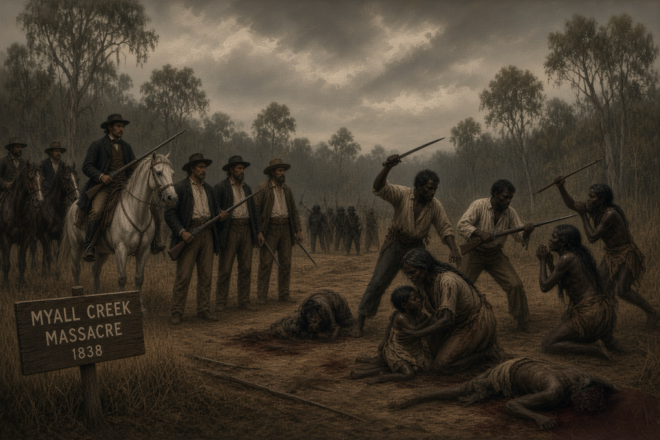
On 13 December 1838, readers of The Australian newspaper in Sydney encountered a poem unlike anything the colonial press had yet published. Written by a recent Irish immigrant, Eliza Hamilton Dunlop, and printed as the fourth instalment in her serial “Songs of an Exile,” “The Aboriginal Mother” gave voice – however imperfectly, and however mediated by a white settler pen – to an Aboriginal woman mourning a husband and a beheaded son, fleeing with a surviving infant through the bush at night. It appeared five days before seven white men were hanged for the Myall Creek massacre, the killing of at least twenty-eight Wirrayaraay people at a cattle station near present-day Inverell in northern New South Wales six months earlier. The poem is not, in the first instance, a literary artefact to be admired for its craft. It is a documentary and political act, composed in the narrow window between a jury’s verdict and a public execution, and it tells – in the actual words of the mother it constructs – one of the most concentrated stories colonial Australia has to offer about the mechanics of frontier violence, the fragility of settler conscience, and the price of speaking on another’s behalf.
This essay reads the poem closely, quoting its key passages at length rather than only describing them; sets those passages against the specific, documented language used against Dunlop by her critics; and situates both within the existing scholarship on the poem, before arguing for a tighter account of what story it actually tells. All quotations below follow the poem’s first printing in The Australian, 13 December 1838, as reproduced in the standard modern transcriptions; a revised song text prepared for Isaac Nathan’s 1841 setting differs from the original in minor but occasionally telling ways, and is treated separately in the discussion of reception below rather than conflated with the 1838 text.
The Massacre Behind The Poem
The Myall Creek massacre occurred on 10 June 1838. A group of twelve stockmen – assigned convicts and ex-convicts working the pastoral frontier – rode to a hut on Myall Creek station where a group of Wirrayaraay people, mostly women, children and old men, had gathered under an informal arrangement of protection with the station’s overseer. The stockmen roped the group together, marched them a short distance from the huts, and killed them with swords and cutlasses, then attempted to burn the bodies. Several children were decapitated. Colonial authorities in Sydney, under the recently arrived Governor George Gipps, pursued prosecution – an unusual step on a frontier where killing Aboriginal people rarely carried legal consequence. Eleven men were tried; an initial trial produced acquittals, but a second trial, on a different charge, convicted seven of murder. They were hanged on 18 December 1838 – the only occasion in the nineteenth century on which white colonists were executed for the mass killing of Aboriginal people.
The verdict provoked a ferocious backlash in sections of the settler press. As the historical record shows, the Sydney Herald did not merely disagree with the executions in measured editorial language; in October 1838 it declared that Aboriginal Australians were “not worth the money the colonists will have to pay for printing the silly documents” generated by their legal protection, and the following month, referring to Aboriginal people as “ferocious savages,” instructed settlers that if such people threatened property or life, colonists should “do to them as you would do to any white robbers or murderers – SHOOT THEM DEAD.” Not every paper took this line – John Dunmore Lang’s Colonist argued on 12 December 1838, the day before Dunlop’s poem appeared, that the killings were “chargeable upon us as a nation” – but the Herald’s rhetoric establishes precisely the climate of opinion into which Dunlop published: a colony in which prominent voices were arguing, in print, that Aboriginal life did not warrant legal protection, using language that denied the victims full human standing altogether. It is against this backdrop that a lullaby given to a grieving Aboriginal mother becomes a political act rather than a literary indulgence. Dunlop had arrived in Sydney only months earlier, in February 1838; her husband David Dunlop was a police magistrate and, from 1839, one of Gipps’s newly appointed Protectors of Aborigines. Evidence given at the Myall Creek trials referenced a woman and child who had escaped the massacre; this detail, more than anything else, appears to have furnished the poem’s narrative frame, carried in the epigraph later attached to the poem: “Only one female and her child got away from us” – evidence before the Supreme Court.
Form: The Lullaby As Elegy
The poem’s governing device is formal and devastating in its simplicity: it is a lullaby that cannot lull. It opens:
“Oh! Hush thee – hush my baby,
I may not tend thee yet,
Our forest-home is distant far,
And midnight’s star is set.
Now, hush thee – or the pale faced men
Will hear thy piercing wail,
And what would then thy mother’s tears
Or feeble strength avail!”
A lullaby promises safety, rhythm, the eventual quiet of sleep. Here the hushing is not comfort but concealment: the mother silences her child not to soothe him but to keep him alive, because his cry might bring “the pale faced men” down on them both. The genre convention of tenderness is turned into a survival tactic, and the poem’s closing stanzas return to and complete this inversion – “Oh hush thee, dear – for weary / And faint I bear thee on” – so that the lullaby which opened the poem as an act of protection closes it as an act of exhaustion. The frame does not resolve; it collapses.
The poem is written in ballad-adjacent common metre, quatrains rhyming abcb – a form associated with hymn and popular narrative verse, already familiar to a colonial newspaper readership. It was the fourth in a serial Dunlop titled “Songs of an Exile,” and the frame of exile is not incidental. Dunlop was born Eliza Hamilton in County Armagh in 1796, into an Anglo-Irish family with Ulster Protestant roots on both the Hamilton and Dunlop sides, and had already published verse in the “sentimental” tradition associated with Felicia Hemans before she ever reached Sydney. Anna Johnston’s research into Dunlop’s Irish and Australian writing argues that the poet’s lifelong preoccupation with elegy – mourning what was left behind, whether a homeland or a murdered child – let her use a single, well-worn literary form to hold together grief for Ireland and grief for Aboriginal Australia, and that “the bloody history of revolution and its suppression in Ireland” supplied a recurring, if largely submerged, frame of reference across her Australian poems. “The Aboriginal Mother” thus arrives already carrying an Irish colonial memory of dispossession and suppressed rebellion, transposed onto a new frontier – not as a direct analogy (Dunlop never claims equivalence between Ireland and Myall Creek), but as an inherited emotional grammar for writing about a people forced from their land by an occupying power. This is itself worth registering as part of the poem’s ambivalence: the sympathy it extends to the Wirrayaraay was assembled, in part, out of the poet’s own inherited experience of colonial upheaval in Ireland, filtered through a genteel Anglo-Irish sensibility rather than a shared position of dispossession.
The sentimental mode itself – a poetic technology, proven effective by the British and American antislavery movement, for producing sympathy through the suffering of an idealised, feminised, maternal figure – is the other formal debt the poem carries. That Dunlop deployed this thoroughly European apparatus on behalf of an Aboriginal woman is itself part of the story the poem tells: even sympathy for Indigenous suffering had to be translated into forms already legible to, and built by, a white settler audience.
Close Reading: Violence Rendered In The Body
The poem does not abstract the massacre; it renders it in exact, bodily detail evidently drawn from courtroom testimony – a debt that Duncan Wu’s Oxford Review of English Studies article on Dunlop has traced directly to newspaper reports of the trials. The central image is unflinching:
“I saw my firstborn treasure
Lie headless at my feet,
The goro on his hapless breast,
In his life-stream is wet!
And thou! I snatched thee from their sword,
It harmless pass’d by thee!”
This is not poetic invention. Decapitation was among the documented horrors of Myall Creek. By placing this fact inside a mother’s voice rather than a magistrate’s deposition, Dunlop moves the massacre out of the register of legal record and into the register of grief – a move that drew explicit criticism at the time for its perceived indecorousness, precisely because it worked.
The husband and father figure, named Toon Bakra and called “my bold and stately mountain-bird,” occupies the poem’s emotional centre almost as much as the child does, and the stanza describing his death is the poem’s clearest statement about the mechanics of the massacre itself:
“For thy young life, my precious,
I fly the field of blood,
Else had I, for my chieftan’s sake,
Defied them where they stood;
But basely bound my woman’s arm,
No weapon might it wield:
I could but cling round him I loved,
To make my heart a shield.”
This detail tracks the historical record precisely: the Wirrayaraay people at Myall Creek were roped together before they were killed, disarmed and immobilised, unable to flee or resist. The poem is therefore not depicting a “battle” or a “skirmish,” the euphemisms contemporaries often reached for; it depicts an active, resisting community – a chieftain, a woman prepared to fight “for my chieftain’s sake” – that is bound and then executed. The mother’s only remaining weapon is her own body, offered as “a shield” that fails. This is Dunlop’s most precise indictment of the massacre’s actual method, expressed not through commentary but through the physical grammar of the verse itself: short, blunt monosyllables (“bound,” “no,” “cling”) standing against the poem’s more lyrical passages elsewhere.
The poem’s Aboriginal vocabulary – goro (spear), koopin, boommerring – signals Dunlop’s atypical linguistic engagement with communities around Wollombi, work she pursued with her husband and in correspondence with the missionary-linguist Lancelot Threlkeld at Lake Macquarie. These words function doubly: they lend a specificity that resists the generic, interchangeable “native” of most colonial writing, while simultaneously marking the poem as an act of translation, in which the mother’s language is never simply allowed to be itself, but arrives italicised and glossed for settler consumption.
The Turn To God: Colonial Christianity Indicted
The poem’s final movement is its most pointed political argument:
“Yes! O’er the stars that guide us,
He brings my slaughter’d boy:
To shew their God how treacherously
The stranger men destroy;
To tell how hands in friendship pledged
Piled high the fatal pire;
To tell, to tell of the gloomy ridge!
And the stockmen’s human fire.”
Having exhausted grief, the mother imagines her dead son’s spirit travelling to “bring thy people’s murder cry / Before the Christian’s God” – to testify, in heaven, to what was done on earth. The imagined testimony is specific: it will “shew their God how treacherously / The stranger men destroy,” and will name the betrayal precisely – “hands in friendship pledged” that “Piled high the fatal pire.” This detail is historically exact: the killers at Myall Creek had extended a pretence of protection to the group before rounding them up, a betrayal contemporaries found especially shocking. The irony Dunlop constructs is devastating and deliberate. She does not ask whether Aboriginal people can be redeemed by Christian civilisation – the era’s dominant humanitarian question – but instead stages a scene of ultimate judgment in which the murdered child, not the coroner or the jury, becomes the accusing witness before the God the killers themselves professed to worship. Heaven becomes the court that colonial law refused fully to be.
Reception: Two Kinds Of Attack, And A Musical Afterlife
The poem’s reception is not merely a footnote to its content; it is where the poem’s political stakes become fully visible, and it deserves to be shown rather than summarised – but the scholarship behind it needs correct attribution. The most detailed account of the Sydney Herald’s campaign against the poem is Duncan Wu’s article “‘A Vehicle of Private Malice’: Eliza Hamilton Dunlop and the Sydney Herald” (Review of English Studies, 2014), which documents a sustained attack that intensified after the poem was set to music and performed publicly in 1841. Wu’s central finding is that this animus was not simply a reaction to the poem’s content but was entangled with the Herald’s wider political war against Governor Gipps’s protective policies toward Aboriginal people, and specifically with the paper’s repeated attacks on Dunlop’s own husband, David Dunlop, in his role from 1839 as a Protector of Aborigines at Wollombi. The literary judgment and the political vendetta, in other words, were the same fight wearing two faces.
The attack itself came in more than one register. When the Sydney Herald printed the newly composed song version of the poem on 15 October 1841, ahead of its concert premiere, the paper conceded that the words were “pathetic” and displayed “much poetic feeling” – but immediately qualified the praise by objecting that the language given to the Aboriginal mother was of a generic, imported kind, more characteristic of a North American literary Indian than of anyone the paper’s “very slight acquaintance with the natives of this colony” would recognise as authentic. This is a subtly different charge from simple hostility to sympathy: it questions Dunlop’s authority to speak for a specific Aboriginal woman at all, even while admitting the poem’s emotional power. A separate, later attack held that Dunlop had given “an entirely false idea of the native character,” a claim that denied, in principle, that Aboriginal people were capable of the depth of feeling the poem attributed to them; as later scholarship has recorded, Dunlop answered with a pointed letter to the editor, published 29 November 1841. Read together, the two charges are double-edged: one accuses the poem of literary inauthenticity, the other of emotional overreach, but both work to discredit exactly the faculty the poem depends on – a settler woman’s claim to have imagined her way into an Aboriginal mother’s grief.
Dunlop did not retreat. She continued publishing sympathetic verse on Aboriginal subjects for roughly another decade, moving between newspapers and editors as some outlets tired of the controversy and others carried her work regardless. The poem also found an unlikely second life in music. It was set by Isaac Nathan, an English-born Jewish composer sometimes called the “father of Australian music,” best known before his 1841 emigration for his Hebrew Melodies collaboration with Byron; Nathan reached Sydney only months after the poem’s original publication and premiered the song version at the Royal Victoria Theatre on 27 October 1841, sung by his own daughter with full orchestral accompaniment. That a poem born from courtroom testimony about a frontier massacre ended its first decade of life as a concert piece, performed in evening dress to a paying Sydney audience, is itself a measure of how thoroughly the sentimental mode could absorb even the most damning colonial subject matter into polite entertainment. Dunlop also continued her ethnographic collaboration at Wollombi during these years, compiling vocabulary lists and transcribing song under the name “Mrs David Milson” – placing her, however incompletely and however shaped by the era’s paternalism, inside networks of exchange with Aboriginal informants rather than writing about Aboriginal people only from a distance. That combination of public advocacy, concert-hall celebrity, and private linguistic labour is unusual enough in the colonial record that scholars – Johnston chief among them, alongside Wu and the contributors to the 2021 Sydney University Press volume Eliza Hamilton Dunlop: Writing from the Colonial Frontier – have, after a century of near-total neglect following Dunlop’s death in 1880, substantially revived critical interest in her work.
What Story Does The Poem Tell Of Colonial Australia?
Read against this evidence, the poem’s contribution is best stated as two claims, not a list of overlapping ones.
First: the poem insists that frontier “conflict” was, in the specific case it documents, an execution of the disarmed, and it proves this through the physical grammar of the verse rather than through argument. The bound arm, the headless child, the sword that “harmless pass’d by thee” – these are not generalised images of suffering but a reconstruction, drawn from trial evidence, of exactly how a group already pledged friendship and already stripped of the means to resist was killed. Placed beside the Herald’s contemporaneous language – “ferocious savages,” “SHOOT THEM DEAD” – the poem functions as a direct rebuttal in the same public arena: where the Herald denied Aboriginal people the capacity for feeling in order to excuse their killing, Dunlop’s poem supplies precisely that interior life, scene by scene, in the deliberately familiar and popular form of the ballad.
Second: the poem discloses, more than it perhaps intends to, the structural limit on how far settler sympathy could travel in 1838. “The Aboriginal Mother” is not an Aboriginal woman’s testimony; it is an Irish immigrant’s reconstruction of one, assembled from newspaper accounts and courtroom evidence, metred to a British hymn form, glossed with italicised vocabulary, and eventually arranged for parlour and concert performance. Dunlop’s courage in publishing it – and in absorbing a documented, sustained newspaper campaign that attacked both the poem and, by extension, her husband’s official conduct – should not be understated. But the very avenue by which Aboriginal grief entered the colonial public record in 1838 was also evidence of the imbalance the poem protests: that grief could be heard only once translated, versified, and performed by someone the settler press was, at minimum, obliged to argue with rather than simply dismiss. The poem indicts colonial violence while remaining a product of colonial cultural power – a tension that does not cancel its value as protest, but is part of what the historical record around it, including its reception, discloses.
The poem closes on grief without resolution – “The echoes of my homeless heart / Reply – the dead, the dead!” – refusing the consolations that Christian elegy conventionally offers. There is no promise of reunion, only an “ever” murmuring “like an ocean torrent” that will not “flow … back” to ease “our lonely woe.” In this the poem anticipates, in an 1838 popular form, what Aboriginal writers, historians and communities have long insisted upon as a matter of historical method: that massacre is not a discrete, closed event but an ongoing condition, corroding even the survivors’ relationship to their own country and its “summer streams” long after the killing stops.
Conclusion
“The Aboriginal Mother” is best understood as a document produced at a genuine hinge point in colonial history – the brief moment when the New South Wales legal system was willing to hang white men for killing Aboriginal people, before frontier practice reverted, almost immediately and for the following century, to near-total impunity. Read with its language quoted rather than paraphrased, and against the Sydney Herald’s own recorded words rather than a summary of them, the poem’s claims sharpen rather than soften: it names an execution as an execution, it reconstructs betrayal with forensic precision, and it stages a final appeal to a Christian God that the killers’ own professed faith could not evade. At the same time, its passage into print only through a settler woman’s hand, in a settler literary form, defended in settler newspapers against settler critics, discloses the narrower channel through which even the fiercest colonial-era protest against Aboriginal dispossession had to travel to be heard at all – a condition against which Aboriginal writers, advocates and communities have been arguing, in their own voices, ever since.
Sources Consulted:
Duncan Wu, “‘A Vehicle of Private Malice’: Eliza Hamilton Dunlop and the Sydney Herald,” Review of English Studies 65.272 (2014)
Anna Johnston, “Hidden women of history: Eliza Hamilton Dunlop,” The Conversation (2021)
Anna Johnston, “‘Songs of an Exile’: Sentiment and Violence in Eliza Hamilton Dunlop’s Irish and Australian Elegies, 1838–63” (Institute of Irish Studies, Queen’s University Belfast, 2023) and “Exile and Elegy: Eliza Hamilton Dunlop and Colonial Verse”
Eliza Hamilton Dunlop: Writing from the Colonial Frontier (Sydney University Press, 2021)
Australian Dictionary of Biography, “Dunlop, Eliza Hamilton”
Orlando: Women’s Writing in the British Isles, “Eliza Dunlop”;
Dictionary of Sydney and Austral harmony (University of Sydney), on Isaac Nathan;
Wikipedia, “Myall Creek massacre,” for the Sydney Herald’s October–November 1838 editorial language;
ResearchGate/JASAL scholarship on Dunlop, Romanticism and antislavery discourse;
Primary text and epigraph via australianculture.org and the Australian Women Writers Challenge Blog, sourced from The Australian (13 Dec 1838), The Sydney Herald (15 Oct 1841), and The Sydney Monitor and Commercial Advertiser (27 Oct 1841).
– – –
Bakchos is the founder of Blak and Black, an Australian media and advocacy platform established in 2010. Bakchos writes from the intersecting perspectives of Wiradjuri heritage, Jewish identity, and humanism.
© Bakchos, August 2026




Thought provoking as always.
Regardless what Pauline Hanson would like people to think, the frontier wars were a genuine historical events that claimed the lives of countless indigenous people and some non-indigenous people. These wars were fought on Australia’s soil, and they should be recognised.
It really is time that Australia woke up to itself and accepted responsibility for what colonisation did to indigenous people who were living here for around about about 65,000 thousand years before the Europeans arrived. No one is suggesting that current Australians have to carry the guilt for what their ancestors did, but what their ancestors did needs to be acknowledged.
History matters and it’s about time Australia accepted all of its history, and not just that history that is not confronting to the nation as it currently is. Australia is built on the bones and ashes of indigenous people, and that needs to be acknowledged, properly acknowledged.