
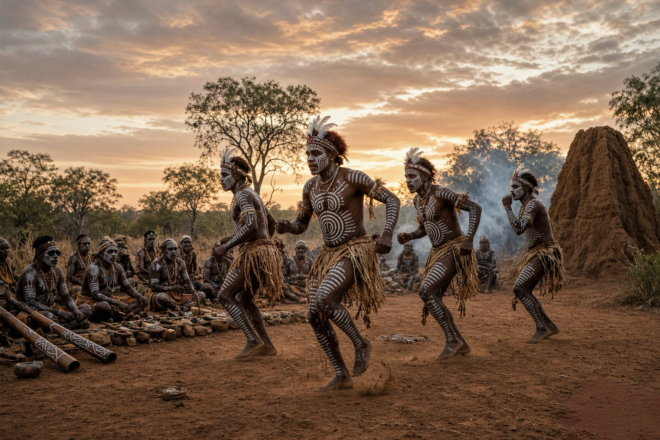
To be welcomed onto Country is to be received into a relationship, not merely greeted at a threshold. Yesterday’s post on Welcome to Country made that argument from the present, and this essay makes it from the ceremonial life that stands behind the practice: the song, dance, painted design and spoken story through which the peoples of this continent kept their law, held their land and maintained their obligations to one another and to the places that sustained them, in a land that had been occupied for tens of thousands of years before the British-led European invasion. The argument is that ceremony was law, not folklore. It was the means by which a society without writing recorded who owned what, who owed what to whom, and how a particular stretch of land was to be treated, and it was carried with a discipline that can be shown rather than merely asserted.
Showing it requires some care about words. The English term most often used for this body of knowledge is Dreamtime, and that word has a history that should be understood before it is used. It is a settler’s translation, it has been stretched far beyond the place it came from, and it tends to pull the reader toward the idea of myth and the distant past, which is exactly the wrong direction. This essay therefore treats Dreamtime as the word under discussion and reaches, wherever it can, for the words that particular peoples use for themselves: Wangarr among the Yol?u of north-east Arnhem Land, Tjukurrpa in the Western Desert, Ngurambang for Country in Wiradjuri. There was never a single Aboriginal culture, any more than there was a single European one. Hundreds of nations, each with its own language, law and Country, cared for this continent, and what follows is built on two documented cases and one language, not on a generalisation about all of them.
The Word and What It Replaced
The expression “dream times” entered English in the 1890s. Francis Gillen, the telegraph and postmaster at Alice Springs and a fluent speaker of Arrernte, used it to translate an Arrernte word that is variously spelled alcheringa, altjira or altyerre, and his collaborator Baldwin Spencer carried it into print, where it spread through the anthropological literature and eventually into popular speech. W. E. H. Stanner later gave the English phrase “the Dreaming” much of its currency, and also supplied the most useful correction to it, the word “everywhen”, which was his attempt to say that what the Arrernte and others described was neither a distant past nor a story about one. The linguist David Campbell Moore has argued that the whole translation rested on a connection between “dream” and the Arrernte word that held only within a limited area, and that it was then applied to the whole continent as though every language had the same idea in the same shape.
None of this means the word is useless, and it would be wrong to pretend that Aboriginal people have not taken it up. Dreaming and Dreamtime have been used in Aboriginal English for decades, often by people who know exactly where the words came from and use them because they are the words that non-Aboriginal listeners will understand. The point is narrower. A reader who meets the word Dreamtime should ask which people’s idea is being described, because the answer changes what the idea is. For the Yol?u, Wangarr names both the ancestral past and the ancestral beings themselves, and the Yol?u word for law, rom, is not separate from it. For Western Desert peoples, Tjukurrpa is spoken of by the custodians of the Seven Sisters story as Law, and the A?angu elders who began the work described below used that word, not a word about dreams. Where the language-specific term carries the meaning, the essay uses it.
Ceremony as Law: The Djang’kawu and Yol?u Manikay
Yol?u society in north-east Arnhem Land is divided into two moieties, Dhuwa and Yirritja, and everything in the world belongs to one or the other. The Djang’kawu sisters, the morning star, the water goanna and the stringybark tree are Dhuwa. The evening star, the stingray and the cycad palm are Yirritja. People belong to clans within a moiety, each with its own language, and each clan holds, as part of the same inheritance, its country (wä?a), its songs, its sacred designs and its ceremonies. This is the first piece of density worth noticing. A single classification binds together kinship, marriage, land tenure, the natural world and the night sky, and ceremony is the practice by which the classification is kept in repair.
The Djang’kawu, two sisters and a brother in most tellings, are the ancestral beings of the Dhuwa moiety. According to the Rirratjingu clan’s account, they travelled by canoe from Burralku, the island of the dead, following the morning star across the sea to Yalangbara on the Arnhem Land coast. They carried their sacred objects with them in mats and dilly bags. At Yalangbara they thrust a digging stick into the sand and fresh water came up, and visitors can still find fresh water by digging at that spot on the beach. The sisters gave birth to the first of the Rirratjingu there, and then travelled on, naming places, producing the founders of other Dhuwa clans and giving each of them a language, a law, a body of song and a set of designs. In this telling the moiety system itself, the structure that governs the Yol?u world, emanates from a particular beach.
The manikay, the cycles of ritual songs that carry this account, are where the record is kept. The Djang’kawu cycle is sung with clapsticks and, in many of its sections, the yidaki, the instrument outsiders call the didgeridoo, though a good part of the cycle consists of what the Yol?u call bilma songs, which use the clapstick alone. The Rirratjingu songs celebrate the well at Yalangbara and the route of the sisters from named place to named place, and they sing the tides and the flow of fresh water as the pattern of conception, birth and death for the Rirratjingu themselves. The country, the law and the life cycle of the people are sung in one set of verses. A singer who knows the cycle holds, in memory, the sequence of the sisters’ journey, the claims that follow from it and the obligations that attach to each of the places named.
The cycle is also graded by who may know what. Manikay includes songs that are public and songs that are restricted, and the Ngärra ceremony, which celebrates the Djang’kawu, includes sessions in which sacred objects are revealed only to those with the right to see them. This is how the law distinguishes between what a visitor may be given and what belongs to the custodians. It is not secrecy for its own sake. It is the same principle on which a legal system distinguishes between a public register and a privileged file, and it is part of what makes the knowledge carry the weight of law.
The Song That Crosses Country: Kungkarangkalpa
The Western Desert offers a different shape of the same principle. The Seven Sisters story, known to Pitjantjatjara and Yankunytjatjara people as Kungkarangkalpa and to Martu as Minyipuru, follows seven sisters pursued across the desert by a man the Anangu call Wati Nyiru and the Martu call Yurla. In the end, in the telling performed by senior custodians at the National Museum of Australia in 2013, the sisters fly into the sky and become the Pleiades. Pleiades narratives are unusually widespread across Aboriginal Australia, but they are not universal, and the names, the plot and the identification of the stars all vary from one country to the next. There is no single authoritative text, and that is part of how the system works.
What makes Kungkarangkalpa useful as a case is that it crosses languages. The route that the exhibition Songlines: Tracking the Seven Sisters followed, over the course of a project that began in 2010 on the initiative of Anangu elders from the Anangu Pitjantjatjara Yankunytjatjara Lands, runs from the Western Australian coast at Roebourne across Martu, Ngaanyatjarra and Anangu country to the east, through three states and across some half a million square kilometres. Different people hold different sections of the song, in their own dialects, in their own country, and the story is complete only when the sections are joined. The elders who began the project said they wanted help to put the songlines back together because they were getting broken up. That sentence is a statement about law as much as about heritage. A song that runs through the countries of several peoples is a record of agreements among them, and when the people who hold the sections die without passing them on, the agreement loses its memory.
The song also does practical work, which is easy to forget when it is described as sacred art. Kunmanara Tjilari, a senior Pitjantjatjara elder, told the researcher Diana James that by knowing the songlines he could go to country for the first time and know where to find food and water, what plants and animals lived there and what had happened there. A singer travelling a section of the song is navigating, reading an ecological survey and checking land tenure at once. The inma, the ceremony of song and dance, performs the same knowledge for the community, and the walka, the designs, record it visually. That is the sense in which the density of these systems can be shown. A single sequence tells the traveller where the water is, who the country belongs to, what the ancestors did there and how to behave.
What Is Public and What Is Not
Much of what readers know as Dreamtime symbolism comes from one region and one period, and it is worth being exact about this. The familiar vocabulary of concentric circles, U-shapes, tracks and dots that appears in popular guides to Aboriginal art derives largely from the graphic conventions of Central Australia. Nancy Munn documented them in detail among the Warlpiri at Yuendumu in the 1950s, in her book Walbiri Iconography, where she showed that a small set of graphic elements, the circle, the line, the U-shape that stands for a seated person, carries different meanings according to the story being told. The same conventions were taken onto canvas and board at Papunya in 1971, and the Papunya Tula movement made them known worldwide. This is public art. It was developed by senior men and later women in a particular place, with the painters deciding what to show, and the dotting that characterises much of it is commonly described as having developed in part to veil restricted material. It is a vocabulary for particular stories told in a particular way, and it cannot be treated as a key to the ceremonial designs of other peoples.
Yol?u designs work differently. A miny’tji is a sacred clan design, and what it represents is a clan’s title to a piece of country. Djurrayun Murrinyina’s painting of Wukili, for example, shows the saltwater country of the Djarrwark clan on Blue Mud Bay as straight, parallel ribbons of design, read as water marked by the passage of the Djang’kawu in their canoe, who sang the fish of that country as Dhuwa totems. There are no dots in it, and no circle that stands for a waterhole. In south-eastern Australia the graphic forms were different again, with designs incised into possum-skin cloaks and carved into trees, and a reader who tried to interpret them using the Central Desert catalogue would be reading in the wrong language. The right question about any motif is whose it is, where it comes from, and whether the person asking has the standing to be told.
The same is true of restriction, which is not only a matter of men’s secrets. Women hold their own ceremonies, their own sacred knowledge and their own responsibilities, and where they are excluded from men’s ceremonies they take part in the shared occasions in different ways, at the edge of the dance ground, with the movements and string figures that belong to women’s law. Women’s business is as restricted, as sacred and as necessary to the continuity of the culture as men’s. Initiation ceremonies reveal sacred designs and their meanings in stages, to those who have been prepared to carry them. The reason for the stages is that knowledge in this system is earned through time and relationship and is not a commodity available to whoever asks, which is a principle that anyone who has watched sacred knowledge be misappropriated will understand.
The legal function of the designs became explicit in the twentieth century, when Yol?u began to use them in dealings with the Australian state. The panels painted by Birrikitji Gumana and others at Yirrkala, in the account held by the Monash University Museum of Art, stated Yol?u ownership of the land in the language of clan design, and they were forerunners of the bark petitions of 1963, which put the same case before the Commonwealth Parliament. Birrikitji himself, according to the same account, was the first to arrive at Gäga in 1911 after Europeans massacred Yol?u who had gathered to perform a Ngärra ceremony. When Yol?u from Yirrkala brought the Gove land rights case in 1971, they were asking an Australian court to recognise the law they had been performing throughout. Justice Blackburn accepted that the Yol?u had a system of law, and then held that it gave rise to no title the Australian courts could recognise. The law was seen, and then ruled irrelevant, and that sequence is the legal history of this country in miniature.
Ngurambang and Yindyamarra: Country as Relationship
Wiradjuri country lies in the inland of New South Wales, bounded by three rivers, the Wambuul (Macquarie), the Galari (Lachlan) and the Marrambidya (Murrumbidgee). The Wiradjuri language was almost lost during the twentieth century and has been rebuilt through the work of Stan Grant Snr and John Rudder, whose dictionary and grammar are the foundation of the terms used here. I have not placed a Wiradjuri song sequence beside the two above, because the sequences I could document to the same standard belong to peoples whose ceremonial traditions have been recorded with their custodians’ participation, and because what is being recovered in Wiradjuri country belongs to the people doing the recovering. What the language already offers is enough to make the argument about relationship.
Ngurambang is the Wiradjuri word for Country, for land and home and the place to which a person belongs. Baayami is the creator spirit, and Murriyang is the Skyworld in which Baayami lives, a name given in 2020 to the Parkes Radio Telescope. Most telling of all is yindyamarra, which carries the meanings of respect, gentleness, politeness, giving honour, doing slowly and taking responsibility. The phrase yindyamarra winhanganha is usually translated as the wisdom of respectfully knowing how to live well in a world worth living in. It is not a word for a mood or an attitude. It describes the conduct that governs a person’s relationship with Country and community, which is to say it is law in the sense the Yol?u mean by rom and the custodians of the Seven Sisters mean by Tjukurrpa. A word that means to do slowly and take responsibility describes how one enters a place, and a Welcome to Country, spoken in language by a person with the right to speak, is the formal occasion on which that way of entering is taught to the visitor.
Continuity and Rupture
None of this is a closed system, and none of it ended in 1788. Yol?u song cycles are still sung, the Seven Sisters custodians are still travelling the route, and Wiradjuri is again being taught in schools. But each of the cases above also records the damage. The Ngärra massacre of 1911, the elders’ fear that the songlines were breaking up, the near-loss of the Wiradjuri language and the long dispossession of sacred objects into museums and private collections are all part of the same history, and the repatriation of ancestral material and the recording of songs with their custodians belong to the same project of repair.
The doctrine of terra nullius, the legal fiction that the continent belonged to no one, was possible only because those who invoked it did not read what was written on the ground in song, design and ceremony. The evidence was being performed in front of them. When the Yol?u put their designs on bark and sent them to Canberra, they were doing what any people does when its law is not recognised and the only remaining course is to present it in a form the other side cannot say it did not see.
For the many First Nations people who grew up away from Country, whether because of removal, displacement or the economic migrations that followed dispossession, the continuity runs through language, through art and through the work of reconnecting. Contemporary Aboriginal art, in Papunya Tula and in the bark painting of Yirrkala and in the cultural centres and language programs of the south-east, is not a departure from ceremony. It is one of the forms ceremony now takes, and the decision about what to show and what to veil is still made by the custodians of the story.
Conclusion
A word like Dreamtime invites the listener to think of myth, and the cases above show why that is a mistake. The Djang’kawu cycle records the founding of a moiety system and the title of clans to their estates. Kungkarangkalpa records a route across several nations’ country, with the knowledge needed to survive it. Yindyamarra describes the conduct by which a person is permitted to be on Wiradjuri Ngurambang at all. In each case the ceremony is the means by which the law is performed, taught and kept, and what appears to an outsider as symbol is, to the people who hold it, a statement of right and obligation.
That is why Welcome to Country is better understood as a legal and diplomatic act than as a courtesy. A custodian who welcomes visitors is drawing on all of this, and offering them a place within a relationship that has terms. To treat it as a formality is to misunderstand what is being offered. The invitation has not been withdrawn. It asks that those who receive it listen carefully, learn from the people whose law it is, and act with the responsibility that being welcomed onto Country demands.
– – –
Bakchos is the founder of Blak and Black, an Australian media and advocacy platform established in 2010. Bakchos writes from the intersecting perspectives of Wiradjuri heritage, Jewish identity, and humanism.
© Bakchos, October 2026
BLAK AND BLACK | MEDIA AND ADVOCACY | EST. 2010