
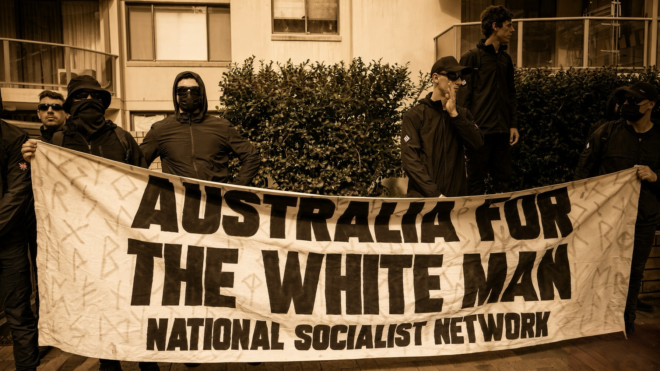
This week the High Court of Australia is doing something it does periodically and uncomfortably: hearing an argument, from a genuinely repugnant litigant, that may turn out to be constitutionally correct. On Tuesday and Wednesday, in Canberra, lawyers for the White Australia Party – the political vehicle assembled by the remnants of the neo-Nazi National Socialist Network – asked the Court to strike down the Commonwealth’s power to proscribe hate groups. Several of the country’s most respected constitutional scholars think they have a real chance of winning, on at least one of the three grounds argued. That prospect should trouble no one who actually believes in the rule of law, and it should trouble everyone who has spent the last four months assuming the law was simply on the side of decency.
It is worth sitting with that discomfort for a moment before getting into the doctrine, because the discomfort is the point. A liberal constitutional order does not get to reserve its protections for people whose politics we find tolerable. It either constrains executive power in general, or it does not constrain it at all. Whether the Constitution actually gives the Commonwealth the mechanism Parliament chose is a separate question from whether White Australia deserves to exist – and it is the only question the seven judges hearing this case are permitted to ask.
From Bondi Beach to Part 5.3B
The law under challenge did not emerge from nowhere. On 14 December 2025, two gunmen – a father and son, Sajid and Naveed Akram – opened fire on a Hanukkah celebration attended by around a thousand people at Bondi Beach, killing fifteen. Australian authorities and Islamic State itself, which claimed credit, described it as antisemitic, Islamic State–inspired terrorism; it remains the deadliest terrorist attack in the country’s history. Five weeks later, on 20 January 2026, Parliament passed the Combatting Antisemitism, Hate and Extremism (Criminal and Migration Laws) Act 2026, inserting Part 5.3B into the Criminal Code two days after that. It gave the responsible minister a new power: to advise the Governor-General to declare an organisation a prohibited hate group, on the minister’s own satisfaction – without a hearing, without procedural fairness, and without any prior finding by a court – that the group had engaged in, planned, assisted or advocated conduct constituting a “hate crime.” Membership, direction, funding or support of a proscribed group then attracts penalties of up to fifteen years.
The National Socialist Network had already read the room. On 20 December 2025 – six days after Bondi, five weeks before the Act existed – White Australia Party Inc was incorporated as a voluntary association in Victoria. In January the Network announced, on Telegram, that it and its satellite outfits the European Australian Movement and White Australia would disband. Dissolution on paper is not dissolution in fact: the incorporated party had been sitting quietly since December, and on 25 April 2026 it lodged an application with the Australian Electoral Commission for registration as a non-parliamentary political party, by then claiming 1,778 members. The Commission balked, telling the group it could not register while it continued to conceal its members’ identities. In May, Home Affairs Minister Tony Burke used the new Part 5.3B power to have the Governor-General declare White Australia a prohibited hate group. The Commonwealth alleges the party’s membership rolls are substantially the Network’s own under new branding – a serious allegation, made in written submissions and contested by the plaintiffs, not a fact either side has conceded.
White Australia went to the High Court, first seeking an interlocutory injunction to suspend the proscription until its constitutional challenge could be heard. Justice Jagot, hearing the matter in May as duty judge, applied the orthodox principle that courts defer to the presumed validity of legislation pending final determination of its constitutional validity. Chief Justice Gageler, ruling on a renewed application in June, went further and narrower: an injunction against the Commonwealth would not actually cure the harm the party said it faced, because the risk of criminal jeopardy for continuing members was inherent in the existence of an untested law and would remain whether or not the injunction was granted, and separately, the risk that Victoria’s Registrar of Incorporated Associations might cancel the party’s incorporation altogether was a risk only a different proceeding, against the Registrar, could address. The substantive case has now gone to a full bench of seven, over two days, on written and oral argument. Its barrister is the former Liberal MP Peter King, who took the brief because the profession’s cab-rank rule obliged him to – a detail worth remembering only because it is the same principle, in miniature, that the rest of this essay is about: a system that only extends its protections to people it likes has already stopped being a system of principle.
Three grounds – but only one is genuinely live
White Australia’s writ pleads invalidity on three grounds: that the Commonwealth lacked legislative power to enact the scheme at all, contrary to the 1951 decision in Australian Communist Party v Commonwealth; that it burdens the implied freedom of political communication; and that it vests punitive power in the executive in breach of the separation of judicial power under Chapter III. A win on any one would bring the scheme down. But the three are not equally strong, and treating them as interchangeable – as much of the commentary around this case has – obscures where the real contest lies.
Start with the weakest, because it is instructive precisely for being weak. The Chapter III argument says that in proscribing a group without a prior judicial finding, the minister is functionally adjudicating past conduct and imposing punishment – a power the Constitution reserves to courts. It is a serious argument in form, but it runs into an immediate structural problem: nobody is convicted, fined or imprisoned by the ministerial declaration itself. The declaration only defines a class. The offences that follow – continuing to be a member, to direct, to fund – are ordinary criminal offences, charged in the ordinary way, tried before an ordinary court, with the ordinary burden of proof and the ordinary right to contest every element including, presumably, whether the accused was in fact a “member” at the relevant time. That is close kin to the architecture Commonwealth terrorism law has used for two decades to proscribe organisations under the Criminal Code’s terrorist-organisation regime – an executive listing that supplies a definitional element of a later offence rather than itself convicting anyone – and analogous schemes have generally survived Chapter III challenge for exactly that reason. White Australia can argue the analogy is imperfect, that here the minister is also, in substance, making a finding about past wrongdoing no court has tested, and that the stakes for an entire political party are of a different order to an individual’s membership charge. But this is the ground on which the government is most comfortable, and with reason: it is defending a structure the Court has broadly tolerated before, not inventing a new one.
The Communist Party ground and the implied-freedom ground are different, and each is live for a reason specific to how this scheme is built, not because a sympathetic bench might simply feel that neo-Nazis have suffered enough scrutiny.
Who finds the facts – the ground the government should fear most
Here is the feature of Part 5.3B that gives the first ground its teeth, and it is not really about communism or Nazism at all: it is about who gets to decide, for constitutional purposes, that the facts required to enliven a head of legislative power actually exist.
The Commonwealth cannot legislate at large. It needs a specific head of power in section 51, and here it has reached for the external affairs power, arguing that Part 5.3B implements Australia’s obligations under international instruments requiring states to prohibit advocacy of racial hatred and to ban organisations that promote and incite racial discrimination. That is a real, previously tested head of power – the High Court has read it broadly before. But there is a catch built into using a treaty-implementation power to justify a domestic proscription scheme: the law has to actually track what the treaty requires, and Part 5.3B, read closely, does not make it an offence to advocate racial hatred as such. It bans membership of a group the minister is satisfied has engaged in a much broader and more loosely defined category of “hate crime” conduct – conduct that need not have been prosecuted, need not have been unlawful when it occurred, and need never be tested by a court before the ban takes effect. Whether that gap between what the treaty requires and what the Act actually proscribes is close enough to count as implementation, or whether the justices take a stricter view of conformity, is one of the two questions on which this ground turns.
The second, and the one with the sharper edge, is exactly the defect the High Court identified in 1951. When the Menzies government tried to dissolve the Communist Party, its Act did not ask a court to find that the Party was engaged in subversion – it simply recited that finding into the statute itself and asked everyone, including the judiciary, to accept it as true. The High Court said no: Parliament cannot bootstrap a law into a head of constitutional power merely by asserting the facts that would place it there, because that would let Parliament will its own power into existence by say-so. Part 5.3B has the same structural feature, only relocated to the executive rather than the legislature. It is the minister, not a court, who is satisfied – on no evidentiary standard higher than reasonable grounds, with no hearing and no cross-examination – that a particular group’s conduct falls within the category the external affairs power is being used to reach. If that satisfaction is treated as conclusive, the scheme is doing exactly what the 1951 Act tried to do: using an executive assertion of fact to manufacture the constitutional foundation for the law, rather than letting a court test independently whether the facts genuinely bring the case within power. This is why serious constitutional lawyers rate this ground, not the Chapter III ground, as the one most likely to trouble the bench – and why the government’s best answer to it is not a doctrinal one at all, but an evidentiary one: showing, on the actual record before the Court, that White Australia’s conduct so plainly and objectively falls within the treaty category that the minister’s satisfaction adds nothing the Court could not have found for itself.
The implied-freedom ground sits close behind it, and for readers unfamiliar with the doctrine it is worth being precise about what “burden” means here, because the government does not need to show the law imposes no burden at all – political parties exist to communicate about politics, and a law extinguishing one obviously burdens that communication. Under the structured proportionality test the Court has used since the mid-2010s, the government has to show the burden serves a legitimate end, is suitable to that end, is necessary in the sense that no less-restrictive alternative would do the job as well, and is adequate in the balance struck between the burden and the benefit. The High Court drew the relevant substantive line last year, in Farmer v Minister for Home Affairs [2025] HCA 38 (decided 15 October 2025), holding that laws of this kind can legitimately target conduct that risks material harm to a community or part of it – actual dissension, intimidation, vilification or strife on a significant scale – but cannot legitimately be aimed merely at conduct that hurts feelings or offends sensibilities, however justified that offence might be. Whether “hate crime” conduct as defined in Part 5.3B sits on the material-harm side of that line, or slides, in its broader applications, toward the feelings side, is genuinely open, because the definition sweeps in preparation, planning and advocacy as well as completed acts, and advocacy is precisely the territory where the line between political speech and incitement gets hardest to hold. It is also the ground most likely to produce a split judgment rather than a clean win either way, because “necessary” and “adequate in the balance” are value-laden steps on which reasonable judges applying the same test have previously landed in different places.
Why the government’s defence is not merely reactive
None of this means the challenge should succeed, and it would be a mistake to let a tidy narrative about government overreach obscure how much ground the Commonwealth actually holds. If the evidentiary record shows what the government says it shows – that White Australia’s membership is substantially the National Socialist Network’s own, reconstituted under new branding specifically to claim protections a proscribed hate group would not otherwise enjoy – then the Court is not being asked to silence a party for its opinions. It is being asked whether a proscribed organisation can immunise itself from proscription by the simple expedient of filing new paperwork, which is a materially different and much easier question than the government’s critics have generally allowed. And the safeguards built into the scheme – ASIO advice, attorney-general sign-off, briefing of the opposition leader – are not decorative; they narrow the scheme from a naked ministerial fiat to something with at least the architecture of considered decision-making, and a court assessing proportionality is entitled to weigh that architecture rather than pretend the discretion is as unconstrained as its critics suggest.
Where the government is more exposed is precisely on the point raised above: procedural safeguards about who is consulted before a declaration are not the same thing as a court independently testing the facts said to enliven the power. The Commonwealth’s strongest answer to the constitutional-facts problem is therefore not “the minister was satisfied” but “the material before the Court, tested here and now, independently supports the conclusion” – and whether the government has actually put that material before the Court, rather than relying on the declaration’s own recitals, may matter more to the outcome than any of the abstract doctrinal argument about which head of power applies.
The politics underneath the doctrine
Strip away the case citations and there is a second contest running alongside the constitutional one, and it is entirely political. In May, Prime Minister Anthony Albanese expressed public confidence the new laws would survive challenge – a scheme drafted and passed in the five weeks between the Bondi Beach massacre and 20 January, while a rebranded vehicle for the very organisation it targeted was already sitting incorporated in Victoria. If White Australia wins, even narrowly, even only on the constitutional-facts point, that confidence will look, in retrospect, like the predictable cost of legislating at that speed after a national trauma. There is also a genuinely uncomfortable prize sitting at the end of a WAP victory: Thomas Sewell celebrating on the steps of the nation’s highest court and using it to launch the very political party the government tried to prevent. NSW Labor MP and former barrister Stephen Lawrence has flagged exactly this risk – that a legal win here functions as a propaganda gift regardless of how narrowly the Court frames its reasoning. That cost is real, and it is fair to weigh politically, even though it cannot factor into how the judges decide the case. The Court is not weighing whether White Australia’s politics deserve protection; it is working out how a law of this shape could be used by a government less careful than this one, because constitutional limits are written for the worst government imaginable, not the best one currently in office.
What a loss would actually mean – and for whom, concretely
This is the point at which a case about neo-Nazis stops being only about neo-Nazis, and it does not require reaching into the 1950s or 1970s to see why. Two other proceedings are moving through the courts right now that show exactly how a scheme built for this litigant reaches other people entirely.
The first is Queensland’s ban on the slogan “from the river to the sea,” now itself under constitutional challenge by pro-Palestinian protesters on implied-freedom grounds identical in structure to the argument White Australia is running this week – a state government reaching for the same basic tool, criminalising a category of political speech by administrative or statutory fiat, against a target whose politics could not be further from Sewell’s. The second is Pauline Hanson’s own application for special leave to appeal to the High Court against a Full Federal Court finding, handed down in July, that she racially vilified Senator Mehreen Faruqi under section 18C of the Racial Discrimination Act. Leave has not been granted and the argument has not been heard, but the ground foreshadowed is the same one White Australia is running this week: that section 18C, like Part 5.3B, rests on the external affairs power and Australia’s obligations under the same international convention against racial discrimination, and that it reaches further than that convention actually requires. A senator currently sitting in Federal Parliament is preparing to argue, in substance, that the treaty-conformity problem in this case applies just as much to the law used against her. Whatever this Court decides about implied-freedom proportionality and about how tightly a treaty-implementation power must track its treaty, the reasoning will not stay contained to White Australia; it is already being cited, argued and relied on by litigants with nothing else in common.
There is a more concrete link still, and it belongs to this case rather than to history. Sewell has been committed to stand trial in Victoria’s County Court, and several other Network members have pleaded not guilty to affray charges there, over an attack last August on Camp Sovereignty – the Kings Domain site established by Krautungalung elder Robbie Thorpe in 2006, which holds the repatriated remains of thirty-eight Aboriginal Victorians and has stood for two decades as a place of ceremony and a focus of First Nations sovereignty organising. Around forty men, many linked to the Network, stormed the camp carrying poles and pipes. That is not a hypothetical about what broad executive discretion might someday be turned against; it is the documented conduct of the very organisation this proscription power was built to reach, against the very kind of Indigenous-led political organising that a differently motivated government, in a different decade, might just as easily decide falls within its own definition of conduct threatening social cohesion. The proscription mechanism now before the Court does not distinguish, on its face, between an organisation that attacks a sovereignty camp and one that merely disrupts it with a placard campaign a minister finds politically inconvenient. That is precisely the discretion the implied-freedom doctrine exists to police, and precisely why getting its limits right in this case, against this litigant, matters far beyond this litigant.
None of this is an argument that White Australia should exist unmolested. If the Court upholds Part 5.3B, it will likely do so – as the Australia/Israel and Jewish Affairs Council’s Jamie Hyams has suggested – on narrow grounds tied to this scheme’s specific facts, not as a judicial blessing of proscription as a general instrument. If it strikes the scheme down, the more realistic prediction is not that neo-Nazi organising becomes untouchable but that the Commonwealth redrafts, more carefully, along the lines the judgment indicates – as it has done before after constitutional losses. Either way, the underlying policy problem, what a liberal democracy does about organisations built around racial violence, is exactly where it was before this case began, and now has to be solved in a form that survives contact with the Constitution rather than one that merely felt adequate to the moment it was written in.
Principle before ideology
There is a discipline here that commentary on this case, in both directions, has mostly failed to exercise. The constitutional questions and the moral ones are different questions, decided by different tests, and collapsing them serves nobody – least of all the next unpopular litigant whose rights actually deserve defending. Defending a legal principle for people whose views everyone finds reasonable costs nothing; the test of whether a society believes in the rule of law is what it does when the principle protects, procedurally, the people it despises.
The seven judges hearing this case are not deciding whether Sewell’s movement deserves a political future – on any reasonable moral accounting it plainly does not. They are deciding whether Parliament, moving fast after real trauma, wrote a law the Constitution actually permits, and specifically whether it can rely on a minister’s own satisfaction to establish the facts that place the law within power. A judgment is not expected for weeks or months, and there is little value in predicting it with false confidence: a bench spanning different eras of doctrine could easily split the difference, upholding the scheme against the Chapter III challenge while striking at the constitutional-facts point, or vice versa. That messiness would not be a flaw in the process; it is what principled adjudication looks like when doctrine this consequential is still being worked out in public, case by case, against litigants nobody would choose.
Whichever way it falls, the judgment will say more about the durability of Australian constitutional government than about the movement that happened to supply the test case. A win for the Commonwealth leaves the proscription mechanism standing for future use against future organisations – for better and for worse – and deserves scrutiny on exactly that basis rather than celebration simply because this defendant lost. A win for White Australia will vindicate nothing the party stands for; it will only confirm that a government moving too quickly, even after real horror and with the best of intentions, can hand the people it was trying to silence a victory they did nothing to earn on the merits. Either way, the task now belongs to the Court, and to nobody else – and that, finally, is exactly as it should be.
– – –
Bakchos is the founder of Blak and Black, an Australian media and advocacy platform established in 2010. Bakchos writes from the intersecting perspectives of Wiradjuri heritage, Jewish identity, and humanism.
© Bakchos, September 2026



“Australia for the white man” sounds a bit gay to me.
Can a minister’s own say-so manufacture the facts that let a law reach into constitutional power? That’s the same problem the Court found in the 1951 Communist Party case, and it’s the ground most likely to decide this one.
I guess Nazis are entitled to their freedom of speech along with everyone else. I don’t like it, but it has to be, in a democracy, that’s governed by the rule of law, not by the whim of a minister.
Nazis are simply life‘s losers.