
Why “alternative facts” corrode what holds a society together
I. A Distinction Before an Argument
One distinction has to be established before anything else, because everything that follows depends on it: the difference between framing and fabrication.
Framing is the ordinary, unavoidable work of political life. It is the choice of which facts to emphasise, which values to weigh most heavily, which consequences to foreground and which to leave in the background. A politician who says “we should prioritise economic growth over emissions reduction” is framing – weighing competing goods, a judgment reasonable people can make differently. Framing can include predictions about an uncertain future, and it can include claims layered on top of settled facts about which value should win. What it cannot include, without becoming something else, is a positive assertion about a past or present state of the world offered as though it were checkable and settled when it isn’t, or known to be false.
That is the test that separates the two and it is narrower than it might first sound: is the claim an assertion about what happened, what a document says, or what the evidence shows – something that could, in principle, be checked against a record – or is it a judgment about what to prioritise, or a forecast made honestly under uncertainty? A politician predicting a policy will grow the economy is framing, even if the forecast turns out wrong, because forecasting under uncertainty is not the same act as misreporting a fact already in hand. A politician asserting that a specific, already documented event occurred differently than the documentation shows is doing the other thing. Fabrication itself takes more than one shape – a direct false statement offered as settled fact; genuine uncertainty overstated as confidence; a system built to generate a false record automatically, at scale, without anyone needing to speak the lie aloud in a single sentence – but all three share that same test. The claim, or the system producing it, could be checked, and answerability to that check has been evaded rather than engaged.
II. The Naming Problem
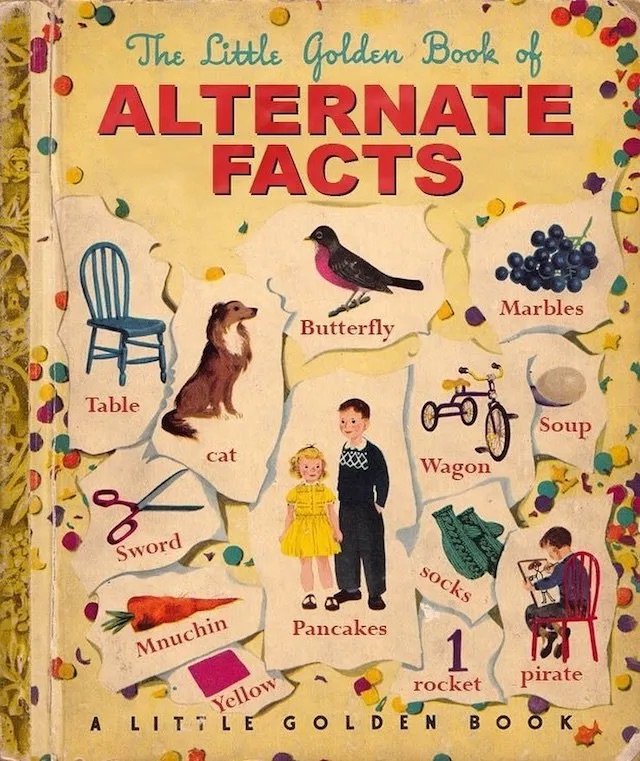
The phrase “alternative facts” has a specific origin. In January 2017, then–White House spokesperson Sean Spicer asserted, contrary to aerial photographs and transit-ridership data, that a presidential inauguration had drawn the largest audience ever to witness one. When pressed on the discrepancy the next day, senior counsellor Kellyanne Conway described Spicer’s claim on national television as offering “alternative facts.” That exchange is a clean instance of the first fabrication variety: a checkable, falsifiable claim, contradicted by available evidence, defended not by disputing the evidence but by relocating the claim into a category – “alternative” – implying it didn’t need to answer to evidence at all.
That relocation is the older and more general mechanism the phrase named. Hannah Arendt drew the relevant line in “Truth and Politics”: factual truth and rational or philosophical truth are not the same kind of thing, and factual truth is peculiarly fragile because it depends entirely on the testimony of witnesses and the survival of records. Nobody argues their way to how many people occupied a given stretch of ground on a given morning; it either happened one way or another. What can be attacked is the credibility of the witnesses and the reliability of the records, until the fact itself starts to look negotiable, and negotiability is mistaken for evidence that it belonged in the framing category after all.
III. What Trust Actually Does
It helps to be precise about what “the fabric that holds communities together” means in structural rather than sentimental terms.
Robert Putnam’s work on social capital treats trust as a coordination device: it lets a society function on a fraction of the verification costs it would otherwise require. Nobody personally audits engineering reports before crossing a bridge, or independently re-derives an agency’s statistics before accepting a policy built on them. Trust is what lets a large, specialized, interdependent society run without everyone becoming a forensic investigator of everyone else’s claims.
Francis Fukuyama’s related concept of the “radius of trust” – how far a society extends good faith beyond kin and immediate community – is a claim about coordination capacity, not a deterministic law of history. Societies have absorbed serious episodes of institutional lying and recovered; trust depletes and rebuilds unevenly. What can be said with more confidence is narrower: an actor who fabricates, in any of the three senses above, draws down a resource that took long, patient, largely invisible contribution to build, and that draws down faster than it refills.
IV. Two Case Tracks, and Who Actually Enforces the Line
The pattern recurs across very different political traditions, and it is not confined to politicians. The case for invading Iraq in 2003 rested substantially on an intelligence picture – mobile bioweapons labs, an active nuclear program – that the U.S. Senate’s own bipartisan investigation later found had been built on sources known within the intelligence community to be unreliable, with confidence levels overstated relative to the underlying evidence: the second fabrication variety, uncertainty dressed as settled fact. Assertions that a national election was stolen, pressed past the point where courts across the political spectrum – including judges appointed by the party making the claim – found no evidentiary basis for it, sit with Spicer’s crowd-size claim in the first variety: a checkable assertion maintained past the evidence available to support it.
Institutions produce the third variety on their own account, without needing a politician to originate it. The 2014 Department of Veterans Affairs wait-time scandal involved a secret, parallel scheduling system, built specifically so that reported wait times would look shorter than veterans were actually experiencing. Volkswagen’s defeat-device software was engineered specifically to detect emissions-testing conditions and behave differently under them. Neither required a single spoken lie; both were systems built to generate a false record automatically, corporate and governmental respectively, but structurally identical in what they did to the relationship between a reported fact and the underlying reality.
If institutions can be the source of fabrication as readily as its target, the harder question is who enforces the line? The answer is plural, not a single guardian. A Senate committee, not the executive branch that had commissioned the original intelligence, established the Iraq findings. The VA’s own Office of Inspector General, structurally insulated from the agency it investigates, exposed the scheduling fraud. Independent researchers at a university, not a regulator, first detected the gap between Volkswagen’s advertised and real-world emissions, which regulators then pursued. Enforcement runs through inspectors general, adversarial press, opposing counsel, whistleblowers protected by statute, and peer institutions with no stake in each other’s cover stories – a distributed, overlapping set of checks, none automatic, each capable of failing on its own.
V. The Asymmetry, Scoped Honestly
There is a genuine asymmetry in how false claims and their corrections travel, and it predates modern media by centuries. Jonathan Swift observed that falsehood flies while truth comes limping after it. Modern information infrastructure changes the speed but not the shape of the problem: a claim can circulate widely before a correction is assembled, and the correction typically reaches a smaller audience with less emotional charge than the original claim carried.
Psychological research on the “continued influence effect” – the finding that corrected misinformation can continue to shape judgment even after the correction is accepted – is one contributing factor to this asymmetry, not proof it is unbeatable. The finding describes how individual belief-updating behaves under study conditions; it does not establish that democratic publics are structurally incapable of correcting course at scale. The narrower and more defensible claim is that fabrication has a head start built into ordinary attention and the economics of what spreads, and that head start is a standing incentive for anyone willing to use it, regardless of which direction they come from.
VI. Complicity, Not Just Origin
A hadith narrated from Hudhayfah and preserved in Musnad Ahmad, with close parallels across the major Sunni collections, has the Prophet (peace and blessings be upon him) reported as saying that rulers who lie and oppress, and those who believe their lies and assist their oppression, do not belong to him and will not reach the Hawd.
The tradition locates guilt precisely where the enforcement question above leaves it: not only in the person who first fabricates, but in belief and assistance downstream of it. The Iraq intelligence case required analysts willing to shade uncertain assessments into confident ones, officials willing to repeat those assessments past the point of internal doubt, and a public willing to accept them without demanding the underlying sourcing. The VA’s falsified wait lists required schedulers willing to keep two sets of records and supervisors willing not to ask why the numbers looked better than the waiting rooms suggested. A false claim with no one willing to repeat it, defend it, or build a career or a policy on it dies where it was spoken. One that acquires believers and enablers becomes a premise other people organize their lives, votes, and institutions around. The hadith’s claim that the believer and the enabler share in the accounting is the same claim the inspector-general and whistleblower mechanisms above depend on: responsibility runs through everyone who had reason to know and chose not to act on it, not only through whoever spoke first.
VII. What Is Actually At Stake
What depletes, when fabrication in any of its forms passes as framing, is specific: the capacity of citizens to agree on a shared factual baseline before arguing about what to do with it, which is the precondition for democratic deliberation rather than democratic theatre. The willingness to accept a lost election or a lost court case, which depends on believing the process was honestly run. The public’s deference to expertise, which depends on believing that agencies, courts, and inspectors general are not simply another faction protecting its own material. And, over time, the ordinary civic habit of treating political opponents as fellow citizens who weigh values differently, rather than as people operating from a different reality altogether – because once fabrication is normalised, disagreement stops being about values and starts being about which side even inhabits the world as it actually is.
None of this requires that most political or institutional actors fabricate most of the time. Trust behaves like a commons – built slowly through broad, unglamorous contribution, and depleted disproportionately by a comparatively small number of visible violations, because each one teaches a durable lesson to everyone watching: that the official channel cannot be relied upon, and that private verification or withdrawal are the safer bets. What holds a community together is not the absence of disagreement but a shared floor underneath it – and that floor is rebuilt the same distributed, unglamorous way it erodes: one enforced distinction at a time, by whoever is positioned to check the record and willing to.
– – –
Bakchos is the founder of Blak and Black, an Australian media and advocacy platform established in 2010. Bakchos writes from the intersecting perspectives of Wiradjuri heritage, Jewish identity, and humanism.
© Bakchos, September 2026

All societies rely on certain agreed facts, once those agreed facts are challenged by those in authority. The glue that holds societies together begins to crumble.
The core argument isn’t that politicians lie — it’s that “alternative facts,” as a technique, works by borrowing the legitimacy of ordinary political framing (emphasis, values, priorities) and using it to shelter fabrication (false or evaded claims about what actually happened).
Starting from the January 2017 exchange that gave the phrase its modern meaning, the essay works through what actually gets damaged when fabrication is allowed to pass as ordinary political framing,
Hanson crowns herself
Alternative facts take flight
Truth waits at the gate