
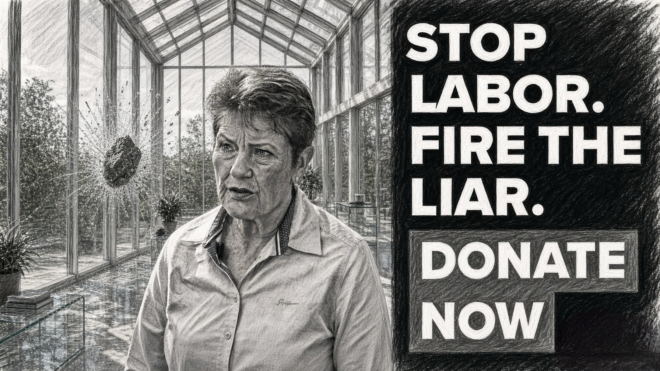
One Nation’s integrity campaign and the standard it invites onto itself
Pauline Hanson’s “Fire the Liar” campaign puts a single word at the centre of Australian politics: honesty. Anthony Albanese, the campaign says, has misled the country on the Voice, on tax cuts, on energy prices, on immigration. Whether each of those charges holds up is a separate argument, and one worth having on its own terms. What concerns this essay is narrower and, in a way, more interesting: a campaign built on the currency of integrity has to spend that currency carefully, and the candidates it has fielded for the Victorian election have already put a strain on the account.
The Record So Far
Public reporting on One Nation’s announced Victorian candidates has not been kind, and each case now has more texture than the first headline suggested. Mark Nicholson was presented in campaign material as a former criminal lawyer, However, in a News Corp article quoted by Crikey as published on 11 July, Nicholson stated that he practised in litigation for six weeks before leaving law to co-found the animation studio behind One Nation’s own Please Explain cartoons – the six weeks are real, the unqualified title is not, since Nicholson was never admitted to practise. Harrison Rindfleish’s biography stated he had completed a double degree in law and commerce; his own, since-deleted LinkedIn profile showed he had started the degree in 2025 and would not finish until 2028, and once the discrepancy was reported the party quietly amended the wording to say he was “undertaking” the degree, declining to comment further. Ben Lucas pleaded guilty to operating an unregistered category-one aquatic facility – a sauna and ice-bath business in Warragul – without the required council registration, and was fined without conviction recorded. Warren Pickering, named the party’s Victorian leader in August, had Hanson brand his former partner’s claims of past drug use and drink-driving as “false”; a day later he fronted the media himself and confirmed both, while disputing some of the specifics she had alleged.
Three corrected or reversed accounts inside one campaign is not proof that a party is indifferent to the truth. It is evidence that whatever vetting exists is under real strain – whether from the pace of candidate recruitment, the thinness of the bench, or both.
A caveat belongs here, in the interest of the same evidentiary precision this essay asks of the campaign it examines. This account works from the cases that reached public reporting – Nicholson, Rindfleish, Lucas and Pickering – not from an audit of One Nation’s full Victorian field, which numbers in the order of seventy candidates. Whether these four are the story because they are the most visible – Pickering leads the party in the state, Nicholson has a public-facing profile – or because the rest of the field is in fact cleaner, is not established by anything in this essay. Where the record is silent, it is more honest to say so than to let four names imply a pattern across seventy.
None of this is disqualifying on its own. People misdescribe their qualifications, make mistakes as young adults, and are entitled to move past them. The difficulty is context: these candidates are running under a banner that asks the electorate to judge a sitting prime minister on precisely the standard of whether his public statements about himself and his government are accurate.
One Nation’s Answer, Put Fairly
To their credit, One Nation’s response to these stories has been consistent rather than evasive, and it deserves to be stated on its own terms rather than dismissed. The party draws a line between a candidate’s personal history – a licence loss, a regulatory fine, an imprecise line on a campaign biography – and what it characterises as deliberate policy deception by a head of government with the machinery of the state behind him. It points to improved internal vetting since Hanson’s own difficult early years in politics. It argues that minor party candidates face a level of media excavation that major party candidates, with better resourced compliance teams, do not. And it notes, not unreasonably, that everyone deserves the chance to be judged as an adult rather than permanently as the person they were at twenty-two.
This is a coherent position. A candidate who once lost a licence for drink-driving is not, by that fact alone, disqualified from later campaigning on trust in government; the two kinds of failure are not obviously the same species. The question is whether that distinction survives contact with a campaign whose premise is that the public deserves leaders whose self-presentation can be taken at face value.
Two Tests, Two Verdicts
The word “hypocrisy” is doing a lot of work in this debate, and it is worth being precise about which test is being applied, because the two available tests point in different directions.
The consistency test. If a party campaigns on the proposition that integrity in public life matters and should be enforced, then it takes on an obligation to apply a broadly equivalent standard to its own candidates’ biographies and disclosed histories. Judged against that test, a former-criminal-lawyer label attached to someone not admitted to practise, and a completed degree that was in fact barely begun, sit uncomfortably beside a slogan demanding the Prime Minister be held to his word. These are not personal failings from a candidate’s past; they are present-tense misstatements made in the course of the very campaign accusing someone else of misstatement. That is where the inconsistency is sharpest, and where the charge of hypocrisy lands hardest.
The equivalence test. If instead the test is whether a candidate’s personal conduct – drink-driving, a regulatory fine, drug use before entering politics – is the same order of wrong as a Prime Minister allegedly breaking a specific policy promise to the electorate, then One Nation has the better of the argument. A past personal failing disclosed and left behind is not equivalent to an ongoing claim about what a government will or will not do. Conflating the two flattens a real distinction between private conduct and public office.
The honest answer is that both tests are being applied at once, to different candidates, and the campaign’s opponents are not obliged to pick only one. The credential misstatements by Nicholson and Rindfleish fail the consistency test on their own terms, because they are exactly the kind of self-description the “Fire the Liar” campaign says voters are entitled to trust. Pickering’s history of drug use and lost licences is squarely an equivalence-test case – old personal conduct, disclosed once it was put to him – and One Nation’s argument has real force there. But the “false” denial issued in his name the day before is not old conduct; it is a statement made during this campaign, about this campaign, and it fails the same test the credential errors do. Only Lucas’s case sits cleanly on the equivalence side: an administrative matter, promptly resolved, with no live false claim attached to it.
There is a weaker link in One Nation’s own defence, though, that deserves to be pressed rather than left to stand. Granting that minor party candidates face more media excavation than major party candidates do not explain what that excavation actually found. It did not fabricate a criminal-lawyer title Nicholson never held, or invent a completed law degree Rindfleish had not completed; it found documents the party itself had published and reported what was in them. Scrutiny finds dirt. It does not write the candidate bio. The volume-of-scrutiny argument explains why the errors surfaced when they did. It does not explain why the errors were there to be found.
The Wider Australian Pattern
It is also worth placing this in context rather than treating One Nation as uniquely exposed. Hanson’s own political biography includes a 2003 conviction for electoral fraud, later quashed on appeal after eleven weeks in custody – a fact her critics raise and her supporters treat as a closed chapter, which under the equivalence test it arguably is. The party has, at various points, preselected or employed people with more serious criminal histories than anything reported of the current Victorian slate. And it is not alone: both major parties have, over decades, endorsed candidates who later turned out to have overstated qualifications, concealed financial trouble, or carried undisclosed criminal records. Mutual accusations of hypocrisy are close to a constant feature of Australian political life, not a peculiarity of this campaign.
That context is true, and worth stating plainly, but it should not be allowed to do more work than it can. That major parties have also run qualification-fakers and candidates with old convictions does not equalise the ledger for a party campaigning on precisely this failure in someone else. A minor party that builds its pitch around a purity standard, then applies that standard to a sitting prime minister, does not get to claim the same “everyone does it” discount available to a party that never made the promise. That is not a claim that One Nation’s candidates carry some unique moral turpitude the major parties have escaped – the reporting does not support that, and this essay does not make it. It is the cost of the branding they chose.
What makes “Fire the Liar” different is not that its candidates have failings – every party’s candidates do – but that the campaign has deliberately made honesty the frame of the contest. A generic scandal is a scandal. A scandal that lands on a campaign built around the word “liar” does more damage per incident, because the standard being invoked is the standard being failed.
Conclusion
None of this settles whether Albanese has, in fact, misled the country on the Voice, on tax, on energy, or on immigration; that remains a live and legitimate argument to be tested on the merits. But a campaign that stakes its identity on the proposition that leaders must be held to their word invites a correspondingly high standard of scrutiny for its own house. Judged by that standard – the one the campaign itself set – at least three of its Victorian candidates have already fallen short, and the party’s defence, however coherently argued, is an argument for a lower bar than the one its own slogan advertises. That gap between the standard proclaimed and the standard practised is not proof of dishonesty on policy. It is, however, a reminder that a campaign built on someone else’s fire still lives in a house made of glass.
– – –
Bakchos is the founder of Blak and Black, an Australian media and advocacy platform established in 2010. Bakchos writes from the intersecting perspectives of Wiradjuri heritage, Jewish identity, and humanism.
© Bakchos, September 2026


Pauline Hanson‘s position on everything she mentions this is fake as her red hair Hanson is interested in only one thing and that’s Hanson.
What’s that old adage about people living in glass houses not throwing stones. For someone who live in a house made totally out of glass , Pauline you’re throwing an awful lot of stones around. Some of them are going to come right back at you.
Hanson herself is hardly a paragon a virtue.
Fire the liar is that Pauline Hanson‘s resignation letter because I think she’s the biggest liar in Australian politics at the moment.
I do not believe anything Pauline Hanson says. If she said the sun was out, I would have to put my head out the window to check, because it’s just as likely to be not out.
Pauline Hanson is a racist bitch.