
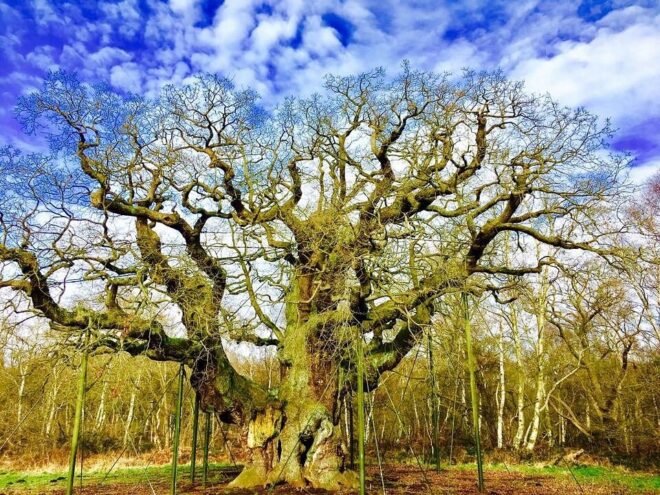
Something like eight hundred years ago – perhaps closer to a thousand, perhaps twelve hundred; no one alive can say for certain – an acorn split open in what would become Sherwood Forest and began, imperceptibly, to become a witness. This year the Royal Society for the Protection of Birds confirmed what many had feared and many more had refused to believe: the Major Oak, the vast, storm-shouldered tree that legend has sheltering Robin Hood and his outlaws, did not put out leaves this spring. It is dead. Not felled, not vandalised, not struck by any single catastrophe – simply, after the better part of a millennium, extinguished. The account of how is almost unbearably human in its detail. Scaffolding erected decades ago to hold up its heaviest limbs, meant to save it, instead forced the tree to keep pumping water outward to branches it should long since have been allowed to shed, denying it the slow “growing down” that very old trees need in order to age well. Two centuries of feet and tyres compacting the soil around its roots until rain could no longer reach them. A run of savage, rainless summers, one of them touching forty degrees, that no English oak evolved to survive. Even the water table beneath it, quietly altered by long-abandoned coal workings miles away. No single cause. A slow accumulation of small human intrusions, each individually forgivable, together lethal.
That is worth sitting with for a moment, because it is close to a parable for everything else in this essay.
The tree will be left standing where it fell into stillness, its dead wood a habitat in its own right, its famous split trunk still recognisable to anyone who has ever seen a photograph of Sherwood Forest. It gave, in dying, one more gift: it will go on hosting beetles and bats and fungi long after the last leaf it grew has composted into the forest floor. There is something in that – an old thing refusing to be entirely finished with usefulness. But first, the sadness, because the sadness is where the argument starts.
I came across the news the way most of us encounter grief now: scrolling, mid-morning, a stranger’s tribute landing between two advertisements. It stopped me anyway. There was something in the finality of a tree simply not waking up that did what statistics rarely manage – it made an abstraction, environmental decline, briefly and physically sad. And once I let myself feel that, I couldn’t stop the thought from widening. If the slow death of a single tree, caused by nothing more dramatic than centuries of human affection and inattention, could move me this much, what am I supposed to feel about everything else humanity has managed to destroy in only the last hundred years? Not a millennium of accumulated harm. A hundred years. One long human lifetime, and not much more.
It sent me to poetry, the way grief does. Louis MacNeice, writing out of some of the darkest years of the twentieth century, asked what use it is to look back at Greek and Roman antiquity when the present is on fire – whether the old world offers real comfort, or only an elegant way of avoiding the flames in front of you. The oak makes a better witness than the question does. It did not see Roman legions on the march through Sherwood – Rome’s roads and forts in Britain lay elsewhere – but by the time it was old enough to be worth naming, it had stood through the world Robin Hood is supposed to have inhabited, through a Lionheart’s Crusade, the plague, the Reformation, the burning of women as witches, the Renaissance, Napoleon’s wars, the slaughter on the Western Front, and the Luftwaffe over England a few decades later. It does not matter, to the tree, that it witnessed any of this. It matters to us, because something rooted and patient stood through all of it asking nothing in return.
That sent me, oddly, to Sylvia Plath’s poem “Apology to Pan”. He is colossal, overbearing, a spring that arrives less like a gift than an argument the poet is losing, nature not as scenery but as an excess she has to apologise to. That is closer to what actually killed the Major Oak than any story about neglect would be: not too little love, but too much of it, arriving steadily and without limit for two centuries, the way Plath’s Pan arrives in a single unmanageable morning – an abundance nobody thought to ration.
Pan and Bakchos – Dionysus, to use the fuller name – are old companions in the Greek imagination: different provinces of the same appetite, the wild and the intoxicated, usually found in the same retinue. If Pan is nature’s excess, Bakchos has always been the god of what happens when a society forgets its limits: excess, dissolution, appetite finally outrunning restraint. Reading the news about the oak, it felt for a moment as if the two halves of my own name had agreed on something.
Four things killed the Major Oak, on the RSPB’s own account: the accumulated weight of people who loved it, scaffolding installed to save it, a mine many miles away, and heat the species was never built to survive. None of the four is a villain. All four together were fatal. Each has a counterpart operating well beyond Sherwood Forest.
Take compaction first, because it is the mechanism least like a villain and most like all of us. Nobody compacted the ground around the Major Oak out of hostility. They came because they loved it: two centuries of feet, prams, coach parties, and eventually cars, each visit reasonable on its own terms, none of them individually enough to harm anything. The harm was never in any single visit. It was in the aggregate, in a volume of ordinary, well-intentioned traffic that nobody was weighing against the one number that mattered – how much a particular patch of soil could bear before it stopped letting water through. We already have a word for a limit like this in every other context – carrying capacity – and use it without hesitation for soil, for fisheries, for grazing land. We have simply never applied it to wealth itself. Concentrated wealth is compacted the same way, and re-compacted every year the same way: not by any single fortune’s origin, but by the ordinary mechanics that keep it exactly where it already is. Compounding returns that grow fastest on the largest base. Tax architecture drafted with the help of the people it benefits. Index funds that lock passive ownership into the same few hands regardless of merit. Regulators and boards who move between each other’s chairs closely enough that the rules rarely tighten. Each mechanism is legal. Each is defensible on its own terms. None of them, alone, compacts anything. Together, repeated every year without anyone weighing the aggregate against a limit, they compact the same ground a little further each season. The RSPB’s response to the oak’s compacted soil was not to shame the visitors who had loved it too much. It was to go underneath the compaction, mechanically, season after season, breaking it up and working new material back in so the soil could breathe again. Redistribution is the same operation. Not punishment. Aeration.
The second mechanism is crueller, because it was installed with the best of intentions. The scaffolding under the Major Oak’s heaviest limbs was built to save it, and for decades it did exactly what it was designed to do: it kept the tree standing in the shape everyone recognised and loved. What it also did, invisibly, was force the tree to keep pumping water outward to branches it should by then have been shedding. Very old trees survive by getting smaller – by retrenching, dropping the limbs they can no longer support, becoming a more modest version of themselves that costs less to keep alive. The scaffolding, built to preserve the tree’s old shape, made that retrenchment impossible, and the tree paid for the preservation of its own silhouette with resources it could no longer spare. We build exactly this kind of scaffolding constantly, around institutions and industries and inherited advantages we have decided are too recognisable to be allowed to shrink. Fossil fuel subsidies do precisely what the scaffolding did to the oak: they keep an ageing structure standing in its familiar shape, at real and rising cost, specifically to avoid the harder work of letting it become something smaller and different in time to survive. The 2008 bank bailouts were the same choice made at a different scale and speed – when the alternative was letting specific institutions contract or fail and rebuilding the financial system in a different, smaller shape, most governments chose instead to prop the existing shape back up, water still pumping outward to the same limbs. Inherited wealth performs the same function at the level of a family or a class – scaffolding for a shape of advantage that would otherwise have to shrink or be renegotiated with each generation, propped up instead so it never has to be. None of this argues that support is always wrong; a young tree needs staking, and a young institution sometimes needs protecting. The question the oak’s death poses is a question of timing: at what point does support stop enabling growth and start preventing the shrinking that would have kept the thing alive, honestly, in a smaller form?
The third mechanism is the one hardest to sit with, because it involves no one standing anywhere near the scene of the harm. The water table beneath the Major Oak was altered by coal workings some distance away, dug and abandoned long before most of the people mourning the tree this year were born. Nobody who worked that mine ever stood under the tree, weighed its roots, or intended it any harm at all; the causal chain simply ran further than anyone’s sense of responsibility had been built to reach. Emissions produced in one jurisdiction alter rainfall and temperature in another. Extraction in one country depletes an aquifer or destabilises a coastline in a country that never consented to the extraction. In each case the people who caused the harm and the people living with it are separated by a distance that no existing accountability structure was designed to close – not because closing it is impossible, but because every structure we currently have for assigning responsibility was built at the scale of a nation, a company, a mine, while the damage itself now moves at the scale of an atmosphere or a water table. That mismatch shows up wherever accountability is drawn at one scale and the harm travels at another: in a border, in a supply chain, in a river shared by countries that drew their maps before anyone measured what the river carried downstream. The mine does not resolve what to do about any of that. It only proves the mismatch is real, and older than any current argument about it.
The fourth mechanism is harder to translate cleanly than the first three, because a thermometer makes a poor stand-in for a person. The Major Oak evolved for a particular range of English weather, and when that range was exceeded – three consecutive drought summers, one of them touching forty degrees – its systems failed because they were being asked to operate outside a tolerance they were built for. Put a person back into that sentence in place of a species, and it stops being a metaphor and becomes recognisable history. Pauline Hanson’s maiden speech to the Australian parliament in 1996 landed in regional communities living through exactly this kind of exceeded tolerance – the tail end of tariff cuts, rural bank closures, and a wool and manufacturing collapse that had already gutted the towns she was elected to represent – and it found an audience not because those communities had been persuaded by an argument but because something in their capacity to absorb further loss without blaming a visible group had already been exceeded before she ever spoke. That does not make the target she chose any less wrong, or the harm done to the people she blamed any less real. A stress response is still a response a person and an institution are responsible for: Hanson for the choice of target, the parliament that gave her a platform, the media that amplified her, and the party structures that have spent thirty years since finding new versions of the same grievance to court. None of them were weather systems reacting passively; all of them made choices. But the tolerance itself – the economic conditions that were exceeded before the scapegoating started – is exactly the kind of thing a society can choose to monitor and repair in advance, the way the RSPB now tracks the Major Oak’s remaining relatives with soil moisture sensors rather than waiting for the next tree to simply fail to wake up. A society that wants fewer people to reach for the nearest scapegoat under pressure has two jobs, not one: hold Hanson, the parliament, and every institution that profited from her afterward responsible for the choice they made, and do the slower work of not exceeding people’s tolerance in the first place. Do only the first and the scapegoating recurs under a different name each decade. Do only the second and the people already harmed by the version that happened are never held to account.
Put the four mechanisms side by side and the same pattern holds across all of them: the visible actor at the point of collapse – the last dry summer, the last visitor’s footstep, the last panicked vote for whoever promises to close a border – is rarely where the causation actually lives. It lives further back: in accumulated ordinary behaviour, in support structures no one has had the nerve to dismantle, in harm travelling from places the people affected will never see, in tolerances quietly exceeded long before anything visibly broke. None of that dissolves responsibility. If anything it multiplies it, because the people who could have addressed the mechanism early – the compaction, the scaffolding, the distant extraction, the exceeded tolerance – usually had far more capacity to act than the person left holding the consequences at the end. That is not a comfortable place to end an argument. It is, simply, a more accurate one than the version where a fairer world just requires everyone to imagine harder.
Which returns me, finally, to the oak. It spent the better part of a thousand years absorbing an unbroken sequence of the worst things human beings have done to each other and to the world, and it kept standing, not because it forgave any of it, but because that is what a living thing rooted deeply enough does: it endures the record without being reducible to it. And now that it is dead, it has not stopped being useful. It will feed the forest for decades yet, quietly, without asking to be thanked for it. There is a lesson in that for anyone doing the slower, less satisfying work of going back into the compaction, the scaffolding, the distant extraction, and the exceeded tolerances that are quietly killing the actual one, and doing something about each of them specifically. It probably will not finish in any of our lifetimes. Ours is not, by any obvious measure, an era of hope; if anything it looks a good deal more like an era of greed and self-interest wearing hope’s old clothes. But I can imagine that there was an era of hope once, further back than living memory reaches, in the way the oak’s earliest years are further back than any record we have of them. And I can imagine, without being able to prove it, that there will be another one ahead – not because the evidence compels it, but because going back for the mechanism, rather than settling for the elegy, is the only method that has ever actually fixed anything. Not a policy. Not a plan. Just the insistence that we look at what actually killed the thing we are mourning, and the stubborn, oak-like patience to keep standing while we take it apart, one mechanism at a time.
Apology to Pan
Colossal is cockcrow of spring today with all
this genesis of bird and budding leaf
flung up from fertile gardens in your skull
to dwarf my child-cry for elaborate proof.
I pouted at the strictness of your season,
poured honey in the stream, colored pale sun
with richer pink than you allowed horizon:
nothing there was I did not scribble on.
This morning I woke to thunder in the yard,
ran to my window and beheld the trees
exploding green fireworks of foliage
at utterance of your enormous word:
diminished by love’s hyperbole, I trudge
toward you through jungles of gigantic grass.
~ by Sylvia Plath ~
– – –
Bakchos is the founder of Blak and Black, an Australian media and advocacy platform established in 2010. Bakchos writes from the intersecting perspectives of Wiradjuri heritage, Jewish identity, and humanism.
© Bakchos, September 2026



Well said: mourning an outcome is not the same as understanding the mechanism that produced it.
Major Oak feels to me a bit like the canary in the mine. If it has died what about the conditions around all the other trees? Politics won’t matter if the trees die; it only matters if we can preserve all forms of life.
Cicero says the gods did not steal Crassus’s life but gave him death as a gift. Crassus died just before the Social War
And the gods Kelly spared Major Oak the added trauma of having to witness the final destruction the orange huge one is going to cause civilisation on this planet.
Every living thing is nourished by the death of other living things. The debt one plant or animal owes to the dying of others cannot be paid back directly. Instead, they pay it forward.
I stood under Major Oak a few years ago, I found it a profoundly spiritual experience.