
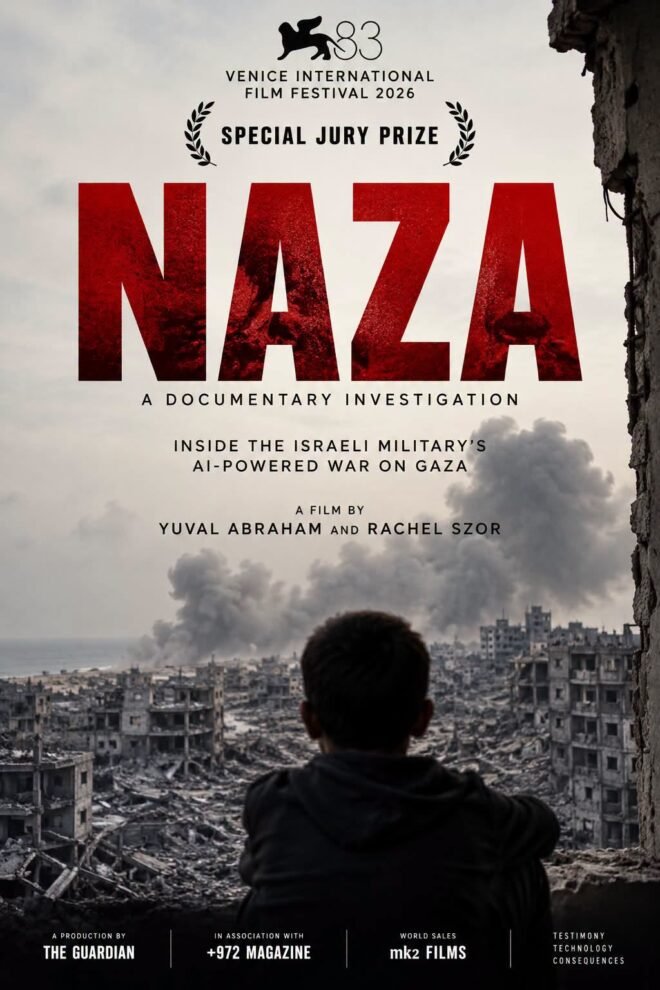
The feet are small. I don’t know how many, perhaps 15, 20 sandwiched between slabs of concrete. They are NAZA. A husband is calling for his wife, “My love”, for his son, “Sa’id … I told you to look after your sister …”. The closing images of the documentary NAZA, are the sole visual confrontation of the destruction and utter waste of life wrought upon Gazans since October 7.
I was fortunate to secure a ticket to one of the preview screenings of Yuval Abraham and Rachel Szor’s documentary NAZA over the weekend. Filmed on the rooftops of Israeli buildings at night between late 2023 and 2025, the movie’s is question and answer format moves between twenty-four people, all shrouded in darkness, their profiles often visible, but not much else. Anonymity was required to protect them from arrest; one source refused any production at all, so that all that you heard was a voice, and even that, as with all candidates was apparently modified. The focus of the movie lies in the concept of collateral damage, the acceptance of extinguishing the lives of non-combatants in order to kill a Hamas operative. Each non-combatant is a count of one. There is no weighting for age or gender. Twenty lives taken as collateral damage counts at a NAZA of 20, and twenty is the number of collateral damage lives that can be taken without authorisation by the lowest ranked soldier. With authorisation, they could take 500 lives. Each suspected Hamas fighter is assigned a NAZA value and when they are all combined, the total count exceeds the population of Gaza.
The movie confirms what we saw. Gazans told to evacuate for areas, and then the area being razed. Death zones being designated that the Gazans did not know about until they crossed some unseen line. Deliberately targeting fathers when they go home to sleep with family. Israeli intelligence track combatant activities, listen to conversations, watch through the camera on the phone. All the data they collect is analysed using artificial intelligence (AI), matching details with that from other phones to form a comprehensive view of the networks between people. The details are then used to target attacks, but there is a substantial risk – 15% of targets are incorrectly identified by AI.
Those interviewed varied in the degree to which they dissociate from Israel’s and their own actions. Whilst one states that Israel is committing genocide, most present an image of powerlessness, “what can I do? I’m just one person.”
The most disconcerting aspect to me was the warnings of 15-20 years ago about online war games and Grand Theft Auto. One source said it was “fun” when they carried our remote attacks. There was a sense of ambition, even competition that made me think that some were trying to “level-up”. The desensitisation that we were warned about years ago with video games came through with the interviewee who commented that psychological support was available to those in his unit, but no-one had needed it. It was perhaps this that the movie most tried to convey – the sense of detachment by those involved in remote combat. One person expresses empathy for the destruction carried out by the Nazis and noted that they were horrendous crimes, but in a moment of cognitive dissonance says that he can now see how they did it, ”So what does that make me?”
There is brief discussion of Benjamin Netanyahu and his office that oversees everything. It does not dig deeply into what he does, but it draws a parallel between the killings and his leadership.
At the conclusion of the movie, a short discussion was held between Palestinian writer Samah Sabawi, Community Engagement Director of the Jewish Council for Australia Ohad Kozminsky and Pakistani-Australian journalist Osman Faruqi. A key question was asked by Faruqi as to whom the others thought the movie was trying to speak to. Sabawi asserted that none of it would be news to Israelis, who serve in the military and know well what goes on; Omar thought it could be directed at the Jewish diaspora and Zionist populations; but overall there was a sense that the movie simply confirmed what we mostly know and that perhaps it did not go far enough.
For myself, I thought the movie did what documentaries attempt to do – act as an account of matters as close to the sources as they can manage. It wasn’t really investigative journalism, but more a confirmation of what we have come to know. Given the collection of interviews commenced not long after the War in Gaza commenced, some of the matters may have been less well known by those outside of Israel and Palestine even two years ago, but the release three years on from October 7 means that much of that material is source notes for what has been before the International Criminal Court for almost three years. That makes the documentary no less important. We need contemporary records to validate the claims that arise and refute the denials.
As the session wrapped up, the final words were left to Samah Sabawi. Having recounted earlier in the discussion about meeting with friends in a restaurant in Gaza that has since been destroyed, it was clear how close these matters were to her. Somewhat emotional, her final words to the audience were an appeal for us not to forget the people of Gaza and Palestine. “We can still be saved, and the system can still be collapsed.” I hope that is so.
– – –
© Watershedd, October 2026



The IDF is made up of heartless, soulless people, who have no concept of honour or morality.