No passport can explain the pulse beneath your skin,
No border holds the breath that gathers there within.
The lines across your palm are rivers, branching, twined –
Each carries its own story, each pours into humankind.
We are not ranks in rows, nor colours sealed apart;
The world keeps making kin wherever hearts meet hearts.
From many tongues, one chorus; from countless seeds, one field—
The differences we cherish are no reason to divide.
So let the hands reach outward, let old walls come undone:
The many are not lesser. The many make the one.
~ Bakchos ~
Under Sail
Nothing settles me like being under sail; no lake or river can offer the same quiet. Out on the water, whether in fair wind or foul, I am reminded how small a single boat is beneath the vastness of sky and sea. A sailor soon learns that he does not cross an ocean alone: he relies on the hands that rigged his vessel, the charts drawn by those who went before, and the lights kept burning on far-off shores. Without that help I would leave no more trace than a wake, and that is why I hold so firmly to the idea of community. Strip it away and there is nothing left: no harbour to return to, no purpose in setting out, no knowledge of who we are.
Yet the sea teaches a second lesson, and it is a less comfortable one. Every harbour has a master, and every master decides who may tie up and who must stand off in the roads. A port can welcome a stranger or turn it away, and the vessel waiting outside has no say in the matter. This essay is about that decision: about the people who make it, the people on whom it is made, and the rare few who refuse to accept that it belongs to the harbour alone. When one crew turns its back on another and leaves them adrift, we do worse than abandon them to open water. We tell every other vessel afloat what kind of harbour we keep.
The Harbour Doors
So much of the strife we encounter is born of greed, and greed itself grows from doubt about our own worth and our place aboard. We cannot stand to see another sailor, let alone another fleet, make better headway than ourselves, as if their fair wind must somehow mean our calm. Instead of welcoming different rigs and different ways of reading the water for the richness they bring, we treat them as rival ships to be feared, and we reduce them to crude caricatures. Many peoples have been cast adrift in this way, but in the last century few were cast adrift as deliberately as the Jews of Europe, and few warnings are as clear as the way that persecution was built, step by legal step.
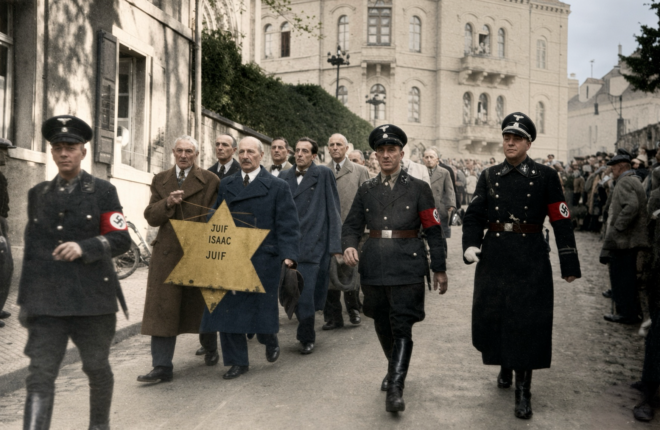
The Holocaust, the systematic murder of six million Jews that its architects called the Final Solution, grew from a poison cultivated for years beforehand. The Nazi regime blamed the Jewish minority for Germany’s defeat in the First World War, caricatured them as wealthy people who looked after only their own, and then wrote persecution into law. The Nuremberg Laws of 1935 stripped Jews of German citizenship and made marriage between Jews and non-Jews illegal. They also defined who counted as a Jew by ancestry, by the religion of a person’s grandparents, regardless of what that person believed or how they lived. Identity was no longer something a person claimed. It was something the state assigned.
The people being sorted had no voice in the sorting, and the world outside had every opportunity to answer. In July 1938 delegates from thirty-two countries met at Évian, on the shore of Lake Geneva, to discuss the refugee crisis, and most declined to take more. Australia’s delegate, Thomas White, explained that his country had no real racial problem and did not wish to import one, a remark that sits uneasily beside the treatment of Aboriginal people at home. It also shows how a harbour master thinks. The question at Évian was never what the refugees needed. It was only what the port was prepared to bear. Nobody asked the people waiting at the border what they wanted, and nobody asked what they were fleeing.
The Night of Broken Glass
Four months later came Kristallnacht. On 7 November 1938 Herschel Grynszpan, a seventeen-year-old Polish-born Jew living in Paris, shot the German diplomat Ernst vom Rath at the German embassy. His family had just been expelled from Germany and left stranded at the Polish border. When vom Rath died on 9 November, the Nazi leadership seized on his death as a pretext. Across the night of 9–10 November, the Brownshirts, along with SS men and ordinary civilians, carried out a pogrom through Germany and the newly annexed Austria. The official toll was 91 Jewish deaths, though historians believe the true number, including deaths in custody and suicides, was far higher. More than 1,400 synagogues were damaged or destroyed, thousands of Jewish shops were smashed and looted, and some 30,000 Jewish men were arrested and sent to concentration camps. The regime then fined the Jewish community a billion Reichsmarks for the damage, funding its war machine from the victims themselves. Kristallnacht was not the beginning of the genocide, which took shape in the early 1940s, but it was a decisive step towards it.
Many Germans were appalled, and the foreign press reported the pogrom in horror, yet governments responded with little more than diplomatic protest while the doors remained closed to those trying to leave. The harbours stayed shut, and the harbour masters expressed their regret.
A Walk Across Melbourne
In Melbourne, however, an elderly Yorta Yorta man named William Cooper, secretary of the Australian Aborigines’ League, led a delegation on foot to the German Consulate on 6 December 1938 to deliver a protest against the cruel persecution of the Jewish people. The consulate refused to accept it. It is often described as the only private protest of its kind anywhere in the world.
Consider who made it. Cooper’s people lived in a country that left them out of its census, controlled where they could live, work and travel, and in many places took their children. Nobody in government had asked them what they thought of Germany, and nobody expected them to have a view. They went anyway. Cooper had no treaty obligation to invoke, no seat at any conference, and no standing that any government would recognise. He had only the conviction that the people being hunted in Berlin and Vienna were people. He did not ask whether the Jews of Berlin were his people. He asked whether they were people, and the answer settled his duty.
The protest changed no policy and saved no lives that anyone can count. But it did what Évian refused to do. It treated the plight of a stranger as a claim on everyone, and it showed that a person with no power to compel can still decline to be silent. Delegates with the authority to act chose not to. A man with none chose to walk.
Both Halves
This story reaches me from both sides of my family. My mother’s family were French Jews, not German Jews, but what happened in Germany that night reverberated through Jewish communities everywhere in Europe and beyond. It is worth remembering that the shot that gave the Nazis their pretext was fired in Paris. Within a few years, French Jews would be defined by statute under the Vichy regime and deported in their tens of thousands. My father’s family are Wiradjuri, not of the same nation as William Cooper and his League, but in a way that matters all Indigenous Australians are family. So in one story I find both halves of my own: one the people the persecution was aimed at, the other the people who answered it. They are connected in different but telling ways.
Made in the Image of God
William Cooper was a devout Christian, and it is hard to read his protest as anything other than an act of faith. He did not need a treaty, a statute or a diplomatic obligation to tell him that what was being done to the Jews of Germany was wrong. That conviction is not peculiar to him. It sits at the root of all three of the Abrahamic faiths, and it is the reason I say that racism is not merely a social failing but an offence against the teachings of God. The Book of Genesis opens with humankind created in the image of God, with no distinction of tribe or complexion, and the rabbis who read that text drew the obvious conclusion. The Mishnah teaches that Adam was created as a single human being so that no one could ever say to another, my ancestor was greater than yours. The Hebrew Bible then commands again and again that the stranger be treated as one of your own, because you were strangers in the land of Egypt. A people who had been enslaved were told never to forget it, and never to do it to anyone else.
The Christian scriptures carry the same teaching into the new covenant. Peter, told in a vision to stop calling people unclean, declares in the Acts of the Apostles that God shows no favouritism but accepts people from every nation who do what is right. Paul writes to the Galatians that in Christ there is neither Jew nor Greek, slave nor free, male nor female. Whatever Christians have done in history, and the record is often shameful, anyone who uses the Bible to justify a hierarchy of races is reading against the grain of the text. Jesus’s own answer to the question of who is my neighbour was a story about a despised Samaritan, a man of the wrong people and the wrong religion, who stopped for a stranger while the respectable passed by.
The Quran speaks to the same truth in a voice that is, if anything, more direct. It tells all of humanity that God created them from a single male and female and made them into peoples and tribes so that they might know one another, and that the most honoured in the sight of God is the most righteous, not the highest born. The Prophet Muhammad, in his farewell sermon, told his followers that an Arab has no superiority over a non-Arab, nor a non-Arab over an Arab, nor a white person over a black person, nor a black person over a white person, except in piety. I am not a scholar of Islam and I do not pretend to be one, but a reading that is this plain does not require a scholar.
Three faiths that have quarrelled bitterly, sometimes murderously, with one another, and yet on this single point they speak with one voice: every human being carries a dignity that no person and no state conferred and none can remove. The consequence for our harbour is plain. If no state conferred that dignity, then no state holds the authority to revoke it, and no harbour master may treat the admission of a human being as a favour that is his to grant or withhold. To rank people by blood, by colour, by creed or by the fractions of ancestry that Australian law once used to sort Aboriginal people is not a different opinion about politics. It is a quarrel with the Creator. And those who claim no faith can reach the same place by reason, as the drafters of the Universal Declaration of Human Rights did in 1948, when they began with the words that all human beings are born free and equal in dignity and rights.
The Question Now
That is the test that faces us today, and we are failing it in too many places at once. In Gaza, civilians have been killed in their tens of thousands, children among them, and the international hunger monitor confirmed famine in Gaza City in August 2025, while the world argued about words rather than acting on the facts. I say this as someone who also grieves for the Israelis murdered and taken hostage on 7 October 2023. The human rights of Jewish people and the human rights of Palestinian people are not rivals. A person who cares about one and is indifferent to the other has misunderstood what a right is. Antisemitism and Islamophobia grow in the same soil and are watered by the same indifference, and I do not accept that I must choose which of my neighbours deserves to live.
In Sudan, the city of El Fasher fell to the Rapid Support Forces in October 2025 after a siege of around eighteen months, with the United Nations reporting systematic killing, sexual violence and famine among a trapped civilian population. More than twelve million Sudanese have been driven from their homes in what the UN describes as the largest displacement crisis in the world, and it has received a fraction of the attention it deserves. In the eastern Congo, millions of people have been displaced by armed groups fighting over the very minerals that sit inside the phones in our pockets, and the killing has gone on for so long that the world seems to have decided that it is simply what happens there. Add to these West Papua, where Indonesian rule has meant decades of repression of a Melanesian people on Australia’s doorstep, and the list is a long one. In every one of these places the rest of the world is the delegation at Évian, deciding what it is prepared to bear. In very few of them has anyone yet matched William Cooper.
Was the Community Asked?
It would be comfortable to treat all this as other people’s tragedy, unfolding in places we can safely read about and move on from. But the lesson of Évian is that looking away is also an act, and the connection to us is often closer than we like to admit. Australian money and Australian companies are in many of these stories. In Ecuador, a subsidiary of Hancock Prospecting, the company chaired by Gina Rinehart, has been exploring for copper and gold since 2017, and has since expanded through partnerships with the Ecuadorian state mining company and with Titan Minerals. Local communities, including in the Intag valley and the parish of Buenos Aires in the north of the country, have resisted mining on their land for years, saying they were never consulted. In 2021 Ecuador’s Ombudsman’s Office called on the government to suspend mining activity in Buenos Aires after what it described as excessive military force used against residents, and Australian advocacy groups have reported tear gas used on unarmed townspeople. The company is entitled to answer those claims, and it is not for me to pretend that every allegation made against any company is established. But Australians are entitled to ask hard questions about what is done in their name and with their country’s most famous fortunes, and the question is the one that Indigenous Australians have had to ask for generations: was the community asked, and did it have the right to say no?
We know exactly what it looks like when a community is not asked. In May 2020 the Juukan Gorge rock shelters, which held forty-six thousand years of continuous human history, were blasted away by a mining company acting within its legal rights. The Traditional Owners, the Puutu Kunti Kurrama and Pinikura peoples, had no power to stop it. A country that has learned that lesson at home has no business exporting the opposite lesson abroad. Free, prior and informed consent is not a courtesy that a company extends when it feels generous. It is the standard in the United Nations Declaration on the Rights of Indigenous Peoples, which Australia endorsed in 2009, and it applies to people in Ecuador as it does to the Wiradjuri and the Yorta Yorta.
Notice that this is the same question Évian asked and answered badly. The harbour master decides what the port will bear, and the people outside the harbour wall are not consulted. Whether the port is a European conference hall, a mining company’s board room or a government department in Canberra, the failure has the same shape: the people most affected are the last to be asked.
Everyone’s Business
This is why, through Blak and Black, the human rights of people of all faiths, cultures and colours are given focus. Indigenous people in Australia have suffered, and continue to suffer, beyond limits most non-Indigenous people would find unacceptable, but the plight of our friends in West Papua, Palestine, Sudan, the Congo and many other places is no less worthy of our concern. The lesson of Cooper’s walk is that these concerns are not in competition. Nobody has to choose between caring for their own people and caring for strangers, because the standard that protects one protects the other. A community that insists on being asked about its own country has no honest way to deny the same right to a stranger, and a community that speaks up for strangers earns the standing to be heard when its own turn comes.
There is little else to mark a person’s worth on this earth than the effect they leave on others. Deeds that do good leave the whole community in a better place than those that destroy and marginalise. We cannot expect support in the pursuit of our own rights if we do not support the rights of those we see wronged before us. If William Cooper and the Australian Aborigines’ League, who were not even counted in their own country’s census, could speak up for Jews persecuted by the Nazis, why can’t we speak up for those around us who are persecuted and denied their rights?
I return, as I always do, to the water. Every sailor has at some point been towed into harbour by a stranger, and none of them asked the stranger’s nationality before taking the line. The sea does not sort its travellers, and neither should the people who keep the lights. The God of Abraham, of Jesus and of Muhammad did not make some of us to be strangers to the rest. Everyone’s rights are everyone’s business, and the duty to act begins with whoever is standing close enough to see.
– – –
Bakchos is the founder of Blak and Black, an Australian media and advocacy platform established in 2010. Bakchos writes from the intersecting perspectives of Wiradjuri heritage, Jewish identity, and humanism.
© Bakchos, October 2026