The Man with the Empty Pot
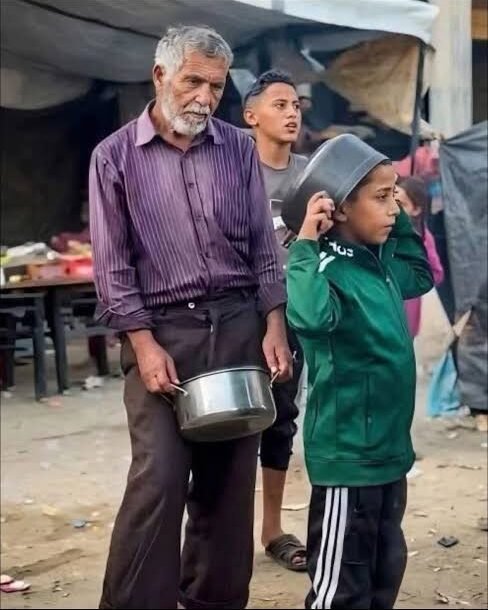
In the short film that has been passing from phone to phone, an old man stands holding an empty pot. His name is Abdullah Mohammed Saber Ayoub. He is seventy-seven years old, an engineer by training, a man who studied, practised a profession and raised a family, and who has lived most of his life in the shadow of one catastrophe or another. His son is gone. His son-in-law is gone. The rest of the family waits somewhere beyond the edge of the frame for him to bring back whatever can be ladled into the pot. Watershedd has already written about him on these pages, and written well, about the furnace that reshapes a person and the debt owed by those of us who watch from a safe distance. I want to come at the same man from another direction, because what struck me when I watched him was not only what had been taken from him. It was what had not.
At one point it seems he might weep, and he does not. He lifts his chin and looks into the lens, which is to say he looks at us, and what is in his face is neither pleading nor performance. It is composure, of a kind I have rarely seen and could not honestly claim for myself. A man who has lost a son and a great part of his family is standing in a queue for food, and he declines to give anyone the spectacle of watching him come apart.
How many of us would keep our chins up if the same thing were done to us? I suspect most of us would falter long before Mr Ayoub has. That is the question I want to take seriously. Why do some people, placed under a weight that ought to flatten anyone, seem to grow quieter and straighter beneath it, while others, perhaps most of us, would give way? Is it something that was in them all along, waiting for the occasion, or something that the occasion itself makes? I do not think there is a tidy answer. But the ancient world spent a great deal of time on exactly this problem, and has more to say about it than we usually allow, so I begin with the sentence that gives this essay its title.
The Sentence from the Danube
Marcus Aurelius wrote the book we call the Meditations for no reader but himself, much of it, tradition holds, in army camps along the Danube, while he governed an empire that was fighting on its frontiers and burying its dead from plague. He titled it, if it was titled at all, , Τὰ εἰς ἑαυτόν, the things addressed to himself. The second book opens with an instruction for the morning: remind yourself that today you will meet the meddlesome, the ungrateful, the insolent, the deceitful and the envious, and that they are as they are because they do not know good from evil. Then comes the sentence that I cannot read without thinking of the old man with the pot.
ἐγὼ δὲ τεθεωρηκὼς τὴν φύσιν τοῦ ἀγαθοῦ ὅτι καλόν, καὶ τοῦ κακοῦ ὅτι αἰσχρόν, καὶ τὴν αὐτοῦ τοῦ ἁμαρτάνοντος φύσιν ὅτι μοι συγγενής, οὐχὶ αἵματος ἢ σπέρματος τοῦ αὐτοῦ, ἀλλὰ νοῦ καὶ θείας ἀπομοίρας μέτοχος, οὔτε βλαβῆναι ὑπό τινος αὐτῶν δύναμαι· αἰσχρῷ γάρ με οὐδεὶς περιβαλεῖ· οὔτε ὀργίζεσθαι τῷ συγγενεῖ δύναμαι οὔτε ἀπέχθεσθαι αὐτῷ
But I, having observed that the nature of the good is beautiful, and of the evil ugly, and that the nature of the wrongdoer himself is kindred to me, not of the same blood or seed, but sharing in the same mind and a portion of the divine, can neither be harmed by any of them, for no one can wrap me in what is shameful, nor can I be angry with my kinsman or hate him.
Three observations are folded into that one long Greek sentence. The first is that goodness is beautiful and wrongdoing ugly. Greek makes this easy, because kalon and aischron do double duty, meaning fair and foul to the eye and noble and shameful in conduct, and the language itself refuses to separate the two. The second is that the person who does wrong is still kin to me, not by blood but by sharing in reason, in what Marcus calls a portion of the divine. The third, which follows from the other two, is a claim about invulnerability: nobody can truly harm me, because the only thing that can truly damage a person is moral ugliness, and no one else can put that on me. Only I can do that to myself.
The verb is worth pausing over. Peribalei comes from a word meaning to throw something around, as one throws a cloak about a person’s shoulders. No one, says Marcus, can throw ugliness around me like a garment. They may take the house, the field, the freedom of movement, the people I love, even my life, and these are real losses that I do not pretend to be anything else. But the cloak of shame that an oppressor hopes to fasten on the one he oppresses, the sense of being made small and soiled by what has been done, can only be worn if the wearer consents to put it on. Watershedd put it plainly when she wrote that the shame in that frame is not Mr Ayoub’s. The old Stoic and the modern writer arrive at the same place from opposite ends of two thousand years.
The Stoics built their whole ethics on the distinction between what is up to us and what is not. Our judgements, our choices and our assent to how things appear lie within our power. Everything else, body, property, reputation, even the lives of those we love, lies outside it, and the discipline is to rest one’s worth entirely on the former. It is a hard doctrine, and in a comfortable mouth it can sound like a counsel of indifference. It is worth remembering that Marcus was an emperor when he wrote it, and that Epictetus, whose discourses he had read and absorbed, was born a slave. The test of a philosophy is not how well it reads on a cushion but whether any human being can actually live it when everything external has been stripped away. That is why a man like Mr Ayoub matters to the argument. He is not an illustration of Stoicism; I doubt he has read a line of it. He is evidence that what the Stoics described is real.
One more feature of the sentence deserves notice, because it keeps it from being a mere doctrine of endurance. Marcus goes on to say that human beings are made for cooperation, like feet, like hands, like the upper and lower rows of teeth, and that to work against one another is contrary to nature. He will not hate the wrongdoer, because the wrongdoer is kin. This does not mean he will not resist. Nothing in the Stoic tradition required passivity in the face of injustice, and Marcus spent his life in the hard business of governing. What it means is that resistance can be carried out without being poisoned by hatred, that one can refuse to submit without becoming what one refuses. Hatred is loud and it consumes the one who carries it. Defiance without hatred is quiet, and it keeps.
What We Mean by a Gentleman
The notes that prompted this essay reach for a second word, gentleman, and I think it is the right one, though it needs rescuing from its history. It comes from the Latin gentilis, belonging to a clan or family, and for centuries it meant a man of good birth, which is to say a man who had inherited his standing. Almost from the start moralists tried to pull it free of birth and attach it to conduct. Dostoevsky’s The Gambler contains the idea, in the rendering usually quoted, that a gentleman who loses everything must show no emotion, because money should sit so far beneath him that it is hardly worth troubling about. We should be a little careful here. It is a novel whose narrator is himself ruined by roulette, and the sentiment taken alone can sound like the pose of a man who has never been hungry. Yet as a picture of a self that does not depend on its possessions, it describes exactly what Mr Ayoub shows us, and it would be a mistake to dismiss it because of the company it keeps.
Dickens knew the difference between the pose and the real thing better than most. In Little Dorrit, William Dorrit lives for decades in the Marshalsea debtors’ prison, where he is known as the Father of the Marshalsea and where he clings to a genteel fiction, accepting small tributes from his fellow prisoners while insisting on his standing. His gentility is entirely a matter of appearances, and it collapses the moment appearances are no longer available. His daughter Amy, who works for her bread and never mentions her station, has the real article without ever claiming it. Dickens understood that the quality, when it is present, is lasting, and that it has almost nothing to do with the display of rank. The gentleman in this old sense is the person whose worth cannot be repossessed.
Aristotle said it best, and in language that fits the man in the film with uncomfortable exactness. In the first book of the Nicomachean Ethics, asking whether a person can be called happy in the midst of terrible misfortune, he concludes that nobility shines through even then, dialampei to kalon, when a man bears many great calamities with good temper, not through insensibility but because he is noble and great-souled. Everything turns on that phrase about insensibility. The dignity we are talking about is not numbness. Mr Ayoub is not unmoved; the whole force of the image is that he is moved, that he feels everything, and that he holds himself upright regardless. Composure that comes from feeling nothing is a poor thing and not admirable. Composure that comes from feeling everything and refusing to be ruled by it is among the finest things a human being can do.
The oldest picture of it in our literature may be the one in the last book of the Iliad, where Priam, king of a city under siege, goes alone at night into the tent of the man who killed his son Hector. He kneels, he kisses the hands that have killed so many of his sons, and he asks for the body so that it can be buried. There is nothing quiet about his grief, and yet nothing in the scene is undignified. Priam’s dignity lies in his purpose. He has a duty to the dead and he performs it, whatever it costs him. When Achilles looks at the old man he sees his own father, and the two weep together, the enemy and the father of his victim, recognising for a moment the kinship that Marcus would later insist upon. The old man holding out his pot is doing, in a smaller and more bitter way, what Priam did: carrying out the duty that remains to him, in front of the people who have done him wrong.
Where It Comes From
If we ask where such steadiness is found, I think the honest answer is that it has several roots and that no one of them is sufficient. I offer them with some caution, since I know Mr Ayoub only through a few minutes of film and the words of another writer, and whatever is truly in him is his own.
The first is a self that was never built out of possessions. A person whose sense of worth rests on property, rank, comfort or the good opinion of others is only as secure as those things are, and when they go, nothing is left standing. A person whose worth rests on what he understands, what he has made, what he has given and who he has chosen to be possesses something that a siege cannot reach. The Stoics were right that what is lodged inside us survives what is taken from outside.
The second is obligation. The pot is empty, but it is held out for others. A man who is needed is held in place by those who need him, and I suspect that part of what keeps Mr Ayoub’s back straight is that people are waiting for him at the other end of the walk. Survivors of catastrophe often say as much: the person who still has someone to provide for, or protect, or bury properly, has a keel that the person with no one lacks. There is a further cruelty in his situation, which is that he has been deprived of the means to provide at the very point at which his family most needs it. And yet he is still the one who goes, who stands in the queue and holds out the pot. He has kept the role even though he has been stripped of the means. That is a kind of dignity no authority can ration.
The third is inheritance. A man born in Gaza in the late 1940s, in the long shadow of the Nakba, has presumably been surrounded since childhood by people who treated endurance as an art. Palestinians have a word for it, ṣumūd (صمود), steadfastness, which names both a way of surviving and an ethic of refusing to be uprooted or humiliated into abandoning the self. It is taught the way a language is taught, by example, at kitchen tables, by grandparents to children. Dignity of this kind is not simply an accident of temperament. It is a practice that a community hands on, and a person raised inside it carries it into the worst hour of his life. We need not look overseas to see the same thing. First Nations people in this country have shown the rest of us, for more than two centuries, what it is to be dispossessed and to remain unbowed, holding to Country, kin and story with a quiet that the dispossessors repeatedly mistook for weakness.
The fourth is meaning. Viktor Frankl, who survived the Nazi camps and wrote about what he saw there, observed that the prisoners who endured longest were often those who still held some reason to go on, a person to see again, a task to finish, a conviction to uphold, and he concluded that the one freedom no captor can remove is the freedom to choose one’s stance toward what is being done to you. He was honest that this offered no guarantee, and that many with every reason to live died anyway. But the observation holds. A man who understands his suffering as an injustice, rather than as a verdict on his own worth, can stand inside it in a way that a man who believes he deserves it cannot.
The fifth, and I think the deepest, is refusal. An oppressor wants more than land or obedience. He wants the person he is oppressing to feel the shame of it, to take the humiliation as an accurate measure of his own worth, and ideally to perform it for an audience. This is the final transaction, and it is the one transaction that cannot be completed without the victim’s cooperation. When Mr Ayoub lifts his chin, he is declining it. He lets the camera see his grief and withholds the one thing the situation was arranged to extract. That is what I take Marcus to mean when he says that no one can wrap him in ugliness: the ugliness is in the act, and it stays with the one who commits it. The quietness matters here too. Anger that shouts is soon spent. Defiance that goes silent is conserved, and it lasts as long as it is needed. The silent will to resist injustice, which I would put at the bottom of everything here, does not announce itself, because it has no need to.
Why Not Everyone
If these are the roots, their absence is the other half of the answer, and here I want to be careful, because an essay like this can quietly turn into a ranking of the admirable and the weak. It should not. Composure under extremity is not the measure of a person’s worth. Hunger, grief, sleeplessness and terror change the body and the mind in ways that no amount of character can fully resist, and people who break under them have often been every bit as brave as those who do not. Some arrive at catastrophe without the scaffolding: without a community around them, or an inheritance of endurance, or a settled self. Some are met with contempt from the start, which is a heavier weight than hunger. Some simply have a different temperament and express their dignity in rage or in weeping, and those are not lesser forms of it. Rage at injustice is itself a form of self-respect. And there is a good deal of luck in all of this that we are slow to admit.
There is a second danger, and it falls on us rather than on him. It is easy to admire the quiet sufferer in a way that makes our watching more comfortable. A man who bears everything with composure invites us to feel that perhaps it is bearable, that perhaps the dignity is a kind of compensation. It is not. His composure is no evidence that the suffering is tolerable and no consent to it. The nobility in the frame is his; the debt, as Watershedd says, is ours. To admire him and do nothing is to turn his strength into an alibi for our own failure.
I have found myself wondering, too, about those at the other end of the arrangement: the soldiers, the officials and the distant authors of policy who hold the keys to the gate and the ladle. How many of them, placed in his position, would carry themselves as he does? I ask it as a question and not as a taunt, and Marcus would remind me that they too are kin, sharing in the same reason and the same portion of the divine. It may be that character formed under power is tested differently from character formed under deprivation, and that most of us are fortunate never to be tested by either. But the ugliness travels in one direction only. If no one can wrap Mr Ayoub in it, then it falls on the one who tried.
What He Asks of Us
What is it, then, that lets a person stand like this? A self rooted in something other than possessions. A duty to people who wait. A tradition that teaches endurance as a craft. A reason to go on. And at the base of them all, a refusal to accept an oppressor’s description of oneself. Few of us have all of these, and fewer still have had them tested. But they can be cultivated, and they are cultivated, in families and communities and in the quiet decisions we make, long before the furnace is lit, about what we will allow to define us.
The old man in the film will probably never read these words, and would likely find them unnecessary. He knows already what Marcus took a lifetime of meditation to set down in Greek: that no one can implicate him in ugliness. What he cannot do, from where he stands, is relieve us of the ugliness that is ours. That work is left to those of us with warm kitchens and the freedom to look away. He looked at us, steadily, with his chin up and his pot in his hands. The least we owe him is to look back, and having looked, to refuse to let it go on.
– – –
Bakchos is the founder of Blak and Black, an Australian media and advocacy platform established in 2010. Bakchos writes from the intersecting perspectives of Wiradjuri heritage, Jewish identity, and humanism.
© Bakchos, November 2026
BLAK AND BLACK | MEDIA AND ADVOCACY | EST. 2010