
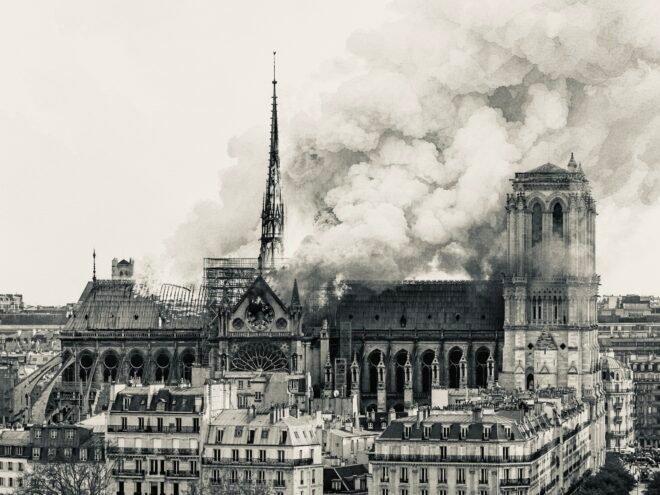
“Nous rebâtirons.” (We will rebuild.)
— President Emmanuel Macron of France, 15 April 2019, as the great cathedral burned.
It was one of those spring days that are so gentle and pretty that all Paris treats them like Sundays, crowding the squares and the boulevards. During such days of clear skies, warmth and peace, there comes a supreme moment at which to appreciate the portal of Notre-Dame. It is when the sun, already sinking, shines almost directly on the cathedral. Its rays, more and more horizontal, slowly leave the pavement and climb the vertical façade to highlight the countless carvings against their shadows, until the great rose window, like the eye of a cyclops, is reddened as if by reflections from a furnace.
— Victor Hugo, The Hunchback of Notre-Dame
I have known Notre-Dame since I was a child. I am not a Catholic, nor any kind of Christian, and I make no claim on the cathedral’s theology. But I have spent a great many hours wandering its corridors and standing beneath its ribs of stone, and I have found there what Hugo found: a building through which the whole of human drama seems to have passed at one time or another – coronations and revolutions, weddings and funerals, the ordinary devotions of nine centuries of Parisians, watched that particular evening by a world holding up its phones from the embankments below.
On 15 April 2019, it very nearly died. And in the hours after the spire came down in a column of sparks, before the fire was even out, President Macron went on television and made a promise: nous rebâtirons – we will rebuild. It was, on its face, a simple undertaking to restore a damaged national monument. But the promise did not stay simple for long. Within days it had been drafted into a much larger argument, one in which the cathedral was no longer only a cathedral, but a body double for something called “the West,” and its burning was no longer a construction-site accident – most likely an electrical short circuit or a workman’s cigarette, the investigation never settled which – but a portent: proof, to a great many commentators, that a civilisation was going up in flames along with it.
I want to take that reading seriously enough to argue with it properly, rather than dismiss it as the excitable overreach it often is. So let me state the thesis in its strongest form, the form its more serious proponents would recognise as their own and then let me take it apart.
The Case for a Civilisation in Ashes
The argument runs, at its best, something like this. For roughly fifteen centuries a set of institutions, symbols and inherited certainties – Christian in origin, later secularised but never quite de-sacralised – supplied European and settler societies with a shared story about who they were and what they owed one another. The cathedral was the literal architecture of that story: a public building that took generations to complete, funded by guilds and monarchs and the widow’s mite alike, oriented toward a horizon nobody who laid its foundation stone expected to live to see. Its very slowness was the point. It taught patience, continuity, the subordination of the individual craftsman’s ego to a project larger and longer than himself.
It is a coherent argument, and it is not a new one. Oswald Spengler was making a version of it a century ago, charting what he took to be the inevitable senescence of “Faustian” civilisation with the same funereal confidence that today’s commentators bring to a burnt roof. Every generation since has produced its own edition: the barbarians are at the gate, the cathedral-builders have been replaced by clerks, the sacred has curdled into the merely administrative. What gives the Notre-Dame version of the argument its particular force is that, for once, the metaphor was not merely rhetorical. An actual, ancient, universally recognised symbol actually caught fire, on camera, in real time, and the coincidence of image and argument was too perfect for the argument’s proponents to resist. Here, at last, was proof rendered in sparks and falling lead: not a metaphor for civilisational collapse but civilisational collapse, live, with a hashtag.
I recognise something of my own experience of the building in this part of the argument, even where I end up rejecting its conclusion. Hugo’s description of the light climbing the façade at sunset, the rose window catching fire with reflected colour rather than actual flame, describes a particular kind of attention that a building has to be very old, and very deliberately made, to reward. You do not get that from a shopping centre atrium, however cleverly lit. There is something to the claim that certain kinds of architecture were built to slow a person down and orient them toward something larger than an afternoon’s errands, and that a great deal of what has been built since has not been built with that intention at all. I do not dispute that loss. I dispute only what it is supposed to be evidence of.
What has replaced it, on this account, is something thinner. The post-1945 West rebuilt itself in glass and concrete and quarterly earnings calls; its public buildings are optimised for cost per square metre, not for the edification of the soul; its dominant story is one of individual entitlement rather than collective inheritance; and its cathedrals, when it can be bothered to repair them at all, are reconstructed not as acts of pious continuity but as tourism infrastructure, insured, branded, streamed. On this reading, the crowds who wept on the Pont de l’Archévêché in 2019 were not really weeping for eight hundred years of limestone. They were weeping for the sense – accurate or not – that they were the last generation to have inherited something whole, and the first to watch it become, irrecoverably, a “pale shade” of itself: present in form, hollow in substance, a museum piece performing sincerity it no longer feels.
It is a coherent argument. It is also, I think, wrong – not because the sense of loss it describes is fake, but because it smuggles in an assumption that does not survive contact with the actual history of the building it uses as its emblem.
The Spire that was Never Medieval
Here is the detail that undoes the metaphor from the inside: the spire that collapsed on the night of 15 April 2019, the one that appears in every grieving photograph as the essence of what Paris lost, was not medieval. It was not even old. It was designed and built in the 1860s by the architect Eugène Viollet-le-Duc, more than four hundred years after the cathedral’s Gothic core was completed, as part of a sweeping restoration that followed decades of neglect, revolutionary vandalism, and the building’s use – during the more anti-clerical stretches of the nineteenth century – as a warehouse.
Viollet-le-Duc did not simply repair what had decayed. He redesigned it according to his own theory of what a “truly” Gothic cathedral ought to look like, adding gargoyles, statuary and a spire considerably more elaborate than the one it replaced, and populating its roofline with figures of the apostles – one of which, in a gesture historians still enjoy, he modelled on his own face. The Notre-Dame that burned in 2019, the one that became shorthand overnight for an entire civilisation’s authentic and irrecoverable past, was in significant part a nineteenth-century romantic invention: a monument to what an earlier generation, anxious about its own sense of discontinuity with the Middle Ages, imagined the Middle Ages to have been.
It is worth noting, too, that this restoration was itself set in motion partly by Hugo’s novel – the very epigraph above this essay. The Hunchback of Notre-Dame was written in 1831 as a polemic against the demolition and disfigurement the building had suffered, and it worked: it shamed a generation into caring about a structure they had been quietly letting fall down. So the object that a further two hundred years later would be mourned as the unbroken thread connecting the present to some pure medieval origin was, at every layer anyone chooses to peel back, already a rebuilding – an act of civilisational anxiety answering an earlier act of civilisational anxiety, each one reaching for an “authentic” past that kept receding the moment anyone reached it.
This is not a minor architectural footnote. It is the whole argument in miniature. There was no year in which Notre-Dame was simply, finally, itself – no state of the building that was not already the product of additions, subtractions, fires (this was not its first), revolutions, restorations and reinventions layered on top of one another for nine hundred years. What burned in 2019 was not a fixed essence finally extinguished. It was one frame in a very long film of continuous rebuilding, and Macron’s promise that Wednesday night – nous rebâtirons – was not a vow to arrest history and return the building to some prior state of grace. It was, whether he knew it or not, simply a restatement of the building’s actual nature. Notre-Dame does not have an original to be a pale shade of. It has only ever been what gets rebuilt.
None of this fully answers the stronger version of the objection, and it is worth granting that version rather than only the weaker one. The strongest complaint is not that the 1860s spire is somehow less real than a medieval one – a fair objector will concede that fabric has always been renewed. It is that a cathedral rebuilt under twenty-first-century heritage law, insured, livestreamed, and raised by a labour market recruited across borders, is not the same kind of social object as one built stone by stone over generations by a society that took its Catholic cosmology as simply true. Even identical oak, even techniques revived exactly as the guilds once practised them, do not by themselves reconstitute the unbroken chain of belief and practice – what a sociologist might call transmission – that once ran through the building alongside its masonry. That loss is real, and reproducing the spire does not refute it. What it does is deny the loss its innocence. Transmission was never, at any point anyone can actually name, the pure and unbroken thing this stronger objection quietly assumes it once was: the nineteenth century’s Gothic revival was already a revival, consciously staged by architects and clergy who knew perfectly well they were reconstructing something they believed had already lapsed. If what died was an unbroken line running back to a Catholic kingdom, it did not die in the twentieth century, or in the fire, or even in the Revolution. It died, if it was ever purely alive at all, long before Viollet-le-Duc climbed onto the roof to design a past worth continuing.
A Different Fire, a Different Myth
I raise this not to relitigate French architectural history but because the same error – the assumption of a pure prior state now degraded – sits underneath a great deal of political argument well beyond Paris, and one especially instructive example is unfolding, at the time I write this, in the courtroom of the High Court of Australia.
On 8 and 9 September 2026, the Full Court sat to hear a constitutional challenge brought by an organisation calling itself the White Australia Party against the Commonwealth. The party’s National President is Thomas Sewell, formerly the leader of a group called the National Socialist Network, which announced its own dissolution shortly after the Commonwealth passed legislation – introduced in response to an act of terrorism in Bondi – permitting the Home Affairs Minister to formally proscribe organisations found to incite racial hatred. Mr Sewell’s group did not so much disband as rename itself; on Anzac Day 2026 it lodged papers to register the White Australia Party as a political vehicle, and shortly afterwards it was listed under the new laws as a prohibited hate group, with membership or material support now carrying penalties of up to fifteen years’ imprisonment. The party’s challenge – that the proscription regime offends the implied constitutional freedom of political communication – is a serious constitutional question, and courts should and will take it seriously as one. I am not interested here in pre-empting the Court’s reasoning. I am interested in the slogan the party marched behind in the rallies that preceded all this litigation: Australia for the white man.
It is worth sitting with that sentence for a moment, because it makes a move that rhymes with the one Notre-Dame’s mourners make, without being quite the same mistake. Like them, it asserts a prior state – a white Australia – that has since been lost, diluted, or stolen, and proposes to rebuild it, or rather to un-build everything added since. Unlike them, it is defending something that did, in an important and dangerous sense, actually exist. This continent has been continuously occupied for at least sixty-five thousand years by peoples organised into hundreds of distinct nations, language groups and law, and that occupation has never been ceded; the colonial project that arrived in 1788 did not find an empty canvas. But it is also true that the White Australia Policy which followed federation in 1901 was not merely rhetoric. It was real legislation, sustained for seven decades by a genuine parliamentary and popular majority, and it did a great deal of its intended work: a century of frontier violence, disease and dispossession had already reduced the Aboriginal population, by the time of federation, to a small fraction of the continent’s people, and the policy that followed set out, quite deliberately, to keep the rest of the country white. It succeeded to a considerable and shameful degree. What it did not achieve – what no purity project ever fully achieves – was completeness. Aboriginal and Torres Strait Islander people did not disappear, non-European communities were never entirely excluded, and the sovereignty the policy assumed it was simply administering was never in fact given up. The slogan Australia for the white man is not false because a white-dominated Australia never existed. It is false because it asks the country to treat as a return to origin what was always, even at its most brutally effective, an unfinished and violently incomplete project – the same species of invented purity Viollet-le-Duc built into a spire, only built here with dispossession rather than limestone.
This is the same structural mistake as mourning the “original” Notre-Dame spire, translated into a register with much higher stakes. It reaches backward for a state of purity that, on inspection, was itself already an invention – a nineteenth-century political fantasy modelled, consciously or not, on the far older Western habit of imagining a golden age just behind one’s own moment, always one generation further back than living memory can check. It is, in this sense, a myth in the strict, technical use of that word: not a lie exactly, but a story that explains and justifies a present arrangement by projecting an idealised past that the present arrangement claims to be defending or restoring. The Greeks understood this instinct better than we usually credit them for. Athena is said to have sprung fully formed and fully armed from the head of Zeus – an origin story that conveniently erases the far messier, more contingent, more compromised process by which any actual thing, deity or nation, comes into being. No civilisation springs fully formed from anyone’s head. Every one of them is assembled, argued over, revised, and – when it burns – rebuilt, out of materials and people who were never as uniform as the myth insists.
It is worth being precise, though, about what this comparison does and does not establish, because collapsing it too quickly does the argument no favours. The mistake of imagining a lost pure Notre-Dame is a mistake of historiography – a failure to notice that the object of one’s nostalgia was itself already a reconstruction. The White Australia Party is not principally guilty of that mistake, or not only of it. It is, on the Commonwealth’s own case, the same organisation as the National Socialist Network, which announced its dissolution as the new hate-crime laws arrived, then resurfaced under successive new names – one of them, “White Australia,” later listed as a prohibited hate group, another of them the party now seeking registration as the political vehicle at the centre of this litigation – a sequence the Commonwealth has characterised as a calculated attempt to dress racist and antisemitic organising in the borrowed legitimacy of parliamentary politics. Whether that survives the implied freedom of political communication is a live and genuinely difficult constitutional question, and it is not this essay’s place to predict how the Full Court will resolve it. But that legal question – whether the Commonwealth may criminalise membership of a proscribed organisation – is different in kind from the historiographical one this essay has been pursuing about invented origins. The two arguments belong side by side, not folded into one. The myth-critique explains why the party’s founding slogan is false. It does not, on its own, tell you anything about the organisation that has adopted it, which is not a wistful historical society mistaking a reconstruction for an original but, by its own history and the Commonwealth’s pleadings, a movement with a recent and violent record.
That record is not abstract. In August 2025, a group of men associated with the National Socialist Network attacked Camp Sovereignty, the protest camp Krautungalung elder Robbie Thorpe and others established in 2006 and re-established in 2024 beside the Kings Domain Resting Place – itself established in 1985 as the burial ground for the repatriated remains of thirty-eight Aboriginal Victorians, people whose bones had been taken from this country by collectors and museums and were only decades later brought home to it. It is difficult to imagine a more literal collision between the two things this essay has been holding side by side: an organisation built on a myth of racial purity attacking, in the same year it began rebranding itself as a political party, the ground beside a resting place for people whose sovereignty over this continent was never ceded and whose presence here predates the myth’s imagined founding by tens of thousands of years. Whatever the High Court decides about the constitutional question before it, that attack was not an argument about how to read history. It was violence.
Rebuilding is Not Restoration
I do not think Western civilisation has been destroyed, and I do not think it is at risk of being destroyed by the presence of people who were absent from some imagined founding photograph. What has happened, in both Paris and Canberra, is less apocalyptic and more ordinary: a civilisation continuing to be built, which always looks like decline to whoever mistook an earlier stage of the building for its finished state.
The actual rebuilding of Notre-Dame, reopened in December 2024, makes the point better than any argument could. French law required it to replicate the cathedral’s last complete state, so Viollet-le-Duc’s nineteenth-century spire was rebuilt again – an invention preserved as though it were the original it never was – using medieval guild techniques that had to be relearned because industrial methods had let them lapse, by a workforce drawn from well beyond France. The rebuilt cathedral is, like every earlier version of it, a composite: medieval bones, romantic invention, and modern craft revival. It is not a pale shade of a lost original. It is simply the latest layer of a building that has never been anything but layers.
The same is true of whatever “the West” is, if the term means anything worth defending. It has never been a fixed inheritance handed down intact: Greek philosophy reached European monasteries through Islamic scholarship, the Renaissance leaned on manuscripts preserved in Byzantium and the Arab world, and even the Gothic cathedral’s pointed arch owes something to techniques that crossed the Mediterranean during the Crusades. A civilisation that only counts as authentic when imagined as racially uniform has confused itself with Athena’s fiction – and forgotten that the stones it wants to defend were raised using ideas that crossed the very borders it now wants to seal.
What We Are Actually Promising
So when I hear “nous rebâtirons,” I do not hear a vow to return to a state of former purity, because no such state exists to return to. I hear a description of what civilisations always do: keep building, argue about what the new spire should look like, borrow techniques and people from wherever the skill resides, and eventually mistake the result for the original once the argument is forgotten.
This does not mean nothing is at stake in Canberra this month, or that the anxieties of 2019 were contemptible. Something real is at stake whenever people feel the ground shift under a story they built their identity on. But the answer is not to grant a fictional prior state the moral authority of loss. It is to acknowledge that the thing being rebuilt was never simple, never finished, never uncontaminated by outside hands – and to rebuild anyway, in the only material civilisations have ever actually been made of, which is each other.
There is a particular comfort available only to people who believe they once had something whole: it locates the wound safely in the past and excuses them from having to build anything new. I understand the appeal. I do not think it is available to us, in Paris or in Canberra, because the clean original it promises was never there. Viollet-le-Duc’s apostles, gazing out over Paris with his own borrowed face, are not a betrayal of some earlier, truer Notre-Dame; they are an earlier chapter of the same argument about what the building should be. The White Australia Party’s slogan belongs to that same history of invented origins, and that is reason enough to call it false. Whether the organisation that carries the slogan may lawfully be banned is a separate question, for the Full Court and not for this essay, and nothing in the history of a cathedral answers it.
I do know that whatever the Court decides, the slogan will remain what it was before any judgment: a description of a country that never existed, offered as the memory of one that did. And I know that the cathedral I have walked through since I was a child is not diminished by having been built twice over by nineteenth-century romantics and twenty-first-century stonemasons alike. It is, if anything, more honestly itself for it – a building that has never once stopped being built, and has therefore never once finished being what it is.
The rose window has been reddened by reflections from a furnace before. It will be again. What it has never once been, in nine hundred years, is finished. Nous rebâtirons was never a promise to bring something dead back to life. It was a description of the only thing a civilisation – French, Australian, or any other – has ever actually known how to do.
– – –
Bakchos is the founder of Blak and Black, an Australian media and advocacy platform established in 2010. Bakchos writes from the intersecting perspectives of Wiradjuri heritage, Jewish identity, and humanism.
© Bakchos, September 2026