
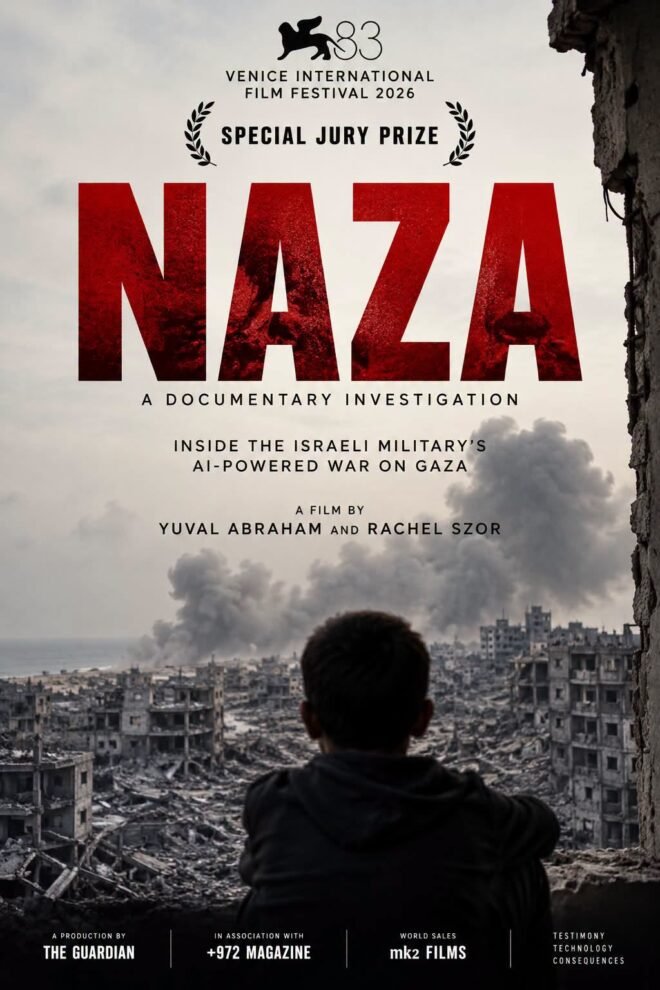
NAZA and the Limits of Wartime Self-Defence
A film almost no one has watched has produced a response almost everyone can see. That asymmetry is the actual subject of this essay. Yuval Abraham and Rachel Szor’s documentary NAZA – named for an Israeli military acronym meaning “collateral damage” – describes an AI-assisted targeting system built on data drawn from thousands of hacked mobile phones, according to unidentified soldiers who appear in it. It has not been released in any country. What has happened instead is a fast, coordinated, and disproportionate campaign to punish the people who made it and the soldiers who spoke to them, running well ahead of any public accounting of whether the film’s claims hold up. The argument here is narrow and does not depend on knowing what’s actually in the film: a state does not get to answer an allegation about how it kills by threatening to strip the allegers of citizenship, sending protesters to their parents’ doorsteps, or drafting speech law named after the accusation itself. Scrutinise the evidence. Do not abolish the person making the claim.
Naming the Argument, Not the Title
It’s tempting to read the film’s title as already making its case – “collateral damage” rendered into bureaucratic Hebrew, exposed as euphemism. But that’s a reading of a title, not a verdict on a film’s evidence, and treating it as one does the same thing the film’s harshest critics do from the opposite direction: judging NAZA without having seen it. What can be said honestly is only this – the title signals that the film intends to interrogate institutional language, the kind of phrasing that lets people do difficult work without confronting its weight in plain words. Whether the film successfully demonstrates that the euphemism conceals wrongdoing, or simply asserts it, is a question only the film itself can answer, and the outside world does not yet have access to it. That uncertainty should be stated and left standing, not resolved by inference from the packaging.
The same discipline has to apply to the film’s evidentiary form. NAZA is built from testimony – soldiers, unnamed, describing a system from the inside. That places it in a familiar genre: institutional-insider disclosure, the kind that lives or dies on the number and consistency of its sources and on what corroborating material surrounds them. None of that is assessable from the outside right now. It is worth saying plainly that a film currently exists mostly as a rumour of itself, known through descriptions of a Venice screening and a 25-minute ovation, rather than through direct engagement by any but a small festival audience. A media-freedom argument doesn’t need to fill that gap with confidence about what’s true inside the film. It only needs to insist that the gap be filled by disclosure and scrutiny, not by state power exercised in the dark on the filmmakers’ behalf – or against them.
What the Backlash Actually Tells Us – and What it Doesn’t
It’s an appealing move to read the fury of the response as proof of the film’s accuracy – institutions don’t threaten citizenship over things they can easily dismiss, so the thinking goes, therefore the threat implies the material is damning. That inference doesn’t hold, and leaning on it weakens the argument rather than strengthening it. Disproportionate reactions to unwelcome speech are not reliable indicators of that speech’s truth-value; states, mobs, and institutions overreact to accusations that turn out to be exaggerated, badly sourced, or wrong, just as often as they overreact to accusations that turn out to be accurate. The intensity of a backlash measures the perceived stakes and the political utility of the moment – not the underlying facts.
Building an inference from anger to accuracy hands a sceptical reader an easy exit: they can simply reject the inference and, with it, everything built on top of it. The stronger position is to decouple the two claims entirely. The response can be indefensible on its own terms, using its own conduct as the evidence, regardless of whether NAZA’s allegations are ultimately vindicated, partially true, or overstated. That’s not agnosticism as evasion – it’s agnosticism as the only honest position available to someone who hasn’t seen the film, paired with a very un-agnostic judgment about what has actually been done in response.
Two Kinds of Actor, Two Kinds of Scrutiny
It matters that “the backlash” is not one thing, and treating it as a single undifferentiated wave of national outrage flattens distinctions that a serious accounting has to preserve.
There is the street-level response: protesters outside the homes of the filmmakers’ parents, chanting that the family should be “expelled,” that the filmmakers should be ashamed to walk in public. This is grief and rage finding a target, and some of it is almost certainly sincere – bereaved families, serving soldiers, and their communities experiencing a documentary’s allegations as a personal accusation against people they love. That kind of pain deserves to be named honestly rather than dismissed as manufactured or merely tribal. It is also, categorically, a different phenomenon from a government minister requesting a secret-service investigation into how journalists obtained their sourcing, or a prime minister proposing legislation named after the film it targets. The first is civil society behaving badly, which happens around contested films and contested wars in every country and does not by itself indict a state’s institutions. The second is the state itself deploying its investigative and legislative machinery against speech it dislikes, which is a different order of problem entirely and the one that actually belongs in a media-freedom brief.
Collapsing these two into a single “backlash” does real damage to the argument, because it lets a reader dismiss the whole essay as an account of an angry crowd – something every controversial film generates and survives – rather than confronting what is distinct and more serious here: a Minister of Culture asking the domestic security service to examine “the source of the information and materials used to create the film” as part of a citizenship-revocation process; a head of government proposing statute; a chief of staff convening senior officers to frame a documentary as an attack on the state itself. Separating the mob from the ministry doesn’t soften the case against the ministry – it sharpens it, by removing the version of the argument a critic can wave away as “people were understandably upset” and leaving only the version that actually requires an answer: elected officials and security services responding to an unreleased film with the tools of state coercion.
Putting the Two Framings Side by Side
The filmmakers describe their own project in a specific way: Abraham has said he and Szor felt a responsibility, as Israelis, to use their position to surface “insider testimony into how the system looks like from the inside, the system of killing.” That is an advocacy frame, openly stated – the film positions itself as an act of accountability from within, not a neutral document produced by outsiders. It’s a frame worth taking on its own terms rather than either accepting or dismissing by proxy. It claims moral standing from insider status; it does not, by that framing alone, establish the accuracy of what the insiders describe.
Set that beside the state’s framing, and the contrast is instructive not because one side is obviously right, but because of what each is actually claiming. Gadi Eisenkot’s charge of “moral blindness,” and his line about an “abysmal gulf” between legitimate criticism and “defaming the names of our soldiers in order to harvest applause at festivals abroad,” is at least addressed to a real question – where is the line between institutional accountability and the exposure of individual soldiers to public shaming for conduct they may not have had full discretion over? That is a coherent concern, one that shows up in almost every serious debate about war reporting and whistleblowing, and it deserves to be taken seriously as an argument rather than waved off as reflexive nationalism.
But Eisenkot’s argument and Netanyahu’s legislative threat are not the same claim, and treating them as points on a single continuum of “the state’s response” obscures more than it reveals. Eisenkot is making a normative argument about where accountability ends and defamation begins – arguable, but an argument. Netanyahu’s proposal to legislate against “defamation of Israeli soldiers and the State of Israel,” reportedly informally called the NAZA laws, and his threat to revoke citizenship from people who “defame IDF soldiers in the world,” is not an argument about where a line sits. It’s a mechanism for enforcing a line without ever litigating where it should be – because a law built around one film’s content, backed by the threat of statelessness, does not ask whether a given piece of speech crosses into defamation as ordinarily and narrowly defined. It presumes the answer and moves straight to punishment. The Committee to Protect Journalists’ characterisation of the citizenship threat as a “dangerous escalation” is the right register for this specific move, and it doesn’t require also endorsing everything Eisenkot said, or everything the protesters outside a family home believed, to hold.
The Part of the Story that Survives Scepticism Intact
Strip away the inferences that don’t travel, and what’s left is not a smaller essay – it’s a sturdier one.
NAZA remains unseen and unreleased, which means neither its critics nor its defenders – including this essay – are in a position to adjudicate its factual claims. What can be assessed, because it has already happened in the open, is the state’s response to an unreleased film: a proposed law naming itself after the controversy it addresses; a ministerial request for a security investigation into journalists’ sources, explicitly tied to a citizenship-revocation process; a military chief of staff treating a documentary as an attack on the nation rather than a claim to be tested. Those are not allegations requiring the film’s contents to be verified first. They are actions, on the public record, that can be judged on their own terms – and judged as incompatible with a legal and political culture that wants to call itself both democratic and capable of investigating its own conduct.
It also remains true, and worth stating without needing the backlash to prove it, that the film describes a live and unresolved problem regardless of how its specific allegations hold up: militaries, in Israel and elsewhere, are increasingly using automated or semi-automated systems to generate targets at a volume that raises real questions about whether human review can meaningfully keep pace, built in some cases on data drawn from exactly the kind of mass surveillance the film alleges. That conversation doesn’t depend on NAZA being fully accurate in every detail. It depends only on the underlying technology existing and being deployed with limited public visibility into its logic and error rates – a claim that predates this film, is not unique to Israel, and deserves scrutiny independent of any single documentary’s fate.
And it remains true that the controversy is unfolding in the shadow of an approaching election, with a former IDF chief of staff now heading his own party and using the film as a campaign point, and with commentators openly discussing the controversy’s electoral effects. That context doesn’t mean the outrage on the street is fake. It means some of the officials responding to it have a second, more self-interested reason to reach for the most visible and punitive tools available – legislation, investigation, denunciation – rather than the slower, less politically rewarding work of actually establishing what happened. Naming that incentive doesn’t require deciding whether any individual politician is acting in bad faith. It only requires noticing that an election calendar makes the loud response more attractive than the careful one, for reasons that have nothing to do with the truth of the underlying allegations.
Where that Leaves the Argument
None of this asks a reader to conclude that NAZA’s allegations are true, that the soldiers who spoke are reliable, or that the film’s advocacy framing is the correct one. It asks only that the reader hold two things apart that the original controversy keeps trying to fuse: the unresolved question of what happened in Gaza, which the film claims to address and which remains genuinely unresolved pending release and scrutiny, and the already-resolved question of what a state is doing right now to the people who are trying to ask that first question in public.
A serious institution, confident in its own conduct, meets a damaging film by contesting its facts once they’re available for contest. Threatening the filmmakers’ citizenship, investigating their sources through the security services, and legislating against a category of speech named after the controversy itself are not that. They are a substitute for it – and a fairly legible one, since a country doesn’t usually need to reach for statelessness as a rebuttal unless the ordinary rebuttal, arguing on the merits, has already been judged insufficient.
– – –
Bakchos is the founder of Blak and Black, an Australian media and advocacy platform established in 2010. Bakchos writes from the intersecting perspectives of Wiradjuri heritage, Jewish identity, and humanism.
© Bakchos, September 2026