
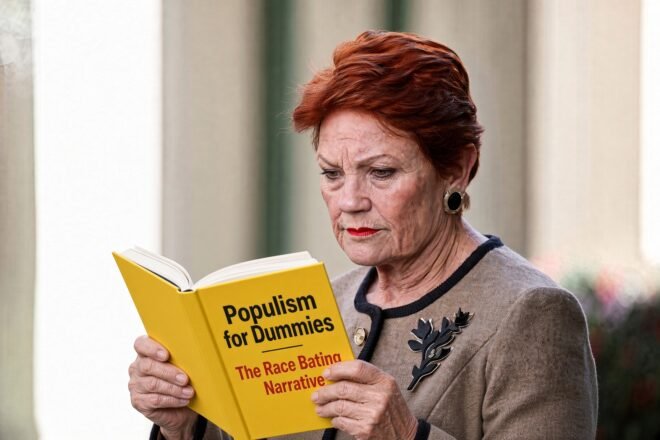
When Pauline Hanson told a Christian podcast audience that Aboriginal people were “the most primitive race on Earth,” she did not need a theory of population genetics to make that claim land. She needed only what she has always had: a durable domestic market for the idea that a racial or ethnic “them” is receiving unearned advantage at the expense of a deserving “us.” That distinction is the argument of this essay, not an aside to it: Hanson’s method and the pseudo-scientific “race realism” now circulating online are related currents, not the same current, and mistaking one for the other makes her look more sophisticated – and more anomalous – than she is.
Three Claims That Are Not the Same Claim
Start with the science, stated precisely rather than gestured at. There are three distinct propositions here, and collapsing them is how bad arguments get made on all sides of this debate.
The first – that humanity divides into a small number of discrete biological races, each a coherent package of inherited physical, intellectual and temperamental traits – is not supported by the evidence and has not been for decades. Richard Lewontin showed in 1972 that most human genetic variation exists within traditionally defined racial groups rather than between them, and the genome-wide studies since have not overturned that finding.
The second – that human genetic ancestry is real, geographically patterned, and statistically detectable – is true. Clustering algorithms, given enough markers, can and do sort individuals into groups that correlate with continental ancestry and migration history. Geneticists who reject “race” as a biological category are not claiming ancestry is invisible in the genome; they are making a narrower claim about what that clinal variation licenses.
The third – that any of this detectable ancestral variation supports ranking human groups by inherent worth, intelligence, or moral standing – is where the science stops and the ideology begins. Nothing in population genetics licenses a hierarchy. The move from “ancestry clusters exist” to “ancestry clusters should be ranked” is a political inference, not a scientific one, dressed afterward in scientific language. This is the case the geneticist Adam Rutherford has made in public for a decade: that scientific racism was never neutral biology arriving at unwelcome conclusions, but a political project that recruited biology after the fact. Linnaeus’s eighteenth-century taxonomy of human “subspecies,” with white Europeans at the top on no empirical basis, is the founding document. Galton’s eugenics, mainstream across the political spectrum in Britain, North America and Europe by the early twentieth century, is its industrialised phase – bad science even by the standards of its day, and directly ancestral to coerced sterilisation programs in the US and Canada and to Nazi “racial hygiene.”
Australia’s own chapter belongs in this history rather than beside it. The University of Melbourne’s anatomy department, under Professor Richard Berry from 1906, assembled a large collection of Aboriginal skeletal remains – from graves, from collectors, from students – explicitly to support theories of white racial supremacy. Financial records from 1914 show Berry advising the university to buy Tasmanian Aboriginal skulls quickly, because their price would rise once the “race” was believed extinct. This was mainstream anatomical science conducted inside a major university, part of the same racial-science climate that licensed protection boards and the removal of children whose effects are still measurable today.
Keeping these three propositions separate is what lets the rest of this argument stay precise: Hanson does not need proposition three to be true. She needs almost nothing from genetics at all.
A Cruder, Older Method
Her 1996 maiden speech complained that “mainstream Australians” were victims of “reverse racism,” that taxpayer-funded services flowed disproportionately to “Aboriginals, multiculturalists and a host of other minority groups,” and that government was “encouraging separatism” by giving Aboriginal people “land, moneys and facilities” unavailable to anyone else. The move here is rhetorical inversion, not scientific: recast a historically dispossessed minority as a privileged interest group, and the historically dominant majority as the system’s true casualty. She has run that inversion on at least three targets in thirty years – Asian immigration in the 1990s, Muslims after 2001, and more recently African migrants and “boat people.” The vocabulary changes; the inversion does not. It is a template a populist can run without ever opening a journal, and Hanson’s career is the proof that it works fine without one.
Where “race realism” and Hansonism intersect is audience and occasional usefulness, not method. A politician running an inversion narrative benefits when a parallel current supplies pseudo-scientific cover for the same conclusion – a veneer that makes “they’ve achieved nothing” sound like an observation rather than a slur. Hanson’s line about Aboriginal people never having “invented the wheel,” and her reduction of sixty-five thousand years of culture to “a few rock paintings,” reaches for that borrowed authority without doing any of the work “race realism” claims to do. The relationship is symbiotic, not identical.
Not Hers Alone, but Not a Network Either
The inversion template is visible, with local modifications, in Trump’s rhetoric on migrants, Marine Le Pen’s National Rally, the AfD, Orbán’s Fidesz, Wilders, and Bolsonaro’s presidency. Each has a distinct cast of scapegoats. What they share is the claim that a “native” population is under demographic and cultural siege from a racialised outsider, and that saying so is the unfashionable truth elites suppress.
Some documented links exist between European far-right parties, and Hanson’s own associations with figures on Australian politics’ fringes are on the record. There is no evidence of a coordinated funding architecture connecting Hanson to Trump, Le Pen or Orbán. What the record supports is narrower: these movements share a rhetorical technology that spreads because it works locally, not because it is centrally directed.
What the Voice Referendum Actually Showed
An Australian National University study that tracked more than 4,200 voters from January to October 2023 found two-in-three “no” voters, 66.1 per cent, said they rejected the change because it would divide the nation, and that very few voters moved from “no” to “yes” over the campaign. The same study found 87 per cent of all respondents thought First Nations people should have a say on matters that affect them – a figure that, per the study’s own authors, includes around three-quarters of “no” voters, 76 per cent specifically. That is a large share of “no” voters affirming the principle of Indigenous voice while still rejecting the proposed model – worth stating precisely, since the overall 87 per cent figure and the “no”-voter figure are two different numbers answering slightly different questions.
A separate, much smaller study – 253 respondents, surveyed before and after the vote and published via The Conversation – measured attitudes toward authority and social hierarchy and found these predicted voting behaviour more strongly than age, gender, ethnicity, income, education or political orientation. The same study found something that cuts against the ANU figures above: “no” voters who were pleased with the result were more likely to see society as generally just, and did not accept the premise that Aboriginal and Torres Strait Islander people are, and have been, unjustly treated. The two studies asked different questions of different sample sizes, and the smaller, Conversation-published study should not be weighted the same as the larger ANU one. Separately, a twenty-year longitudinal reconciliation survey series led by Professor Andrew Gunstone at Federation University – the longest such series in Australia – found that limited public understanding of what “equality” means in this context, combined with poor awareness of Indigenous socio-economic conditions, contributed to opposition, and that racist attitudes contributed both to the vote and to the campaign’s tenor.
Put together: a general preference for hierarchical social ordering was one of the strongest predictors of “no” voting in at least one smaller study, layered over a widespread but shallow understanding of the disadvantage the Voice addressed, with racialised attitudes measurably present in the campaign – while three-quarters of “no” voters simultaneously told the larger ANU study they believed First Nations people deserved a policy voice in principle. That is the claim this essay can carry.
The Steelman
A person can oppose a specific, race-conscious constitutional body without believing races exist as ranked biological subspecies. A person can support lower migration or oppose particular multicultural settings for reasons that have nothing to do with racial hierarchy – social cohesion, housing, wages, institutional trust, or a preference for incremental over structural constitutional change. The ANU finding above makes exactly this case for a meaningful share of “no” voters: 76 per cent of them affirmed the underlying principle that First Nations people should have a say on matters affecting them, and still voted no, because they rejected the model. Treating every objection to race-conscious policy as evidence of belief in hierarchy is not just uncharitable; it is wrong about three-quarters of the voters this essay is about, and an argument that cannot survive that admission was doing more work than the evidence supports.
What survives is narrower: this is not a claim that all opposition to Indigenous-specific policy, migration, or multiculturalism reflects belief in ranked subspecies. It is a claim about a specific rhetorical structure – the inversion narrative – and about the minority of politicians who build careers on deploying it regardless of which minority is available to plug in. The research above shows that structure has real purchase with a measurable slice of the electorate. It does not show that most “no” voters share its premise.
Programs Exist. Disadvantage Persists. Both Are True.
Hanson’s narrative depends on a factual claim worth confronting rather than dismissing: that Aboriginal-specific programs and legal mechanisms exist and are not universally available. This is true. Native title processes, ABSTUDY, Indigenous-specific health and justice funding, land rights mechanisms – all real, all targeted. Denying this would be dishonest and is not necessary to the argument, because the dishonesty in Hanson’s claim sits elsewhere.
It sits in what she asks that existence to prove. Targeted programs exist because disadvantage persists at a scale untargeted services have not closed, and the Closing the Gap reports tabled in federal parliament every year document that persistence – across life expectancy, incarceration, child removal, health and education outcomes, more than half a century after the 1967 referendum. A program’s existence is not evidence the disadvantage it addresses has been solved, still less overcorrected into reverse privilege. A targeted response to measurable, persistent disadvantage is evidence the disadvantage remains severe enough to warrant one, not evidence of unfair advantage.
A Case That Doesn’t Settle Anything
The British sociologist Jason Arday, who became the youngest Black professor in Cambridge’s history in 2023, resigned in 2026 amid allegations of academic misconduct and biographical inaccuracies, and was found dead at his London home nine days later, aged 41; his cause of death has not been released and is not evidence for or against anything discussed here. The plagiarism allegations came from Nathan Cofnas, an academic previously removed from an associate position at Cambridge’s Emmanuel College over writings arguing Black people would largely disappear from high-status positions under a “true meritocracy.” Cambridge’s own disciplinary process dismissed the student misconduct complaints against Cofnas and found his blog posts lawful speech; Emmanuel College’s separate decision to end his association stood regardless, and Cofnas’s suit against the college over that decision was dismissed by the county court on 13 March 2026. Independent reviewers of the Arday allegations reached different conclusions – one reviewer called the evidence of plagiarism unambiguous; Arday maintained he had made mistakes but was not a liar, and said an internal panel had cleared his thesis of deliberate plagiarism. No account resolves which characterisation is correct. A genuinely unresolved integrity dispute became entangled, on both sides, with claims about race – which illustrates the broader climate this essay describes without settling anything about this particular case. It is cited here as exactly that: suggestive, not probative.
The Colder Point
None of the preceding qualifications weakens the core claim; they narrow it to what it can actually hold. Hanson does not need “race realism” to be true, and shows no sign of having read any of it. She needs a template that inverts victim and beneficiary, a media environment that finds her outrages more profitable to cover than to fact-check, and a real, if partial, segment of the electorate for whom that template resonates regardless of which group she points it at. One Nation’s support has fluctuated for thirty years – sometimes single digits, sometimes well into double figures in the Senate – and current polling puts first-preference support at close to a third in some measures, three decades after a maiden speech whose central claims the government’s own data has repeatedly contradicted.
That is the finding worth sitting with, and it is colder than “Hanson is close to race science” would have been: her durability does not depend on any of it being true. Strip out the genomics, strip out Cofnas, strip out every contested case that might or might not fit the pattern, and the mechanism she has run since 1996 is untouched, because it was never built on evidence in the first place. It does not need better evidence to keep working. It needs only what it has always had – a grievance, a target, and a public willing, often enough, to supply the rest.
– – –
Bakchos is the founder of Blak and Black, an Australian media and advocacy platform established in 2010. Bakchos writes from the intersecting perspectives of Wiradjuri heritage, Jewish identity, and humanism.
© Bakchos, September 2026



What Pauline Hanson has run since her 1996 maiden speech is a much older, cruder rhetorical inversion — recasting a historically dispossessed minority as a privileged interest group, and the historically dominant majority as the system’s true casualty — applied in turn to Asian immigration, to Muslim Australians, and now to African migrants.
Pauline Hanson is a genuine racist who’s too stupid to understand her own limitations, and the absolute rubbish she speaks.