
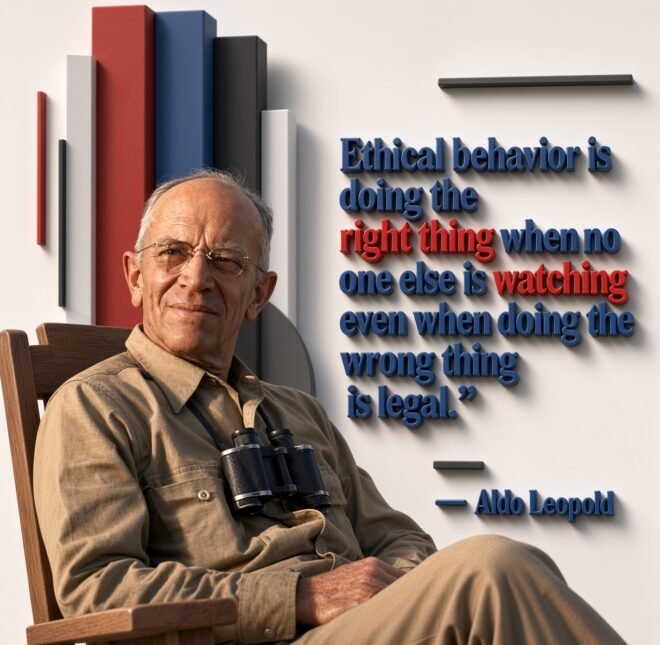
Fact, obligation and the unresolved claims of a holistic environment
We tend to speak of “the environment” as though it were a place we could step out of, a backdrop against which human affairs unfold and which we might consult, protect, or exploit as circumstances require. The word itself betrays us. To call something our surroundings is already to assume a centre, and that centre is us. Yet anyone who has watched a river flood into a plain, or a fire move through country that evolved to burn, knows that no such centre exists. There is only a web of relations in which every strand is simultaneously cause and consequence, and in which we are woven as surely as the lichen on the stone. A holistic understanding of the environment begins with giving up the idea that we stand outside it. What follows from that, and how much of it is fact and how much is choice, is the subject of this essay.
The Fallacy of the Inventory
The dominant habit of modern thought has been to treat the natural world as an inventory. Timber is counted in board feet, water in megalitres, soil in tonnes of yield, and a landscape is valued according to what can be extracted, sold, or enjoyed. This accounting is not stupid. It has fed cities and built economies. But it rests on a quiet falsehood, which is that the parts of a living system retain their value when severed from the whole. A wetland is not a collection of reeds, frogs, and filtered water that happens to sit together. It is a process, a set of relationships enacted continually, and the “services” we extract from it are merely the visible surface of that enacting. Drain it for pasture and we do not simply lose its components. We lose the pattern that made them what they were, and no sum of the parts can restore that pattern.
This is why the language of resources, however well-intentioned, tends to fail at the decisive moment. A resource is by definition something whose worth lies outside itself, in its usefulness to another. When we apply that logic to the living world, we make every forest, estuary, and grassland answerable to a single question: what is it for? The holistic view proposes that this question, while not meaningless, is secondary. The prior question is what the thing is, what it is bound to, and what unravels when it is removed.
Interdependence as a Fact
It is easy to repeat that everything is connected until the phrase goes dead in the mouth. The force of the claim returns when we attend to its particulars. Consider a single mouthful of bread. Behind it lies wheat, which depends on soil, which is a living assemblage of fungi, bacteria, and invertebrates whose collective work turns rock and rot into fertility. The wheat depends on rain, which depends on the transpiration of distant forests and the temperature of faraway oceans. It depends on pollinators for much of what accompanies it, on the absence of certain pests and the presence of their predators, and on a climate stable enough to make planting and harvest predictable. Remove any one of these and the loaf does not merely become more expensive. It may cease to be possible.
What is true of bread is true of breath, of water, of the temperature at which our bodies can function. The boundary between organism and world, so firm in ordinary thinking, proves porous at every point. We inhale what trees exhale. Our bodies host microbial cells in numbers comparable to our own, and our digestion, immunity, and even mood are partly negotiated with them. We are not so much individuals set within an environment as local concentrations of a continuous process, temporary eddies in a current that was flowing before we arrived and will flow after we have gone.
All of this is description, and good description. But it is worth noticing how quickly writing of this kind slides from “we depend” to “we owe,” as though the second were contained in the first. It is not, and the slide deserves to be slowed down.
From Dependence to Debt
Dependence by itself creates no obligation. A tick depends on its host, a tyrant on those he governs, a company on the town whose river it fouls, and no one concludes that dependence as such is a debt. Very often it is merely an arrangement of power, and the dependent party feels nothing but appetite. To say that we owe something to the living world, one must say what supplies the “owe,” because ecology cannot supply it.
The most defensible route runs through what we already believe about one another. When we ask why we owe consideration to a neighbour, the answers we give are rarely about retaliation or usefulness. We say that the neighbour sustains us in countless small ways, that we share a place and a fate with them, and that we are able to harm them in ways they cannot always answer. These are the grounds on which a person becomes someone to whom something is owed rather than something merely to be dealt with. The living world meets every one of those conditions, and meets them more thoroughly than any human neighbour. It sustains us entirely. We share its fate absolutely. And our capacity to harm it, particularly in the last two centuries, is vast while its capacity to answer is nil. If sustaining, sharing, and the power to harm are what ground obligation among people, consistency asks why they should cease to ground it at the boundary of the species.
That is an argument, and it can be resisted. A critic may reply that obligation requires a being that can claim it, can reciprocate, and can nurse a grievance, and that soil and rivers can do none of these things. The reply has real force, though it is weakened by the fact that we already hold obligations to those who cannot reciprocate: to infants, to the severely incapacitated, to the unborn. But weakened is not refuted. The critic may still say that the living world has no interests of its own, only functions that matter to those who have interests, and I do not think ecology or philosophy can finally compel agreement. What remains, once the argument has been made as well as it can be, is a decision about the kind of member one wishes to be. This is where the essay turns from what can be shown to what is chosen. The obligation is a conclusion, reached by extending a principle we already live by. It is not a fact read off the soil.
Membership Instead of Mastery
If the conclusion is accepted, then our relation to the web must be described differently. The vocabulary of mastery, stewardship, and management all assumes a manager who stands apart and decides. Even stewardship, gentler than domination, implies that the world is a property held in trust, with humanity as the trustee. Membership is a more honest word. A member does not hold a title over the community but belongs to it, depends on it, owes it, and is shaped by it. A member can be wise or foolish, generous or parasitic, but cannot opt out.
Many of the world’s oldest traditions have understood this without needing the detour taken above. Across Aboriginal Australia, Country is not a synonym for landscape or territory. It names a living system of kin that includes people, animals, plants, waters, winds, and the stories that hold them together, and it carries obligations that run in both directions. One does not own Country; one belongs to it and is responsible for it as one is responsible for family. In such traditions the step laboured over in the previous section is never taken, because there is no gap to cross. Fact and obligation arrive together, as parts of one knowledge, encoded in law, ceremony, and kinship and refined over many thousands of years of close attention to burning regimes, seasonal cycles, and the relations among species. What is a recognition there is, for those reasoning from the far side of the inventory, a conclusion that has to be argued toward. That difference matters, and a holistic ethic built by argument should not pretend to the certainty of one that was built by inheritance.
Beauty, and the Limits of Confidence
This is the passage of the essay about which the author is least certain, and the uncertainty is better shown than smoothed over. The tempting claim is that beauty is a kind of ecological knowledge: that when a landscape moves us, we are responding to the coherence of a system in which every element fits, and that the ugliness of a degraded place, with its eroded banks and its silence where there should be noise, is the face of a system that has lost its relations. There is something in this. People do not only need clean water and a stable climate. They need the sight of a particular ridge at dusk, the return of birds in a given season, the smell of rain on dry ground, and a world without them would be impoverished in ways the statistics register poorly.
But the claim fails as often as it holds. We find open parkland beautiful because it resembles gardens our ancestors preferred, and a good deal of it is ecologically thin. We find a mangrove flat, a saltmarsh, or a swamp forbidding, and these are among the most productive and protective systems on earth. A degraded place can be lovely in the evening light, and a healthy one can be dull or repellent to the unschooled eye. Beauty tracks charisma and familiarity at least as much as it tracks health. If beauty is a guide, it is a poor and culturally trained one, and anyone who leans on it to decide what is worth protecting will protect the postcard and lose the swamp. Yet what moves us still matters, and meaning attaches to places in ways that people will not abandon. A river is an archive of floods and crossings and gatherings, and to damage a place can be to sever a community from its own past. What cannot be said with confidence is that the felt quality of a place reliably tells us how it is faring. Perhaps the most that can be claimed is that beauty is where attention begins, and that attention then has to be educated past it.
Justice Within the Web: A Case Where It Hurts
It is easy to say that an ecological ethic must hold justice inside it, and easier still to say it in a way that costs nothing. The damage of the last two centuries has been inflicted unevenly and borne unevenly. Those who have lived most lightly and held the deepest knowledge of place have often been the first to be dispossessed in the name of development and the last to be consulted about repair. A conservation that locks away land by evicting its custodians repeats the old fracture it claims to heal. The principle is sound. The difficulty is that principles of this kind do not stay in agreement when they meet an actual case.
Consider a coastal community with long-established rights to hunt a marine animal whose numbers have fallen. The decline has many causes: the loss of seagrass beds smothered by runoff from distant farms, collisions with boats, drowning in commercial nets. The community has caused little or none of this. Ecology says that every animal taken matters now, because a slow-breeding population cannot absorb losses it did not used to face. Justice says that the people who did least to cause the decline should not be the ones asked to give up the most, and that a ban imposed from outside, by the descendants of those who took the land in the first place, is a familiar thing and not a neutral one. Custodianship says that this community has managed these animals for longer than any government has existed, may understand the population better than the agencies counting it, and has a right to decide its own restraint. Each of these claims is serious. Each draws on a different part of the holistic view, the ecological, the redistributive, and the relational, and in this case they point in different directions.
There is no formula that settles it, and anyone who offers one should be distrusted. What the holistic view can do is refuse the easy exits: the exit that says the animal’s survival overrides everything, and the exit that says custodianship means the community can never be questioned about outcomes. It can insist that the farms and the nets be dealt with first and hardest, since the weight of repair should fall on those who caused the harm. It can insist that any restraint worth having is one the community chooses, with the means and standing to enforce it, rather than one handed down. And it can admit that this may still leave a stretch of time in which an animal is lost that a different arrangement might have saved, and that someone will have borne a cost for which no one paid them. A whole in which every claim fits is a comfort. A whole in which claims collide and must be weighed by people who are themselves members is the real thing.
The same difficulty extends forward in time. Those who come after will inherit whatever balance we leave, and they cannot speak in our deliberations. To act as a member of a community that spans generations is to accept that some of what we do will benefit no one now living, and to do it knowing that the people with the most urgent present claims will sometimes be asked to wait.
What Right Action Might Look Like
None of this resolves into a simple rule. Living at all means taking from the web: we eat, build, and burn. The question is never whether to affect the world but how, and with what attention. A holistic outlook offers habits of mind in place of a formula. It asks us to see consequences as ramifying rather than isolated, to treat the long-term stability of a system as weightier than the short-term yield of any part of it, to value diversity as both the insurance and the substance of resilience, and to approach unfamiliar interventions with humility, remembering how often confident manipulation of a complex system has produced results no one intended.
It also asks for a restraint that sits uneasily with an age of acceleration. Healthy systems are not maximised; they are balanced. A forest does not seek the highest possible growth in a single species, and an economy that does so within a living world is borrowing against a debt it cannot repay. To act well within the web is often to accept sufficiency in place of excess, to leave some things alone, and to measure success by the continued vitality of the whole rather than by the extraction of its fruits.
Conclusion
The environment, understood holistically, is not a thing we possess, protect, or visit. It is the living fabric of which we are a part, and our flourishing and its flourishing are not two outcomes but one. That much is fact, and can be shown. What we owe in return is a different kind of claim, reached by carrying across the species line a principle we already live by, and held in some traditions as a recognition so old it needs no argument. It is better to know which of the two we are asserting at any moment. The old categories do loosen under this view: the divide between nature and culture, the assumption that ethics ends where the human species ends, the habit of valuing each part by its price. What takes their place is more demanding than comfort, since it asks us to weigh claims that will not always agree. The world does not need us to rule it. It needs us to take our place in it with understanding, humility, and a willingness to be answerable when the answers are hard.
– – –
Bakchos is the founder of Blak and Black, an Australian media and advocacy platform established in 2010. Bakchos writes from the intersecting perspectives of Wiradjuri heritage, Jewish identity, and humanism.
© Bakchos, October 2026