Everyone Has Something to Offer
Culture, language and the politics of othering, forty years after Alice Springs
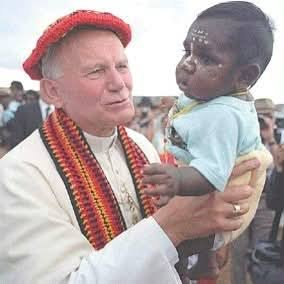
On 29 November 1986, in Blatherskite Park in Alice Springs, Pope John Paul II stood before a gathering of Aboriginal and Torres Strait Islander people and delivered an address that is still spoken of as ground-breaking. The photograph that came to epitomise the visit, the Pope holding the nephew of Miriam-Rose, travelled the world and made international headlines. Photographs, however, are quickly absorbed and forgotten. The words deserve a longer life, because they said something that Australia in 1986 was not yet ready to hear and that Australia in 2026 has still not fully learned.
This essay returns to that address and asks what it demands of us now. My argument is in three parts. First, that the Pope was right to insist that culture, language and story are not decorative extras but the substance of a people’s dignity, and that their preservation is a continuing obligation rather than a finished task. Second, that the obligation runs in both directions: Aboriginal and Torres Strait Islander people have long been asked to understand the Western world, and it is long past time that the Western world made the same effort in return. Third, that this has become more urgent, not less, in the forty years since, because the rise of populist politics has made the othering of minorities a standard instrument of public life, and a society that has not learned to value what each of its peoples brings is easy prey for that instrument.
The words at Blatherskite Park
The central passage of the address is worth setting out in full, because its generosity is easy to overlook.
…for thousands of years you have lived in this land and fashioned a culture that endures to this day. And during all this time, the Spirit of God has been with you. Your Dreaming, which influences your lives so strongly that, no matter what happens, you remain forever people of your culture, is your own way of touching the mystery of God’s Spirit in you and in creation. You must keep your striving for God and hold on to it in your lives.
~ Pope John Paul II, Alice Springs, 29 November 1986 ~
Two features of this passage matter. The first is the verb tense. The Pope did not describe a vanished people or a relic to be admired from behind glass. He described a culture that endures, and a people who, whatever had been done to them, remain forever people of that culture. That is a statement about resilience, and it was made to an audience whose parents and grandparents had lived through removals, reserves and the deliberate suppression of language and ceremony. The second feature is that the Pope treated the Dreaming as a way of touching the divine in its own right, not as a primitive precursor to something better. One need not share his theology to recognise the significance of a global religious leader declining to ask Aboriginal people to set their spiritual inheritance aside as the price of belonging.
The address went further than spirituality. The Pope spoke of the rock paintings and ancient tools that testify to how old Indigenous culture and connection to this land are, which was, in effect, an affirmation of ancient occupancy in a country whose law had still not rejected the fiction of terra nullius. That rejection would not come until the High Court decided Mabo in 1992, six years later. He also made a very pointed comment, a remark that may have been aimed at the conditions in which many Aboriginal and Torres Strait Islander people were then living: that the dignity of the Aboriginal race must not be allowed to disappear. Elsewhere in the same address he acknowledged that Aboriginal people had been moved from their homelands onto reserves, that families had been broken apart and children orphaned, and he insisted that fair recognition of land rights was not discrimination. A pope speaking in Alice Springs was not offering consolation in place of justice. He was naming the injury and the remedy in the same breath.
Songs, stories and living culture
The sentence most often quoted from the address is the one that gave its title to the cause: “Your songs, your stories, your paintings, your dances, your languages, must never be lost.” It is worth reading what comes next, because the whole passage holds a tension that is easily flattened into a slogan.
The hour has come for you to take on new courage and new hope. You are called to remember the past, to be faithful to your worthy traditions, and to adapt your living culture whenever this is required by your own needs and those of your fellow man.
Remember the past, be faithful to tradition, adapt a living culture: these are three duties, and they pull in different directions. Preservation in the sense of the museum, the recording archived and the artefact catalogued, is necessary but insufficient. A language that is only recorded is not alive, and a story that is only written down has lost the voice, the Country and the relationships that give it meaning. The Pope understood this when he described the culture as living, and when he said that it should adapt according to the needs of the people who carry it. The authority to decide what adaptation is required belongs to those people, and not to anthropologists, governments or churches.
The stakes are practical as well as symbolic. At the time of colonisation there were roughly 250 distinct Aboriginal and Torres Strait Islander languages in this country, and only a minority of them are still spoken as living languages today. Each carries more than vocabulary. A language holds kinship systems, law, ecological knowledge accumulated over more than sixty thousand years, and ways of reasoning about obligation and place that no translation fully captures. Stories are how that knowledge crosses generations. When a language falls silent, a body of knowledge about how to live on this continent falls silent with it. The United Nations has declared 2022 to 2032 the International Decade of Indigenous Languages precisely because the loss is global and accelerating, and Australia, which has among the most acute language loss anywhere, has a particular responsibility to be among the nations that answer it.
Walking in two worlds
I want to place at the centre of this essay a reflection of my own, because it says plainly what the Pope’s address implied. It comes from the experience of moving between cultures.
We have to walk in two worlds and try and get a better understanding of how Westerners live and function in their towns and cities. We’re saying it shouldn’t be just one-way traffic. It should be that the Westerners come and learn about us as well. You know, we’re able to speak their languages and understand what it’s like to live in cities and towns and what is the expectation by the Westerners if we were there. I’ve lived in Sydney, Paris, Vienna and New York so I feel that I have a really good understanding of what is expected of you from the Westerners in the world. We would like them to understand us better as well.
The phrase one-way traffic is exact. For two centuries the burden of translation in Australia has fallen almost entirely on one side. Aboriginal and Torres Strait Islander people have learned English, learned the workings of courts, schools, hospitals, welfare offices and parliaments, and learned how to read the expectations of the people who hold power over them. This is a form of expertise, and those who have acquired it are entitled to be proud of it. But it is expertise acquired under compulsion, and it has rarely been reciprocated. Very few non-Indigenous Australians can say that they have made a comparable effort to understand Aboriginal law, kinship, language or ways of knowing, and fewer still have been required to.
What a reciprocal effort might yield is not abstract. Miriam-Rose Ungunmerr-Baumann, whose family appears in the account of the 1986 visit, has spent decades teaching a practice she calls dadirri, a deep and respectful listening, a quiet and still awareness that is patient with other people and with silence. It is difficult to think of a discipline more needed in a public culture that increasingly confuses volume with argument. Aboriginal and Torres Strait Islander cultures are not only a heritage to be protected on behalf of Aboriginal and Torres Strait Islander people. They are a resource for everyone who lives here, and the Pope’s phrase about the needs of “your fellow man” can fairly be read as recognising this. A culture adapts to the needs of its own people and also to those of the wider community with which it shares a country, and a wider community that will not listen has refused half of that exchange.
The politics of othering
None of this would need saying with such urgency if the politics of the last four decades had moved in the direction the Pope’s address pointed. It has not. The year of the Alice Springs visit was also the year in which the French National Front, a party built on hostility to immigrants, entered the National Assembly in numbers for the first time. A decade later, in 1996, Pauline Hanson used her maiden speech in the Australian Parliament to attack Indigenous-specific funding and to call for the abolition of the Aboriginal and Torres Strait Islander Commission, and her party was founded the following year. Since then, in country after country, parties and movements that define themselves against some category of fellow citizen have moved from the fringe towards the centre of political life.
It is important to be fair to the people who vote for them. The grievances that populist politics draws upon are frequently real. Wages have not kept pace with the cost of living, a generation of younger Australians is locked out of home ownership, public services are strained, and many people feel, with some justification, that established institutions and the major parties have stopped listening to them. A serious critic of populism begins by conceding all of this, and by conceding too that contempt for populist voters is itself a political gift to the populists. My argument is not with the grievance. It is with what is done to it.
The difficulty is that the grievances are hard problems with no quick answers. Housing supply, wage growth, the funding of health and education, the transition of an economy, all require patient, specific, contestable policy, of exactly the kind that populism tends not to supply. A movement that cannot say how it would fix them has a standing temptation, which is to point instead at someone to blame. The someone is almost always a person or group with less power than the speaker and the audience: the migrant, the refugee, the welfare recipient, the First Nations person who is said to enjoy special privileges. Othering performs a political function. It converts a failure of policy into a story about a villain, and it does so at no cost to the person telling it. The numbers alone expose the weakness of the story. Aboriginal and Torres Strait Islander people are less than four per cent of the Australian population, and they are, on almost every measure of health, income, housing and life expectancy, the most disadvantaged group in the country. Whatever is wrong with housing affordability or hospital waiting times, it is not their doing.
I want to be careful about the limits of this claim. I am not saying that every person who votes for a populist party is prejudiced, nor that no politician on any side has ever reached for a scapegoat. My claim is narrower and, I think, more defensible: that a politics which depends for its energy on setting one group of citizens against another is structurally dependent on othering, and that the dependence grows as the lack of workable ideas becomes harder to conceal. That dependence is destructive in three ways. It injures its targets directly, in the daily experience of being talked about as a problem. It injures the majority, who are told that their difficulties are caused by people weaker than themselves, when the actual causes lie in decisions that could be examined and changed. And it injures the public conversation, because every hour spent on a manufactured enemy is an hour not spent on the harder question of what would actually work.
Why preservation matters more now
This is why the Pope’s call to preserve culture, language and story is not a nostalgic one. It is a call that bears directly on the health of our public life. A society that has never learned to value the particular things that its different peoples hold has no defence against the claim that those people are merely a burden. Where Aboriginal languages are heard in schools and on the radio, where stories are told by the people whose stories they are, where Country is understood as a relationship rather than a resource, the other-as-threat narrative struggles to take root, because there is a familiarity that fear cannot easily displace. Preservation, in this sense, is not just something done for Indigenous people. It is an investment in the capacity of the whole society to recognise value in what it does not already own.
There is also a lesson in the scale of time. Aboriginal and Torres Strait Islander cultures have managed a continent across more than sixty thousand years, through climate shifts, sea-level rise and the arrival of strangers. Whatever else one thinks of that record, it is the longest continuous experiment in living sustainably on this land, and the political cycle, with its three-year horizons and its appetite for a fresh enemy each election, is a poor judge of it. If the preservation of language and story means preserving the long view, then it offers, to a politics that has lost the long view, something it badly needs.
What this requires of non-Indigenous Australians is not guilt, but attention and resources. It requires sustained, properly funded support for language programs and the Indigenous-led organisations that run them. It requires truth-telling about the history that the Pope himself named in 1986, so that the reserves, the removals and the broken families are part of what every Australian knows. And it requires a willingness to make the effort of understanding that has so far been asked only of one side. None of these is a concession. Each is the ordinary condition of a country that means what it says when it claims to value a fair go.
Everyone has something to offer
In seven weeks it will be forty years since that wind-swept afternoon in Alice Springs. Much of what the Pope asked for has not been done. The languages are still falling silent, the dignity of the people he addressed is still too often denied in practice, and the politics of othering has grown more confident, not less. Yet the core of his address remains as sound as when it was spoken. A culture that has endured for thousands of years is an asset to the nation and not a problem for it. The people who carry that culture have spent generations learning to understand everyone else, and are entitled to ask in return to be understood. And the claim on which every attempt to divide us depends, that there are people in our midst who have nothing to give, is false.
Everyone has something to offer. That is not a sentimental proposition. It is the working premise of any society that expects to solve hard problems, because hard problems are solved by drawing on every available form of knowledge, experience and imagination, and a country that has decided in advance which of its peoples to ignore has cut its own resources before it begins. The Pope said that the songs, the stories, the paintings, the dances and the languages must never be lost. The measure of whether we have taken him seriously is not what we say on anniversaries, but whether, in the decades ahead, we have made room to listen to them.
– – –
Bakchos is the founder of Blak and Black, an Australian media and advocacy platform established in 2010. Bakchos writes from the intersecting perspectives of Wiradjuri heritage, Jewish identity, and humanism.
© Bakchos, October 2026