
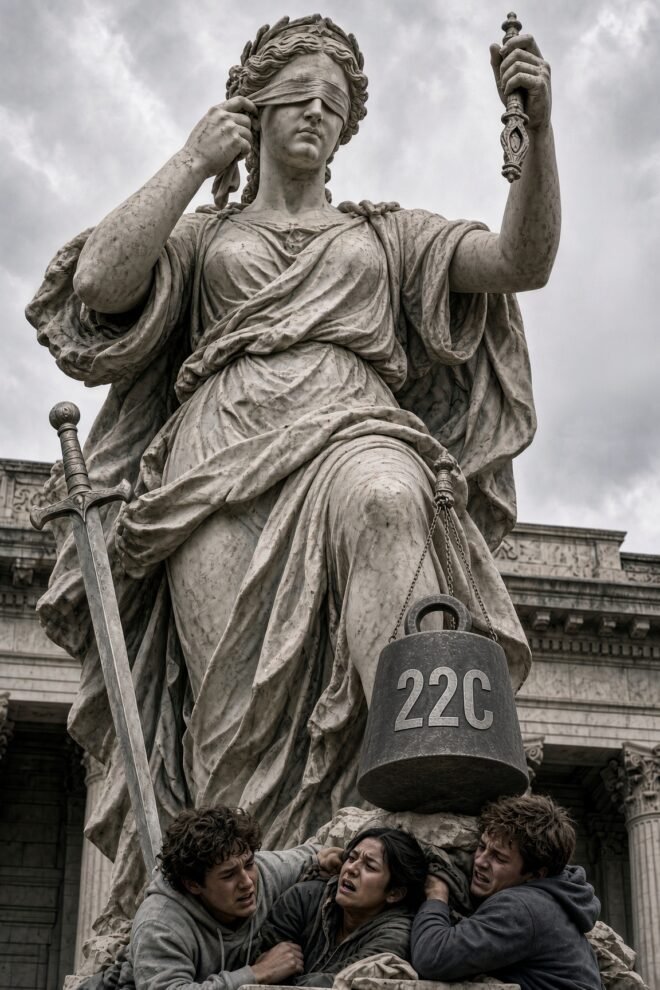
A bail hearing is one of the quietest and most consequential moments in the criminal law. It happens before any trial, before any evidence has been tested, and before anyone has been found to have done anything wrong. The question is simply whether a person who is presumed innocent should wait for their day in court at home or behind bars. For an adult, the answer has long turned on a balance of risk, liberty and fairness. For a child, the stakes are higher still, because the weeks and months spent in custody fall at the stage of life when identity, schooling, family bonds and a sense of the future are being formed. New South Wales has now decided to keep a law that makes that decision harder for children than for adults, and to keep it until 2028. The law is section 22C of the Bail Act, and the evidence gathered about it, much of it from the judiciary itself, shows a measure that is unfair in principle, flawed in operation and deeply discriminatory in effect.
What 22C does
Section 22C was introduced in 2024 as a response to public anxiety about youth crime, particularly in some regional communities. It applies to children aged fourteen to seventeen who are charged with repeated break-and-enter and motor vehicle theft offences. For those children, the ordinary approach to bail is reversed. The court must refuse bail unless it has a high degree of confidence that the child will not reoffend. Anyone who has worked near a courtroom will recognise how demanding that standard is. It asks a magistrate or judge to predict the future conduct of a teenager with something close to certainty, and it places the burden of proving a negative on the child.
The government called the measure a circuit breaker, a short, sharp intervention to interrupt a pattern of offending. The metaphor is appealing, but it is also revealing. A circuit breaker cuts power to the whole system, and it does not distinguish between the wire that is faulty and the ones that are sound. In practice, a bail law that cuts off the liberty of every child who falls within its charge categories will catch the child who is genuinely entangled in repeated offending, and it will also catch the child who has been wrongly or excessively charged. It does not distinguish between them, and that is where much of the harm lies.
A stricter test for children than for adults
The most striking feature of 22C is that it treats children more harshly than adults. Under the Bail Act, adults accused of the most serious offences, including murder and grievous bodily harm, must satisfy a show cause test, which requires them to justify why they should be released. That is a significant hurdle, and Parliament reserved it for grave crimes. Yet section 22C places a child accused of break-and-enter or car theft under a test that Justice Dina Yehia observed in 2024 was more onerous than show cause. A fifteen-year-old accused of stealing a car therefore faces a harder road to freedom than an adult accused of killing someone.
That outcome cannot be reconciled with any coherent account of why we treat children differently in the law. The whole premise of a separate youth justice system is that children are less mature, less able to weigh consequences, and more capable of change than adults. A bail regime that inverts that logic, demanding more of the child than of the adult, has abandoned the principle on which youth justice rests.
Justice Peter Rothman, one of the most experienced judges to sit on the question, made the point with unusual force. He described the law as a “ham-fisted attempt” to deal with a political difficulty, and said it created serious problems for the administration of justice without solving the problem it was meant to address. He also drew attention to the arbitrariness at its centre. Take two co-offenders charged over the same conduct, one aged seventeen years and eleven months and the other eighteen years and one month. The older one faces the ordinary bail framework, while the younger is subject to the stricter test, simply because of a gap of a few weeks in their birth dates. Rothman observed that this differentiation operates on people who are, on average, less mature and less capable of executive functioning, and it demands more of them than of the adults beside them. When the law’s own distinctions cannot be defended by reference to the characteristics of the people it affects, it fails the basic test of rational legislation.
The consequences of over-charging
A second concern runs through the criticism of 22C, and it goes to how the law interacts with police practice. Because the stricter bail test attaches to particular charges, the decision about which charge to lay becomes a decision about whether a child will be released. That gives police a powerful incentive, whether conscious or not, to select the more serious charge that triggers the test. Experts have warned that children are being overcharged for exactly this reason, and that the result is time in custody without proper justification.
The Aboriginal Legal Service made this point in its submission to the statutory review. It reported appearing in multiple matters where police had laid more serious charges that brought 22C into play, only for those charges to be withdrawn or to fail at court. It also pointed to a decision in which a judicial officer suggested that a serious charge had been improperly laid in order to invoke the higher bail threshold. If that is correct, it describes a bail law that works as an instrument of leverage, because the label placed on an allegation at the outset determines whether a child waits for trial in a cell or at home.
The case of a fourteen-year-old Aboriginal boy before Justice Julia Lonergan shows how this plays out. He was charged with taking part in a police pursuit while on bail for aggravated break and enter. By the time his application reached the Supreme Court, Her Honour had been told that the charges were likely to be withdrawn. He had already spent three months in custody. Lonergan noted that the law required children to be treated less favourably than adults facing the same charge, and that the unfairness was thrown into sharp relief by the likely collapse of the case. She also observed that if more care had been taken in assessing charges against children in the first place, she would not have needed to work through the process the Act required. Three months is a long time in the life of a fourteen-year-old, and no later withdrawal of charges can return it.
Who bears the burden
None of these concerns falls evenly across the community. The data compiled by the Bureau of Crime Statistics and Research for the statutory review shows that Aboriginal children made up 79 per cent of those captured by 22C and 83 per cent of those refused bail under it. Aboriginal children are a small fraction of the young population of New South Wales, so a law in which they account for roughly four in five of the children affected has an impact that cannot be put down to chance.
Sharif Deen, the Acting Chief Executive of the Aboriginal Legal Service, put the matter plainly. He said there was clear evidence that the law was having a discriminatory effect, with about 80 per cent of the children imprisoned under it being Aboriginal. He also pointed to a fact that should trouble anyone who cares about the presumption of innocence, which is that the vast majority of children in New South Wales jails have not yet had their day in court or been found guilty of anything. A bail law that adds to that number is, in effect, expanding the use of imprisonment against children who have not been convicted.
The case of a sixteen-year-old Aboriginal girl, noted in the review material, makes the abstraction human. She had a limited criminal history, yet she spent seven weeks on remand. She was later acquitted of the charges that had led to her detention. Seven weeks is nearly two months of schooling, family life, and community connection lost, and it was spent in custody for a case the court eventually decided the Crown could not prove. Nothing the justice system can do afterwards will give those weeks back to her.
An old pattern
For Aboriginal communities, the pattern here is a familiar one. The Royal Commission into Aboriginal Deaths in Custody reported in 1991 that the over-representation of Aboriginal people in custody was driven by their disproportionate contact with the criminal justice system, and not by any greater propensity to offend. It recommended that imprisonment be a sanction of last resort. More than three decades later, Aboriginal young people remain vastly over-represented in detention across the country, and the Closing the Gap framework commits governments to reducing that over-representation. A law that sends Aboriginal children to custody at rates far beyond their share of the population pulls in the opposite direction from commitments governments have signed.
It also runs against Australia’s international obligations. The Convention on the Rights of the Child, which Australia has ratified, requires that the detention of a child be a measure of last resort and for the shortest appropriate period. The International Covenant on Civil and Political Rights, to which Australia is also a party, gives particular protection to the liberty of persons awaiting trial and requires that accused juveniles be treated in a manner appropriate to their age. A statute that makes pre-trial detention more likely for children than for adults accused of comparable or graver offences is difficult to square with the spirit of either instrument.
The disproportion is also not merely a statistical curiosity, because the effects of early detention compound. A child who spends time in custody is more likely to be disconnected from school, more likely to lose stable housing or supportive relationships, and more likely to be exposed to older and more entrenched offenders. For Aboriginal families, who carry the memory of earlier generations of removal and institutionalisation, the sight of children being taken from their communities and held in custody carries a particular weight. A policy that adds to it, even unintentionally, risks deepening the very disadvantage that contributes to offending in the first place.
Does it work?
A fair assessment has to deal with the government’s central claim, which is that 22C works. Attorney-General Michael Daley pointed to the statutory review, which he said showed falling bail rates and falling youth crime, and his office described the law as helping to disrupt high-risk offending and stabilise youth crime in regional New South Wales. The government has also framed community safety as a fundamental obligation, one the community rightly expects it to discharge. That obligation is real, and the communities that have suffered repeated break-ins and car thefts are entitled to be taken seriously. Nobody who cares about justice should dismiss their fear.
But the review’s own findings are more qualified than the government’s summary suggests. It concluded that the law was likely to have contributed to short-term disruption of high-risk offending and the longer-term stabilisation of youth crime rates. At the same time, it found that offending had peaked before the law was introduced. That matters a great deal. If the trend was already turning, then falling numbers cannot be credited to 22C with any confidence, and the claimed benefit looks much weaker. The review also recorded significant criticism of the law, including its disproportionate application to Aboriginal children. A statutory review that acknowledges the discriminatory pattern and still recommends extension has effectively concluded that the discrimination is an acceptable price.
It is also worth noting how the timing sits. Most of the pointed judicial criticism was delivered before the review recommended extension. Judges who see the law operate in individual cases, and who are required to apply it even when they doubt its justice, told the community in plain language what they were seeing. That evidence was available to the government and was set aside. When the people charged with applying a law say that it produces arbitrary results, that it punishes children more harshly than adults, and that it encourages over-charging, a responsible legislature would treat that as a serious warning and not as an inconvenience.
The government’s acknowledgement
There is some irony in the government’s response. A spokeswoman for the Attorney-General’s office said the government acknowledged the genuine concerns raised about the over-representation of Aboriginal young people in the criminal justice system. That is an important admission, and it deserves to be taken at face value. But acknowledgement alone changes nothing for the child in a cell. If a government accepts that a law is falling disproportionately on one group of children, and extends it anyway, then the acknowledgement functions as a courtesy and not as a remedy. The test of sincerity is whether the policy changes, and so far it has not.
The same tension appears in the way the law is defended. Government statements describe it as part of a broader suite of measures, which is a reasonable point, since no single law explains changes in crime rates. But that framing cuts both ways. If many measures are operating together, the government cannot confidently attribute improvement to the one measure that judges have repeatedly condemned, and it cannot dismiss the evidence of harm as incidental to a package that is otherwise working. A measure that is unfair and unproven should not be extended on the strength of a package whose individual parts have not been separately assessed.
What a better approach would look like
Rejecting 22C does not mean ignoring youth crime. It means insisting that the response to it be effective, lawful and fair. The evidence on what reduces offending by young people is consistent across jurisdictions and decades. Stable housing, engagement in school, access to mental health and disability support, culturally grounded programs run by Aboriginal community organisations, and early intervention for families under pressure all reduce the likelihood that a child will become entangled in serious offending. Bail support programs, which provide supervision and practical help to children released into the community, can address the risk of reoffending directly without the damage that custody causes. These measures cost money and demand patience, which is why they are politically harder than a headline-friendly change to the Bail Act. But they work in a way that detaining unconvicted children does not.
A better approach would also deal with the integrity of charging decisions. If there is a real risk that charges are being selected because of the bail consequences they carry, then there should be independent scrutiny of those decisions, transparent data on charges laid and later withdrawn, and accountability where a pattern emerges. The principle is straightforward: the decision to charge should be made on the evidence, and never on the procedural advantage that a particular charge brings.
And a better approach would restore the principle that children are not to be treated more severely than adults. If legislators believe that a particular category of offending warrants a presumption against bail, they should explain why that presumption should apply to a child when it does not apply to an adult accused of the same offence. They have not done so, and the judges who have been forced to apply the law have said they cannot.
Conclusion
The extension of 22C to 2028 locks in a policy that the judiciary has repeatedly criticised, that treats children more harshly than adults, that creates an incentive for over-charging, and that falls on Aboriginal children at a rate that no neutral explanation can account for. The government’s case for it rests on the claim that it has helped, yet its own statutory review found that offending had peaked before the law arrived, and the review accepted that the law was being applied disproportionately to Aboriginal children.
The costs of that approach are measured in human terms: a fourteen-year-old boy held for three months on charges that were likely to be dropped, and a sixteen-year-old girl held for seven weeks before a court acquitted her. They are measured, too, in the trust that Aboriginal communities place in a justice system that promises equal treatment and delivers something else. Each child detained without conviction deepens the distrust, and distrust of that kind makes the system’s job harder, not easier.
A community that wants to be safe is entitled to ask its government for effective policy. It should also ask that policy be lawful, evidence-based and fair, particularly where it concerns children who have been convicted of nothing. Section 22C does not meet those standards. Until it is repealed or fundamentally reformed, New South Wales will continue to imprison children who are legally presumed innocent, and it will continue to do so most often to Aboriginal children. That is a failure of justice, and a failure that governments have the power to correct.
– – –
Bakchos is the founder of Blak and Black, an Australian media and advocacy platform established in 2010. Bakchos writes from the intersecting perspectives of Wiradjuri heritage, Jewish identity, and humanism.
© Bakchos, October 2026


The statutory review’s own data: Aboriginal children made up 79 per cent of those captured by 22C and 83 per cent of those refused bail under it.
This is a really interesting and very disturbing article. We know that police load up charges early on, drop a number, possibly all later, despite the fact that they can (and do) add to the list later. Without being able to afford independent legal representation, many young accused are reliant upon overworked, underfunded legal services in the state and Indigenous youth will be the most affected. It delays education, risks apprenticeships, breaks families. Yet more proof that when it comes to Closing the Gap, it’s all lip service from the legislators.
Indigenous people are always the losers in law and order auctions.
If the trend was already turning, then falling numbers cannot be credited to 22C with any confidence, and the claimed benefit looks much weaker.
Law and order auctions always bad and the losers when this happens and the most vulnerable members of our society.
The white Australia Policy lives on in multiple different facets of the Australian justice system.