When I was in first class, a group of my classmates tied me to a fence and urinated on me. They did it because of who my father was. I was six or seven years old. No one intervened, and no one afterwards held anyone to account. I have carried that memory for most of my life, and I have come to think it is not only a private injury but a small, concentrated image of something larger. It shows how contempt for Aboriginal people is learned, how it is rehearsed in playgrounds before it is expressed in parliaments and newspaper columns, and how it survives because the adults and institutions that could interrupt it choose not to.
I want to ask a question that has troubled me for a long time. Why do some Australians feel entitled to say the most outrageously racist things about Indigenous people, in public, with apparent confidence that nothing will follow? The answer is partly psychological and partly historical. But a large part of it, I believe, lies in a legal fiction that governed this continent for more than two centuries and that still shapes how many people think, even those who have never heard its name.
The Fiction at the Foundation
Terra nullius is a Latin phrase meaning land belonging to no one. As a doctrine of international law it was meant to apply to territory that was genuinely uninhabited, or inhabited by peoples so lacking in social and political organisation that the law could pretend they were not there. When Britain claimed the east coast of the continent in 1770, and when settlement began at Sydney Cove in 1788, the colonial authorities proceeded as though the doctrine applied. The fact that this was untrue was not in dispute at the time. Captain Cook’s own instructions had directed him to take possession of territory only with the consent of the natives, if there were any. There were, in great numbers, and their consent was neither sought nor given.
It is worth pausing on how deliberate the fiction was. The British knew the land was inhabited. Their journals describe fires, canoes, fishing weirs, tracks, ceremonies and a dense network of languages and peoples. Governor Bourke’s proclamation of 1835, which voided John Batman’s treaty with the Kulin people near Port Phillip, made the legal position explicit. Only the Crown could acquire land, and the people already living there had nothing to sell because, in law, they owned nothing. A century and a half later, historians such as Henry Reynolds would show how many colonists understood perfectly well that they were taking something that belonged to someone else, and how uneasily they lived with that knowledge.
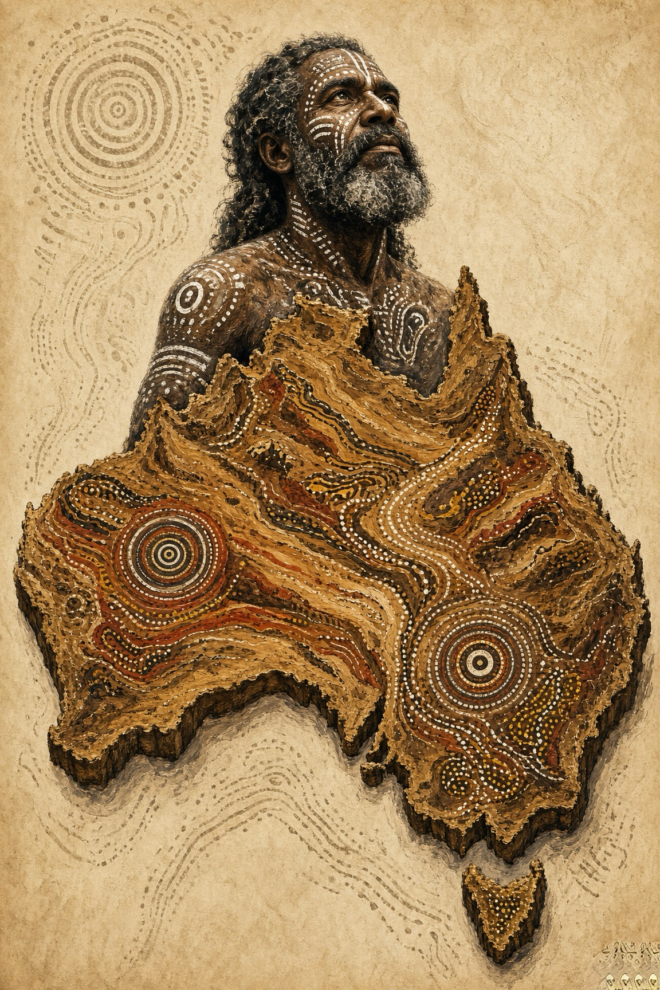
A legal fiction of this kind does not stay in the law books. It becomes a way of seeing. If the land was empty, then the people on it were not owners but obstacles, not nations but nuisances. If they had no law, then the violence done to them was not a violation of anything. If they had no sovereignty, then their resistance was not war but crime. Every later policy, from the frontier massacres to the protection boards to the removal of children, drew its permission from this founding assumption. Once a people has been defined out of the legal order, nearly anything can be done to them, and nearly anything can be said about them.
The Law Changes, the Habit Does Not
In 1992 the High Court of Australia, in Mabo v Queensland (No 2), rejected the doctrine of terra nullius as a description of Australian legal history. Justice Brennan, writing the leading judgment, said that the common law could not be allowed to rest on a discriminatory view of Aboriginal and Torres Strait Islander peoples, and that the fiction had to be discarded. The Court recognised that native title had survived the acquisition of sovereignty and could still exist where the connection to country had been maintained. Edward Koiki Mabo, a Meriam man from Mer in the Torres Strait, did not live to see the judgment. He died in January 1992, five months before the Court delivered it.
It would be comforting to believe that a High Court judgment can end a habit of thought. It cannot. Many Australians have never read Mabo and could not say what it decided. Some have heard of it only as a grievance, a decision that supposedly threatened backyards, as the scare campaigns of the early 1990s claimed. Others accept the legal outcome in the abstract but remain unwilling to accept what it implies, which is that the people who were here when the British arrived were not a vanishing remnant of the Stone Age but the owners and governors of a continent, in possession of law, language, economy and spiritual life.
This is the point at which denial becomes ordinary. Some people will still tell you, with the settled air of someone reciting common sense, that Aboriginal people were not really here in any meaningful sense, that they were nomads who owned nothing, that the continent was effectively empty, that nobody lost anything that mattered. These are the intellectual descendants of the doctrine the High Court rejected, and they persist because they do useful work. They allow the beneficiaries of dispossession to feel that no one was dispossessed. If there was no one here, there is no debt, no grief and no obligation. It is not hard to see why that story remains attractive, even to people who would be horrified to be called racist.
Who Counts as Aboriginal?
A second line of attack is directed at Aboriginal identity itself, and here my own family history bears on the question. In the south-east of the continent, where colonisation was earliest and most intense, the great majority of Aboriginal people today are of mixed ancestry. This is not a mystery and it is not an embarrassment. It is the direct consequence of two centuries of policy and violence. Frontier sexual exploitation, the forced removal of children, the institutional management of missions and reserves, and the assimilationist doctrine of “breeding out the colour” all pushed in the same direction. When the same society that engineered these outcomes then turns around and says that a person of mixed descent cannot be really Aboriginal, it is making an argument that is both cruel and circular. It creates a condition by force and then cites that condition as proof of illegitimacy.
My father was born on the Erambie mission at Cowra, a Wiradjuri man living under the regime of the Aborigines Protection Board and its successors. He was of mixed ancestry, as were many of his generation and as are very many of mine. He never doubted that he was Aboriginal, and neither did my cousin, Aunty Isobel Coe, whose lifelong commitment to the Wiradjuri people and to the cause of justice has never depended on the quantum of her blood. Their certainty was not a matter of arithmetic. It was a matter of belonging, of kinship and of the stories that tell a person where they come from.
The law reached the same conclusion by a different road. The test commonly applied in Australian courts and administrative practice has three parts: descent from Aboriginal people, self-identification as Aboriginal, and acceptance by the community in which one lives or has lived. The test deliberately does not turn on appearance or percentages, because those measures were the tools of the protection regimes and because they say nothing about what identity actually is. A person is Aboriginal because of who they come from and who claims them, not because a stranger has decided they look the part.
Those who challenge Aboriginal identity on the basis of ancestry or complexion are therefore not defending any rigorous standard. They are applying the very logic of the old protection acts, which sorted people into categories of “full-blood”, “half-caste” and “quadroon” and assigned rights and restrictions accordingly. That the logic is now deployed in the name of authenticity rather than control does not make it any less a product of the system that created it.
Two Inheritances
My mother was a French Jew, and I have always felt that this gave me a particular vantage point on the relationship between Indigenous and non-Indigenous peoples. I stand with one foot in a tradition that has been hated for its otherness for two thousand years, and with the other in a tradition that has been dispossessed and disparaged for two hundred. I do not say this to claim any equivalence of suffering, which would be both false and offensive. Different peoples bear different histories and each deserves to have its own recognised on its own terms. I say it because the experience of belonging to a people that the dominant culture has found easy to caricature gives one an ear for the grammar of contempt. It has recurring features: the reduction of a people to a stereotype, the attribution of collective guilt, the claim that they are not really part of the place where they live, and the suggestion that their grievances are exaggerated.
I should be honest about one thing. I have never personally experienced antisemitism. I have experienced racism, and a great deal of it, and it came because of my father’s Aboriginality. That asymmetry is itself instructive. It tells me that in the Australia in which I grew up, one inheritance made me a target and the other did not, and that the difference had nothing to do with anything I had done or been. Hatred of this kind never responds to the actual qualities of its object. It responds to a classification.
I also believe in the G-d of the Torah, and I believe in Indigenous spirituality, and I do not experience any conflict between the two. I know that some would find this incoherent. But the Torah speaks of a G-d who made every human being in the divine image, who commands that the stranger be loved as oneself, and who insists that there shall be one law for the native and the foreigner alike. Wiradjuri belief locates the sacred in country itself, in the rivers, the stones and the living memory of ancestors in the land. These are different languages, but they are not hostile to one another. Both insist that human beings are answerable to something greater than themselves. Both treat the land as a trust rather than a commodity. And both understand that a people cut off from its stories and its obligations is a people in danger of losing itself.
Perhaps this is why I find the claim that Aboriginal spirituality is primitive or inferior so thin. I have lived inside a tradition of sacred text and communal law, and I recognise in the Wiradjuri tradition the same seriousness about obligation and memory. Racism towards Indigenous Australians is not only an offence against people. It is an offence against a body of knowledge about how to live on this continent that is, by any measure, among the oldest continuous traditions on earth.
The Fence and the Bystanders
Return, then, to the fence. What I remember most about that day is not the cruelty of the other children, though it was real, but the silence that surrounded it. Adults existed in the world of that school. There were teachers, there was a playground, there was a system of supervision and discipline. Nothing happened. No one was punished, no one was spoken to, and nothing was said to me by anyone in authority to suggest that what had been done was wrong.
I did not understand it then, but I understand it now. The children who did this to me were not acting in a vacuum. They had learned somewhere that an Aboriginal child was someone to whom such things could be done. That lesson came from the household, from the street and from the wider culture that had spent two centuries treating Aboriginal people as legitimate targets of contempt. And they were confident they would not be stopped because, in their experience, no one ever was.
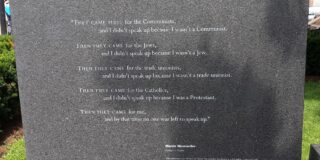
This is the real engine of racism in any society. It is not the existence of cruel individuals, who can be found everywhere. It is the willingness of everyone else to look away. Racism flourishes where it is cheap, where the person who says the unspeakable thing pays no price and the person who objects is told to lighten up. Every unchallenged remark teaches the next person that the boundaries are looser than they thought. Every institution that fails to act teaches its members that the rules are for show.
I think of this when I consider the letters that Angel Marina wrote, and the correspondence that surrounded them. Those documents, including Marina’s letter of 9 May 2002, Mark Mullins’s letter to Jon Stanhope of 27 June 2003, the reply from Harris of 4 July 2003, and the Ombudsman’s letter of 26 June 2005, have been publicly available for years. The Marina allegations were accepted by Harris as having taken place. The documents have been before the ACT Supreme Court. And yet nothing of substance has followed. I do not draw the comparison lightly and I do not suggest that the subject matter is the same. But the structure is the same. Someone has spoken, the record exists, officials have acknowledged what was said, and the machinery of accountability has declined to move. A person with the power to act looked at what was in front of them and decided that doing nothing was safer.
That is how institutional failure works in practice. Rarely does it take the form of an active conspiracy. More often it takes the form of a hundred small decisions to defer, to refer elsewhere, to wait for someone else, to treat a documented wrong as a matter of mere procedure. Each decision is individually defensible. Collectively they produce a system in which wrongs can be proven and still never be remedied.
What Would Change Things
I do not think the answer is a new slogan or a new law, though laws matter. Australia has had the Racial Discrimination Act since 1975 and the nation has long known what racism looks like. The harder problem is cultural and institutional. It involves making racism costly in the places where it is currently cheap.
That begins with honesty about the past. A country that teaches its children that the continent was empty, or that colonisation was essentially benign, is manufacturing the next generation of deniers. Truth-telling about dispossession is not an exercise in guilt. It is an act of accuracy, and accuracy is the precondition of any serious conversation about justice. The same is true of the history of mixed ancestry: it needs to be told plainly that the identity of Aboriginal people in the south-east was not diluted by accident but was the target of deliberate policy, and that the survival of that identity is therefore a form of resistance and not an anomaly to be explained away.
It continues with the courage of bystanders. Teachers who see a child being tormented, officials who receive a documented complaint, colleagues who hear a racist joke in a staff room: each of these people holds a small piece of power, and the sum of those pieces is the difference between a society where racism is checked and one where it is tolerated. I was tied to a fence because the people around me chose to be spectators. Had one adult stepped in, I would have learned something very different about the world.
And it requires that institutions treat evidence as something to be acted on rather than something to be filed. When a record shows that a wrong occurred, and when those in authority have accepted that it occurred, the next step is not silence. The next step is a remedy.
Conclusion
The contempt that some Australians express for Indigenous people, and the ease with which they express it, did not appear from nowhere. It descends from a legal fiction that declared a continent empty, from policies that dismantled families and then questioned the identity of the survivors, and from a long tradition of looking away. The fiction was formally abandoned in 1992, but the habits it created have proved far more durable than the doctrine.
My father was Aboriginal, and so was my cousin, and so am I in the sense that matters, whatever else runs in my blood. I draw strength from the Wiradjuri people whose country I come from and from the Jewish tradition of my mother, and I do not believe I have to choose between them. What I do believe is that a society is measured less by the cruelty of its worst members than by the response of its ordinary ones. A child tied to a fence is a test, and so is a letter that sits unanswered in a file. We have failed those tests many times. The question for this country is whether we are prepared, at last, to pass them.
– – –
Bakchos is the founder of Blak and Black, an Australian media and advocacy platform established in 2010. Bakchos writes from the intersecting perspectives of Wiradjuri heritage, Jewish identity, and humanism.
© Bakchos, October 2026