“Sit down boys!”
“But Sir, the Westgate Bridge has fallen down!”
So said one of my brothers, from his first floor classroom. Another, both arms in plaster and concussed from a fall from a height, wandered to my mother who was farewelling a friend on the doorstep to tell Mum the same. He’d seen it on the television. They all looked south to see the bridge gone, all that remained was smoke from a fire triggered by ignited diesel oil.
Dad had a long trip home that night from the other side of the river. And our parish priest, driving along the river at the time, found himself at the site, doing what men and women of the cloth do.
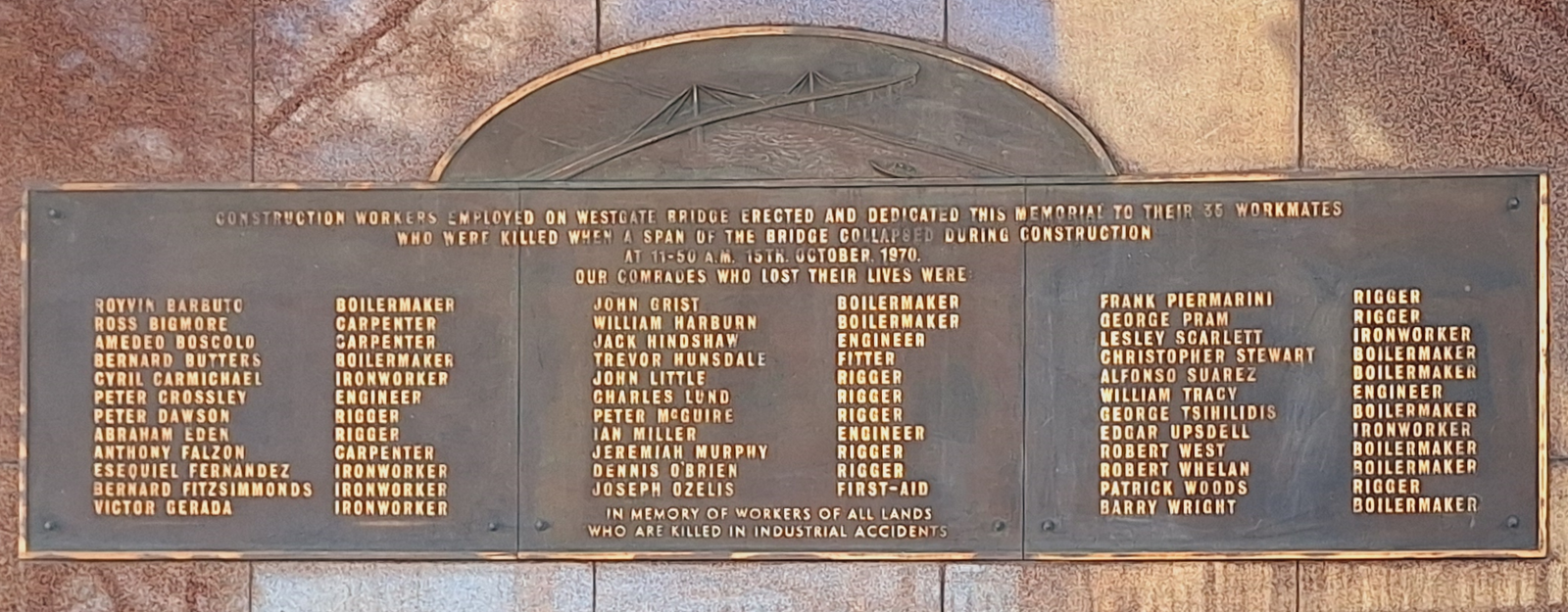
I was a babe in arms, so have no memory of the event, but it is etched in the people who experienced it to greater or lesser degree. Thirty-five men killed in an instant. One mother of four waited eight days until the body of her husband was found, it rising to the surface only after debris had been removed from the water, allowing the corpse to arise. Eighteen survived, some with barely a scratch, but most with severe injuries.
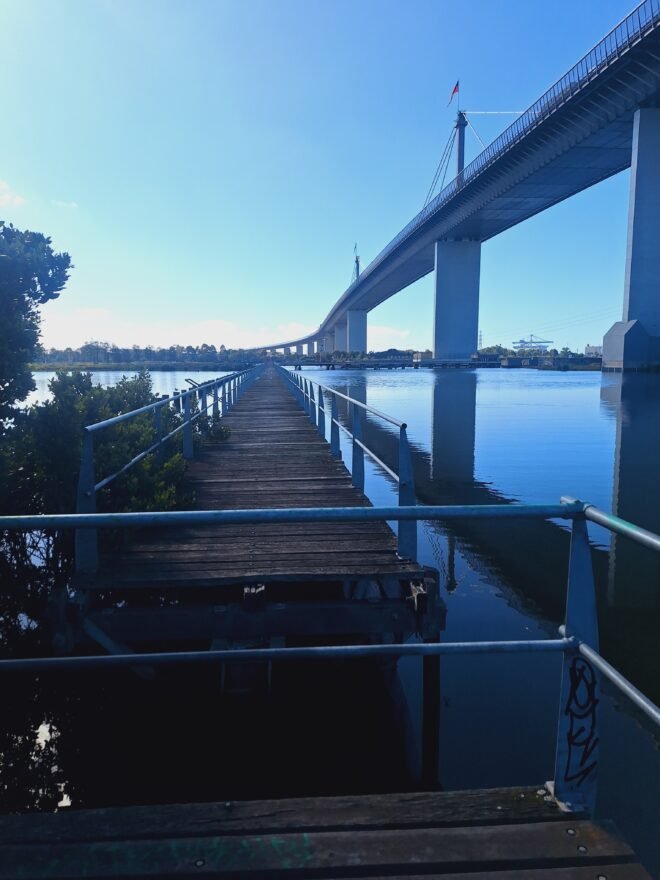
If you walk along the mouth of Melbourne’s great river, you find a pylon with the names of those who died. There’s a footbridge not far from there that runs just underneath, a span missing, too long to jump across, an echo of tragedy. The bridge belongs to them and their families. On this 56th anniversary of the Westgate Bridge Collapse, as I cross under the night sky from our own family celebration I will look at the fairy lights and remember the twinkling souls denied the same gift.
When the two sides of the bridge met in the middle over the river there was a disparity of 11 cm in height. To correct the error, engineers placed ten heavy loads called kentledges, each weighing eight tonnes, on the taller half to bend the steel. In the days before the collapse, some of the workers expressed concern about the construction, having felt tremors whilst on the bridge, but work continued. The fact was, rather than realignment, the weight placed too much stress on the steel and it buckled. Resident Engineer Jack Hindshaw, of the London based firm Freeman Fox Engineers, noted six days prior in his diary, “Obvious overstress due to concrete kentledge.” On the morning of 15 October 1970, workers were directed to remove bolts to allow the buckled section to straighten. At 11:00 am, serious concerns were rising as those on the bridge noted two other panels had also buckled. An urgent call was placed to Hindshaw for direction and a colleague went to find him. Still work continued. When Hindshaw arrived he placed another call for advice. Before workers were told to stop disaster occurred. At 11:50 am, 2,000 tonnes of construction materials plummeted to the river, landing on a site shed where workers were eating, others free-falling with the unsecured span through a fifty metre drop.
Many of those who worked on the Westgate were immigrants, the “new Australians” with whom my family worked and played and went to church. They and many others who worked on the Snowy Hydro Scheme, the Sydney Opera house, Ord River Irrigation Scheme, Moomba to Sydney Gas Pipeline were of immigrant backgrounds. Whatever the anti-immigration movement wants to tell you, Australia was built by those very people that Pauline Hanson and Angus Taylor would now exclude.
But it is far more than just what they built that matters. The collapse of Melbourne’s skyline masterpiece into the Birrarung, the river of mists, marked a seminal shift in workers’ rights and the union movement. Before this disaster workers compensation did not really exist, there was no occupational health and safety, no due process that protected an employee from being fired on the spot. Those who survived the bridge collapse were laid off with just a week’s pay. In an era when most homes were single income, for the 28 widows and 88 children, losing the adult male meant financial disaster. There was no compensation for those families grappling not only with the loss of a husband and father, but with the real immediate problem of keeping a roof overhead and food on the table. The subsequent lay-offs were the final straw.
In the aftermath, unions got angry and safety became a priority. The Royal Commission concluding six months later, found that the accident was preventable, laying the blame on engineering miscalculations, poor design and failed communication between engineers and contractors. The fact that a bridge constructed in Wales by the same company and of similar design had collapsed four months earlier, had not gone unnoticed. Workers called a halt to work until reassured by Hindmarsh that the design was sound. And whilst Hindmarsh, one of those killed that day, was found to be in part responsible for the collapse, the Commission also placed blame at the feet of the unions for striking over the very safety issues that had taken so many lives. The finding incensed workers.
Unions and the public were rightfully angry. Whilst supporting the widows through donations, unions demanded better conditions, unions whose membership was in no small part comprised of immigrants. It is as a result of the activism of those workers that workplace safety began to be taken seriously. Union representatives were empowered to halt work on unsafe sites and standardised procedures were developed covering risk assessments and monitoring of construction. Counselling for the grieving, the workers and families became the norm. The introduction of Occupational Health and Safety Legislation in 1985 carried with it consequences for employers who failed to provide a safe workplace.
There’s a haste to blame anyone other than ourselves for the demise in living standards, without considering what those others built for us. Pauline Hanson will tell you that she’s all for the battlers, whilst voting against every measure in the Parliament that would improve the quality of life for the ordinary person. Often she won’t even be present in the Senate when a vote is held. For votes held on Fair Work Legislation and a motion about Industrial Manslaughter in December 2023 she was absent. In 2020 she voted against the Economic Recovery Package (Jobseeker Hiring Credit) Amendment Bill 2020, intended to deliver protections for workers who had been laid off or had their hours reduced to lodge a dispute with the Fairwork Commission. She has voted against measures to improve housing affordability, including the Help to Buy Scheme and was absent for motions regarding the deployment of Australian soldiers to the Middle East in March 2026 as well as for motions regarding relations with Israel the month prior.
Migrants built much of the infrastructure that forms our way of life today and the newer generations of migrants, the health and aged care workers, IT professionals, cleaners and cooks and wait staff, underpin a quality of life that would not be possible without them. But the reality that Hanson and many others forget is that the immigrants who died at the mouth of Melbourne’s great river, so close to where Batman proclaimed he would build a city, gave us the modern union movement which underpins workplace safety and conditions. That’s a far greater legacy for 35 men than the horror of the fateful day and far more than Hanson, Taylor or the white supremacists will ever achieve.
– – –
© Watershedd, October 2026