
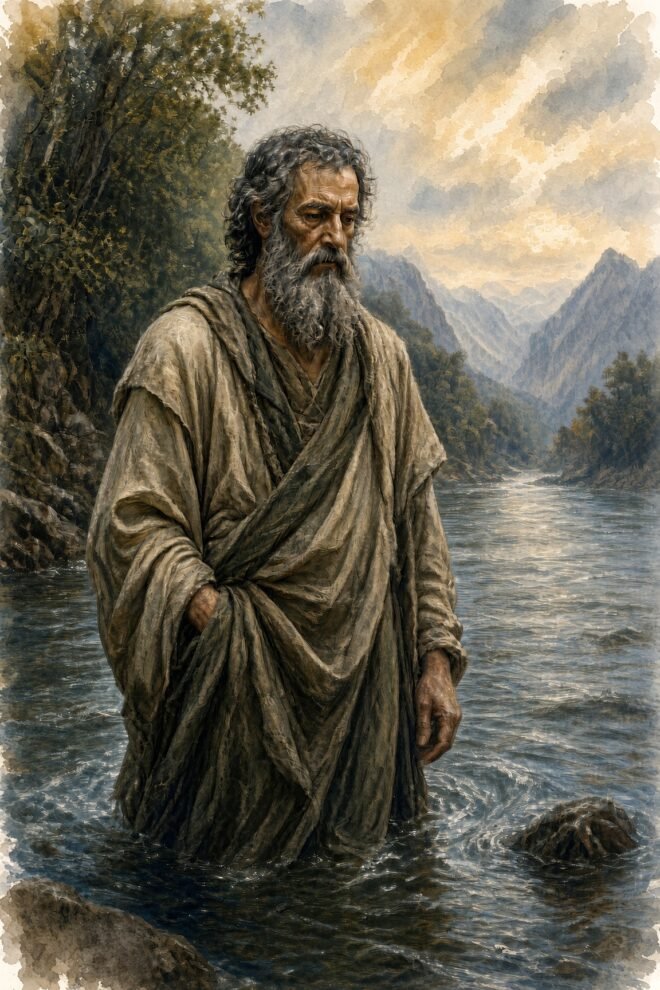
The River That Will Not Wait
There is a sentence that has been repeated for twenty-five centuries, in lecture halls, in pulpits, in graduation speeches and on the walls of cafés, and it is almost always attributed to Heraclitus of Ephesus: no man ever steps in the same river twice, for it is not the same river and he is not the same man. The version most of us know is a gloss, a tidy paraphrase handed down through Plato and later writers rather than a clean quotation from the man himself, but the gloss has survived because it captures something that every living person knows in their bones. Time moves in one direction only. What has gone cannot be re-entered. The water that touched your ankles a moment ago is already somewhere downstream, and the ankles themselves have been altered by the touching.
want to use that old idea as a lever against a very modern and very Australian piece of political theatre, the promise that the country can be taken back to a better time. Whenever a politician tells a crowd that we can turn the clock back, that we can restore the nation to what it once was, she is making a claim about the river. She is saying that the water can be called upstream, that the society of 1955 or 1975 or whatever golden year she has in mind is sitting somewhere waiting to be stepped into again, intact and unchanged, if only we have the courage to reject the people and ideas that supposedly ruined it. That claim is not merely mistaken. It is a kind of lie, and it is a lie that depends upon the listener not stopping to think about what a river actually is.
Just as you cannot step into the same river twice, you cannot step back into the past of any society, and anyone who tells you otherwise is either deliberately deceiving you or deceiving themselves. There is no third category. The person who promises a return is either a cynic who knows better and trades on your longing, or a dreamer who has mistaken memory for a place. In either case the promise is hollow, and in the Australian context it has a particular character that deserves to be named. The loudest merchant of this promise at present is Pauline Hanson, and in my judgement she is among the most un-Australian figures in our public life, a nationalist who has dressed herself in the clothing of a patriot. The rest of this essay is an attempt to explain why, beginning with the river and ending, I hope, with a better account of what it means to love a country.
What Heraclitus Actually Saw
It helps to be clear about what Heraclitus meant, because the popular reading is sometimes flattened into a cliché about change being the only constant. The surviving fragment, in its more literal form, speaks of different and different waters flowing upon those who step into the same rivers. Notice that the rivers remain the same in one sense. The Thames is the Thames, the Murrumbidgee is the Murrumbidgee, and a person can point to it and name it across a thousand years. Identity persists. But it persists through flux rather than despite it. The river is the same precisely because the water is always different, because the pattern of movement continues while its contents are constantly replaced. Stillness would not preserve the river. Stillness would make it a pond, and then a swamp, and then a dry bed.
This is the philosophical heart of the matter, and it dismantles the nostalgic programme at its root. The nostalgist imagines that a nation is a fixed object, a statue, which has been vandalised and could be restored by removing the graffiti. Heraclitus teaches that a nation is a river, which is to say a continuing pattern of life that exists only in its movement. To demand that the movement stop and reverse is to demand the death of the thing you claim to love. A society that has genuinely stopped changing is not a preserved society. It is a dead one, and history is full of examples, empires and cultures that froze their forms in amber and were swept away because the world around them kept flowing.
There is a second layer to the fragment that is easy to miss, and it is the one that matters most when we turn to politics. It is not only the river that changes. The man changes too. The person who stepped in yesterday is not the person who steps in today, because he has lived another day, learned something, lost something, been hurt or healed. This is why nostalgia is so treacherous. When we remember the past fondly, we are remembering it with the eyes of someone who survived it, who knows how it ended, who has had the sharp edges worn smooth by decades of retelling. We could not return to that moment even if the moment could be rebuilt, because the person doing the returning is no longer the person who left. The child who found a street enormous and safe would walk back along it as an adult and find it small, and would find that the safety had always been partly an illusion maintained by other people’s labour and silence.
Twenty Bridges and a Very Old River
Rudyard Kipling understood something of this when he wrote “The River’s Tale” in 1911. The poem opens with the bridges of London, twenty of them stretching from the Tower to Kew, who wanted to know what the River knew, for they were young and the Thames was old, and this is the tale that the River told. The conceit is delightful and quietly devastating. The bridges, those proud works of engineering and civic pride, are children in the presence of the water. They arrive late, they are confident, they believe they are the story, and the river, which has seen the Romans and the Danes and the plague and the fire, listens with the patience of something that has outlasted every empire that ever tried to cross it.
The point deserves to be taken literally. In the vast stretch of time that the Thames has existed, which runs back past any human reckoning, the bridges are indeed new. They belong to the last small fraction of the story, to the later phase of human occupation of that territory. Today there are many of them, road and rail and footbridge, more than a hundred crossings of one sort or another if one counts the pedestrian ones, and every single one is a monument to a moment. Each was built by people who believed they were making something permanent, and each has been rebuilt, widened, strengthened, closed, reopened, and in some cases swept away. London Bridge, of nursery rhyme fame, has been replaced so many times that the question of which bridge is the real one has no coherent answer. The crossing persists. The structure is always another structure.
Here is the lesson for a nation. A country’s institutions, laws, customs and self-understanding are its bridges. They matter enormously, and a healthy society looks after them, repairs them, and honours the people who built them. But they are not the river. They are the temporary and renewable means by which a living people cross the water of their own history, and every generation has the right and the duty to rebuild them in light of what it knows. The person who treats a particular bridge as sacred and unalterable, who insists that the bridge of 1950 is the true bridge and everything since is an act of vandalism, has mistaken the crossing for the current. Worse, that person usually has not noticed who was left on the far bank when the old bridge was in use.
The Seduction of the Golden Age
Why, then, does the promise of return have such power? Because it is not an argument. It is an emotion wearing the costume of an argument. Almost everyone feels, at some point, that the world has accelerated beyond their comfort, that the familiar has been displaced, that the streets and the voices and the rules are no longer quite their own. That feeling is real and deserves respect. Change is a loss as well as a gain, and anyone who pretends otherwise is being glib. The honest response to that feeling is to help people navigate the change, to ensure that its benefits and burdens are fairly shared, and to build the new bridges well.
The dishonest response is to exploit the feeling by offering a villain and a time machine. The villain is whoever is newest or most visible or least able to answer back, migrants, refugees, religious minorities, First Peoples demanding that their history be told, and the time machine is a vague promise that if these people can be pushed back or silenced the nation will return to its proper form. The beauty of this offer, from the point of view of the demagogue, is that it can never be tested. The golden age is a place that cannot be visited, so no one can ever discover that it was not golden. And when the promised restoration fails to arrive, as it must, the failure can always be blamed on the enemies who were not sufficiently removed.
The historical record should make us suspicious of every golden age we are offered. The Australia of the 1950s, so often invoked as a lost paradise, was a country in which the White Australia policy governed immigration, in which Aboriginal people across the continent lived under protection boards and exemption certificates, in which women were pushed out of public employment on marriage, and in which difference of almost any kind was policed with a thoroughness that people now find hard to credit. My own father was born on Erambie Mission at Cowra, a place where Wiradjuri people were managed by officials who controlled where they could live, whom they could marry, and whether their children would stay with them. For people like him, the proposition that the country should return to the way it used to be is not a gentle appeal to simpler times. It is a proposal to walk back into a house whose doors were locked from the outside. Every nostalgic promise has a hidden roll call of the people who paid for the golden age, and the nostalgist’s first task is to stop us reading it.
A Country in Perpetual Motion
Australia, like every nation, is in a constant state of flux, and the flux is not a modern affliction. It is the permanent condition of the place. Long before the Thames had a single stone bridge, these lands were being read, managed and renewed by peoples whose continuity of culture is among the oldest on earth. And here is the paradox that the nostalgists never grasp: that continuity was itself a product of adaptation. Aboriginal societies survived climate change, rising seas, the extinction of megafauna and the shifting of whole ecosystems, not by freezing their way of life but by carrying a living body of law and knowledge through every transformation. The tradition endured because it was capable of change. The river was the same river because the water was always different.
Then came the colonial invasion, and with it a catastrophic reordering that was imposed rather than negotiated, and from that violent beginning the country has continued to change through waves of arrival. The Irish and the Scots and the English, the Germans in South Australia, the Chinese on the goldfields who were met with riots and exclusion laws, the Afghan cameleers who opened the inland, the Italians and Greeks who rebuilt the post-war cities, the Vietnamese, the Lebanese, the Indians, the Sudanese, the Chinese again. Each wave was greeted by some of its predecessors as a threat to the national character, and each wave went on to become part of what the national character means. The Greek grocer, the Italian coffee machine, the Vietnamese bakery, the Lebanese corner shop, these are not departures from Australia. They are Australia, as surely as the meat pie and the Hills Hoist.
This matters because it shows that the thing Hanson claims to defend does not exist in the form she imagines. There is no pure and fixed Australia against which the present can be measured and found wanting. There is only the river, carrying one generation’s contributions and another’s, constantly redrawing its own banks. To insist on a particular snapshot as the authentic nation is to take one frame from a long film and declare the rest an error. It is also, quite plainly, to misunderstand the history of the very people on whose behalf such politicians claim to speak. Many of the families who now feel threatened by newcomers are themselves the descendants of people who were once the newcomers, and who were once told that they did not belong.
Hanson and the Politics of Subtraction
Pauline Hanson entered the national stage in 1996 with a maiden speech that warned of the country being overrun by people of Asian background, and she has spent the decades since adjusting her target while keeping the essential structure of her message intact. The Asians gave way to the Muslims, the Muslims to the African gangs, the African gangs to whichever group the news cycle has made available. The specific enemy changes with remarkable flexibility. What does not change is the shape of the offer, which is subtraction. Remove the outsiders, reduce the rights of the minorities, wind back the recognition of First Peoples, cancel the policies that acknowledge difference, and the real Australia will supposedly reappear. At no point in this long career has she offered anything that adds to the country, a plan for building, a vision of shared purpose, a proposal that asks citizens to do something generous rather than something fearful.
It is worth noticing what this politics requires in order to function. It requires a constant supply of grievance, because a movement built on subtraction has nothing to offer once the grievance is satisfied. It requires that division be kept alive, because unity would remove the audience. And it requires a particular relationship with the truth, in which the claim that the clock can be turned back is repeated with confidence long after everyone involved, including its author, has had ample evidence that it is impossible. When she appeared in the Senate in 2017 wearing a burqa as a piece of theatre aimed at her Muslim fellow citizens, the gesture told us everything about the method. It was not an argument. It was a performance of contempt, staged for the cameras, designed to make one group of Australians feel like a problem to be solved rather than neighbours to be lived beside.
I do not say any of this out of personal animus. I say it because the consequences of this politics fall on real people. When a senator, with all the authority and platform that the office provides, spends years telling the country that a minority is a danger, the effect is not confined to the chamber. It enters the schoolyard, the bus stop and the workplace. It emboldens the person who wants to shout at a woman in a headscarf, and it frightens the family who simply wanted to buy milk. A public figure who traffics in division bears some responsibility for the weather she creates, and the claim that she is only saying what people are thinking is no defence at all, because leaders are supposed to raise the tone of a nation’s thinking rather than to harvest its worst moments.
Nationalist or Patriot
The distinction between a nationalist and a patriot is old, and it is not a quibble. George Orwell drew it sharply in the aftermath of the Second World War, describing patriotism as devotion to a particular place and way of life that one believes to be the best in the world but has no wish to force on other people, while nationalism, in his account, is inseparable from the desire for power and the need to assert superiority over others. The patriot is defensive in the best sense. She loves her country the way she loves her family, with attachment and with honest recognition of its faults. The nationalist loves her country as a trophy. Her pride depends upon someone else being smaller.
By that test Hanson is a nationalist and is not a patriot. A patriot who loved Australia would love all of it, the inconvenient parts included. She would love the ancient Aboriginal and Torres Strait Islander cultures that make this continent unlike any other place on earth, and would want the country to tell the truth about how those cultures were treated. She would love the migrant communities who have built the suburbs, run the hospitals, driven the cabs and taught the children, and would count their belonging as part of the nation’s strength rather than a dilution of it. She would be willing to look at the dark chapters of the story without flinching, because the patriot trusts the country to survive honesty. It is the nationalist who cannot bear the truth, who treats every acknowledgement of past wrongs as an insult and every new arrival as an invasion, because her sense of the nation is too brittle to withstand contact with reality.
This is also why I call the project un-Australian, a word that has been much abused and which I use deliberately. The phrase has too often served as a club for beating dissenters, but there is a better and older meaning in the ideal of the fair go, the instinct that people should be judged by what they do rather than where they come from, and that a country is made by those who show up and pitch in. A politician who builds her career on telling some citizens that they do not belong, who treats entire communities as threats, and who asks the country to turn away from its own diversity is working against the grain of that ideal. She is not defending the Australian tradition. She is betraying its best part.
Wading In
So what is the alternative to the fantasy of return? It is to accept the river, and to take responsibility for the person who is standing in it. That does not mean cheering every change as progress or pretending that the pace of modern life costs us nothing. It means facing the present honestly, acknowledging what has been lost, and asking what we owe each other in light of what we now know. A country that can tell the truth about Erambie and the protection boards, and can also welcome the newest refugee with a straight face, is not a country that has abandoned its heritage. It is a country that has understood what a heritage is, which is something carried forward rather than preserved under glass.
The bridges of the Thames will keep being rebuilt, and the river will keep running past them, patient and unimpressed, long after the engineers who built them and the politicians who opened them have gone. Kipling’s young bridges wanted to know what the river knew, and the river told them a long story in which every proud structure turned out to be a passing guest. Perhaps that is the humility we most need in our public life, the recognition that no generation owns the river and no politician can command it to run backwards.
Heraclitus gave us the question in its simplest form, and the answer is not difficult once we stop pretending. You cannot step into the same river twice, because neither the river nor the person is the same. The past is a country we cannot visit, however loudly someone promises a ticket. What remains is the harder and better work of building the next bridge together, with all of the people who now live on both banks, and of building it well enough that those who come after us can cross in safety. Pauline Hanson offers no such work. She offers a longing with a villain attached, and a river that will never flow the way she says it will. Australia deserves better than a politician who stands at the water’s edge and shouts at the current.
– – –
Bakchos is the founder of Blak and Black, an Australian media and advocacy platform established in 2010. Bakchos writes from the intersecting perspectives of Wiradjuri heritage, Jewish identity, and humanism.
© Bakchos, October 2026