I. Introduction: The Apparition and the Apparatus
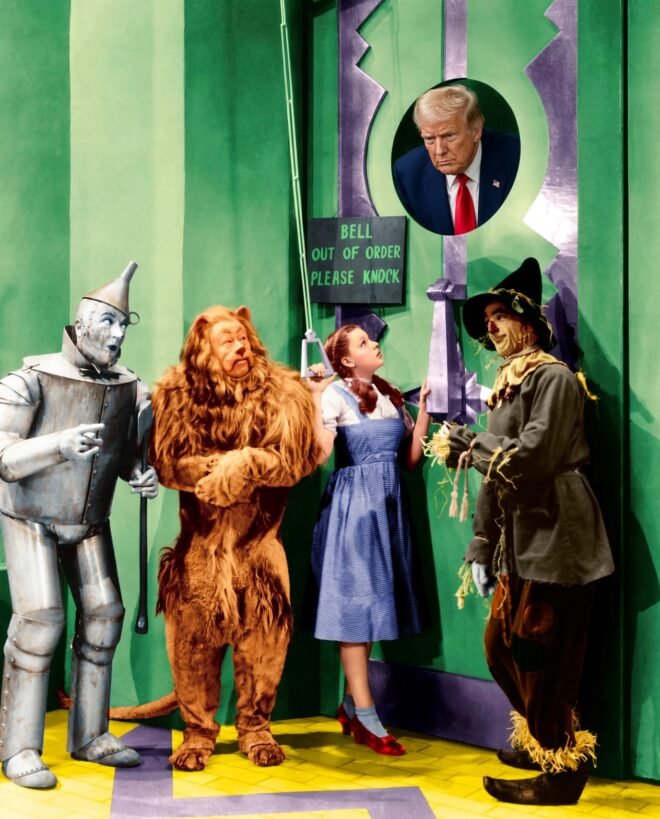
When Dorothy and her companions at last reach the throne room in L. Frank Baum’s 1900 novel, the Wizard of Oz does not appear to them as one thing. To Dorothy he is an enormous head, to the Scarecrow a lovely lady, to the Woodman a terrible beast, and to the Lion a ball of fire. Each petitioner meets the apparition he or she most hopes for or most fears, and each is told that the price of what they ask is a deed: the death of the Wicked Witch of the West. It is only when Toto knocks over a screen in the corner that the apparatus is exposed. Behind it stands a small, elderly man, a former balloonist from Omaha, working the voice and the smoke, who cheerfully confesses that he is a humbug.
What follows is easily forgotten, and it is the heart of the analogy. The Wizard does not send the travellers away empty-handed. He gives the Scarecrow a head full of bran, pins and needles, the Woodman a silk heart stuffed with sawdust, and the Lion a draught from a green bottle. Each gift is a prop, and each works, because the recipient already possessed the quality the prop is said to confer and needed only to be told so by an authority he believed in. The Wizard has altered no one’s capacities. He has altered what they believe about themselves, and he has done it with a fine instinct for theatre.
This essay argues that Donald Trump’s political career is best understood through that figure, which I will call the populist Wizard. By the term I mean a politician who mobilises ordinary voters through dramatic rhetoric, a personal brand and promises of restoration or empowerment, while relying more on performance and perception than on durable institutional or policy substance. The claim is deliberately narrower than the usual polemic. It does not say that Trump has achieved nothing, and it does not say that his supporters are dupes. It says that the ratio of spectacle to structural change in his career is unusually high; that the claims made for his achievements regularly outrun the measurable record; and that where he has produced lasting change, the levers pulled were largely those of conventional politics, operated in significant part by other people.
The argument proceeds in five steps. The first examines how the persona is constructed and why its machinery is more ordinary than its image. The second sets promises against outcomes across both terms. The third gives the strongest counter-evidence its full weight, because a thesis that cannot survive its best objections is not worth holding. The fourth considers what survives of the claim after those objections, and the fifth turns to the limits of the analogy itself, which, as will emerge, fails at the very moment Baum’s story depends on: the unmasking.
II. The Making of the Wizard
The persona long predates the politics. Trump’s 1987 book The Art of the Deal, written with the journalist Tony Schwartz, offered the public a portrait of the decisive, instinctive dealmaker and gave the world a defence of what it called truthful hyperbole, an innocent form of exaggeration that sells. From 2004 The Apprentice converted that portrait into weekly television, a boardroom in which a commanding executive hired and fired with a gesture. The image of the tycoon whose judgement was infallible was therefore manufactured by a production crew at a time when casino companies bearing his name had gone through Chapter 11 reorganisation on four separate occasions. Even before he entered politics, the persona and the record were different things. The first was the product. The second was the man behind the curtain.
The political career has been built from the same materials. The slogans are simple and total: Make America Great Again, drain the swamp, build the wall. The rally is a staged event in which the audience is both spectators and cast. The announcement is dramatised as revelation. The tariff programme unveiled on 2 April 2025 was called Liberation Day and presented at a White House event, with the vocabulary of national emancipation attached to what was, in legal terms, a set of import duties imposed under an emergency statute. In the second term the same instinct has found physical form. AFP’s review of the first year noted that Trump demolished part of the White House late in 2025 to make way for a ballroom, a fitting symbol, in its words, for a presidency that began like a wrecking ball. Whatever one makes of the project, it is a gesture designed to be seen.
The argument here is not that spectacle is illegitimate. All politics is theatre to some degree, and the capacity to command attention is itself a form of power. The argument is about the relationship between the show and the levers. The levers Trump has used are the conventional ones: executive orders, which he has signed at a pace without modern precedent; appointments; the machinery of the Republican Party and its majorities in Congress; and the prosecutorial and regulatory discretion of the executive branch. None of these is peculiar to him. What is peculiar to him is the ability to make an ordinary exercise of them look like a singular act of will, and to make an announcement stand in for an outcome.
This is where the gap between projection and reality becomes visible. The image of the outsider who would bring boardroom decisiveness to Washington sits awkwardly beside the documented turnover in his senior staff during the first term, which scholars of the presidency found to be unusually high, and beside the repeated discovery that a presidential announcement is the beginning of a legal and administrative process rather than its end. The persona is the primary product. The governing is something else, and it is subject to the same constraints that bind every president: Congress, courts, markets, other nations, and the sheer difficulty of administering a continental state.
III. Promises Versus Realised Substance
The first term supplies the canonical illustrations. Trump promised a wall across the southern border that Mexico would pay for. Mexico did not pay, and the several hundred miles of barrier that were eventually built or replaced consisted largely of new fencing laid where older fencing already stood rather than closing open ground. He promised to repeal and replace the Affordable Care Act, and the effort collapsed on the Senate floor in July 2017. He said in 2016 that he would eliminate the national debt over eight years, and the debt grew substantially even before the pandemic. Infrastructure Week became a running joke in Washington because it was announced so often and never arrived; the bipartisan infrastructure law that finally did arrive was signed by his successor in 2021. These are well-known examples, but their value for the thesis lies in their structure. In each, the announcement was grand and unconditional, the delivery depended on actors Trump did not control, and the gap was absorbed without cost to the persona.
The second term allows a more systematic assessment, because there is now an independent tracker. By February 2026 PolitiFact was following seventy-five of Trump’s second-term promises. It judged that he had kept about nineteen per cent of them, that three tax promises had ended in compromise, and that nearly a third had stalled through inaction in Congress, obstruction in the courts, or a lack of White House initiative. In January, Trump told an audience in Detroit, “I’ve kept all my promises, and much more.” A tracker that rated most promises as still in progress is not evidence of failure, and PolitiFact made no value judgement about the promises themselves. But it is evidence of a gap between the claim and the record, and the claim in this case was total. One promise it rated as broken was the pledge to end the war between Russia and Ukraine within a single day.
The signature policy of the second term, tariffs, shows the pattern most clearly. On 20 February 2026 the Supreme Court ruled by six votes to three that the International Emergency Economic Powers Act does not authorise the president to impose tariffs. Chief Justice Roberts, writing for the majority, observed that the statute contains no reference to tariffs or duties, and that no president had previously read it to confer such a power. Tariffs resting on that statute made up roughly sixty per cent of the total, and the Customs and Border Protection figures reported by trade press put the sums collected under it at around US$130 billion by mid-December. The ruling did not address refunds. Trump called the decision a disgrace and announced, the same day, a ten per cent global tariff under a different statute. Defenders are right to observe that tariffs have not disappeared and that the administration retains other authorities. But the episode illustrates the thesis in a particular way: a policy announced as transformative and presented as liberation had been built on a legal foundation that the Court found to be a stretch, and the trade agreements announced with fanfare on its strength were left in a state of uncertainty that observers could not immediately resolve.
The cost of living offers a harder test, because it was the promise on which the 2024 campaign most plainly rested. Trump promised to bring down the price of everyday goods. In September 2026 the annual inflation rate was 3.7 per cent, according to Labor Department data reported in mid-October, against 2.4 per cent in September 2024. A war with Iran, begun with US and Israeli strikes on 28 February 2026 and described by Trump as a campaign of four to six weeks, had by the two-month mark closed the Strait of Hormuz, driven the national average price of petrol to around US$4 a gallon from about US$3.15 a year earlier, and sent costs rising across airline tickets, housing, fertiliser and groceries. A ceasefire and a memorandum in June were followed in July by his announcement that the ceasefire was over. Payroll growth in September was a modest 29,000 jobs, with annual wage growth around three per cent. Causation here is contested, and a fair account must allow that global energy markets, the war and the tariffs all play a part. The point for this essay is narrower. A politician whose appeal rested on a promise of restored affordability, and who proceeded to a war that its authors had projected to be short and which was not, has produced precisely the divergence between promise and outcome that the Wizard model predicts.
It is worth identifying what the model does and does not claim here. It does not claim that nothing has happened. It claims that a great deal of the political effect has operated through narrative and confidence, by changing what people believe is happening or about to happen, rather than through the creation of new capacities. Some of the most conspicuous kept promises are of this kind. The pardons of the January 6 defendants on the first day of the term, which PolitiFact counted as kept, were acts of will that required no one’s cooperation and altered no institution. The rescue of TikTok, among the most popular promises, was likewise an act of presidential discretion. These are symbolic victories in the strict sense. They matter politically, but they are different in kind from changes that bind future governments, and the thesis requires that the two be distinguished.
IV. The Strongest Case Against the Thesis
A serious essay must now give the opposing argument its best form. The first and most formidable point is the border. The Department of Homeland Security reported preliminary figures of 98,708 Border Patrol apprehensions on the southwest border in fiscal year 2026, the lowest annual total on record, and said that for the first time the Border Patrol had released none of the migrants it apprehended into the interior. Pew’s analysis of federal data found that total Border Patrol encounters in fiscal 2025 were already the lowest since 1970. Whatever else may be said, this is a measurable result in the area on which Trump campaigned most insistently, and it was achieved through executive action, in the face of predictions that it could not be.
The second point is legislative. The One Big Beautiful Bill Act, signed on 4 July 2025, permanently extended the individual provisions of the 2017 tax law that was the signature achievement of the first term, and added further provisions on tips and overtime. The Tax Foundation estimated that its passage prevented a tax increase in 2026 for more than sixty per cent of Americans. Whatever one thinks of its distribution, and the Congressional Budget Office’s estimates of a deficit increase of about US$3.3 trillion and a Medicaid reduction of roughly a trillion dollars over a decade are the basis of much criticism, it is a very large enactment that changes the law of the land for years.
The third point concerns the courts. Trump appointed three Supreme Court justices and a large number of lower-court judges in his first term, and the decision in Dobbs v. Jackson Women’s Health Organization in 2022 overturned a precedent that had stood for nearly half a century. If durable structural change is the test of substance, this is the most durable change of any modern presidency. The fourth point is a set of first-term accomplishments that no humbug theory comfortably explains: the First Step Act’s sentencing reforms, the replacement of NAFTA by the USMCA, the Abraham Accords normalising relations between Israel and several Arab states, and the accelerated development of vaccines under Operation Warp Speed.
The fifth and subtlest point is political. Trump won the presidency in 2016, lost it in 2020, and returned in 2024, winning the popular vote and every swing state, after two impeachments and a criminal conviction. A figure who does that has demonstrated a capacity well beyond that of a showman, and the Wizard of Oz, we should remember, was not a failed ruler. In Baum’s book he governed the Emerald City for many years and was loved for it.
The humbug was an effective monarch. The analogy therefore cuts both ways, and a defender of Trump might reasonably say that its most accurate reading is a compliment: the Wizard held the city.
Finally, the defenders can note that the institutional opposition Trump has faced, including the Supreme Court’s tariff ruling, constrains any president, and that a constraint is not evidence that the ambition behind it was theatrical.
V. What Survives of the Thesis
These objections are substantial, and they require the thesis to be restated rather than abandoned. The first thing they establish is that the Wizard analogy is most persuasive as a description of political communication and self-presentation, and least persuasive as a total denial of policy impact. Border enforcement has changed, taxes have been cut, and judges have been appointed. Any account that denies this is a polemic rather than an analysis.
But the objections do not touch the thesis at its core, which concerns scale, durability and attribution. On scale, the largest claims have been the least fulfilled: the promise to eliminate the debt, to bring prices down, to end a major war in a day, and to remake the global trading system through a single statutory instrument. On durability, the border results depend on executive discretion and on the deterrent effect of enforcement, which a future administration can alter, as the first term’s barrier programme was altered before it. The sharp fall in crossings began in the second half of 2024, after the previous administration’s restrictions, so the apparent size of the effect depends on where the counterfactual is drawn. Even a sympathetic analyst writing in the Washington Examiner in July cautioned that apprehensions are enforcement outputs rather than complete measures of border security, since they do not count successful entries or explain why fewer people attempted the journey. The measure is real, and it is narrower than the claim.
On attribution, the point is that the most enduring achievements came through machinery that belonged to others. The tax law is the programme of the Republican congressional majority, passed through a reconciliation procedure that any party in power might have used. The judicial appointments rested on lists and networks that long preceded Trump’s candidacy and on a Senate leader’s strategy of blocking and then confirming nominees. These were real levers, pulled effectively, and the credit for pulling them is genuine. But they were conventional levers. The distinctive contribution of the Wizard was the performance that surrounded them, and the performance is the part that the thesis is about. In this respect the more precise formulation is that Trump is a conventional Republican president of unusual effectiveness in the use of established instruments, wrapped in a persona that systematically overstates the novelty and magnitude of what he does.
A further objection should be anticipated: that the same criticism can be made of any charismatic populist, from Berlusconi to Johnson to Perón. This is partly true, and the thesis should therefore be confined to what is distinctive. Three features are. The first is that the brand was created before the politics, by television, so that the political career is the extension of a performance rather than the reverse. The second is the scale of the claims, which habitually reach for the superlative, the greatest, the most secure, the best ever. The third is the way the persona absorbs falsification, so that an announced result that fails to materialise is replaced by a new announcement rather than explained.
VI. Conclusion: The Curtain That Will Not Stay Down
The analogy breaks down at the point where Baum’s story reaches its climax. In the novel the Wizard’s power ends when the screen falls. Once the apparatus is visible, the apparition cannot be sustained, and he must find a balloon and go. Trump’s politics has not followed that script. The machinery has been in public view for decades: the deal announced as triumph, the threat issued as negotiating leverage, the bargain presented as a performance and acknowledged as one. It has been exposed again and again by journalists, courts, trackers and opponents, and the exposure has not ended the spell. This suggests either that his supporters were never entirely deceived, and have valued the disruption, the defiance or the symbolism for its own sake, or that a media environment organised around attention has made unmasking a recurring event that is absorbed into the show rather than a single catastrophe that ends it. Either way the “humbug” charge is stronger as a claim about the relation between claim and record than as a claim about a deceived audience, and a rigorous version of the thesis should say so.
The broader implication concerns the relationship between political performance and governing capacity in contemporary media systems. Where attention is the scarcest resource, the politician who commands it can substitute narrative for delivery for longer than the older theories of accountability assumed. The record the thesis points to, an inflation rate higher than at the start of the electoral cycle, a flagship tariff regime struck down, a short war that was not short, set against the persistence of political support, is a measure of that substitution. How durable it is will be tested by the midterm elections and, beyond them, by the question of what remains once the performer leaves the stage.
Opponents of this reading would make three points, and they deserve to be stated at full strength. Supporters would say that the record on the border, taxes, the courts and trade shows a president who has delivered on his central commitments at a speed and scale few predecessors have matched, and that “humbug” is the label elites reach for to avoid engaging with a successful politician’s agenda, much as the “amiable dunce” label was once applied to Reagan. Critics from the other direction would say that the Wizard frame is too gentle: that to describe a president who has demolished part of the White House, tested the limits of emergency powers and led the country into a war as a showman risks complacency about the real exercise of power. And scholars would note that several of the empirical questions on which the thesis rests remain open, among them how much of the border decline is attributable to policy rather than earlier trends, how much of the inflation is attributable to tariffs and the Iran war rather than global conditions, and what the tariff regime will ultimately be once the legal contest over its replacement is complete. The thesis is offered as an interpretation of the relationship between performance and substance in Trump’s career, to be tested against that evidence and revised as it develops, and it remains an argument rather than a verdict. If the curtain proves durable, it will be because the audience has long since seen what is behind it and chosen, for reasons the thesis cannot fully capture, to keep watching.
– – –
Bakchos is the founder of Blak and Black, an Australian media and advocacy platform established in 2010. Bakchos writes from the intersecting perspectives of Wiradjuri heritage, Jewish identity, and humanism.
© Bakchos, October 2026