
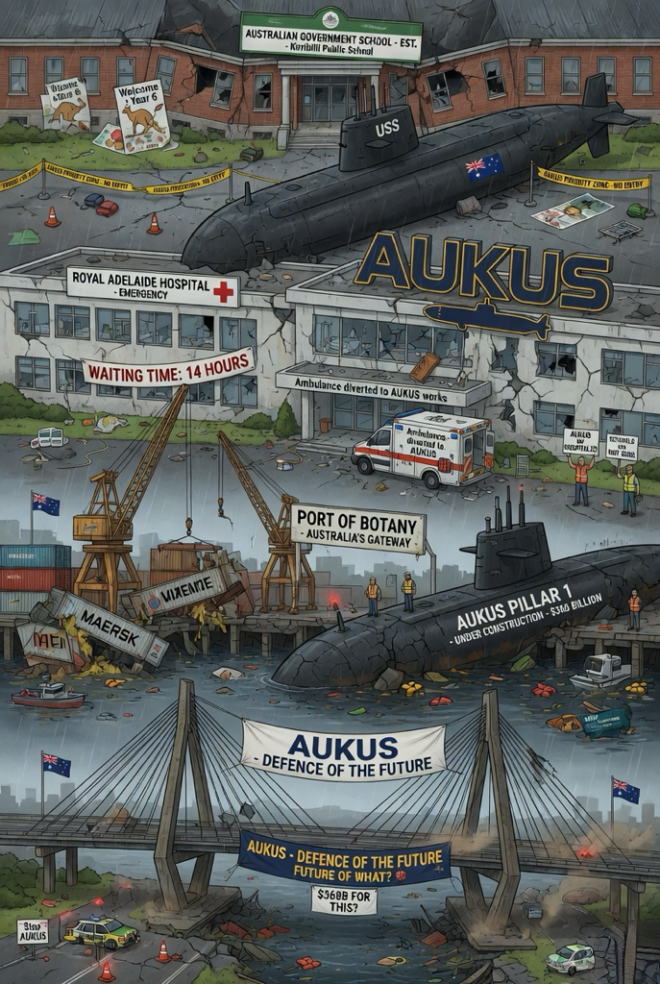
I. The Great Misdirection
There is a particular cruelty in the spectacle of a government announcing, in the same fiscal breath, a blowout in its nuclear submarine program and a modest increase in the funding allocated to schools serving the children of the poor. Australia in April 2026 has done precisely that. Defence Minister Richard Marles stood at the National Press Club on 16 April 2026 and announced that the AUKUS submarine budget – for the next decade alone – had risen by 34 per cent, from an already eye-watering $53–$63 billion to somewhere between $71 billion and $96 billion. The figure is not a final cost. It is an estimate. And estimates for the most complex engineering projects in the history of the defence world have a well-documented habit of expanding rather than contracting as reality asserts itself.
Meanwhile, one in six Australian children lives in poverty. More than 280,000 Australians accessed specialist homelessness services in 2023–24, and the numbers are rising. Seventy-one per cent of people who sought emergency relief from the Salvation Army in 2025 were experiencing housing stress – spending more than 30 per cent of their disposable income on housing costs. Australia has, by multiple measures, the worst rental affordability on record and the lowest ratio of social housing stock in four decades. These are not background statistics. They are the faces of a society that has been asked to wait while its government plays with the most expensive naval toys in Australian history.
This essay makes a simple argument: that Australia cannot afford AUKUS at the scale presently imagined, that the deal was conceived in a geopolitical context that is already shifting beneath our feet, that the promised submarines from the United States face production challenges that make delivery timelines a work of speculative fiction, and that the human cost of the current trajectory – in foregone schools, hospitals, housing, and social infrastructure – is a political and moral choice, not an iron inevitability. Choosing people over submarines is not naive. It is, on the evidence, the only defensible position.
II. The Price of a Dream: What AUKUS Actually Costs
Let us begin with the numbers, because the numbers are staggering and the political class has been careful not to present them in terms that ordinary Australians can readily digest. The total AUKUS commitment, across three decades, is estimated at $368 billion Australian dollars. The Australian Strategic Policy Institute – hardly a nest of pacifists – produced analysis suggesting the final cost could reach $153 billion to $171 billion for the submarine fleet alone, given the programme’s sensitivity to cost-growth drivers including the shift to larger submarine designs in both the US and UK. These are figures of a kind that require comparison to become comprehensible.
Australia’s entire education budget in the 2025–26 fiscal year represents 6.9 per cent of Commonwealth expenditure. Health accounts for 15.9 per cent. Social security and welfare – the programmes that stand between the poorest Australians and destitution – represent 37 per cent of Commonwealth spending. Against those proportions, the AUKUS commitment is not a line item. It is a structural reorientation of the nation’s economic life, spread over thirty years, that will crowd out exactly the investments in human capital and social infrastructure that produce lasting national prosperity.
The October 2025 blowout announcement itself demands scrutiny. When a ten-year budget estimate rises by a third in a single update – from $63 billion at the outer range to $96 billion – one of two things has happened: either the original estimates were politically motivated fictions, or the programme has already encountered cost-growth pressures of the kind that historically do not abate. In defence mega-projects, the latter is almost always the case. The F-35 Joint Strike Fighter programme, the UK’s Queen Elizabeth carrier programme, the US Coast Guard’s National Security Cutter – these are the genre within which AUKUS submarines sit. Cost overruns of 30 per cent are not unusual in this genre. They are, in fact, considered good performance.
Australians are being asked to commit, over the next three decades, an amount of money that could instead fund: the complete reconstruction of the nation’s public hospital network; universal quality early childhood education from birth; the elimination of the housing crisis through a sustained social housing building programme; and the full funding of every public school to 100 per cent of the Schooling Resource Standard – not in 2034, as currently projected, but now. These are not fantasy alternative investments. They are the investments that evidence consistently shows produce healthier, better-educated, more productive, and more cohesive societies. They are the investments that actually make a nation worth defending.
III. The Virginia Problem: Why the Submarines May Never Arrive
The logic of AUKUS rests on an assumption so foundational that its fragility has been largely overlooked in Australian public debate: that the United States will actually deliver the submarines it has promised. The pathway to Australian nuclear-powered submarine capability under AUKUS Pillar 1 depends, in its first phase, on the United States selling Australia three Virginia-class attack submarines beginning in the early 2030s. That assumption deserves forensic examination.
The Congressional Research Service, in its January 2026 report to Congress on the Virginia-class programme, documented a production rate that should give every Australian taxpayer considerable pause. Although the US Navy has been procuring Virginia-class submarines at a nominal rate of two boats per year since 2011, the actual construction rate has never reached 2.0 boats per year. Since 2022, the production rate has fallen to approximately 1.1 to 1.2 boats per year. The April 2025 Navy testimony to Congress attributed this decline to workforce challenges, quality failures at first inspection, material and supplier delays, and complications with the Virginia Payload Module variant. The result is a growing backlog of submarines procured on paper but not yet built.
The implications for AUKUS are direct and severe. If the US cannot build submarines at the rate required to meet its own Navy’s force structure requirements – and it plainly cannot – then the pathway to selling three operational Virginia-class boats to Australia by 2032 narrows dramatically. The Congressional Research Service noted the Navy and industry were aiming to increase the production rate to 2.0 boats per year by 2028 and subsequently to 2.33 boats per year. Admiral Lisa Franchetti told a Senate confirmation hearing in 2023 that the Navy would need to raise production from 1.2 to 2.2 boats per year to meet its AUKUS obligations. Meeting that target has proved elusive, and the industrial base challenges – workforce skills, supply chain fragility, shipyard capacity – are structural rather than cyclical.
The Trump administration’s review of AUKUS in 2025 added another layer of uncertainty to an already uncertain programme. While the Pentagon ultimately reaffirmed support for the agreement, the fact that the Pentagon’s initial review had to be rewritten – according to a December 2025 press report – to conform with President Trump’s personal enthusiasm for the deal is not a reassurance. Policy made by presidential temperament can be unmade by presidential temperament. The geopolitical environment of 2026, in which the Trump administration is simultaneously restructuring US global alliances, imposing tariffs on historical partners, and pursuing bilateral great-power negotiation with China and Russia, is not the environment in which the AUKUS architecture was originally designed to operate.
The SSN-AUKUS class submarines – the new design to be built in both the UK and Australia for eventual Australian operation – are scheduled for first British delivery in the late 2030s and Australian-built delivery in the 2040s. Australia’s first domestically constructed nuclear-powered submarine arriving decades hence is not a capability. It is a promissory note issued against a future that may look very different from the present. In the interim, the capability gap – the period between the retirement of Australia’s ageing Collins-class submarines and the arrival of operational nuclear boats – remains precisely the vulnerability that AUKUS was designed to address, and which it may, in practice, do nothing to close.
IV. The Opportunity Cost: Schools, Hospitals, Housing, and the Social Fabric
Education: The Long Betrayal
The 2025–26 federal budget committed $407.5 million over four years to jurisdictions that have signed the Better and Fairer Schools Agreement – the mechanism by which the Commonwealth is to raise its share of the Schooling Resource Standard to 25 per cent by 2034. By 2034. Twelve years from now. The SRS, developed by David Gonski’s review over a decade ago, was supposed to ensure that every Australian child, regardless of postcode or family income, received the educational resources necessary for their development. In 2026, we are still discussing targets to be met in 2034, while committing, right now, to decade-long defence budget increases that dwarf anything committed to the education of the nation’s children.
The consequences of educational underinvestment are not abstract. They compound. A child who does not receive adequate educational support in their early years enters adolescence with diminished prospects. The adolescent who does not complete secondary education faces a labour market that is increasingly hostile to low-skill workers. The young adult who accumulates unsustainable HELP debt – a problem the government has begun to address by wiping $16 billion from outstanding student loans – faces a decade of financial constraint that suppresses household formation, consumption, and economic dynamism. The failure to invest adequately in education is not merely a social problem. It is an economic self-inflicted wound, and AUKUS makes it worse by consuming the fiscal headroom within which genuine educational transformation could occur.
Housing: A Crisis That Is Not Being Solved
Australia has, by any serious international comparison, a housing system in crisis. The 2025 State of the Housing System report documented households under growing pressure, with increasing rental stress and a sharp rise in people stuck in rental stress for over two years. Social housing as a proportion of all housing has continued to decline. Homelessness Australia reported that 280,000 people accessed specialist homelessness services in 2023–24. The Salvation Army’s Red Shield Report 2025 found that 71 per cent of those seeking emergency relief were experiencing housing stress, and that a third feared losing their home within twelve months. Australia currently has the worst rental affordability on record.
The federal government’s Housing Australia Future Fund – $10 billion to support social and affordable housing construction – was a welcome start. But it is dwarfed by the scale of the problem. The National Housing Supply and Affordability Council has called for social housing to be raised to 6 per cent of all homes, with a long-term target of 10 per cent. Meeting that target would require sustained, decade-long investment of a kind that is structurally incompatible with simultaneously committing to a $71–96 billion submarine programme over the same decade. The fiscal trade-off is not hypothetical. It is the arithmetic of a finite budget and a government that has not been honest about what AUKUS crowds out.
Healthcare and Social Welfare: The Understated Crisis
The 2025 federal budget allocated $1.8 billion to continue public hospital funding, raising the Commonwealth contribution to $33.9 billion in 2025–26. This sounds substantial until one considers that public hospitals across Australia are operating under conditions of chronic underfunding, staff shortages, and demand pressures that have intensified since the pandemic. Elective surgery waiting lists remain extended. Mental health services – perpetually identified as underfunded in every review conducted across the past twenty years – continue to fail hundreds of thousands of Australians. The pharmaceutical co-payment reduction from $31.60 to $25.00, while welcome, is a marginal improvement rather than a structural reform.
The ACOSS Raise the Rate campaign has documented, year after year, that Australians relying on JobSeeker and Youth Allowance face lives of genuine deprivation – incomes so far below the poverty line that stable housing, adequate nutrition, and participation in social life are simply unavailable. One in eight Australian adults, and one in six Australian children, live in poverty. These are not the statistics of a country that has solved its domestic obligations and can therefore afford the luxury of nuclear submarine ambition. They are the statistics of a society that has made, and continues to make, a series of choices about whose suffering is tolerable and whose security deserves investment.
V. The Strategic Fallacy: What Defence Cannot Buy
The proponents of AUKUS argue that security is the precondition for everything else – that without it, no amount of domestic investment matters. This argument has a surface plausibility that deserves engagement rather than dismissal. But it rests on several assumptions that bear scrutiny.
The first assumption is that the strategic threat environment justifies this particular response. The threat most commonly invoked is China. But China is also Australia’s largest trading partner. A military confrontation between Australia and China would be catastrophic for both countries long before a single submarine was deployed. The security calculus is not simply a question of military capability but of diplomatic architecture, economic interdependence, and the management of great-power competition through multilateral institutions. Nuclear-powered submarines contribute to exactly one of those dimensions. The diplomatic, economic, and institutional dimensions are, if anything, weakened by a posture that signals to Beijing that Australia has chosen its side in a binary confrontation that Australian interests counsel avoiding.
The second assumption is that AUKUS improves Australia’s effective military capability within the relevant timeframe. The evidence reviewed above suggests otherwise. If the Virginia-class submarines arrive behind schedule, if the SSN-AUKUS programme delivers in the 2040s, and if the Collins-class vessels retire in the intervening period, Australia will have spent enormous sums on a capability vacuum – the very outcome AUKUS was designed to prevent. A more modest investment in highly capable conventionally powered submarines, air power, long-range missiles, and cyber capability would deliver operational capacity within a realistic timeframe at a fraction of the cost.
The third assumption is that closer military integration with the United States, through an agreement that involves the transfer of nuclear propulsion technology and the stationing of US submarines at HMAS Stirling, enhances rather than constrains Australian sovereignty. This is a question that the Australian strategic community has been reluctant to confront with full honesty. The AUKUS architecture makes Australia more deeply enmeshed in US strategic planning, US alliance obligations, and US domestic political volatility than at any previous point in the postwar period. The events of 2025 – a Trump administration that required its Pentagon to rewrite an AUKUS review to match presidential enthusiasm – should give pause to any Australian strategist who believes that treaty commitments are insulated from the vagaries of US domestic politics.
Security is not only, or even primarily, about submarines. A nation whose citizens cannot afford to house themselves, whose public schools are chronically underfunded, whose healthcare system turns people away, and whose social welfare safety net has been deliberately eroded over decades is not a secure nation. It is a nation accumulating internal fractures – of inequality, of resentment, of declining trust in institutions – that are ultimately more dangerous to the social fabric than any external military threat. The Gini coefficient is as much a security metric as the number of attack submarines in the fleet. A government that treats them as unrelated categories is not engaging in strategic thinking. It is performing it.
VI. The Political Economy of Fear
It is worth asking why AUKUS commands the bipartisan political support it does, when the evidence of its affordability problems, delivery uncertainties, and strategic questionability is available to anyone who cares to read a Congressional Research Service report or an ASPI analysis. The answer lies in the political economy of defence spending and the particular way in which security discourse functions in Australian political culture.
Defence spending is politically easier to justify than social spending because its beneficiaries are abstracted and its costs are diffused. A submarine programme generates local employment – the Osborne Naval Shipyard in South Australia will sustain jobs, and Henderson in Western Australia will see investment. These are real and politically legible benefits. The children not receiving adequate school funding, the families in housing stress, the people turned away from homelessness services – these are, in the language of political economy, diffuse and unorganised interests. They do not write op-eds for major newspapers. They do not lobby. They vote, when they vote at all, with diminished faith that the outcome matters.
The Murdoch press ecosystem – which has dominated Australian political discourse for decades and whose relationship to the Australian defence and security establishment is one of mutual reinforcement – consistently amplifies the threat environment and consistently marginalises the domestic social cost of defence spending. The framing of AUKUS as a binary choice between security and naivety, between responsibility and recklessness, is a political construction, not an analytical finding. Alternative security frameworks – emphasising diplomacy, economic interdependency, conventional military capability, and the regional relationships that sustained the post-Cold War Pacific order – are available and have been advocated by serious strategic thinkers within Australia’s own university and policy communities. They simply receive less coverage.
There is also the matter of the France submarine contract – the $66 billion deal that Australia tore up in 2021 to sign AUKUS, triggering a diplomatic rupture with Paris that took years to repair and cost Australia considerable standing in the European community. The political investment in AUKUS is partly the sunk cost of that decision. Having paid the price of cancelling the French contract, having absorbed the diplomatic damage, having made the commitment, the political class finds it very difficult to subject the deal to the scrutiny that any $368 billion expenditure across three decades self-evidently requires. The politics of sunk costs is the enemy of rational policy reassessment.
VII. What an Alternative Looks Like
None of this essay’s argument should be read as advocating for unilateral disarmament or strategic passivity. Australia faces genuine security challenges in an Indo-Pacific region undergoing rapid change, in a global order in which the liberal internationalist architecture of the postwar period is visibly strained. The question is not whether Australia should invest in defence capability. It is whether the AUKUS nuclear submarine programme, at this cost, with these delivery uncertainties, against these domestic opportunity costs, is the right investment.
An alternative defence posture – one that took seriously both security requirements and fiscal constraints – would retain and upgrade the Collins-class fleet as a matter of priority while pursuing next-generation conventional submarine capability from established manufacturers, potentially including European partners whose industry and diplomacy Australia needs to cultivate. It would invest heavily in the capabilities that Australian geography actually rewards: long-range maritime patrol aircraft; over-the-horizon radar networks of the Jindalee type (already being exported to Canada at significant revenue); long-range strike missiles; cyber and electronic warfare capability; and the regional diplomatic architecture – in particular with Indonesia, Papua New Guinea, the Pacific island states, and ASEAN – that constitutes Australia’s first and most important line of strategic defence.
The money thus saved – measured in the tens of billions over the next decade – would be available for the investments that produce genuine national resilience. Universal quality early childhood education, which evidence across every developed country consistently identifies as the highest-return public investment available, reducing inequality, improving educational outcomes, and increasing labour force participation. Full funding of public schools to the Schooling Resource Standard, not in 2034 but now. A sustained social housing building programme at the scale that the housing crisis actually demands – not $10 billion but something approaching the $50 to $80 billion investment that housing economists estimate is required to restore affordability. A healthcare system funded to meet the demands of an ageing population without waiting lists that amount to rationed care.
These are not utopian proposals. They are the investments that comparable societies – Norway, Denmark, Finland, Canada, New Zealand – make as a matter of course, and which produce the educational attainment, health outcomes, social cohesion, and economic productivity that Australia’s political class claims to want but systematically fails to fund. The difference between Australia and those comparators is not geography or wealth. It is political choices, made repeatedly, about whose interests the state exists to serve.
VIII. Conclusion: The Nation Worth Defending
The ancient injunction to beat swords into ploughshares – the prophet Isaiah’s vision of a world in which the implements of war are transformed into the instruments of cultivation – is not, in the twenty-first century, a counsel of pacifism. It is a counsel of proportion. It asks: what is it, finally, that a defence programme is supposed to defend? And it insists that the answer cannot be abstract – cannot be ‘Australia’ as a geopolitical entity disembodied from the lives of its actual inhabitants. It must be the schools where children learn to read. The hospitals where the sick are treated with dignity. The homes in which families are sheltered from precarity. The communities in which people find meaning and belonging.
A nation that spends $96 billion over the next decade on submarines that may not be delivered, while one in six of its children lives in poverty and 280,000 people seek specialist homelessness services in a single year, has inverted the proper relationship between the instruments of state and the people those instruments are supposed to serve. It has chosen the symbol of power over the substance of wellbeing. It has made a calculation – whether consciously or through accumulated political inertia – that the anxiety of its strategic class is more politically potent than the suffering of its poor.
AUKUS, as presently constituted, is a $368 billion bet on a geopolitical future that was already changing when the deal was struck, executed through a defence-industrial pathway whose central component – the Virginia-class submarine – the United States is currently producing at barely half the rate required. The bet may pay off. Or it may deliver, three decades from now, a fleet of nuclear submarines in a strategic environment that has rendered them largely irrelevant, at the cost of a generation’s worth of foregone investment in the education, health, housing, and social infrastructure of the Australian people.
The choice is not between security and idealism. It is between two versions of security: one that counts submarines and another that counts children. The second is harder to photograph, harder to announce at a press conference, and considerably harder to sell to a media ecosystem oriented toward visible displays of martial resolve. But it is, in the long run, the only version that actually works.
Australia must choose. And it must do so honestly, with full sight of the opportunity costs it is bearing and full acknowledgement of the precariousness of what it is paying for. The people of this country – the children in underfunded classrooms, the families in housing stress, the Australians turned away from homelessness services – deserve that honesty. They are, after all, the nation worth defending.



People should always come first, they should always come before weapons of war.
Fuck AUKUS, fuck Trump, fuck war! Put the people of Australia before foreign multinational weapons manufacturers.
As always I will argue for people before weapons of war. Stick AUKUS, invest the money in the Australian community instead.
Stop wasting our tax money on over priced and underperforming weapons platforms.
No good for the common man or woman ever came from war. Stop wasting money on machines of death, instead invest in the means of a productive life for all.
Totally in agreement with you Faceless, invest in people not just war.
Stop wasting money on machines of death, instead invest in the means of a productive life for all.