
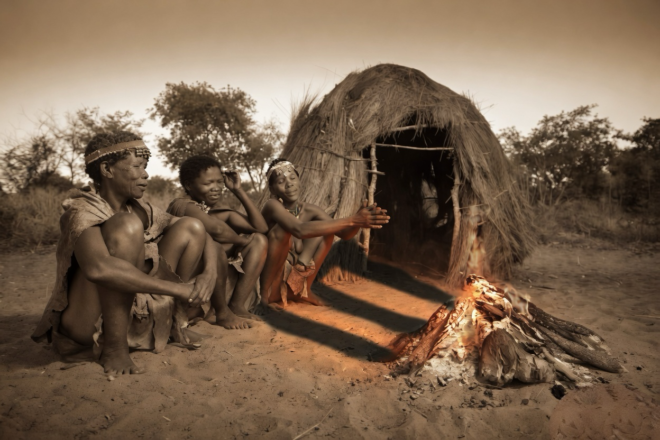
There is a Kalahari proverb – attributed to the San people, one of the oldest continuous human culture on earth – that has lodged itself in my thinking like a splinter of flint: there is a dream dreaming us. Not a dream we dream, but a dream that moves through us. Not a story we tell, but a story being told through our bodies, our forgetting, our longing. This essay is an attempt to follow that thought wherever it leads.
It leads, inevitably, to shadow.
I. THE SHADOW WE WILL NOT CARRY
To be real, in the oldest and deepest sense of that word, is to throw a shadow. The Chinese knew this. Their classical greeting – may your shadow never grow less – was not a pleasantry but a metaphysical observation: the person who casts no shadow is not fully present in the world. Among the Zulu and the broader Bantu-speaking communities of southern Africa, the same intuition persists. To say of someone that they throw a shadow is to pay them the highest possible compliment. It means: here is a human being of substance, of weight, of genuine presence.
We in the industrialised West have lost that understanding, or rather, we have buried it so deeply that it now lives only in our nightmares. We speak of a person being “shadowy” and mean something sinister, untrustworthy, half-seen. We have inverted the ancient meaning entirely. What was once the mark of full humanity has become the language of the criminal, the evasive, the suspect. In doing so, we have told ourselves a great deal about what we fear – and what we have rejected.
The Swiss psychiatrist Carl Jung spent much of his life mapping what he called the shadow: the repository of everything the conscious self refuses to acknowledge. Not only our vices and our cruelties, though those are certainly there, but also our unlived lives, our abandoned gifts, our suppressed capacities for joy, for wildness, for surrender. The shadow, in Jung’s understanding, is not our enemy. It is our inheritance – the full inheritance we have not yet had the courage to claim.
A civilisation, like a person, can have a shadow. And a civilisation, like a person, will be haunted by whatever it throws into that shadow without acknowledgement.
II. WHAT AUSTRALIA HAS REFUSED
I speak now as someone who carries this question in their blood. My father was born on the Erambie mission in Cowra. He identified, without qualification and with great dignity, as an Aboriginal man. My mother came to this country as a refugee, carrying in her memory the ruins of another world. I grew up between these inheritances, which is to say I grew up understanding that identity is not a fixed coordinate but a journey – and that Australia, as a nation, has never fully consented to take that journey.
There is something I have long believed about the anxiety that non-Indigenous Australians feel in the presence of Aboriginal people – an anxiety that manifests, depending on the individual, as contempt, paternalism, sentimentality, or an elaborate moral performance that manages to centre itself rather than its supposed object. That anxiety is not, at its root, about difference. It is about recognition. It is the terror of seeing, in another person, something that you have thrown into your own shadow and told yourself was gone.
What has Australia thrown into its shadow? The knowledge that the land was not empty. The knowledge that the oldest living cultures on earth were not primitive but were, in fact, operating according to epistemologies of extraordinary sophistication – ways of knowing Country, of reading ecological signs, of understanding time and belonging and obligation that the Western tradition is only now, in its ecological crisis, beginning to approach with anything like humility. The knowledge that what was called civilisation came at a cost that has never been honestly named, let alone paid.
To be in the presence of an Aboriginal person who has not internalised the colonial judgment – who is, in the old sense, real, who throws a full shadow – is to be confronted with that suppressed knowledge. It is to feel the weight of the dream that has been dreaming this continent for sixty-five thousand years, pressing against the thin membrane of a two-hundred-year story that has tried, with diminishing success, to contain it.
The fear is not, as is sometimes claimed, a fear of going backwards. It is a fear of going inwards. A fear, as I have heard it described, of going dark in the spiritual sense – of entering one’s own shadow and discovering there what one has refused to carry.
III. THE BROTHERS IN THE WOOD
In the Arthurian cycle – that great compendium of Western psychological mythology – there is a story that has always struck me as the most honest account of racial and civilisational violence that European culture has produced, perhaps because it does not know it is speaking about that subject.
Two brothers, the Black Knight and the White Knight, set out separately on a quest. They travel north and south, each on his own road, each accumulating the experience of years. When they finally meet, it is in a dark wood – that ancient symbol of the unconscious, the place where the known paths end. They do not recognise each other. They assume, as strangers in a dark wood will, that the other is an enemy. They fight with everything they have. It is only when both are bleeding out on the grass, when the contest is effectively over, that they remove their helmets and see each other’s faces. They were brothers all along.
The story holds a warning as much as a hope. The recognition comes too late to undo the damage. What the myth is asking, with a seriousness that its chivalric setting only partially disguises, is whether human beings are capable of recognition before the contest – before the bleeding, before the irreversible harm.
Australia has been in that dark wood for a long time. The question of whether we will recognise our brotherhood before or after the decisive wounding is not yet settled. The defeat of the Voice referendum in 2023 suggested that many Australians are still not ready to remove the helmet – still prefer the familiar grammar of opposition to the more difficult grammar of relation. But that is not the end of the story. The dream is patient. It has been dreaming this continent since long before the helmet was invented.
IV. THE MYTH IS THE REAL HISTORY
We live in an age that has made “myth” a synonym for falsehood. To call something mythological is, in ordinary usage, to dismiss it – to place it in the category of the charming but untrue, the primitive but superseded. This is one of the more consequential errors of the modern mind.
Myth is not the opposite of history. It is the depth of history – the dimension of historical experience that survives precisely because it cannot be reduced to fact. The great myths are not stories that failed to become history. They are the stories that carry what history, in its positivist and administrative modes, cannot hold: the weight of meaning, the persistence of longing, the recurring shape of human crisis.
The exodus myth – the terrifying liberation out of Egypt, out of the house of bondage, into the precarious freedom of the desert – is not less real for being mythological. If anything, it is more real. It has been lived, in its essential shape, by every people who have endured captivity and imagined freedom. The child found among the bulrushes, called to lead and reluctant to do so, running from his vocation and ultimately unable to escape it – this is not a story about a particular man in a particular century. It is a story about what it costs to become the instrument of liberation, and why liberation, even when it comes, leads first into a wilderness.
For Aboriginal and Torres Strait Islander peoples, the great myths of Country – the songlines, the Dreaming tracks, the stories of the Ancestor beings who shaped the land and encoded in it the law for living – are not metaphor. They are, precisely, the real history. They carry the knowledge of how to live in right relation with Country, with each other, with the cycles of season and species and sky. The colonisation of Australia was, among other things, an attempt to replace this mythological infrastructure with a different one – the myth of terra nullius, the myth of progress, the myth of improvement – and the ongoing crisis of this country is, in part, the consequence of that replacement’s failure.
You cannot stop the dream dreaming. You can suppress it, distort it, drive it underground. But it persists, because it is not contingent. The Dreaming was not created by human decision and cannot be ended by human decision. It is the condition of existence in this place, and the land has been patient in asserting that fact, even as successive governments have attempted to legislate it away.
V. THE JOURNEY THAT MUST NOT STOP
At the origin of every religious and mythological tradition, if you go back far enough, you find the same image: the journey. Not as metaphor but as the fundamental structure of conscious life. The journey is what it means to be awake in the world.
For Aboriginal peoples, this is not a spiritual abstraction. The physical journey through Country – the seasonal movement along songlines, the ceremonial travel between sacred sites – is the condition of spiritual and cultural life. It is how knowledge is transmitted, how relationships are renewed, how the covenant between people and Country is maintained. When colonial policies of confinement – the missions, the reserves, the forced relocations – severed those journeys, they did not merely restrict freedom of movement. They severed the connection to the very pulse of existence. People did not die from malnutrition alone, though they died from that too. They died because the journey had been stopped and with it, the dream that the journey sustained.
I have spent time in Arnhem Land, and I have felt, in a way I cannot fully articulate, the presence of that dreamtime geography – the sense that the land itself is alive with accumulated meaning, that every feature of the landscape is a word in a language being continuously spoken, and that the people who know that language are living inside a story of extraordinary richness and antiquity. To stand in that country and then return to the managed flatness of contemporary Australian political discourse is a vertiginous experience. The contrast is not between tradition and modernity. It is between depth and shallowness.
What the journey requires, above all, is that we do not stop. The great myths all contain this warning: you cannot go back. The flaming angel stands at the gate of the garden. The sea closes behind the freed people. Whatever lies behind you is finished, and the only authentic movement is forward, into what has not yet been known.
For Australia, the forward movement requires a reckoning with the shadow – not as punishment, not as self-flagellation, but as the necessary precondition of becoming whole. A nation that carries an unacknowledged shadow is a nation perpetually at war with itself, perpetually anxious, perpetually drawn to the false clarity of scapegoating and exclusion. The integration of that shadow – the honest acknowledgement of what was done, the genuine recognition of what was taken, the commitment to a different kind of relation – is not weakness. It is the only path to the substance that the old greeting honoured: the full shadow, the real weight, the undeniable presence.
VI. CONCLUSION: MAY YOUR SHADOW NEVER GROW LESS
The dream is dreaming us. It was dreaming this continent before the first sail appeared on the horizon, and it will be dreaming it long after the current convulsions of politics and identity have settled into whatever shape they will eventually take. The question is not whether the dream will continue. The question is whether we will consent to be dreamed by it – whether we will stop fighting the recognition and accept, at last, that what we have called the other is the part of ourselves we threw away, and that we cannot be complete without it.
The Black Knight and the White Knight can remove their helmets before the bleeding. That is what hope insists on, and what history permits. Not inevitably, not automatically, not without courage and sustained political will. But it is possible. The myth says so, and the myth is the real history.
I was taught, by the women and men of this country who carry the oldest knowledge, that consciousness is not a gift. It is a discipline. It requires that you see, and go on seeing, even what you would prefer not to see. It requires that you take up what you have rejected, and carry it alongside what you have chosen, until the two become one weight and the one weight becomes bearable because it is, at last, true.
May your shadow never grow less.


Our shadow could be seen as being synonymous with the mark we leave as we pass through life. Some have a large shadow others less so.
Australia has been in a dark wood for a long time. Two knights. One dark wood. Neither willing to remove the helmet. The Voice referendum told us where we still stand. But the dream is patient. It has been dreaming this continent for 65,000 years.
Western tradition makes the mistake of casting what is painful into the shadow. But the shadow is not a void, it is the substance of the soul and it is that which leaves the impression.
You’re right watershedd, in the west we tend to run from our shadows instead of embracing them.
You’re 100 right Bakchos, we must embrace our shadow selves to be whole, and true to ourselves.
Every human being is composed of light and shadow, we need to embrace both to be fully human.
To be whole we must embrace both our ying and our yang.
The whole truth and reality in one sentence: “The dream is dreaming us. It was dreaming this continent before the first sail appeared on the horizon, and it will be dreaming it long after the current convulsions of politics and identity have settled into whatever shape they will eventually take.”