
Any honest account of this subject has to begin with what happened on 7 October 2023, because the entire chain of events that follows – the war, the death toll, the sanctioning of a UN official – begins there. Hamas fighters crossed into southern Israel and killed roughly 1,200 people, the overwhelming majority of them civilians, in the single deadliest day in Israel’s history. They took some 250 hostages, many of them still unaccounted for. Credible reporting, including from UN-mandated investigators, has documented sexual violence committed that day. None of this is contested by serious observers, and none of it is incidental to the moral weight of what follows. Hamas bears direct responsibility for the atrocities of that day, and for embedding military infrastructure inside civilian areas of Gaza in ways that predictably increase civilian harm in any Israeli response. A just accounting of the war has to hold that responsibility alongside everything that follows – not as a footnote, but as part of the same ledger.
It is also true, and equally undeniable, that the scale of the response in Gaza has killed civilians, including children, in numbers and circumstances that have drawn the scrutiny of international courts, UN bodies, and independent investigators. Holding both of these facts at once – the horror of 7 October and the scale of harm to Gazan civilians since – is not a contradiction. It is simply what the evidence requires. What follows is an argument about one narrow but consequential thread inside that larger picture: what happened to the person whose job was to report on the treatment of Palestinian civilians, after she reported on it.
In January 2024, somewhere near a petrol station outside Tel al-Hawa, a six-year-old girl named Hind Rajab telephoned a Red Crescent dispatcher from the back seat of her uncle’s car. She was surrounded by the bodies of her relatives. She was still alive. She asked, simply, to be collected: “Will you come to get me? I’m so afraid.” She was killed before the ambulance reached her, and the paramedics who tried were killed alongside her. A forensic investigation led by Eyal Weizman’s team later concluded it was not plausible that Israeli soldiers firing on the vehicle could not have seen it held children.
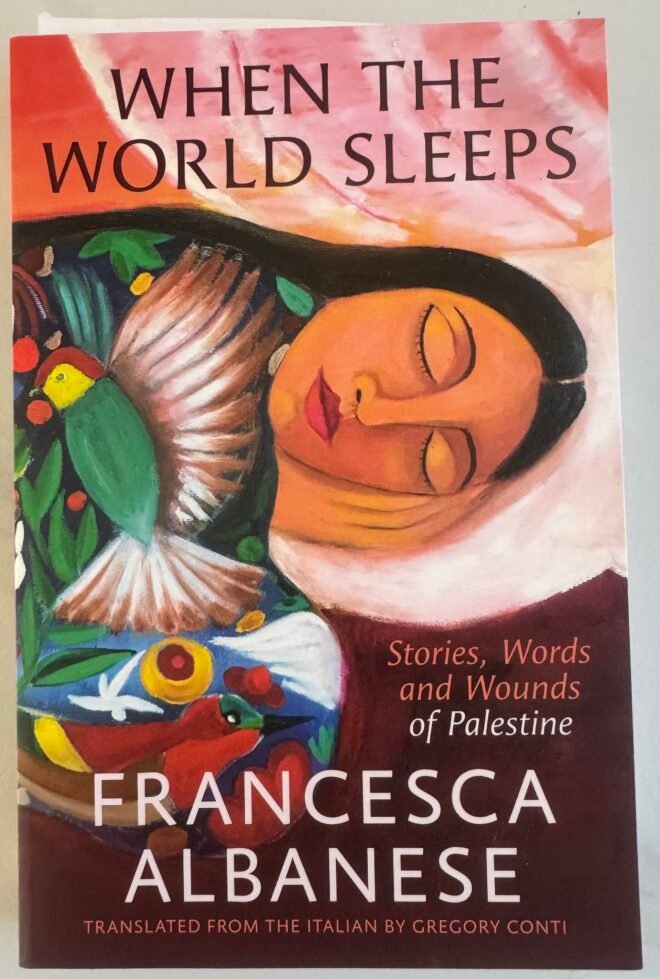
Eighteen months later, the United Nations Special Rapporteur who opened her book with this story – Francesca Albanese, an Italian jurist who has spent her career inside the architecture of international law – was sanctioned by the government of the United States. Her stated crime was procedural: an allegation that she had cooperated with the International Criminal Court. Albanese frames the irony plainly at the start of her own account, writing that she is composing it “at a strange moment” in her life, having just been sanctioned for the “absurd ‘crime’” of doing the job her UN mandate had asked of her.
It is worth sitting with the asymmetry contained in those two facts, set side by side. A child can be killed in a car that investigators say was visibly full of children, and no government sanctions anyone for it. A lawyer can report on that killing, situate it within a body of international law that every UN member state has nominally agreed to uphold, and be sanctioned by the most powerful state in the world for doing so. One of these acts ends a life. The other names it. Only the second attracts punishment.
This is not an accident of bureaucratic overreach. It is a demonstration, almost too literal to require interpretation, of which human beings the current international order treats as rights-bearing, and which it does not.
It matters here to separate two claims that are easy to collapse into one another. The first is that a body of international law exists – the Geneva Conventions, the Rome Statute, the UN Charter, the Universal Declaration – setting out obligations that bind states regardless of power or alliance. That claim is simply true; the law exists, in treaty text and customary practice, whether or not any given state honours it. The second, separate claim is that this law is currently enforced consistently and apolitically against all parties, including powerful ones. That claim is false, and it is false in a way the Albanese case demonstrates with unusual clarity. The existence of a legal obligation and the practice of enforcing it are not the same thing, and conflating them is itself part of how unequal enforcement gets defended: critics of selective enforcement are sometimes accused of denying that the law exists at all, when the actual claim is narrower and harder to dismiss – that the law exists, but is currently applied with one standard for client states and another for everyone else.
The Architecture Albanese Threatens
Special Rapporteurs exist because the postwar human rights system was built on a specific premise: that human rights are not a courtesy extended by powerful states to favoured populations, but a floor beneath all people, independent of nationality, and enforceable – at least in principle – against the conduct of any government, including the most powerful ones. The mechanism only has meaning if it can be pointed at strong states as readily as weak ones. A Special Rapporteur who can comment freely on violations connected to minor or friendless states, but who is punished the moment she comments on violations connected to a close ally of the United States, is not part of an impartial system. She is proof that the system has a ceiling, and that the ceiling sits precisely where Western strategic interest begins.
This is the “nihilistic assault” that Pankaj Mishra identifies in his framing of Albanese’s book – an assault on international law conducted not by its declared enemies, but “by leaders of the world’s democracies” themselves: the very states that built the postwar legal order and now treat its application to their allies as an act of hostility to be punished, rather than a rule to be honoured. The publisher’s own description of the book captures the same collapse from a different angle, calling it “a work of legal witnessing written from inside the collapse of the international order,” tracing what it means to keep invoking law under conditions of emergency, even as the institutions meant to enforce that law repeatedly fail to act.
What makes Albanese’s sanctioning so legible as an attack on the rule of law, rather than a partisan dispute about her conclusions, is the mismatch between the offence and the response. Disagreement with a Special Rapporteur’s findings has an established remedy: states can dispute the evidence, challenge the legal reasoning, lobby the Human Rights Council, or decline to act on recommendations. Sanctioning the person who delivered the finding is a different category of act altogether. It does not contest the claim. It punishes the claimant for having made it – and in doing so, it sends a clear signal to every other rapporteur, investigator, and witness: cross this particular line, and the apparatus built to protect your independence will not protect you.
The Case Against Albanese
It would be dishonest to present Albanese’s sanctioning as a pure case of a neutral expert punished for neutral fact-finding, because her record is genuinely contested, and not only by reflexive defenders of Israeli policy. She has made specific statements that critics, including governments not otherwise aligned with the Israeli government on this conflict, have called antisemitic. The most cited instance is her comparison of the Israeli prime minister to Hitler, condemned at the time by the U.S. ambassador to the Human Rights Council as reprehensible. She has also used language describing American policy as shaped by a “Jewish lobby,” phrasing that recalls older antisemitic tropes about Jewish political control regardless of her intent, and in the immediate aftermath of 7 October she was criticised for appearing to contextualise the killing of Israeli civilians as a response to occupation, a framing that struck many, reasonably, as minimising the deliberate targeting of civilians that day. France, Germany, and several other governments have formally called for her removal on these grounds, not merely the United States.
There is a separate and more structural criticism, distinct from the antisemitism allegations, that deserves equal honesty. Albanese’s mandate exists under Agenda Item 7 of the Human Rights Council, the only standing country-specific item on the Council’s agenda – a permanent feature aimed solely at Israel, with no equivalent standing item for any other state’s conduct, however severe. Unlike country mandates for North Korea or Syria, the Item 7 mandate does not require regular renewal review, and critics, including past UN secretaries-general, have called its existence a structural anomaly that singles out one state for permanent scrutiny while leaving the conduct of Hamas, the Palestinian Authority, or other actors outside the mandate’s scope entirely. A rapporteur operating under a mandate built this way cannot straightforwardly claim the mantle of dispassionate, symmetrical fact-finding, because the architecture she operates within was not built that way to begin with.
None of this answers the central claim of this essay, but it should sharpen it rather than dissolve it. Even granting the strongest version of the case against Albanese – that her personal rhetoric has at times been intemperate, and that the mandate she holds is institutionally lopsided – the remedy available to a state that believes this is censure, formal complaint to the Human Rights Council, a push for her removal through the ordinary review process, or a sustained diplomatic campaign, all of which multiple governments have in fact pursued. What the remedy is not supposed to be is a unilateral financial sanctions designation, the instrument typically reserved for terrorists, drug cartels, and hostile state actors, applied to a sitting UN mandate holder for the substance of her reporting and her cooperation with the International Criminal Court. The structural critique of Item 7 is an argument for reforming or abolishing the mandate. It is not an argument for sanctioning the person who holds it. Those are different remedies aimed at different problems, and the United States chose the one that disables the office rather than the one that reforms it.
A Test of Symmetry
The clearest way to judge whether this is principled concern about UN bias or selective retaliation is to ask a simple counterfactual: would the same instrument be used against a rapporteur or investigator whose findings burdened an adversary of the United States rather than an ally? The UN has long maintained country mandates and commissions of inquiry directed at North Korea, Syria, Iran, Belarus, Myanmar, and Russia, among others, and American administrations across both parties have consistently welcomed and funded that scrutiny, treating it as proof the system works. No rapporteur investigating Syrian or Russian or North Korean conduct has been sanctioned by Washington for cooperating with the ICC or for the severity of their conclusions, even when those conclusions were just as damning, because in those cases the findings served rather than complicated American strategic interests.
That asymmetry of treatment, more than any single statement Albanese has made, is the strongest evidence that her sanctioning was not a principled response to a mandate-holder violating norms of impartiality. If it were, the same instrument would have been available, and would have been used, against any rapporteur whose findings were intemperate or one-sided in the other direction – and there is no shortage of candidates, including rapporteurs whose mandates concern American allies and adversaries alike. The test is not whether Albanese is above criticism. She is not, and this essay has not argued that she is. The test is whether the tool used against her would be used with the same severity against an investigator whose findings happened to embarrass Washington’s adversaries rather than its allies. On the available evidence, it would not, and that selectivity, not the content of any particular UN report, is what makes this a question about the rule of law rather than a question about one official’s conduct.
The strongest reply to this symmetry test, from those who hold the opposing view, is that the comparison is not actually symmetrical to begin with. No rapporteur on North Korea or Syria operates under a standing, non-reviewable mandate created for that single purpose; the asymmetry, on this account, was built into the architecture before Albanese ever held the role, and a sanction against its current holder is better understood as a correction applied to that pre-existing imbalance than as a new act of selective punishment. This reply has real force, and it means the symmetry test cannot be treated as fully decisive on its own. But it does not fully answer the question of remedy. A formal review process did, in fact, examine the antisemitism complaints against Albanese and concluded, after hearing her explanation, that they did not warrant her removal – she was subsequently reappointed to a further term. Critics dismiss that outcome as proof the review process is itself captured by the same bias they attribute to the mandate; defenders take it as evidence the complaints did not hold up under scrutiny. Either reading is available, but what is not available is the claim that no such review took place. The choice to bypass that process and reach instead for a unilateral sanctions designation – an instrument built for hostile state actors and terrorist financiers, not for officials whose conduct a review body has already examined – is a choice to override the system’s own findings rather than work through them. The structural critique of Item 7 may justify reforming or abolishing the mandate. It does not, by itself, justify treating its current holder this way.
It is worth pausing, before moving on, to let the opposing view stand fully on its own terms, rather than treating it as a position to be itemised and then moved past. From inside that view, the sequence looks different, and not unreasonably so. A Human Rights Council that maintains a permanent, non-reviewable agenda item against one state and no other; a Special Rapporteur appointed under that item who has, by her own public record, compared Israel’s prime minister to Hitler, used language about a “Jewish lobby” that tracks a long and ugly historical pattern, and within days of the worst massacre of Jews since the Holocaust offered a frame in which Israeli policy explained the killing of Israeli civilians – this is not, to those who hold this view, a neutral office under attack. It is a person who has used the credibility of a UN mandate to advance a one-sided political project, operating inside an institutional structure already built to make that one-sidedness look like impartial fact-finding. On this account, the sanctions are not an assault on the rule of law at all; they are one of the only tools available to a government that believes the ordinary mechanisms of UN accountability – review committees that, on this telling, share the Council’s own institutional bias – will never discipline her, because the architecture that appointed her was never designed to. From this vantage, defending Albanese as a martyr for international law mistakes a partisan advocate, operating under a mandate that was rigged from its creation, for a dispassionate witness, and mistakes a justified act of resistance to that rigging for an attack on law itself.
This essay does not, in the end, find that view persuasive as a full account – for the reasons already given above, and the ones that follow – but it is not a fringe position, and the strength of the counter-argument has to be measured against it honestly, not against a weaker version of it.
Equal in Theory, Unequal in Practice
The founding claim of the modern human rights project, inherited from the Universal Declaration, is that all human beings are born free and equal in dignity and rights. Nothing about Hind Rajab’s death falsifies that claim as a moral proposition. What it falsifies – what the asymmetric treatment of Albanese makes almost impossible to avoid seeing – is the claim that this equality is currently honoured in practice, by the very states whose diplomats wrote the Declaration and whose governments now selectively enforce it.
Consider what the sanctions regime actually protects, and what it leaves exposed. It does not protect a child from being killed in a car that was, according to independent forensic reconstruction, visibly occupied by non-combatants. It does protect the architects and operators of that killing from the ordinary mechanisms of international scrutiny – by making the scrutiny itself costly to perform. The risk has been moved from the perpetrator to the witness. That is not a neutral legal outcome. It is a hierarchy, expressed not in declared doctrine but in the practical distribution of consequence: punishment flows toward the act of naming harm done to Palestinians, and away from the harm itself.
Albanese’s own framing gestures toward this same structural point without needing to argue it abstractly. She describes the systematic denial of Palestinian children’s ordinary lives as “unchilding” – a deliberate stripping away of the conditions, security, mobility, and continuity that childhood is supposed to guarantee everywhere else. The children she interviews describe their losses in spare, unadorned language: one boy, eleven years old, tells her, “First I became an orphan, then they left me homeless.” There is no legal abstraction in that sentence. It is simply a description of a life with the protections removed. The same removal of protection, scaled up and formalised, is what a sanctions designation against the UN official reporting on it represents.
Conscience Under Sanction
Mishra’s blurb makes a further claim worth taking seriously: that Albanese’s writing helps “keep alive the idea of individual conscience during an extensive moral and intellectual breakdown among writers and journalists.” This is not incidental praise. It identifies the real stakes of sanctioning a rapporteur – not merely as an attack on one woman’s freedom of movement or financial access, but as an attempt to make conscience itself more expensive to exercise. A sanctions designation is, among other things, a public demonstration of cost: this is what happens to those who insist on applying the same legal standard to the powerful that they would apply to anyone else.
That the punishment was aimed specifically at an allegation of cooperation with the International Criminal Court is its own kind of admission. The ICC is one of the few remaining mechanisms through which international law claims jurisdiction over heads of state and senior officials regardless of their country’s power. To sanction a UN official for proximity to that mechanism is to signal, plainly, that the mechanism’s claim to universal jurisdiction will be contested not on legal grounds but through economic and diplomatic retaliation against anyone seen to assist it. The message is addressed not only to Albanese, but to every investigator, registrar, and witness who might otherwise have cooperated with the Court in any future case touching a powerful state’s conduct, or that of its allies.
What the Asymmetry Reveals
None of this requires abandoning the universalist premise that grounds international human rights law – the claim that dignity is not distributed unevenly according to nationality or strategic alignment. If anything, the case for that premise becomes harder to walk away from once its violation is this visible. The argument is not that Palestinians possess some different, lesser category of rights by nature. It is that the existing enforcement architecture is currently treating them that way in practice, while treating the people who document that treatment as the actual threat requiring sanction.
Albanese’s book closes its central proposition with a line worth returning to directly: that achieving change requires becoming change, that nothing shifts in the world until something shifts in the person attempting to shift it. It is a humble, almost private statement, oddly placed at the end of an account that is, among other things, a record of international institutions failing at scale. But it is also the only honest place such an account can end. The mechanisms that were supposed to enforce equal protection – the Special Rapporteur system, the Human Rights Council, the ICC – have not collapsed entirely. They have been made to operate selectively, punishing those who use them against the powerful while leaving them open for use against everyone else. Recognising that selectivity, and naming the people made to pay for resisting it, is the necessary first step before any of those mechanisms can be expected to mean what they say.
The death of a six-year-old girl in a clearly marked civilian vehicle, and the sanctioning of the woman who reported on it, are not two separate stories. They are the same story, told from either end of the same broken chain of accountability – one end where a child’s claim to safety went unprotected, and the other where the official whose job was to say so was punished for saying it.
– – –
Bakchos is the founder of Blak and Black, an Australian media and advocacy platform established in 2010. Bakchos writes from the intersecting perspectives of Wiradjuri heritage, Jewish identity, and humanism.
© Bakchos, June 2026




Despite Albanese’s flaws, which you have addressed, the actions of the IDF are unconscionable.
Powerful words!
Hind’s own words on the phone: “The tank is right next to me. It’s moving. Will you come to get me? I’m so afraid.”
I cannot understand how anyone could do what they did to Hind Rajab. The terror she must have felt is beyond heartbreaking.
The treatment of Francesca Albanese by the Americans has been disgustingly. It doesn’t in anyway help improve the image of Israel.
Hind Rajab was fleeing the city in a car with her aunt, uncle and three cousins at the time.
Audio recordings of calls between Hind and emergency call operators suggest that the six-year-old was the only one left alive in the car, hiding from Israeli forces among the bodies of her relatives.
Her pleas for someone to rescue her ended when the phone line was cut amid the sound of more gunfire.
Paramedics from the Palestinian Red Crescent Society (PRCS) managed on Saturday to reach the area, which had previously been closed off as an active combat zone.
They found the black Kia car Hind had been travelling in – its windscreen and dashboard smashed to pieces, bullet holes scattered across the side.
Across the road was another burnt out vehicle, later identified as the ambulance sent to get her.
That incident is so disturbing, that it’s almost unbelievable, sadly the incident is very real.