

There is a passage in the Book of Amos – that most unsparing of the Hebrew prophets – where the word comes down like a hammer: ‘For three transgressions of Israel, and for four, I will not revoke the punishment; because they sell the righteous for silver, and the needy for a pair of sandals.’ Amos was not describing an aberration. He was describing a system – one that had learned, through long practice, to call its injustices by other names: administration, procedure, necessity, law.
It is in that spirit that we must speak plainly about what has happened – and what continues to happen – at the intersection of policing, politics, and First Nations life in Australia. But speaking plainly, in 2025, demands something more than moral outrage, however justified. It demands intellectual honesty. Because the arguments that matter most – the ones that might actually shift policy, change culture, and save lives – are the ones that can survive scrutiny from their opponents. An argument built on half-truths is not advocacy. It is a liability.
This essay attempts something harder than polemic: to hold moral clarity and empirical honesty in the same hand, and to insist that neither one requires the sacrifice of the other.
What the Data Actually Says
Let us begin with the numbers, because they are real and they matter. According to the Australian Bureau of Statistics Prisoners in Australia release for June 2025, there were 17,432 Aboriginal and Torres Strait Islander people in custody nationally – 37 percent of the entire adult prison population, drawn from a community that represents roughly 3.8 percent of the Australian population. The age-standardised imprisonment rate for First Nations adults stands at 2,500 per 100,000, against an overall national rate of 216 per 100,000: a ratio of approximately twelve to one, and one that has worsened steadily since the 2019 Closing the Gap baseline of 1,925 per 100,000. In Western Australia, the disparity is still more extreme, with the First Nations imprisonment rate exceeding 4,600 per 100,000. These are not contested figures. They are the government’s own data – documented, consistent, and deeply troubling.
In specific categories of offending – particularly violent offences, domestic and family violence, and property crime in remote communities – rates of involvement are, in some datasets, disproportionately high relative to population share. The Australian Institute of Health and Welfare and the BOCSAR data for New South Wales confirm this. To acknowledge these figures is not to endorse racist conclusions about them. It is to take the problem seriously enough to look at it directly rather than away from it.
The question is not whether disparity exists. It does. The question is what it means and what produces it – and that question cannot be answered by invoking race as a causal category. Race does not cause crime. Poverty causes crime. Trauma causes crime. The destruction of community structures, the removal of children from family, the denial of economic opportunity, the intergenerational effects of dispossession – these cause crime. Race is not the variable. It is the marker of who has been most consistently subjected to the conditions that drive offending.
Professor Marcia Langton, in her submission to the 2021 Senate Inquiry into the Aboriginal and Torres Strait Islander Experience of Law Enforcement, made this point with characteristic precision: the over-representation of First Nations people in the criminal justice system cannot be understood except through the lens of historical and ongoing dispossession. But she also made a second, equally important point: understanding causation does not relieve communities of responsibility for behaviour that harms other community members. Both things are true simultaneously. Complexity is not an evasion; it is a prerequisite for honest analysis.
The Myth of the Neutral Institution
Against that backdrop of empirical complexity, we must still insist on something that the data alone cannot capture: the Australian Federal Police and ACT Policing are not neutral instruments of a neutral law.
This is not primarily an accusation of individual malice – though individual malice exists, and we should not pretend otherwise. It is a structural observation. When an institution is built within a settler-colonial society, when its founding logic includes the enforcement of that society’s property rights and social hierarchies, when its culture is shaped by decades of internal reinforcement and minimal external accountability, then the neutral enforcement of law is not what that institution does. It is what it claims to do.
Hannah Arendt, writing about the banality of evil, was at pains to point out that the most terrible acts of systemic injustice are rarely carried out by monsters. They are carried out by functionaries – people who follow procedure, who process paperwork, who act in accordance with institutional expectation, and who never pause to ask whether the institution’s expectations are themselves just. Australia has its share of such functionaries. Some of them carry badges.
When a police officer acts on racial assumption rather than evidence – when an accusation made by someone motivated by racial animus is treated as credible without scrutiny, while a complaint made by a First Nations person is minimised or dismissed – that officer is not being neutral. They are making a choice, even if they have never articulated it to themselves as such. The cumulative effect of such choices, made by thousands of officers across decades, is a system whose outcomes diverge sharply from its proclaimed values.
The documented history of fabricated evidence, false affidavits, and prosecutions pursued without credible evidentiary basis – prosecutions that collapse when exposed to the light of proper legal contest, producing acquittals that vindicate the accused but cannot restore the years spent under accusation – is not ancient history. It is recent history. And it should weigh on the conscience of every leader of every law enforcement agency in this country.
Corruption Has No Party
The integrity failures we are describing are not partisan. Corruption in its deepest sense – the betrayal of public trust, the use of institutional power for purposes other than justice – has no party affiliation. It appears in LNP governments and ALP governments. It appears in agencies led by officers appointed across different political administrations. It appears in the small decisions of individual investigators and in the large decisions of commissioners and ministers.
The expectation that our elected officials and our law enforcement leaders operate with integrity is not a left or right position. It is a foundational democratic principle, and one that has been honoured more in the breach than the observance. The AFP’s handling of politically sensitive investigations – the raids on the Australian Broadcasting Corporation, the targeting of whistleblowers, the differential application of investigative resources depending on the political colour of the person under scrutiny – has been the subject of parliamentary inquiry, legal challenge, and sustained public criticism. These are matters of public record. They should be matters of political consequence.
We must also acknowledge that accountability must be genuine and not merely tactical. Too often in Australian political life, demands for accountability are deployed as weapons against one’s opponents while one’s own side is shielded. An integrity framework that is applied selectively is not an integrity framework. It is partisanship dressed in civic language. The standard we apply to our opponents must be the standard we accept for ourselves.
What Communities Owe Each Other
Intellectual honesty requires us to say something that is sometimes elided in progressive advocacy about First Nations justice: accountability is not only a demand we make of institutions. It is a demand communities and individuals must be willing to make of themselves.
Violence within First Nations communities – particularly family and domestic violence – causes devastating harm. The victims of that violence are overwhelmingly First Nations women and children. Any framework for justice that centres institutional accountability while remaining silent about intra-community harm is not only incomplete; it is a betrayal of the women and children most at risk. Aunty Marcia Langton has been consistent on this point for years, at considerable personal cost within some activist circles. She is right.
This is not a contradiction of the structural critique. It is its completion. If we insist that institutions must be held responsible for the harm they cause, then the same logic applies to individuals and communities. The difference – and it is an important difference – is that the response to intra-community harm must be designed with the community, not imposed upon it; must be resourced adequately, not funded as an afterthought; and must address the conditions – poverty, trauma, housing instability, substance dependence – that drive that harm, rather than simply punishing its expressions.
Community-controlled justice reinvestment programs – like those operating in Bourke, New South Wales, and in parts of the Northern Territory – have demonstrated, with measured outcomes data, that when communities are given genuine agency over the design and delivery of justice responses, both offending rates and incarceration rates fall. This is not ideology. It is evidence. And it is evidence that Australian governments have been systematically slow to act on, because acting on it would require ceding control and genuinely sharing power.
Specific Reform, Not Vague Aspiration
Moral clarity without specific proposals is merely catharsis. The following are not aspirational gestures. They are concrete, costed, and in several cases already recommended by royal commissions whose findings have gathered dust on ministerial bookshelves.
First: mandatory, independent oversight of every decision not to prosecute or to withdraw charges in cases involving potential police misconduct. The current framework allows law enforcement agencies to investigate themselves, a practice that has been discredited everywhere it has been applied. An independent statutory body with coercive powers – not an ombudsman with a clipboard and advisory functions – is the minimum threshold for credibility.
Second: the full implementation of the recommendations of the Royal Commission into Aboriginal Deaths in Custody, thirty-four years after that Commission handed down its report. Of the 339 recommendations made in 1991, the Australian Institute of Criminology found in its 2021 review that a majority remain either unimplemented or only partially implemented. In that same period, more than five hundred Aboriginal people have died in custody. The political will to implement these recommendations is the measure of whether any government is serious about this issue.
Third: justice reinvestment at genuine scale. This means a dedicated federal funding stream – not redirected from existing Indigenous affairs budgets, which have already been cut to the bone – for community-controlled justice reinvestment programs in high-incarceration communities, with independent evaluation, multi-year funding certainty, and genuine community governance of program design.
Fourth: reform of the bail and remand system. A disproportionate share of First Nations people in custody have not been convicted of any offence. They are on remand, often for minor matters, because they cannot satisfy bail conditions that presuppose stable housing, regular employment, and proximity to metropolitan courts. Reform of bail conditions to reflect the realities of remote and regional Indigenous communities would reduce the incarcerated population significantly without any reduction in public safety.
Fifth: mandatory cultural safety training for police that is designed and delivered by First Nations organisations, not by government agencies producing in-house modules that tick a box without changing behaviour. Training that is assessed, that has consequences for non-completion or poor performance, and that is integrated into promotion criteria rather than treated as optional professional development.
The Prophetic Tradition and the Long Game
Marcus Aurelius wrote in his Meditations: ‘The first rule is to keep an untroubled spirit. The second is to look things in the face and know them for what they are.’ Accountability, in this sense, is not primarily punitive. It is cognitive – a willingness to see clearly what has been done, and to name it honestly.
Micah’s three requirements – to do justly, to love mercy, to walk humbly – are not soft. They are demanding. To do justly means to apply the law without fear or favour, without the thumb of racial prejudice pressing on the scale. To love mercy means to recognise that the legal system interacts with human beings whose lives, histories, and vulnerabilities are not captured by a charge sheet. To walk humbly means to maintain the constant awareness that institutions are fallible, that power corrupts, and that confidence in one’s own righteousness is often inversely proportional to one’s actual commitment to justice.
The knowledge carried in First Nations governance systems – of relationship, responsibility, and the accountability of the powerful to the community – is not a relic. It is a resource. Justice reinvestment, community-controlled services, and the principle of free, prior, and informed consent are not departures from good governance. They are its expression.
We write this because naming is itself an act of resistance. Because the communities that have borne the weight of these failures deserve to have them spoken plainly, not euphemised into managerial language about ‘challenges’ and ‘areas for improvement.’ Because the prophetic tradition that runs through both the Hebrew scriptures and the Songlines of this land insists that silence in the face of injustice is not neutrality – it is complicity.
But we also write it because honesty demands that we hold the full picture: the structural failures of institutions, the real data about offending and its causes, the accountability that communities owe to their most vulnerable members, and the specific, measurable changes that a government serious about justice would make.
The law must be held to account. The institutions that carry it must be held to account. The politicians who shape those institutions must be held to account. And the work of building communities where safety is possible – where children are not removed, where men do not raise their fists in despair, where the future is something one is permitted to imagine – must be held as a shared responsibility, not assigned to one party and absolved from another.
We have been walking this road a long time. We have not finished walking yet. But the path is clearer when we look at it honestly, without flinching and without pretending.
– – –
Bakchos is the founder of Blak and Black, an Australian media and advocacy platform established in 2010. Bakchos writes from the intersecting perspectives of Wiradjuri heritage, Jewish identity, and humanism.
© Bakchos, June 2026
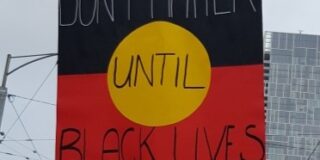

These are very troubling statistics:
Statistics Prisoners in Australia release for June 2025, there were 17,432 Aboriginal and Torres Strait Islander people in custody nationally – 37 percent of the entire adult prison population, drawn from a community that represents roughly 3.8 percent of the Australian population. The age-standardised imprisonment rate for First Nations adults stands at 2,500 per 100,000, against an overall national rate of 216 per 100,000: a ratio of approximately twelve to one, and one that has worsened steadily since the 2019 Closing the Gap baseline of 1,925 per 100,000. In Western Australia, the disparity is still more extreme, with the First Nations imprisonment rate exceeding 4,600 per 100,000. These are not contested figures. They are the government’s own data – documented, consistent, and deeply troubling.
This is what must happen: The law must be held to account. The institutions that carry it must be held to account. The politicians who shape those institutions must be held to account
Justice delayed is justice denied.
It’s clear that Indigenous Australians are treated as second class citizens in every part of Australia’s justice system.
Hannah Arendt, writing about the banality of evil, was at pains to point out that the most terrible acts of systemic injustice are rarely carried out by monsters. They are carried out by functionaries – people who follow procedure, who process paperwork, who act in accordance with institutional expectation, and who never pause to ask whether the institution’s expectations are themselves just. Australia has its share of such functionaries. Some of them carry badges.
This is the truth: “We must also acknowledge that accountability must be genuine and not merely tactical. Too often in Australian political life, demands for accountability are deployed as weapons against one’s opponents while one’s own side is shielded.”
Let’s face the harsh reality, the AFP are corrupt and racist.