
Introduction
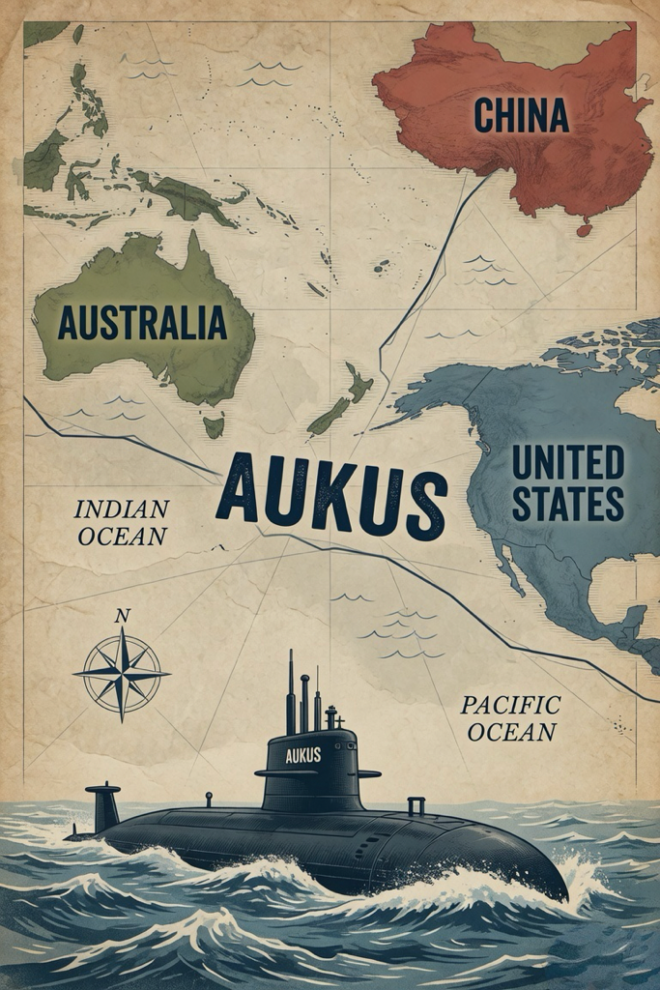
There is a peculiar kind of political theatre that has settled over Canberra since 2022, one in which a Labor government elected on a platform of Australian confidence and independence has spent much of its energy quietly signing away the very sovereignty it claims to protect. Anthony Albanese did not invent AUKUS – that dubious honour belongs to Scott Morrison – but he has owned it, defended it, and deepened it with a conviction that borders on theological. “Full-steam ahead” has become his mantra whenever the pact is questioned, a phrase that, as commentators have noted, evokes a ship already cutting confidently through the water even as the debate rages over whether that ship can be built, crewed, financed, or delivered at all.
None of this is happening in a vacuum, and a fair accounting has to start by conceding what AUKUS’s defenders get right. China’s military modernisation is real, rapid, and regionally consequential: the Pentagon’s own assessment is that Beijing wants to be able to win a war over Taiwan by the end of 2027, and 2026 has brought the commissioning of the carrier Fujian, apparent construction of a nuclear-powered carrier, and a Pacific ballistic missile test that ASPI analysts read as a demonstration that Beijing is seeking “to reshape the regional order through intimidation, coercion and the projection of military strength.” China’s coast guard has used water cannons and ramming manoeuvres against Philippine and Vietnamese vessels, restricted airspace around Taiwan for stretches far longer than any announced exercise, and pressed repeated incursions into Taiwanese-administered waters at Pratas/Dongsha through 2026. None of that is manufactured Western propaganda; it is documented, repeated behaviour, and it is entirely rational for a middle power in the region to want some hedge against it.
Nor is AUKUS, whatever its execution failures, simply “provocation” in intent. Its stated logic – denial-based deterrence along the First Island Chain, submarines that complicate any Chinese calculation about contesting regional sea lanes, interoperability that lets Australia operate meaningfully alongside larger partners rather than alone – is a genuine, if contestable, theory of how a middle power avoids being picked off one at a time as China’s reach extends further into the Pacific. Any serious defence policy for a country of Australia’s size involves trade-offs: some loss of unilateral freedom of action is close to the unavoidable price of credible alliance-based deterrence, just as some economic exposure to a dominant trading partner has been the price of decades of resource-export prosperity. The real question is not whether AUKUS involves trade-offs – of course it does – but whether Albanese has struck a defensible balance among them, or overcommitted on the sovereignty-and-antagonism side of the ledger while underdelivering on the deterrence side. The evidence increasingly suggests the latter.
Pillar Two of AUKUS, which focuses on advanced capabilities in areas such as artificial intelligence, hypersonics, and undersea warfare, offers potential strategic benefits that are less dependent on the submarine delivery timeline and have drawn support even from some sceptics of Pillar One.
The trouble, then, is not that AUKUS chases an illegitimate goal. The trouble is strategic incoherence in execution. Australia is being asked to bind its defence posture, its economic exposure, and increasingly its diplomatic voice to a United States whose president has shown himself erratic, transactional, and willing to treat allies as expendable line items – while simultaneously antagonising China, the country that buys nearly a third of everything Australia sells abroad, without a correspondingly credible increase in deterrence to show for it. That is not a rejection of hedging as such. It is a critique of one specific, poorly calibrated version of it.
The Sovereignty Question: What Albanese Has Actually Signed Away
Start with what AUKUS materially commits Australia to. In August 2024, Albanese made what were described as “undisclosed political commitments” with the UK and US on the transfer of naval nuclear technology, arrangements that raised concerns even before the ink dried about the storage of high-level radioactive waste on Australian soil. The submarines themselves – when and if delivered – are Virginia-class boats, with the first transfers now expected to be in-service vessels rather than newly built. These boats would arrive with substantially less than their full 33-year design life remaining – typically in the range of 18 to 27 years after refurbishment – and would remain subject to the inventory priorities of a U.S. shipyard system whose production rate has hovered around 1.1–1.2 boats per year, well below what the U.S. Navy requires for its own needs, let alone Australia’s.
More troubling than the hardware is the command structure around it. Interoperability is not, in itself, a dirty word – it is the standard currency of alliance deterrence, and a credible case can be made that Australia gains real capability by being able to operate seamlessly alongside a much larger navy. But analysts giving evidence to the current parliamentary inquiry into AUKUS have pointed to “an extraordinary emphasis on interoperability” embedded in the integrated planning documents the Albanese government has produced, at a level that starts to look less like coordination between equals and more like subordination by degree. Richard Tanter, one of the inquiry’s most detailed critics, has flagged the absence of any clear policy or legal barrier to nuclear weapons transiting through Australian territory, so long as they are labelled as being in “transit or visit” rather than stationed. While AUKUS itself concerns the transfer of nuclear propulsion technology rather than nuclear armament, this gap in existing arrangements remains a legitimate point of concern for those who have long assumed Australia maintains a firm nuclear-weapons-free posture in practice as well as in policy. That is not a technicality. It is the erosion, by drafting convenience, of a nuclear-weapons-free stance that Australians have generally assumed still held.
Former Labor prime minister Paul Keating put the underlying point more starkly than most sitting politicians would dare: the arrangement would witness “a further dramatic loss of Australian sovereignty, as material dependency on the United States robbed Australia of any freedom or choice in any engagement Australia may deem appropriate.” Keating is not a disinterested bystander, but the argument does not rest on his authority – it rests on the structure of the deal itself. A nation that depends on another nation’s shipyards, reactors, and inventory schedules for its principal strategic asset has, by definition, mortgaged part of its freedom of action. When the asset in question also entrenches “interoperability” with US command architecture, the mortgage looks less like a loan and more like a lien.
None of this is happening in an atmosphere of open democratic debate. AUKUS has been, in the words of one critic, “draped in secrecy” from the outset, with more detailed public information available from British and American sources – whose parliamentary and congressional systems are simply more transparent – than from anything the Australian government has volunteered. Within the Labor Party itself, the “doubting elders,” including former minister Ed Husic, have been folded into a manageable Saturday-afternoon session at the party’s national conference rather than given a genuine airing. A grassroots network within the party, Labor Against War, numbering more than 500 members, has said openly that the leadership seems more concerned with “assuring its partners-in-war at the Pentagon that they have us under control” than with permitting democratic scrutiny that a $368 billion commitment – the largest defence acquisition in Australian history kind – would ordinarily demand.
The Economic Reality Albanese’s Strategy Ignores
Here is where the incoherence becomes undeniable. China is not a minor character in Australia’s economic life; it is the load-bearing wall. In the 2024–25 financial year, two-way trade between Australia and China reached roughly $309–312 billion, making China Australia’s largest trading partner by a wide margin – accounting for close to a third of all Australian exports and nearly 30 percent of everything Australia imports, almost three times the volume of Australia’s second-largest import partner, the United States. Iron ore, LNG, gold, and agricultural exports to China have underwritten Commonwealth and state budgets for two decades. Chinese tourism and international student numbers have rebounded past a million visitor-arrivals annually, and Chinese investment, while a smaller share of the picture, continues to grow.
This is not a relationship Australia can casually jeopardise, and Beijing has already demonstrated it knows exactly which levers to pull if provoked. During the 2020–22 trade freeze, China targeted coal, barley, and wine – sectors where Australia had alternative markets – while carefully avoiding iron ore, the one commodity China cannot easily source elsewhere at scale. Australia absorbed the pain in the exposed sectors and, crucially, still has no alternative buyer for iron ore at anything like the volume China represents. The lesson from that episode was not that Australia is invulnerable to economic coercion; it was that China calibrates its coercion to avoid self-harm, and that Australia’s exposure in the sectors China chooses to hit is real and painful.
To be fair, Australian governments have pursued some trade diversification in recent years, including through critical minerals partnerships and deeper engagement with India and ASEAN. These efforts remain modest relative to the scale of exposure to China, however, and do not yet alter the fundamental asymmetry.
Now overlay the strategic picture. Washington’s own defence establishment is deeply divided on China policy, but the trajectory of hardware and posture is unmistakable: a National Defence Strategy released in January 2026 built around “denial-based defence” along the First Island Chain, an unprecedented Taiwan arms package exceeding $11 billion, and joint exercises across the Philippine Sea explicitly rehearsing the defence of Taiwan against amphibious invasion – with Australian warships participating alongside the US, Japan, and the Philippines. Whatever else one makes of Trump’s own mixed signals on Taiwan – and they are genuinely mixed, more on that below – the military infrastructure being assembled in the Indo-Pacific under AUKUS’s Pillar Two is being built for one contingency: a war involving China.
Australia is therefore in the position of deepening its military entanglement in a US-China confrontation architecture while depending on China for a third of its export income. If Beijing and Washington were to come to blows over Taiwan, or even to a serious diplomatic rupture short of war, Australia would face a Chinese economic response calibrated with the precision it showed in 2020 – except this time against the backdrop of Australian submarines, exercises, and basing arrangements that Beijing would have every reason to regard as directly hostile. That is not a defence strategy. It is a formula for maximising exposure on both the economic and military fronts simultaneously.
The Instability of the Ally Australia Is Being Asked to Trust
The case for AUKUS has always rested on the assumption that the United States is a stable, reliable guarantor whose strategic commitments can be trusted across electoral cycles. That assumption has not survived contact with Donald Trump’s second term. In April 2025, Trump imposed what he called “reciprocal” tariffs on Australia despite Australia imposing no tariffs on the United States at all – a decision Albanese’s own government was forced to describe as having “no basis in logic” and running counter to the basis of the two nations’ partnership, adding that “this is not the act of a friend.” That a government so heavily invested in the AUKUS relationship had to say, in an official statement, that its supposed principal ally was acting in bad faith should have been a moment of reckoning. It was treated instead as a passing irritant.
On the substance of the China relationship itself, Trump has been erratic in exactly the way that should worry a junior partner staking its sovereignty on American resolve. Ahead of and during his May 2026 summit with Xi Jinping, Trump repeatedly suggested he was open to discussing US arms sales to Taiwan directly with Beijing – a marked departure from the “Six Assurances” that have anchored American Taiwan policy since the Reagan administration, under which Washington has never agreed to consult China on arms sales to Taipei. Trump told reporters he would “have that discussion with President Xi,” framed Taiwan’s semiconductor success as something the island had effectively “stolen” from America, and described US security commitments in transactional, insurance-premium terms. Brookings analysts characterised this as inviting “an onslaught of pressure from Beijing on both Washington and Taipei,” and warned that Trump’s sympathy for Xi’s framing would “embolden Beijing to increase pressure on Taipei,” raising rather than lowering the risk of confrontation.
This is the paradox Australian policymakers seem unwilling to confront: the same administration whose military planners are building an Indo-Pacific denial architecture aimed at China is led by a president who treats the central flashpoint of that same rivalry – Taiwan – as a bargaining chip to be traded away in pursuit of a trade deal, while also happily blindsiding Australia with unjustified tariffs and threatening allies elsewhere, from pressuring Denmark over Greenland to launching strikes in Venezuela with no apparent regard for how allies might read the precedent. An ally capable of simultaneously talking tough on China’s military encirclement and soft on China’s core territorial ambitions, while treating tariff relationships with actual allies as expendable, is not a stable pole around which to organise one’s entire strategic posture. Analysts at the Center for American Progress have gone so far as to describe the administration as “arming Taiwan for a war [it] has already signaled it has no interest in fighting” – a pattern of “strategic instability” that, they argue, “invites a catastrophic military miscalculation” rather than preventing one.
If the guarantor is this unpredictable, the logic of surrendering sovereign decision-making capacity to align with it collapses. Australia would be accepting real, calculable costs – the erosion of nuclear-weapons-free norms, the subordination of naval assets to US command structures, the diplomatic antagonism of its largest trading partner – in exchange for a guarantee whose reliability is publicly in question even among the guarantor’s own foreign policy establishment.
Why Placate Trump at China’s Expense?
This is the question that ought to dominate Australian public debate and does not. If the United States itself appears unwilling to commit unambiguously to Taiwan’s defence, and is willing to impose “totally unwarranted” tariffs on a supposedly cherished ally on a whim, what exactly is Australia purchasing with its acquiescence? The honest answer is: insurance against abandonment, purchased at the price of provoking the one power capable of doing the most immediate economic damage to the Australian economy. It is a bargain that makes sense only if one assumes the American guarantee is rock solid and the Chinese relationship is expendable. Neither assumption survives scrutiny of the last eighteen months.
A more coherent Australian strategy – and one with a long lineage in the party Albanese leads – would look more like what Kevin Rudd counselled during the original AUKUS debate: avoid overtly obtrusive criticism of China, quietly improve independent capability, and resist being locked into a security architecture whose central assumption (unwavering, predictable American resolve) is precisely the assumption current events keep falsifying. Diversification of trade, genuine investment in sovereign defence manufacturing rather than second-hand imports, and a foreign policy that treats Washington and Beijing as two powers to be managed rather than one to be worshipped and one to be provoked, would far better serve the “national interest” Albanese invokes whenever AUKUS is questioned.
Conclusion
None of this requires believing China is a benign actor, or that the criticisms of AUKUS made by Greens senators or academic critics are beyond dispute – they are not, and reasonable people can disagree about the right balance between hedging and alignment. It is also worth noting that AUKUS enjoys bipartisan support in Australia, having been initiated under the Morrison government and maintained under Albanese, which suggests the underlying strategic impulse is broader than any single prime minister. But the specific configuration Albanese has entrenched – deepening military subordination to a mercurial Washington, at real cost to sovereign decision-making, while simultaneously normalising the antagonism of Australia’s largest trading partner – fails on its own stated terms. It neither guarantees the security it promises, given the demonstrated unreliability of the guarantor, nor protects the prosperity Australia actually depends on, given the trade relationship it puts at risk. A prime minister genuinely committed to Australian sovereignty would be asking why the nation is expected to bear all the costs of this arrangement while the benefits remain, on the best evidence available from the Pentagon’s own production schedules, largely notional.
– – –
Bakchos is the founder of Blak and Black, an Australian media and advocacy platform established in 2010. Bakchos writes from the intersecting perspectives of Wiradjuri heritage, Jewish identity, and humanism.
© Bakchos, July 2026

A prime minister genuinely committed to Australian sovereignty would be asking why the nation is expected to bear all the costs of this arrangement while the benefits remain… largely notional.
Aukus was nothing more than another Scott Morrison self serving arrangement.
AUKUS is Scott Morrison’s sheltered workshop in retirement.