
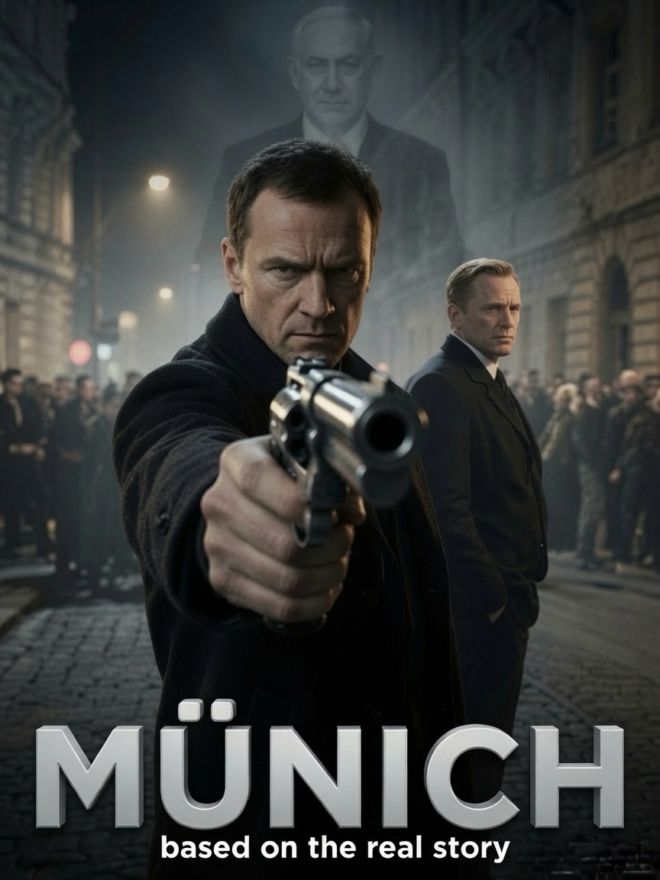
Steven Spielberg’s 2005 film Munich opens with the stark horror of the 1972 Olympic massacre and then shifts its gaze to the quiet, grinding aftermath. What follows is not a simple tale of righteous retribution but a prolonged meditation on the inner life of those assigned to deliver it. At the centre stands Avner Kaufman, portrayed by Eric Bana with a restrained intensity that grows more fractured as the narrative unfolds. Recruited to lead a clandestine team charged with eliminating those held responsible for the slaughter of athletes, Avner begins the mission with a sense of duty rooted in national survival and historical memory. As the killings accumulate, however, that sense erodes. The film traces his progressive questioning of the morality of what he has been asked to do – questions that touch on righteousness, evidence, the cycle of violence, the transformation of the self, and the meaning of home. These concerns are rendered with deliberate ambiguity, refusing easy resolution. In doing so, the film invites reflection on the enduring human costs that arise whenever societies confront sudden, devastating attacks on their civilians and respond with campaigns of targeted elimination – campaigns that inevitably raise parallel dilemmas about proportionality, certainty of guilt, and the soul of the avenger.
Avner’s initial commitment is framed as pragmatic necessity. In the early sequences, after the massacre’s images still burn in the collective memory, he accepts the assignment from the highest levels of authority. The rationale is clear: an attack of such calculated brutality cannot go unanswered without signalling vulnerability. The team – composed of men with specialised skills in forgery, explosives, cleanup, and driving – operates with official deniability, funded covertly, their actions insulated from public accountability. Avner approaches the first operations with a mixture of resolve and technical focus. Yet even in these opening acts, seeds of unease are planted. Team members debate whether celebration is appropriate after a successful hit. One invokes a midrashic interpretation of the parting of the Red Sea, in which the angels are rebuked for rejoicing over the drowning of the Egyptians – children of the same Creator. The response from another team member is blunt and tribal: certain acts simply invite consequences. Avner occupies a middle ground, neither fully endorsing jubilation nor rejecting the mission. As the body count rises, the argument sharpens. The explosives expert, a man who once crafted toys, insists that the people he belongs to do not do wrong simply because their enemies do wrong; that righteousness is not a luxury but the substance of their historical self-understanding, and to lose it is to lose the soul. Avner’s reply is the language of emergency: under present conditions, such decency has become unaffordable. Neither man wins the argument, and the film is careful not to let either win it. It returns to the exchange in quieter moments, when the team gathers to cook elaborate meals in safe houses – rituals of domesticity that only heighten the dissonance with their nocturnal work – establishing the picture’s central and most durable tension: the imperative of survival set against an ethical inheritance that claims to distinguish the victims of history from those who would merely replicate its cruelties.
It would be a mistake, however, to read the film as simply endorsing Avner’s doubt over the explosives expert’s certainty, or to treat the argument for restraint as the one the film wants us to carry away. Munich takes the counter-position with real seriousness, and it is worth dwelling on the sequence that states it most starkly: the dinner at which Golda Meir, before the mission is authorised, tells her ministers that every civilisation finds it necessary to negotiate compromises with its own values. This is not a throwaway line, and the film does not stage it as villainy, nor as the false comfort of a leader talking herself into something she already knows to be wrong. The massacre the film opens with was not incidental violence; it was a spectacle engineered for an Olympic audience of hundreds of millions, designed specifically to humiliate a nation still within living memory of attempted extermination, and to demonstrate that its citizens could be seized and murdered on the world’s most visible stage without consequence. A state that had just buried eleven of its athletes and coaches, killed in view of the world’s cameras, faced a genuine question that the film does not treat as false: what does visible inaction communicate, to allies, to citizens, and above all to the sponsors of the killers, about the cost of doing it again? Deterrence in this context is not a bureaucratic euphemism; it is the wager that failing to respond invites a second Munich, and a third, and that a state which cannot protect its citizens abroad forfeits something closer to sovereignty than mere prestige. The scene is deliberately placed before any of Avner’s doubts have had the chance to accumulate, so that the audience meets the case for the mission on its own terms, unmediated by the corrosion that follows – and the film returns to it, obliquely, in his mother’s later insistence that whatever was done, was done for the sake of a home that needed defending, an argument the film neither validates nor dismisses. Avner’s doubts are real and the film honours them, but so is the argument he is doubting, and it does not let that argument fade simply because the doubts grow louder as the running time advances. The two do not cancel each other into a false balance; they coexist as live, unresolved pressures bearing on the same decision, which is precisely what makes the film harder to enlist for any single verdict than its reputation as a “message movie” suggests.
The question of evidence emerges gradually and becomes one of Avner’s most corrosive doubts. The list of targets is presented as authoritative, derived from intelligence assessments of those who planned or enabled the original attack. Yet as operations proceed, the team encounters uncertainties – failed attempts, possible misidentifications, replacements who seem more extreme than the men they succeed. Later, when team members begin to fall, the personal losses sharpen the inquiry: have the true architects been removed, or has the operation merely pruned one set of names while new ones emerge, radicalised by the very response meant to deter them? This is the structural pattern the film keeps returning to, and it is worth being precise about what does and does not travel from 1972 to the present, rather than leaving the comparison in the realm of gestured resemblance. Avner’s mission was a small, deniable team of perhaps a dozen operatives, targeting roughly a dozen named individuals over several years, executed largely outside public view, funded through channels designed to leave no fingerprints, and without the machinery of a uniformed military behind it. A state waging sustained war against an entrenched non-state armed organisation dug into a densely populated territory is a categorically different undertaking, in kind and not merely in degree: conducted by conventional and irregular forces in full view of live broadcast and satellite imagery; at a scale of firepower, duration, and civilian death that Avner’s team could not have inflicted with car bombs and pistols in a decade of trying; waged by an army with a chain of command, rules of engagement, and a military advocate general answerable to civilian courts, rather than a handful of men operating under an assumed identity with instructions to vanish if caught; and conducted against an organisation that itself embeds among the civilian population it claims to defend, a tactical reality that has no real analogue in the discrete, identifiable men on Avner’s list. A reader tempted to collapse these two campaigns into a single moral shape is not honouring the film’s ambiguity but flattening it. What does travel, despite the difference in scale, instrument, and accountability, is the structural mechanism the film is actually interested in: intelligence that is necessarily provisional rather than certain, a list – or a target set – that expands as new figures step into the vacated roles of the old, and the corrosive possibility that a campaign calibrated to remove a leadership cadre instead produces the next one, better recruited by the campaign than by the massacre that provoked it. That narrower claim, about mechanism rather than moral equivalence, is what the film dramatizes with such patience, and it is a fair question to put to any war fought against a networked adversary, whatever the differences in who is fighting it, at what scale, and under what accountability. It is also the question that finally catches up with Avner himself.
By the later stages of the mission, Avner’s internal fractures are visible: flashbacks to the massacre intrude during intimacy with his wife, paranoia about retaliation against his family intensifies, and he relocates his household, seeking distance from the apparatus that dispatched him. Confronting his handler, he demands confirmation that the men he helped kill were demonstrably linked to the massacre; the response is evasive and bureaucratic – such matters are not discussed with those who, for operational reasons, no longer officially exist. Avner proposes an alternative available in earlier historical reckonings – arrest, extradition, public trial – and is told it was impractical under the conditions of the time. He offers a gesture of hospitality, an invitation to break bread as a symbol of possible reconciliation across the divide; the invitation is declined, sealing his alienation.
Spielberg’s direction refuses to simplify these dynamics into propaganda for or against the mission. The original atrocity is never minimised; its brutality is shown in fragmented, nightmarish detail that continues to haunt Avner. At the same time, the film dwells on the human particularity of the targets – their domestic routines, their conversations, the moments when a bomb is placed and the agents wait for the result while ordinary life continues around them. The psychological disintegration of the team is rendered with clinical attention: one member’s increasing volatility, another’s mechanical detachment, Avner’s growing inability to inhabit the role of husband and father without intrusion of violence into his private sphere. The result is a portrait of moral ambiguity rather than a didactic lesson, though it would be inexact to call the balance perfectly even: once the mission is under way the camera’s sympathies increasingly follow Avner’s disintegration and the particularity of the men he kills, and the strategic case made at Golda Meir’s table is not returned to with the same intimacy again. Viewers are left to weigh the competing claims: the imperative to protect a community that has already suffered catastrophic loss against the danger that the methods of protection may corrode the community’s ethical foundations and prolong the very conflict they seek to end – and, just as pressingly, the danger that failing to respond decisively confirms to an enemy that atrocity carries no price. The film’s discipline lies not in weighing these two dangers with an even hand throughout, which it does not, but in refusing to let its evident sympathy for Avner’s disintegration cancel the legitimacy of the argument he is disintegrating under.
The film’s exploration of “home” provides one of its most resonant threads. For the agents, home is the place that justifies the sacrifice of ordinary moral restraints; for those they pursue, home is the absent reality that justifies reciprocal violence. When Avner ultimately settles in a distant, multi-ethnic city, the relocation is both practical and symbolic: he has performed the work of defence, yet he can no longer live comfortably within the society that required it, or within the certainty his mother still holds without apparent difficulty. The film suggests that the pursuit of absolute security through elimination can leave the pursuer himself without a settled moral or physical home – a displacement that is not presented as pathology unique to Avner, but as the predictable residue of applying instruments of state violence over extended periods without clear endpoints or public accounting.
In examining Avner’s trajectory, Munich also raises the distinction between justice and revenge. The early framing invokes an “eye for an eye” logic calibrated to make future attacks costly. Yet as the operation expands, the criteria for inclusion on the list become less transparent even to the men carrying it out. The absence of judicial process removes the possibility of public scrutiny, of defence, of the kind of formal reckoning earlier historical cases had employed. Avner’s late proposal of trials is not naïve idealism; it is a recognition that the methods chosen may have sacrificed a form of legitimacy that could have distinguished the response from the crime it answered. Whether trials were feasible under the geopolitical constraints of the period is left open; the film is less interested in operational feasibility than in the psychological and ethical residue left behind when they are forgone. The personal cost to the avenger is the film’s most sustained focus in the second half: the tremor in Avner’s hands during early operations gives way to numbness, then to hypervigilance; intimacy becomes contaminated by intrusive memory; trust in institutions erodes. The very skills that made him effective – discipline, compartmentalisation, decisive action – become liabilities once the mission ends and ordinary life must be resumed. Other team members undergo parallel transformations: some harden into unreflective instruments, others collapse under the weight of contradiction. Even where the original cause is grounded in genuine trauma and legitimate self-defence, sustained participation in lethal secrecy produces a secondary toll among those who carry it out – a toll that official narratives of operational success rarely have occasion to acknowledge, then or now.
These themes retain their force because they address structural features of conflict rather than the particulars of any single episode: the demand for visible action after catastrophic loss, the compilation of target lists from intelligence that may later prove incomplete, the emergence of new adversaries radicalised by the response itself, and the gradual moral fatigue of those tasked with execution. The film’s refusal to resolve Avner’s doubts into either full endorsement or full repudiation of the mission is its most rigorous achievement. But it is worth resisting the temptation to convert that refusal into a lesson of its own – the comfortable modern habit of treating permanent unsettledness as the highest form of moral seriousness, as though ambiguity were itself a virtue rather than simply an honest description of a hard case. The film does not counsel indecision; Avner’s team acts, repeatedly and with lethal effect, and the film does not suggest they were wrong to have been sent. States facing mass civilian atrocity do not have the luxury of infinite deliberation, and a posture of permanent doubt, held by those not required to decide, can become its own form of evasion – a way of retaining the comfort of moral purity without bearing the cost of a choice. What the film asks of its audience is not that we withhold judgment forever, but that whatever judgment we reach be held alongside a clear-eyed accounting of what the chosen instrument actually cost: in lives taken on uncertain evidence, in the character of the men who did the taking, and in the security it did or did not, in the end, secure.
By the final frames, Avner has completed the formal requirements of his assignment. Nine of the named figures have been removed. The original trauma remains unhealed. The broader conflict continues. He stands in a new city, estranged from the apparatus that once claimed his loyalty, offering a gesture of shared humanity that is not reciprocated. The film does not suggest that his doubts invalidate the original need for response, nor that the doubts themselves are mere weakness; it presents them as the necessary, if painful, accompaniment of any serious engagement with the ethics of force – an accompaniment to the decision, not a substitute for making one. Just as tellingly, it declines to adjudicate the campaign’s success on its own terms: we are never shown whether the killings bought the deterrence Golda Meir’s argument promised, or whether they simply fed the cycle Avner comes to fear. That withholding is not an oversight; it is part of the film’s rigour, a refusal to let hindsight supply the certainty that neither side possessed at the time. In a world where sudden mass violence against civilians continues to occur, and where the campaigns mounted to neutralise those responsible continue to unfold under conditions of imperfect information, the questions Avner asks remain live, even where the scale, the actors, and the instruments of the current wars fought in that same corner of the world bear only a structural resemblance to his. What evidence is sufficient? When does necessity become habit? How does a people preserve its claim to righteousness while employing methods that mirror those of its adversaries? What becomes of the individuals who carry out the work once the immediate crisis has passed? Munich does not answer these questions, and is right not to; but it also does not pretend that leaving them open is itself an answer. It asks only that the decision, whichever way it falls, be made with full knowledge of what it will cost the people who carry it out, and the people it is carried out upon.
– – –
Bakchos is the founder of Blak and Black, an Australian media and advocacy platform established in 2010. Bakchos writes from the intersecting perspectives of Wiradjuri heritage, Jewish identity, and humanism.
© Bakchos, July 2026



Good morning Bakchos, I had to read this piece twice before I started to gain a hint of the veiled and oblique references to Gaza. The image, while confronting, in its own way, was a clue to read deeper into your film critique.
The endless cycle of violence and retribution has dehumanised both sides in the never ending conflict over the “promised land”.
Hate begets hate, it’s as simple as that. Love begets love, is also simple.