
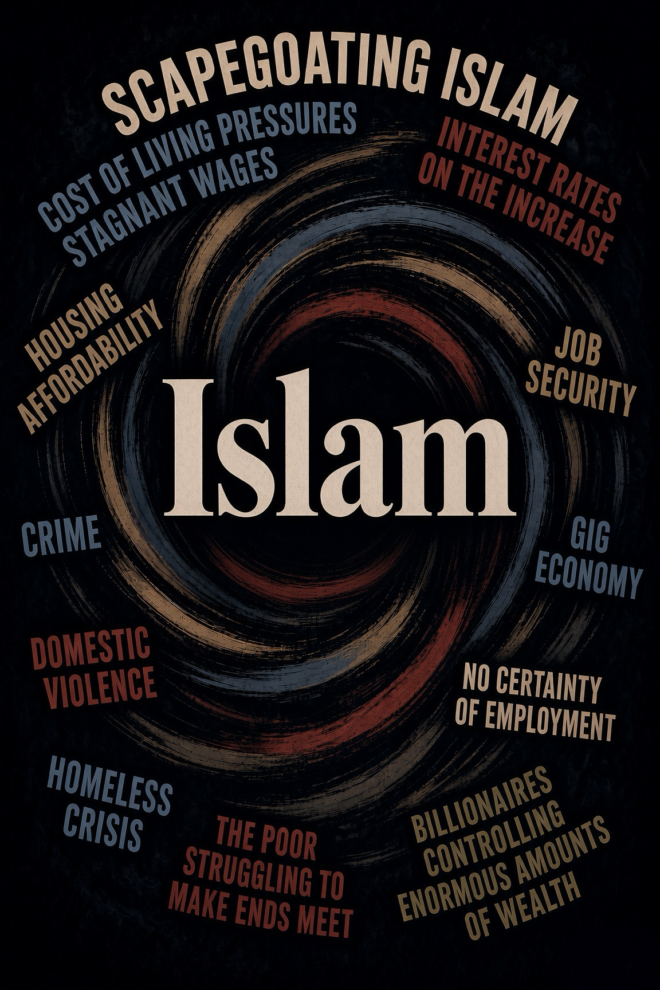
Two things are true at once, and the harder discipline is holding both. Fear of Islam and Muslims has been, and continues to be, cynically and repeatedly instrumentalised for electoral advantage, media attention, and the consolidation of state power – a scare politics in the fullest sense of the term. And distinct, well-documented currents within contemporary political Islam have produced sustained campaigns of violence and illiberal governance whose human cost, borne overwhelmingly by Muslims themselves, cannot be waved away as manufactured panic. Neither proposition cancels the other, and an honest essay on this subject cannot proceed by erecting one thesis and then dutifully qualifying it in a final act of throat-clearing. Both realities operate on the same public simultaneously, at the same volume, and any framework – of either political direction – that resolves the tension by ignoring one side of it is not analysis but advocacy wearing analysis’s clothes.
Toni Morrison’s observation that racism’s “very serious function… is distraction,” keeping its targets perpetually “explaining, over and over again, your reason for being,” has been repeatedly applied to anti-Muslim rhetoric in the quarter-century since September 11, 2001. Suhaiymah Manzoor-Khan’s sharper claim – that Islamophobia in Britain functions as a tool to distract from the systemic violence of austerity, housing precarity, and stagnant wages – extends the argument into political economy. These are genuine insights into how fear operates as a mechanism of social control, and this essay treats them seriously. But it treats with equal seriousness the Global Terrorism Database’s tally of tens of thousands of Islamist attacks since 1979, the French state’s own casualty figures since the Charlie Hebdo massacre, and Pew Research Center survey data spanning more than a decade across dozens of Muslim-majority countries. The task is not to adjudicate which side is “really” correct – both are, in their own domain – but to map where genuine distraction ends and genuine threat begins, and to propose working criteria for telling the two apart when they arrive, as they usually do, tangled together in the same news cycle.
Morrison, Exhaustion, And The Limits Of The Racial Analogy
The Morrison framework describes a mechanism of exhaustion rather than mere prejudice. Racism, in her formulation, is a structural device that forces its targets into a state of perpetual self-justification – proving, again and again, a legitimate claim to full humanity, art, history, belonging. Applied to Muslims after 9/11, the pattern is recognisable: ordinary Muslims have been repeatedly called upon to condemn terrorism they did not commit, to demonstrate loyalty to nations that sometimes treat their citizenship as conditional, and to affirm, on command, their compatibility with liberal norms. Each new attack – Madrid, London, Boston, Paris, Nice, Berlin, Manchester, and the string of vehicle and knife assaults since – triggers a fresh round of demands for collective reassurance that rarely falls with equal weight on other communities implicated in political violence.
The analogy to race, however, deserves scrutiny rather than uncritical adoption, and this is worth stating plainly rather than passing over. Race is an ascribed, involuntary characteristic; Islam is a belief system and a set of political movements, both of which are properly subject to argument, critique, and even rejection in a way that a person’s ancestry is not. Treating “Islamophobia” as structurally identical to anti-Black racism risks placing theological and political claims – sharia’s proper scope, the legitimacy of a caliphate, the interpretation of specific hadith – behind the same protective wall that rightly shields immutable identity from attack. A critique of Islamism as a political ideology is not, in itself, a category error in the way that a critique of Blackness as an ascribed identity would be.
Yet the analogy is not simply void, for two reasons. First, in practice, anti-Muslim hostility very often does attach to phenotype rather than professed belief: Sikhs, Christian Arabs, and Hindu South Asians have all been attacked in the West by assailants who could not have known, and did not ask, what their targets actually believed – the 2012 Oak Creek gurdwara shooting in Wisconsin is the starkest American example. When fear operates this way, it is functioning exactly as Morrison describes racism functioning: as a response to appearance, not doctrine. Second, the demand for perpetual explanation that Morrison identifies is a real phenomenon independent of whether its object is ideological or ascribed – collective demands for disavowal, applied to millions of people for the acts of a small and unrepresentative minority, are exhausting and politically productive of division whether or not the underlying category is, strictly, a “race.” The corrective, then, is not to discard the exhaustion insight but to hold it apart from any claim that criticism of Islamic theology or Islamist politics is thereby placed off-limits – the two claims travel together in popular usage but are not, in fact, the same claim.
Manzoor-Khan, The Green Scare, And Political Economy
Manzoor-Khan’s argument that Islamophobia debates can themselves become a red herring – absorbing energy that might otherwise confront austerity, the housing crisis, or the hollowing-out of local government services – describes a real feature of British and European political discourse. When politicians amplify claims of “no-go areas” or demographic “replacement,” claims repeatedly investigated by journalists and found exaggerated or fabricated outright, the resulting panic can crowd out scrutiny of more mundane and more consequential policy failures. This dynamic finds historical depth in the “Green Scare” thesis: the argument that post-9/11 Western states elevated Islam itself, beyond the specific networks that carried out attacks, into an organising civilisational threat, much as anti-communism organised Cold War domestic politics. The USA PATRIOT Act, the expansion of surveillance architecture, and the travel bans targeting Muslim-majority nations all drew rhetorical justification from a threat sometimes described in terms broader than any specific terrorist organisation’s actual operational reach.
Electoral Instrumentalisation, Right And Left
Electoral politics provides the clearest evidence for the distraction thesis, and it is here that intellectual honesty requires examining incentives on both sides of the aisle with the same rigour, rather than treating instrumentalisation as a vice unique to the political right.
On the right, the pattern is well documented. France’s Rassemblement National (formerly Front National) has built its modern electoral strategy substantially around Islamisation and the compatibility of Muslim populations with laïcité. Germany’s Alternative für Deutschland pivoted from a Euroscepticism-focused party into one organised significantly around opposition to Muslim immigration following the 2015 refugee crisis, a shift that coincided with its rise to the second-largest bloc in the Bundestag. The Netherlands’ Geert Wilders made explicit civilisational claims central to his platform for two decades before his Party for Freedom became the largest party after the 2023 election. In each case, cultural anxiety substituted for a governing economic program precisely at moments when such a program was most needed and least available.
The incentive runs the other way too, and deserves the same scrutiny. Governing and opposition parties of the centre-left have repeatedly faced allegations – not merely from their opponents, but from official, independent inquiries – that a desire to avoid appearing to target an ethnic or religious minority contributed to the minimisation of serious crimes committed within that minority. The clearest documented case is the Rotherham child sexual exploitation scandal in England. Professor Alexis Jay’s 2014 independent inquiry, commissioned by the Labour-run Rotherham Metropolitan Borough Council, found that at least 1,400 children had been abused between 1997 and 2013 by organised networks, and concluded that council and police failures to intervene were compounded by what the inquiry itself described as an institutional “nervousness about ethnic issues” – officers and social workers avoiding action for fear of being labelled racist, given that a significant proportion of perpetrators were of Pakistani heritage. A subsequent review by Dame Louise Casey found the council “in denial” about the scale of the problem years after it was known internally. It should be said, in fairness, that later analyses – including critiques from the left – have argued the “political correctness” framing oversimplifies a failure that was, at bottom, about institutional misogyny and the routine disbelief of working-class girls in care, a failure that cut across councils of every political stripe and predated the racial dimension becoming public. Both readings can be true simultaneously: an underlying culture of institutional failure toward vulnerable children, made worse in this specific instance by a documented reluctance to act decisively once the ethnic pattern of offending became apparent. The lesson for this essay is not that either side of politics has clean hands, but that both an inflated and a minimised account of a minority’s involvement in crime can serve a party’s electoral coalition, and both deserve the same evidentiary standard before they are accepted.
The Empirical Record
Empirical data on Islamist violence is not manufactured, and its scale should be stated with actual figures rather than gestured at. Fondapol, the French policy institute, compiled attack data spanning 1979 to April 2024 and documented 66,872 Islamist attacks worldwide, causing at least 249,941 deaths globally. Of that global total, 218,734 deaths – 87.5 per cent – were concentrated in just the thirteen worst-affected countries, underscoring how geographically concentrated this violence actually is even as its absolute scale is real. The same dataset records 60 attacks and 3,121 deaths in the United States over that period (dominated by, but not limited to, the 3,001 killed on September 11, 2001) and 86 attacks causing 988 deaths in Russia. The Institute for Economics and Peace’s Global Terrorism Index similarly finds that roughly ten countries account for 87 per cent of terrorism deaths worldwide, with over 90 per cent of attacks and 98 per cent of deaths in 2023 occurring within active conflict zones – a pattern that should reframe how the threat is discussed in Western public debate, since the overwhelming majority of victims are Muslims living in Nigeria, Somalia, the Sahel, Afghanistan, and Iraq, not Westerners. The Africa Center for Strategic Studies documented more than 150,000 deaths linked to militant Islamist groups across the continent in the decade to 2025 alone, with the Sahel and Somalia each recording over 49,000 fatalities.
France, which has borne a disproportionate share of Islamist violence within Western Europe, illustrates that concentration does not mean absence in the West. Fondapol’s own tracking records at least 305 deaths across 62 attacks in 33 towns and 24 departments between the Mohamed Merah shootings in Toulouse in March 2012 and a further attack in Lyon in September 2025 – a sequence that includes the Charlie Hebdo and kosher-supermarket killings of January 2015, the Bataclan and Stade de France attacks that killed 130 people that November, and the Nice truck attack that killed 86 in July 2016. These are not statistically negligible events, and no serious account of “scare politics” can proceed as though they were.
What The Survey Data Actually Shows
Pew Research Center’s landmark 2013 study “The World’s Muslims: Religion, Politics and Society,” based on more than 38,000 face-to-face interviews across 39 countries, found support for making sharia the official law of the land ranging from 8 per cent in Azerbaijan to 99 per cent in Afghanistan, with 91 per cent in Iraq, 89 per cent in the Palestinian territories, 84 per cent in Pakistan, 83 per cent in Morocco, and 74 per cent in Egypt. On apostasy, Pew’s own reporting is more precise than the headline figures usually quoted, and the precision matters: among Muslims who already favour sharia as their country’s official law, support for executing those who leave Islam reached 86 per cent in Egypt and 82 per cent in Jordan – the two highest of the twenty countries with adequate sample sizes for this question. This is a conditional figure, not a share of the general population, and it should be reported as such. But it is not a trivial distinction that disappears on inspection: in Egypt, for instance, support for sharia as official law itself runs at 74 per cent of all Muslims surveyed, so the two figures compound rather than cancel. The spread across countries – from double-digit support in Central Asia to majorities in parts of the Middle East and South Asia – demonstrates the data cannot be reduced to a single “Muslim world” position, while also showing that in several of the world’s most populous Muslim-majority states, this is not a fringe view once the conditional structure of the question is accounted for.
On violence specifically, the same survey found that a global median of roughly seven-in-ten Muslims say suicide bombing and attacks on civilians are never justified in defence of Islam – a genuine and important majority position. But minorities holding the opposite view were concentrated and substantial in specific places: 40 per cent in the Palestinian territories, 39 per cent in Afghanistan, 29 per cent in Egypt, and 26 per cent in Bangladesh said such violence was at least sometimes justified. Earlier Pew tracking found even higher figures in some years and countries – a 2011 survey recorded 34 per cent support in Nigeria and 39 per cent in Lebanon, though these figures had fallen sharply, by 15 to 42 percentage points, from where they stood in 2002 across most countries tracked. Western Muslim populations diverge sharply from this pattern: Pew’s polling of American Muslims found 81 per cent say such violence is never justified, compared with just 8 per cent who say it is often or sometimes justified – figures more firmly opposed to violence than most of the Muslim-majority countries surveyed. This gap between diaspora and origin-country attitudes is itself analytically significant, and cuts against any narrative, from either political direction, that treats “Muslim opinion” as a single, undifferentiated bloc.
The Charge In Reverse: Silencing Reform From Within
Critics of the distraction framing argue that the charge of Islamophobia frequently operates in reverse – not as a shield for the vulnerable but as a check against scrutiny of ideology and doctrine. By equating good-faith criticism of Islamist political movements or specific scriptural interpretations with racial bigotry, the term risks constructing something close to a de facto blasphemy protection for a single religious tradition. Ex-Muslims, apostates, and reformist theologians – both within Muslim-majority societies and in Western diaspora communities – report social ostracism, and in severe cases physical threat, for positions that would in almost any other context be treated as unremarkable exercises of conscience. Women’s-rights advocates working within Muslim communities on forced marriage, honour-based violence, or unequal family law frequently describe being caught between two hostile forces: a majority culture too quick to generalise their specific critiques into a wholesale condemnation of Islam, and community leadership too quick to dismiss those same critiques as an imported Western imposition. The reflexive dismissal of all such concern as mere “scare politics” can, whether intentionally or not, protect the most illiberal currents within Muslim political life while obscuring exactly the voices most in need of a hearing.
Working Criteria: Telling Distraction From Threat
Given that both realities are genuine, the more useful question is not which framework is correct but what distinguishes a legitimate application of concern from an illegitimate one. Three working criteria are offered here, not as a complete taxonomy but as a starting discipline.
Legitimate security measures target specific, evidenced behaviour – documented network ties, financial flows, prior conduct – rather than an entire religious or ethnic category; they are proportionate to the actual scale of risk as measured by data such as the Global Terrorism Index rather than to media salience; they include sunset clauses, judicial oversight, and periodic review; and they pass a consistency test – would the same measure be considered acceptable if applied, mutatis mutandis, to a domestic ideological threat of comparable lethality from a different source? A travel ban naming entire nations by religious composition fails this test in ways that individualised watch-listing tied to specific intelligence does not.
Legitimate cultural critique is falsifiable and specific: it names a movement, a text, a practice, or a statistic, and remains open to revision by contrary evidence. It distinguishes Islam as a faith of roughly two billion people from Islamism as a political movement, and further distinguishes among Islamist currents – the Muslim Brotherhood, Salafi-jihadism, Deobandi revivalism – that differ sharply from one another in method and aim. It survives a symmetry test: would the same standard of scrutiny be applied, with the same rigour, to a comparable claim or practice within another religious or political tradition? Essentialising bigotry, by contrast, treats the views of a Pakistani village elder, a London-born accountant, and an Indonesian civil servant as interchangeable expressions of a single fixed essence, indifferent to the wide variation the Pew data itself documents.
Genuine reformers, as distinct from the most assertive self-appointed community spokesmen who tend to dominate media coverage, typically show an independent track record predating any political usefulness; institutional and financial independence from both state patronage and foreign religious funding; a willingness to take positions unpopular within their own community, which functions as a costly and therefore credible signal; and openness to engagement with ex-Muslim and dissident critics rather than reflexive dismissal of them as inauthentic or captured. Representativeness is better tested against survey data of the kind Pew and similar bodies collect than against who is most quotable or most frequently invited onto a panel.
Conclusion
Morrison’s insight into exhaustion remains valuable, properly bounded: the demand for endless self-justification is a real mechanism of social control, whether its object is an ascribed identity or, as is often functionally the case, a phenotype mistaken for one. Manzoor-Khan’s observation about displaced material analysis is likewise sound, and the Rotherham case shows the same displacement can run in the opposite direction, toward minimisation rather than exaggeration, when a different set of political incentives applies. The Green Scare literature is right that states have long securitised identities for ends only loosely connected to the bounded threat invoked. None of this, however, licenses treating the Global Terrorism Database’s casualty figures, the French state’s own attack tallies, or a decade of consistent Pew survey findings as beside the point. The scare politics of Islam are real. So is the violence some currents of political Islam continue to produce, at a human cost still borne overwhelmingly by Muslims themselves. A politics that collapses this into pure distraction fails the test of seriousness. A politics that inflates every instance of theological conservatism into civilisational conquest fails the test of proportion. The working criteria offered here – specificity over category, symmetry over exception, evidence over salience – will not resolve every hard case. But they at least name what a resolution would require: the sustained clarity that distraction, deployed from either direction, is specifically designed to prevent.
– – –
Bakchos is the founder of Blak and Black, an Australian media and advocacy platform established in 2010. Bakchos writes from the intersecting perspectives of Wiradjuri heritage, Jewish identity, and humanism.
© Bakchos, August 2026


Islam is in the easy scapegoat for politicians who pray on the gullibility of poorly and not particularly bright voters. Pauline Hanson is simply using the MAGA playbook to import US political instability into Australia, using Islam as the smoke screen for that importation.
Greedy white folk of destroyed Australia they’ve taken paradise and turned it into a junkyard. It’s not only we blackfullas who are missing out, poor and disadvantage white folk are also missing out on a share of the wealth of this county. Instead of blaming blackfellas, Islam, youth crime the greedy white folk need to stop and take a long hard look at themselves.
In absolute agreement with you uncle.
Scapegoating Islam seems like easy political point scoring, the long term costs might be higher than first thought.
“The very serious function of racism … is distraction. It keeps you from doing your work. It keeps you explaining, over and over again, your reason for being. Somebody says you have no language and so you spend 20 years proving that you do. Somebody says your head isn’t shaped properly so you have scientists working on the fact that it is. Somebody says that you have no art so you dredge that up. Somebody says that you have no kingdoms and so you dredge that up. None of that is necessary.” – Toni Morrison
https://www.huffpost.com/entry/toni-morrisons-most-powerful-quotes-on-racism_n_5d49b529e4b0244052e226ea