
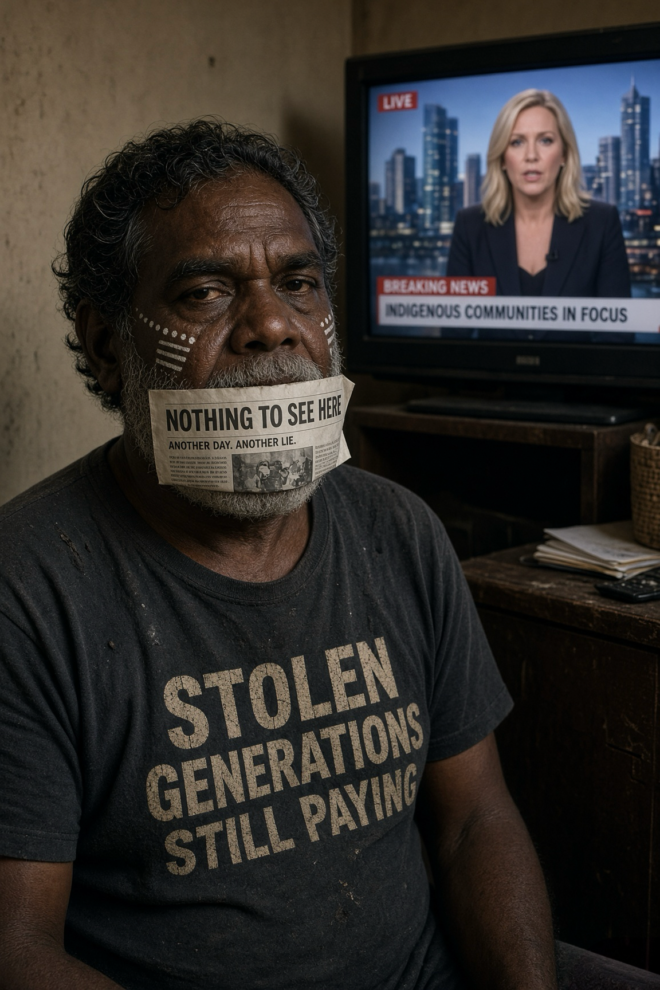
Every society tells itself a story about who it is, and every society outsources the telling of that story to institutions it trusts to be honest. When those institutions fail – not through a single scandal but through decades of quiet, repeated distortion – the failure becomes indistinguishable from policy. It shapes who is believed, who is feared, and who is funded. This is the terrain that opened before the Joint Standing Committee on Aboriginal and Torres Strait Islander Affairs when it convened its inquiry into racism and violence against First Nations people, and took evidence from some of the most senior Indigenous journalists working in this country.
What emerged was not a complaint about isolated incidents. It was testimony, in the older and more exacting sense of that word – an account given under obligation to truth, by people who had spent careers watching an industry make the same choices for the same reasons, and who were now naming the pattern for the record. But testimony, however credible, is an account of experience, not a measurement. The obligation on anyone examining it afterwards is to ask whether the pattern holds up against the record the industry itself has produced – the audits it has commissioned, the disparities it is reporting on, and the economics that shape what makes it to air in the first place. It does, largely. But it holds up in a more complicated shape than the testimony alone suggests, and the complications matter.
The Shape Of The Problem
The core allegation, distilled from hours of evidence, is this: mainstream Australian media does not merely under-report First Nations achievement. It structurally prefers crisis. Community-led programs that reduce youth offending, health initiatives that close outcome gaps, cultural institutions that rebuild what colonisation tried to erase – these stories exist in abundance, and they are routinely passed over in favour of coverage built around conflict, dysfunction and disorder.
This is a distinct claim from the more familiar accusation of overt racism, and the distinction matters. Slurs are easy to identify and, in theory, easy to police. What witnesses described to the committee was harder to isolate and therefore harder to correct: a habit of framing that never needs to use a racist word to produce a racist effect. An image chosen because it confirms an existing stereotype rather than because it is representative. A crime story run without the demographic or historical context that would explain rather than merely alarm. None of this requires malice. It requires only convention, unexamined and repeated until it hardens into common sense.
That convention is not simply a matter of anecdote. Australian academic content analysis of online crime reporting involving Aboriginal and Torres Strait Islander people has found the same pattern the witnesses described under critical discourse analysis: coverage that repeatedly foregrounds Indigenous identity in crime stories while leaving the structural causes of over-representation in the justice system unexamined, reproducing the framing established during earlier flashpoints such as the Northern Territory Emergency Response. A separate, decades-spanning body of research into how Aboriginal deaths in custody are reported has reached a comparable conclusion: coverage tends to default to one of two narrow roles for Aboriginal people, as offenders or as passive victims, crowding out the fuller account of a life and a death that responsible reporting would require. Neither of these findings depends on the parliamentary inquiry’s witnesses being believed on trust. They are independent measurements arriving at the same place.
What The Audits Actually Show
The most direct test of the “crisis preference” claim, however, is not content analysis of individual stories but the industry-wide audits Australian media itself has co-operated with. Media Diversity Australia’s benchmark study, conducted with the University of Sydney and UTS Jumbunna Institute, examined two full weeks of free-to-air news and current affairs programming and tracked who actually appears on screen. Its first finding, in 2020, was that people of Indigenous background made up roughly 1.2 per cent of on-air appearances against a population share of around 3.3 per cent – meaning Indigenous Australians were not merely under-represented in the stories being told, they were substantially under-represented among the people trusted to tell any story at all. The same study found no Indigenous presenter, commentator or reporter on any regional network sampled, and none appearing on broadcast news in the Northern Territory, South Australia or Tasmania – jurisdictions where Aboriginal and Torres Strait Islander people make up a significant share of the population the news claims to serve.
The follow-up audit two years later, in 2022, gives the trajectory question a genuine answer rather than a rhetorical one, and the answer is not encouraging. Anglo-Celtic representation on screen moved from 75.6 per cent of appearances in 2019 to 76.0 per cent in 2022 – statistically flat, against a population estimated at roughly 54 per cent Anglo-Celtic background at the time. Improvement for Indigenous and other under-represented reporters was, in the researchers’ own words, inconsistent across networks rather than structural. Three-quarters of newsroom staff surveyed rated the industry’s overall handling of cultural diversity as poor, and more than three-quarters of culturally diverse respondents said their background had actively worked against their career progression. Every national news director surveyed in the 2020 baseline was male and Anglo-Celtic; the 2022 update found leadership diversity had barely moved. It is worth being explicit about what has not happened since: Media Diversity Australia describes the study as biennial, but no further round appears to have been published beyond the 2022 report – meaning the industry’s own preferred instrument for measuring its progress has itself gone quiet for longer than the gap between its first two editions. An audit trail that stalls is not neutral evidence. On a question this contested, the absence of a more recent scorecard is itself a data point, and not a favourable one.
None of this proves newsroom racism operates with intent. What it does is remove the inquiry’s central claim from the category of impression and place it in the category of measured, repeated, independently audited fact: two years apart, using the same methodology, Australian television news was reporting on a country it was not reflecting, by a margin that had not meaningfully closed.
A Genuine Disparity, Not A Manufactured One
The honest version of this argument has to concede something the witnesses did not dwell on and the earlier draft of this essay did not adequately weigh: crisis coverage of First Nations communities is not, in every case, invented. The Productivity Commission’s 2026 Closing the Gap report, the most current national accounting of outcomes against the 2021 agreement’s nineteen targets, found that only three targets are on track to be met, alongside one, preschool enrolment, already achieved. Four indicators are actively going backwards: suicide rates, adult imprisonment, children in out-of-home care, and the proportion of children reaching developmental milestones on time. The imprisonment rate for Aboriginal and Torres Strait Islander adults reached 2,500 per 100,000 in 2025 – 16.7 times the non-Indigenous rate, and as high as 4,305 per 100,000 in Western Australia. The rate of First Nations children in out-of-home care now stands at 52.2 per 1,000, 11.5 times the non-Indigenous rate. Youth detention, the specific indicator most relevant to the crime-reporting pattern the witnesses described, sat at 25.7 children aged 10 to 17 per 10,000 in 2024–25, with the Productivity Commission recording no measurable movement toward the target of a 30 per cent reduction by 2031.
A newsroom reporting these figures accurately is not manufacturing a crisis. It is covering one that a Commonwealth statutory body has itself confirmed, in detail, against government-set targets the country is failing to meet. This matters because it sharpens rather than weakens the witnesses’ underlying argument. The problem the inquiry heard about is not that hard stories get told. It is that they get told in isolation from the data that would explain them, disproportionately relative to their actual share of daily Indigenous life, and almost never in the same breath as the evidence – sitting in the same Productivity Commission reports the crisis figures come from – about which interventions are demonstrably reducing them. The failure is one of proportion and pairing, not of truthfulness. Distinguishing those two claims is not a technicality; it is the difference between an argument that can be tested and won, and one that can be dismissed as advocacy dressed as journalism.
The Stories That Don’t Make The Bulletin
This is where the evidence for what witnesses called under-told success becomes most concrete, and where vague testimony can be replaced with an audited outcome. Brooke Boney raised justice reinvestment as an example of a solutions story that struggles for airtime relative to the offending it addresses. The clearest test case is Maranguka, the Aboriginal-led justice reinvestment initiative operating in Bourke, New South Wales since 2012 in partnership with Just Reinvest NSW. An independent economic impact assessment conducted by KPMG on a pro bono basis found that, in its first fully assessed year, the initiative produced a 23 per cent reduction in police-recorded domestic violence incidents, a 31 per cent increase in Year 12 student retention, a 38 per cent reduction in charges across the five most common categories of juvenile offending, a 14 per cent reduction in bail breaches, and a 42 per cent reduction in the number of days young people spent in custody. KPMG estimated the resulting economic impact at $3.1 million against operating costs of roughly $600,000 – a return of approximately five dollars in avoided justice-system and community cost for every dollar spent, in a town previously recording the highest rates of juvenile crime and domestic violence in the state.
Set beside the Productivity Commission’s national youth detention figures – a rate that has not moved toward its 2031 target in the years since – Maranguka is not a marginal curiosity. It is one of the most rigorously measured pieces of evidence in the country that the underlying causes of Indigenous youth offending can be substantially altered by community-led, place-based intervention within a matter of years, at a fraction of the cost of the incarceration it displaces. That evidence has existed, audited and public, since 2018. Its comparative absence from national crime coverage, next to the volume of coverage given to the offending itself, is not a gap in the story. It is the story – a demonstrated solution sitting largely unreported beside a worsening national trend it has already shown how to reverse locally.
The explanations witnesses offered for this imbalance were mundane in a way that made them more, not less, damning: positive stories bumped because a camera crew was unavailable, because the bulletin was full, or because a newsroom lacked the resources to chase a story that would not otherwise force its way to the top of the running order. That explanation deserves to be taken seriously rather than treated as a polite excuse, because it points to a second causal engine running alongside racial bias, and it is the one the industry’s own economic data confirms most clearly.
The Economics Running Underneath
It would be a mistake to treat newsroom resourcing as a secondary alibi for a problem that is really about bias. The two forces are more accurately described as co-equal and mutually reinforcing. Australian journalism has lost roughly 3,000 jobs to redundancy alone in the past five years, according to research by the Public Interest Journalism Initiative, with local and regional news availability falling by 68 per cent in metropolitan suburbs and 45 per cent in regional areas over the period it has been tracking. More than twenty regional and community newspapers ceased printing or closed entirely across an eighteen-month span spanning late 2024 into 2025. Regional television has not been spared: entire newsroom operations have closed in towns including Wagga Wagga, Orange, Dubbo, Albury and Hervey Bay. The Federal Government’s response – the $180.5 million News Media Assistance Program, including a dedicated Journalism Assistance Fund and continued support for Australian Associated Press – is itself an acknowledgment from Canberra that the commercial model underpinning Australian journalism has failed, not merely strained.
A newsroom operating with a fraction of its former staff, on tighter deadlines, with fewer specialist rounds and less institutional memory, will gravitate toward whichever story requires the least additional labour to stand up: the wire copy on an offending charge, the replayed footage of an already-filmed disturbance, the crime report that arrives pre-packaged from a police media unit rather than the six-week investigation into why a community-led program is working. This is not a defence of the pattern the witnesses described – the same economic pressure falls on stories about every community, and it is Indigenous communities whose complex, positive, resource-intensive stories are disproportionately the ones left on the cutting-room floor when the newsroom is stretched thinnest. But it does mean the remedy cannot be moral appeal alone. An industry with three thousand fewer working journalists than it had five years ago is not simply choosing crisis over context out of habit; it is choosing the story it can afford to produce before deadline. Fixing that requires resourcing specialist Indigenous affairs reporting as a distinct, protected function – the way Boney’s and Janke’s own roles at NITV and SBS exist as an institutional exception precisely because the commercial model will not otherwise sustain that kind of reporting – not simply asking under-resourced generalist newsrooms to try harder.
Thirty-Five Years, Two Decades Of Growth, And A Stalled Audit
SBS Director of First Nations Tanya Denning-Orman, whose career spans more than three decades including the entire life of NITV since its founding, situated the inquiry’s evidence within a much longer institutional memory. She reminded the committee that its substance had already been established, in near-identical terms, thirty-five years earlier, by both the Royal Commission into Aboriginal Deaths in Custody and the National Inquiry into Racist Violence, each of which found that negative and inaccurate media representation of First Nations people helped produce a social climate in which racism and violence were tolerated.
It would be too simple, though, to read the intervening thirty-five years as flat continuity, and a more complete account has to hold two things that are both true at once. The first is that dedicated First Nations media has grown substantially in reach and institutional weight across exactly that period – NITV’s establishment and its now near-twenty-year run within SBS, the development of specialist Indigenous affairs desks and editor roles at outlets that did not carry them a generation ago, and a body of academic and industry research, much of it now cited in evidence like this inquiry’s, that did not exist when the Royal Commission reported in 1991. That growth is real and it has changed who gets to correct the record, even if it has not yet changed the record itself. The second is that, measured at the level the audits actually track – who appears on screen, who leads newsrooms, how crime is framed – the movement across the most recent, comparable, apples-to-apples window on record, 2019 to 2022, was negligible, and the instrument built to keep measuring it has itself gone quiet since. Progress and stagnation are not competing conclusions here; they describe two different layers of the same system, one of which has genuinely improved and one of which has not.
There is something almost Stoic in the discipline required to hold both of those facts without collapsing them into a simpler story in either direction. Marcus Aurelius counselled himself, in the depths of an empire’s daily grind, that the obstacle is the way – that clarity about a problem’s true, unflattering shape, including the parts of it that are actually moving, is the only honest starting point for doing anything about it. Thirty-five years of a partially remedied, partially unremedied pattern is not evidence that nothing can be done. It is evidence that the interventions which have worked – building dedicated Indigenous media institutions – need to be extended into the parts of the system that have not moved at all: who staffs and leads the mainstream newsroom, and how its crime desk is resourced.
The View From Inside The Newsroom
Veteran broadcaster Narelda Jacobs, a Whadjuk Noongar woman with a broadcasting career spanning more than a quarter of a century, gave the committee a granular account of how racialised storytelling recurs at the level of individual editorial decisions. Coverage of Aboriginal and Torres Strait Islander communities, she said, has repeatedly leaned on a narrow visual vocabulary – poverty, litter, arrest, homelessness – deployed without the surrounding context that would explain rather than merely display. Commercial newsrooms, operating under the same resourcing pressure documented above, default to the images that require the least explanation, and those images are almost always the ones that confirm what the audience already expects to see.
Jacobs also spoke about racism she has encountered inside newsrooms themselves, and made a specific institutional recommendation: that anti-racism education be treated by media organisations with the same seriousness as the legal and compliance training journalists are required to complete as a condition of their employment. The comparison is a pointed one. News organisations already accept that certain kinds of harm – defamation, contempt, breach of suppression orders – are serious enough to warrant compulsory training and formal accountability structures. Racism, on Jacobs’s account, has not yet been placed in that category, despite producing harm that is at least as serious and considerably more sustained. Academic research into Indigenous journalists’ experience inside mainstream newsrooms corroborates the substance of that account: Indigenous reporters describe routinely bringing a wider historical and policy lens to stories that non-Indigenous colleagues had covered narrowly, in effect doing structural correction work that sits outside their formal job description and is rarely compensated or resourced as such.
Perhaps the most telling evidence Jacobs gave concerned the fate of stories that Indigenous journalists themselves try to pitch. She described a structural double bind: raising a story about racism affecting First Nations people invites an unusually high evidentiary bar, higher than would be applied to comparable stories about other forms of discrimination, and even documented cases are frequently declined. Indigenous journalists pitching those stories, she said, are often told they are too close to the subject to be trusted with it – a judgment she named, correctly, as itself a form of racism, since it treats lived proximity to injustice as a disqualification rather than as the expertise it actually represents. No journalist covering a war is disqualified for having strong feelings about war. The suspicion is reserved, specifically, for the people with the deepest standing to report the story accurately.
Jacobs offered the committee a concrete case study in what gets lost when this suspicion governs editorial judgment: national coverage of unrest in Alice Springs, built almost entirely around replayed footage of violence, stripped of the context that police and community leaders had already identified rising tensions and that there had been real opportunities to intervene before the situation escalated. The effect of the coverage, repeated across news cycles with the same clips, was to leave a national audience with the impression that the town existed in a permanent state of chaos – an impression that then does its own damage, corroding trust between the community being depicted and the media that claims to be depicting it.
The Coin And The Comments Section
Nothing in the evidence captured the scale of the online dimension of this problem as vividly as the story told by NITV and SBS National Indigenous Affairs Editor John Paul Janke about the commemorative coin issued to mark the anniversary of the 1966 Wave Hill walk-off – the Gurindji stockmen’s strike that became one of the founding acts of the land rights movement, immortalised in the image of Gough Whitlam pouring a handful of soil into the palm of Vincent Lingiari. Janke told the committee that online news coverage marking the coin’s release attracted comment sections filled with racist abuse, in numbers running into the thousands, and that those comments had simply been left there – visible to any Aboriginal or Torres Strait Islander reader who opened the page, uncorrected and unremoved by outlets with the resources and, arguably, the obligation to moderate them.
Janke’s broader point to the committee was that this is not exceptional. He described racism toward First Nations people as a present, everyday condition, amplified now by algorithms that reward the most inflammatory engagement and tolerated by publishers who possess the technical capacity to intervene and elect not to. He also told the committee he had withdrawn from the platform then known as Twitter, now X, after witnessing the volume and character of abuse directed at First Nations voices during the Voice to Parliament referendum campaign – a decision that, however necessary for his own wellbeing, had the effect of removing an experienced Indigenous voice from a national conversation at precisely the moment that conversation most needed it.
What Accountability Would Actually Look Like
The witnesses were, notably, not asking the committee to suppress reporting on hardship, crime or dysfunction within First Nations communities. What was asked for, and what the evidence above suggests is genuinely achievable rather than merely aspirational, was symmetry: that hard stories be told with the same rigour, context and follow-through responsible journalism owes any subject, paired with the trend data and evaluated solutions – Maranguka’s audited outcomes among them – that already sit inside the same government reports the crisis figures are drawn from.
A more decisive set of measures follows directly from the record rather than from goodwill. Crime reporting involving Aboriginal and Torres Strait Islander people should be run against Productivity Commission trend data as a matter of editorial standard, not as an occasional addition. Claims should be verified before publication and corrected transparently when wrong. Indigenous affairs reporting should be resourced as a protected specialist function, insulated from the general contraction of newsroom budgets, on the model NITV and SBS already demonstrate works. Anti-racism training should carry the same institutional weight as legal compliance training, with consequences attached to its neglect. Outlets should be held to the same standard of care over their own comment sections that they claim to exercise over their reporting. And Media Diversity Australia’s benchmark audit – the only instrument that has actually measured any of this over time – deserves the funding and institutional backing to resume on schedule, because an industry that stops measuring its own progress has, in effect, decided it no longer wants to be held to it.
Where This Leaves The Inquiry
Janke closed his evidence by describing something the committee should sit with as carefully as anything in the formal testimony: the accumulated frustration of ordinary people who have watched inquiry after inquiry, review after review, royal commission after royal commission, arrive at findings that echo the ones before them, and then watched those findings fail to change very much. His message to the committee was not despair. It was a demand that this particular process not become one more entry in that list.
The record now supports a more exacting version of that demand than testimony alone could establish. The audits confirm the imbalance is real and has not meaningfully shifted across the only comparable window on record. The Productivity Commission’s own data confirms that some of what gets reported is a genuine, worsening crisis, which sharpens rather than excuses the case for pairing it with the evidence of what works. The economics confirm that newsroom behaviour is being shaped by a collapsing commercial model as much as by inherited habit, which points toward resourcing as a lever alongside training. And the trajectory confirms that where First Nations people have been given the institutional resources to tell their own stories, the picture has genuinely improved – which is itself the strongest evidence available that the remaining, unmoved parts of the system could improve too, if given the same resourcing and the same expectation of accountability. What remains is the considerably less difficult task of believing the evidence now assembled, and acting as though the last thirty-five years of being told the same thing had actually been heard.
– – –
Bakchos is the founder of Blak and Black, an Australian media and advocacy platform established in 2010. Bakchos writes from the intersecting perspectives of Wiradjuri heritage, Jewish identity, and humanism.
© Bakchos, August 2026

It’s rare to see a positive news story about Indigenous Australians on the television. It’s even rarer to hear Pauline Hanson say anything positive about Indigenous Australians, much of what she says, which could be slanderous, she says under parliamentary privilege which is gutless. The media needs to have a solid rethink about how it presents stories about Indigenous Australians if the situation is to improve.
From almost the day I can remember reading the newspapers. All the stories about Indigenous Australians have been negative. All this does is reinforce a stereotype, which in turn becomes self perpetuating..
Newspapers tell one story, often with little context and plenty of value judgement. Few people look beyond what they read to understand more. Perhaps in some small way this online source counters some of that.
Comfortable lies are easier to deal with than uncomfortable truths.
The media learned a long time ago, there’s more profits in hating blackfullas, than there is in telling the truth.
Australian politics and media are built on smoke and mirrors, for spoken mirrors to work, there always has to be a distraction. The distraction is the Indigenous people of Australia. They are Australia’s perennial scapegoats, and they become the distraction whenever anyone starts to question too closely what is really going on in our community.
It has never ceased to amaze me that the ABC had two journalists sit through your entire trial in 2017, and as soon as it became apparent you were going to win, and not just win, but win convincingly, by proving that the AFP and the DPP prosecuted you on a forged document, the ABC journalists lost total interest in reporting on the case. That could’ve been a big story about an Indigenous man, or any man for that matter standing up to the system and prevailing, but because it was an Indigenous man who stood up to the system and prevailed, they had no interest in reporting on it
The media continually lie about blackfellas It’s rare to see a good blackfellas story. The media is all about reinforcing stereotypes.