
I. The Grammar Of Affordability
There is a particular vocabulary reserved for the poor and the disabled in Australian public life. Their needs are never simply needs. They are “blowouts.” Their support is never simply support. It is a “handout.” The National Disability Insurance Scheme does not grow, in this grammar; it “explodes.” Childcare that ordinary families can actually use is not a public good; it is “unsustainable.” This is a vocabulary of alarm, deployed with remarkable consistency by politicians and business lobbyists whenever the subject turns to the money government spends on people who need help to live a decent life.
It is worth asking, then, what vocabulary is reserved for the money government spends on some of the most profitable corporations on earth. When BHP, Woodside, Glencore or Gina Rinehart’s Hancock Prospecting receive billions of dollars in concessions, discounts and direct payments from Commonwealth, state and territory governments, the word “handout” rarely makes an appearance. Nor does “blowout,” even when the figures involved dwarf the growth rates used to justify tightening the belts of NDIS participants. This asymmetry in language is not an accident of style. It is a political technology, and it does real work: it makes the redistribution of public money toward the wealthy feel natural and invisible, while making the modest redistribution of public money toward the vulnerable feel like a crisis in need of urgent correction.
Marcus Aurelius wrote that a great deal of what passes for necessity is merely habit dressed up as principle. Australia’s fossil fuel subsidy regime is exactly this kind of inherited habit: a set of arrangements that began under different economic conditions, defended today less by argument than by the simple fact that they have always been there. Habits of this kind rarely survive honest scrutiny, which is precisely why they are so seldom subjected to it.
This essay sets out to correct the ledger. Using the Australia Institute’s most recent annual accounting of subsidies, concessions and tax breaks flowing to fossil fuel companies, it argues that Australia’s fossil fuel subsidy regime has become a burden the public purse can no longer justify – not because Australia is poor, but because the country has chosen, budget after budget, to prioritise the balance sheets of coal and gas companies over the services that keep ordinary Australians housed, healthy and safe.
A note on terms before proceeding: “subsidy” is itself a contested label here. OECD and International Energy Agency methodologies typically count arrangements like the Fuel Tax Credit Scheme as fossil fuel subsidies; Australian government and industry accounting more often does not, treating them instead as ordinary tax design. This essay uses “subsidy” because that is the terminology of the source data it draws on, but nothing in the argument below depends on winning that definitional dispute. Whatever label is attached to them, the fiscal transfers and the incentives they create are real, measurable and growing – and it is those effects, not the taxonomy, that this essay is concerned with.
II. Reading The Ledger
Steelmanning the case for these subsidies first: defenders will say fossil fuel industries employ tens of thousands of Australians, generate significant royalties and export revenue, and that some of the concessions – particularly fuel tax arrangements – exist to avoid taxing an input cost that would otherwise cascade through the entire economy, raising prices on everything from freight to fresh food. These are not trivial arguments, and any honest reckoning with subsidy reform has to take the transitional and distributional consequences seriously, particularly for regional communities whose local economies are tied to a single mine or gas plant.
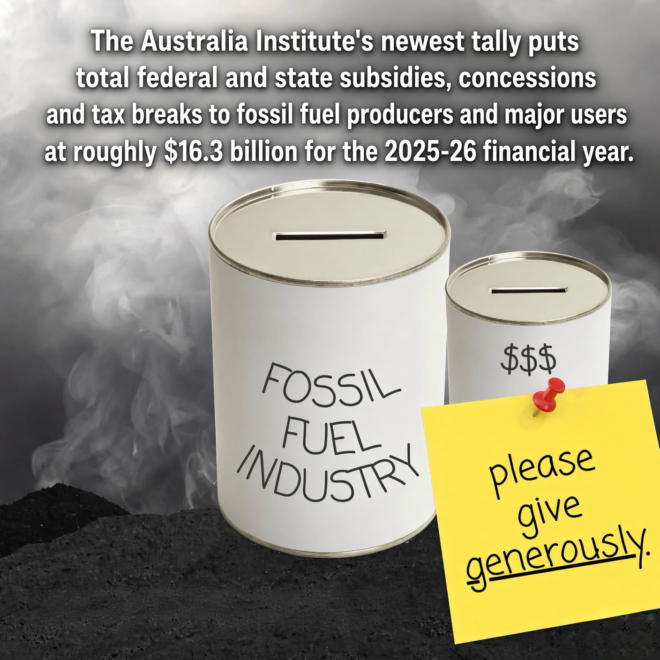
But the scale of what is actually being transferred deserves scrutiny on its own terms, independent of whether the underlying policy rationale is sound. The Australia Institute’s newest tally puts total federal and state subsidies, concessions and tax breaks to fossil fuel producers and major users at roughly $16.3 billion for the 2025-26 financial year. That is up from an estimated $14.9 billion the year before – an increase of close to ten per cent in a single year. Over the same period, the NDIS, so routinely described as growing out of control, expanded by a comparatively modest 7.6 per cent.
It should be said plainly that this is a gross figure, not a net one – it counts what flows out through concessions and does not, by itself, net that against what the sector pays in through royalties, company tax and payroll tax. That netting exercise matters, and this essay returns to it directly rather than leaving it as an implied concession. But a gross figure is still the right starting point for a question about the design and growth of specific subsidy programs, in the same way a household’s grocery bill is a legitimate thing to scrutinise even before it is weighed against the household’s total income.
Put plainly: the public money flowing to mining and gas companies is growing faster than the public money flowing to Australians with disability. Nobody in the federal press gallery is asking whether Hancock Prospecting’s tax concessions are “sustainable.” Nobody is demanding an independent review into whether Glencore’s subsidies represent good value for the taxpayer. The scrutiny runs in one direction only, and it is not the direction the money is actually moving fastest. Sixteen billion dollars is, at reasonable per-service costings, enough to fund a substantial expansion of bulk-billed general practice clinics in underserved suburbs and regional towns, with room left over for a serious investment in crisis accommodation for women and children fleeing domestic violence – two of the areas Australians consistently nominate as their most pressing daily concerns.
This is the comparison that rarely makes it into budget commentary, because the subsidies are structured as foregone revenue rather than a visible line of spending. A grant looks like spending. A tax credit looks like nothing at all. But a dollar not collected because of a concession is functionally identical, in its effect on the budget bottom line, to a dollar collected and then handed straight back out. Treating the two differently in public debate is not a neutral accounting choice; it is a rhetorical one, and it consistently favours the party receiving the concession.
III. The Diesel Illusion
No single subsidy illustrates the problem better than the Fuel Tax Credit Scheme, which alone accounted for an estimated $10.8 billion of foregone federal revenue in 2025-26 – not far short of the entire budget allocated to the Australian Army, which sits at roughly $13 billion for the same year. On paper, the scheme is a neutral mechanism: businesses that use diesel and petrol off public roads, for machinery, generators or heavy vehicles on private sites, can claim back some or all of the excise they pay at the bowser, on the theory that fuel excise is meant to fund road infrastructure that off-road users don’t actually use.
In practice, the scheme has become something closer to a direct subsidy for the country’s largest fuel consumers, with mining companies as its overwhelming beneficiaries – though it is worth being precise about where that criticism lands. For the farmer running an irrigation pump or the regional haulage operator whose trucks rarely touch a public road, the credit still does roughly what it was designed to do: it stops a road-funding tax from being charged on off-road use. The problem is not that the mechanism exists; it is that a mechanism sized for that constituency has, through decades of largely unexamined expansion, become the vehicle for a very different and much larger transfer to an industry whose off-road diesel use is measured in the billions of litres rather than the thousands. Consider the disparity in scale. A typical suburban household filling up with fifty litres of petrol a week, at a fuel excise of roughly 52 cents a litre, pays around $26 in tax per tank and something in the order of $1,300 a year, with no credit and no rebate. BHP, by contrast, burns through close to 1.3 billion litres of diesel annually across its mining operations. Under the credit scheme, the company claws back an estimated $627 million of the excise it would otherwise pay.
The suburban driver funds the road network in full. BHP is refunded almost the entirety of what it pays at the pump, on fuel it never puts anywhere near a public road. Both are, notionally, following the same tax rules. Only one of them experiences those rules as a cost.
This is not an allegation of wrongdoing on BHP’s part; the company is doing exactly what an entirely legal, decades-old scheme allows it to do. The failure sits with the design of the policy, and with the political reluctance of successive governments – of both major parties – to revisit a scheme that transfers close to eleven billion dollars a year, disproportionately, to the country’s largest and most profitable resource companies, at the very moment those same governments insist there is no money left for anything else. What began, decades ago, as a modest exemption for regional and agricultural users has, through years of largely unexamined expansion, become the single largest fossil fuel subsidy in the federal budget – a policy that can be well intentioned at birth and badly overdue for reform in its middle age.
IV. The States Join The Queue
Fossil fuel subsidies are not solely a federal phenomenon; state and territory governments have their own extensive, and far less scrutinised, contributions to the ledger.
In the Northern Territory, government commitments to purchase gas from projects widely regarded as commercially marginal exceed $4 billion – public money underwriting demand for gas that might otherwise struggle to find a market on its economic merits alone. In Western Australia, some $308 million in state support has gone to the Griffin coal operation, propping up a mine whose long-term commercial viability has been repeatedly questioned. Queensland coal producers benefit from an estimated $1 billion in discounted access to the state’s rail network, effectively subsidising the cost of moving coal to port below what a commercial rate would demand. New South Wales runs a $100 million fund dedicated to promoting “coal innovation” – a curious use of public money at a moment when the state, like every Australian jurisdiction, has committed to net zero emissions targets that a thriving coal sector makes harder, not easier, to reach.
Each of these programs has its own history and its own local political logic – regional jobs, energy security, industry transition timelines. But taken together, they describe a pattern: state governments reaching for the public purse to cushion an industry that, on the numbers alone, is not short of capital, and doing so with far less public debate than accompanies even minor adjustments to social service eligibility.
Part of what makes these state-level commitments so durable is that they rarely appear as a single, headline-grabbing figure in any one budget. A rail discount here, a gas purchase guarantee there, a coal innovation fund tucked inside a broader industry portfolio – each is small enough, in isolation, to escape sustained scrutiny, even as the cumulative total runs into the billions. Compare this with the granular, itemised, publicly contested nature of NDIS plan reviews, where individual participants can have specific pieces of equipment or hours of support queried, reduced or denied. One form of public spending is subjected to line-by-line interrogation; the other is bundled, obscured and largely left alone. The asymmetry is procedural as much as rhetorical, and it compounds the effect described at the outset of this essay.
V. Cracks In The Consensus
It would be a mistake to present opposition to fossil fuel subsidies as a fringe position. The case against schemes like the Fuel Tax Credit is increasingly made by voices that cannot be dismissed as reflexively anti-mining.
Fortescue – itself a major resources company – has called for reform of fuel tax arrangements. The Australian Council of Trade Unions and the Labor Environmental Action Network have both pushed for subsidies to be phased out or redirected. Matt Kean, who chairs the Climate Change Authority and previously served as a Liberal state treasurer in New South Wales, has described the Fuel Tax Credit Scheme in blunt terms, calling it “insane.” Federal Climate and Energy Minister Chris Bowen has signed Australia on to international commitments recognising the need to phase out what are termed “inefficient” fossil fuel subsidies as soon as practicable.
That this coalition spans mining executives, trade unionists, a former Liberal treasurer and a sitting Labor minister suggests the argument for reform is not a partisan one. It is closer to an emerging consensus that current settings no longer make economic or environmental sense – a consensus that has so far produced international rhetoric and expressions of concern, but very little actual change to the scale of the subsidies themselves.
VI. A World Moving, Slowly, In The Other Direction
Australia is not alone in grappling with this problem, and the international picture offers little comfort to those who insist reform is impractical. Multilateral commitments to phase out “inefficient” fossil fuel subsidies have been reaffirmed repeatedly at G20 and international climate forums over the past decade and a half, with successive Australian governments among the signatories. What has followed those commitments, in Australia as in many other wealthy nations, has been more rhetoric than reform. The subsidies persist, the accounting remains opaque, and the definition of what counts as “inefficient” is left conveniently vague enough that almost any existing arrangement can be argued to fall outside it.
This pattern is not unique to fossil fuels, but it is particularly stark here because the scale of the sums involved is so much larger than in most other areas of contested public spending, and because the industry receiving the concessions is neither struggling nor small. Other jurisdictions have shown that reform, while politically difficult, is not impossible: subsidy reviews in parts of Europe and reforms to diesel rebate schemes elsewhere have demonstrated that removing or tapering these concessions does not require dismantling an entire industry, only a willingness to treat fossil fuel subsidies with the same fiscal scrutiny routinely applied to social spending – typically through caps, sunset clauses and phased tapering rather than abrupt withdrawal, an approach this essay returns to below. Australia has the administrative capacity to do the same. What it has lacked, across governments of both major parties, is the political will.
VII. Whose Handout, Whose Burden
There is a deeper injustice buried inside this arrangement, one that runs alongside the question of climate policy and cuts to the heart of how this country decides who deserves public support and who does not.
Communities that have borne the sharpest edge of Australia’s extractive economy – including many First Nations communities living with the environmental and social legacy of mining on or near Country – routinely wait longest for the services fossil fuel subsidies could otherwise fund. The same governments that find $4 billion to underwrite marginal gas projects in the Northern Territory preside over remote communities without reliable water, without adequate primary healthcare, and without the housing stock needed to close well-documented gaps in health and life expectancy. The same fiscal seriousness demanded of NDIS spending is never applied with equal rigour to the industries whose activities have, in many cases, contributed directly to the environmental degradation and dispossession those communities are still living with.
This is not a coincidence of policy design. It reflects a settled hierarchy of who is treated as a cost to be minimised and who is treated as a partner to be supported – a hierarchy that has shaped Australian public finance since well before the current subsidy regime existed, and that continues to determine whose need is framed as legitimate and whose is framed as a fiscal risk.
VIII. The Other Side Of The Ledger
A rigorous case for reform has to do more than contrast rhetoric with rhetoric. It has to sit with the strongest versions of the counter-arguments, on their own terms, rather than noting them once and moving on.
Take tax design first. The Fuel Tax Credit Scheme’s original justification – that fuel excise is a road-funding charge and should not apply to fuel that never touches a public road – is not a bad-faith rationalisation. It is a coherent principle of tax design, and one Australia is right to apply to farmers, foresters and remote-area operators whose off-road diesel use has always sat outside the scheme’s intended target. The honest critique of the scheme is not that this principle is wrong, but that it has been allowed to scale without a corresponding review of whether its largest beneficiaries still fit the category it was built for. A road-funding exemption designed around tractors and irrigation pumps does not obviously need to extend, unexamined, to mining fleets consuming more diesel in a year than a small country. Reform here does not mean abandoning the principle; it means re-testing who the principle should still apply to, and at what scale.
Take net contribution second, because it is the strongest of the industry’s arguments and deserves to be treated as such. Mining and gas companies do pay substantial company tax, and state governments do collect significant royalties on the resources extracted – public returns for the use of a resource that belongs, constitutionally and morally, to the public. The order of magnitude is genuinely large: industry-commissioned analyses put combined company tax and royalty payments from the minerals sector at roughly $64 billion in 2023-24, and from the oil and gas sector at close to $22 billion in 2024-25 – figures that, taken together and treated with the caution due to any industry-funded accounting, dwarf the $16.3 billion subsidy total this essay opens with. Any honest ledger should set these payments against the subsidies catalogued here, and a fuller accounting than this essay can offer would need independent, sector-by-sector reporting of exactly that netted figure, published with the same rigour currently applied to NDIS cost projections. But even granting figures of this scale, netting royalties against subsidies is not as clean an exercise as it first appears, because the two payments are not really commensurable. A royalty is the price paid for a finite public asset once it is gone; a subsidy is public money spent regardless of whether the asset is managed well or poorly, extracted efficiently or wastefully, or ultimately worth what was given up to get it. Treating royalty revenue as though it cancels out subsidy spending assumes the resource itself was costless to relinquish, which is precisely the assumption a reform-minded ledger ought to question rather than accept.
Take reform pathways last, because this is where the argument has to stop being only diagnostic and start being practical. Three mechanisms recur in comparable reform efforts elsewhere and would translate reasonably well to the Australian settings described above. A hard cap on the Fuel Tax Credit Scheme, set at current usage levels for the industry’s largest claimants and indexed conservatively, would arrest the growth in the subsidy without eliminating it overnight. A sunset clause tied to technology readiness – tapering eligibility for large-scale mining claimants as electrified and hydrogen-fuelled heavy haulage becomes commercially viable, rather than to an arbitrary calendar date – would align the phase-out with the industry’s own decarbonisation timeline instead of working against it. And a revenue recycling commitment, hypothecating some or all of the fiscal savings from capped or reformed subsidies directly to GP access, domestic violence services or remote community infrastructure, would answer the fairest objection to reform: that removing a subsidy achieves nothing if the savings simply vanish into consolidated revenue rather than reaching the services this essay argues they should fund. None of these mechanisms require dismantling the resources sector. They require treating its subsidies as a program to be actively managed, rather than a historical fact to be left alone.
IX. The Choice Budgets Make
None of this is to argue that Australia is a poor country forced into impossible trade-offs by circumstances beyond its control. Australia remains among the wealthiest nations on earth, measured any way you like – GDP per capita, mineral and energy reserves, sovereign credit rating. A country with these resources can, in principle, fund a properly resourced public hospital system, a disability support scheme that meets genuine need, and adequate services for the communities the extractive economy has most affected.
What a wealthy country cannot do is fund everything at once, without limit, forever. Every budget is an act of choice, and every choice about what not to fund is also a choice about what to fund instead. Money directed toward tax concessions for the country’s largest diesel consumers is money that is, by definition, not available for aged care, mental health services, public housing or remote community infrastructure. This is not an abstraction; it is arithmetic.
Framed honestly, the coming federal and state budgets present a straightforward question, stripped of the euphemisms that usually surround it: should governments continue directing tens of billions of dollars a year toward some of the most profitable companies operating in this country, growing that support faster than support for people with disability, or should that money begin, deliberately and transparently, to be redirected toward the public services and communities that need it more?
The Australia Institute’s figures make clear that this is not a question about affordability. Australia can afford to support both a functioning social safety net and a fair, efficient tax system. It cannot afford to keep pretending that one of these is a crisis of restraint while the other is treated as an unremarkable feature of the landscape. Until that pretence is abandoned, every warning about the “unsustainable” cost of disability support, childcare or aged care should be met with the same question: unsustainable compared to what, exactly, and unsustainable according to whom?
There is an old prophetic instinct, running through traditions far older than the Australian budget cycle, that true justice begins with an honest accounting – with naming, plainly and without euphemism, who is being asked to bear a cost and who is being spared one. That instinct is worth reviving here. The next time a treasurer or a shadow treasurer stands up and warns that Australians can no longer afford to look after each other properly, the correct response is not despair, and it is not resignation. It is a question, asked as often and as loudly as necessary: what about the sixteen billion dollars going the other way?
The ledger is public. It is simply rarely read aloud. It is well past time someone did.
– – –
Bakchos is the founder of Blak and Black, an Australian media and advocacy platform established in 2010. Bakchos writes from the intersecting perspectives of Wiradjuri heritage, Jewish identity, and humanism.
© Bakchos, August 2026




As you’ve said in your post: there’s one language for those with wealth, and a totally different language for those without.
The ALP is as much a neoliberal party as the Liberal Party is. Neoliberalism doesn’t have a place for the poor and the disadvantaged and Albanese is making that clear to everyone who falls within those categories..
The only thing Albanese cares about is tugging his forelock to donors, gambling donors, fossil fuel donors, aged care providers, etc…
Prime Minister Albanese is a class traitor, and an absolute moral coward and hypocrite.