
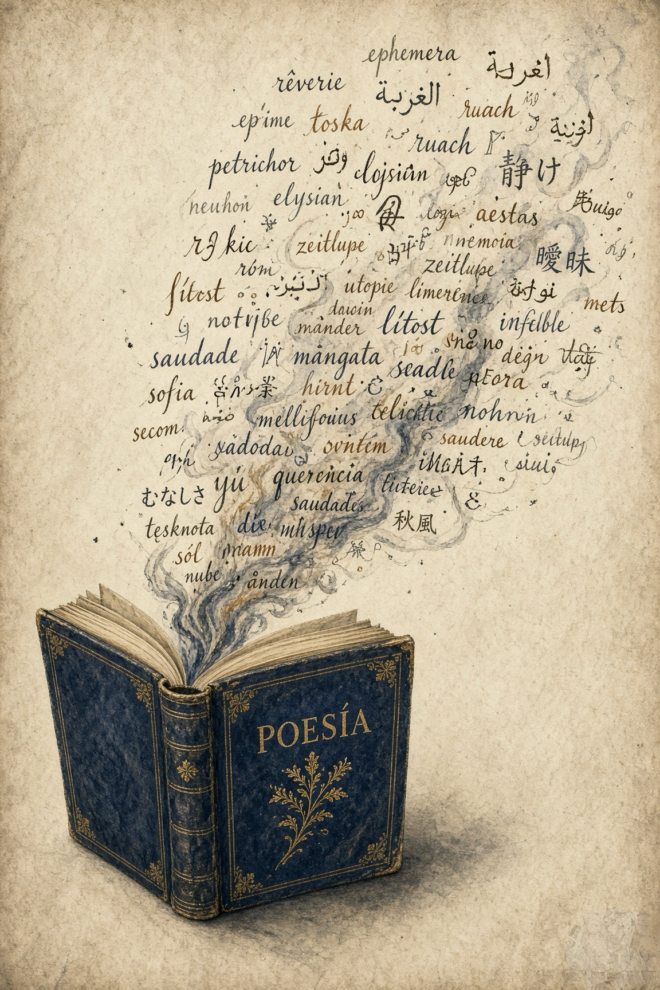
Poetry is rarely merely decorative or private, though it can certainly be both. Across centuries and continents, it has also functioned as a weapon of the weak, a repository of forbidden memory, a declaration of identity under erasure, and a catalyst for solidarity. When states censor newspapers, ban assemblies, or rewrite history, the compressed intensity of verse often survives – smuggled on scraps of paper, recited in secret, or printed on makeshift presses. It names what power seeks to silence. W.H. Auden’s famous line from his elegy for W.B. Yeats – “poetry makes nothing happen” – is frequently invoked to dismiss political verse. Yet the full context reveals a more complex claim: poetry survives “in the valley of its making,” becoming “a way of happening, a mouth.” It does not issue decrees or command armies; it endures, witnesses, and reshapes consciousness. This essay examines poetry as resistance to oppression, focusing on its historical role, its mechanisms, and key practitioners, particularly Mahmoud Darwish and Pablo Neruda, before widening the frame to include Irish, South African, Aboriginal Australian, and other traditions where verse has served as a means of survival, memory, and defiance.
Historical Foundations Of Resistance Poetry
Resistance through poetry is ancient. Ovid was exiled by Augustus partly for verses that challenged imperial morality. In the Islamic world, the pre-Islamic qasida and later classical traditions linked the poet to the tribe’s honour and to the critique of rulers; court poets who turned satirist risked imprisonment or death for verses that mocked a caliph’s justice. Colonial and postcolonial contexts intensified this role. Barbara Harlow’s concept of “resistance literature,” developed in relation to anti-colonial struggles, describes writing that arises from and sustains liberation movements – not as propaganda alone, but as cultural practice that asserts agency against domination. Twentieth-century upheavals – world wars, fascism, Stalinism, apartheid, occupation, and dictatorship – produced an extraordinary flowering of such poetry. Carolyn Forché’s anthology Against Forgetting gathers voices from these “dark times,” showing how poets bore witness when official histories were falsified.
In occupied or authoritarian societies, poetry’s formal economy proved advantageous. Short lines travel easily; metaphor and ambiguity evade censors; rhythm and rhyme aid memorization and collective recitation. A poem need not be printed to survive – it can live in the body, passed mouth to ear at a checkpoint, a prison yard, or a kitchen table, in a way that a pamphlet or manifesto cannot. Bertolt Brecht asked, “In the dark times / Will there also be singing? / Yes, there will also be singing / About the dark times.” That singing itself constituted resistance: an insistence on human voice amid dehumanisation. The very act of composing verse under surveillance – choosing which words to risk, which to withhold – became a form of moral discipline, a rehearsal of freedom performed in miniature.
This economy of form has a political logic as well as a practical one. A pamphlet argues; a poem enacts. Where prose exposition can be seized upon by a censor for its explicit claims, a poem’s meaning is distributed across image, rhythm, and implication, making it harder to prosecute even as it remains legible – often more legible – to an audience already attuned to the conditions the poet describes. Regimes have understood this danger clearly. Licensing boards, banned-book lists, and loyalty oaths for publishers all attest to how seriously governments have taken the poem as a potential vector of subversion, even when its author claimed only to be describing a garden, a season, or a lost home. The very obliqueness that let a poem pass a censor’s desk often deepened its resonance for readers who had learned, through necessity, to read for what a text could not say aloud.
Mahmoud Darwish: The Poet Of Palestinian Resistance
No modern figure more fully embodies poetry as resistance than Mahmoud Darwish (1941–2008). Born in the village of al-Birwa in Galilee, he experienced the 1948 Nakba as a child when his family fled and the village was destroyed. Living as a “present-absent” under Israeli military rule, he was repeatedly imprisoned for his writing and political activity. His early poem “Identity Card” (1964), from the collection Leaves of the Olive Tree, became an anthem. Addressed to an unnamed official demanding to register him, the poem opens with the command to write down that the speaker is an Arab, before cataloguing his family, his labour, and his refusal of pity, ending in a warning about the anger that dispossession breeds.
The speaker confronts an official who records identity for the purposes of control. Darwish turns the bureaucratic act into defiance, claiming ancestry, labour, and land while rejecting charity and asserting rage if starved. The poem was set to music and sung at protests; its author faced house arrest. Darwish later reflected that “every beautiful poem is an act of resistance.”
His oeuvre evolved. Early work was more directly militant; later collections, written in exile in Cairo, Beirut, Tunis, and Paris, grew more philosophical and lyrical while remaining rooted in Palestinian experience. State of Siege (2002), composed during the Israeli siege of Ramallah, mixes despair with stubborn hope, comparing the besieged to prisoners and the unemployed who nonetheless nurture hope as a daily discipline. In “Silence for Gaza,” he refuses to romanticise the place yet elevates its popular resistance as the purest expression of will. Darwish insisted that Palestinians could not be defined solely by their relationship to the occupier; poetry had to recover ordinary life, love, and landscape. Yet occupation remained the horizon. His funeral in Ramallah drew tens of thousands, confirming his status as national poet whose words had sustained a people across decades of dispossession.
Darwish’s resistance operated on multiple levels: linguistic (reviving and modernising classical Arabic forms), memorial (preserving villages and names erased from maps), and existential (asserting the right to beauty and complexity under conditions designed to reduce people to statistics or threats). Critics note that he avoided pure sloganeering; the aesthetic integrity of the work gave it lasting force. In later interviews he resisted being conscripted purely as a “resistance poet,” insisting that love poems and elegies for his mother were no less political for their intimacy – an insight that recurs across the tradition: the demand to be simply human is itself a claim against a system that denies it.
Close Reading: “Identity Card”
“Identity Card” repays sustained attention because its resistance is structural, not merely thematic. The poem is built as a monologue addressed to an unnamed clerk – almost certainly a figure of the Israeli military administration under which Galilee’s remaining Palestinian population lived after 1948, subject to identity documents, curfews, and travel permits. Darwish opens with an imperative, “write down,” repeated across the poem like a refrain, and in doing so performs a small but total inversion of power. In the actual bureaucratic encounter, it is the official who issues commands and the subject who complies; in the poem, the roles reverse. The Palestinian speaker commands the record-keeper, dictating the terms of his own inscription into the file. The poem does not contest the fact of registration – the speaker does not refuse to be catalogued – but it contests who controls the meaning of that catalogue. This is a recurring move in occupation poetry: rather than rejecting the state’s instruments outright, the poet occupies them from within, using the very form of the identity card, the census, or the interrogation to stage a counter-claim.
The poem’s second strategy is enumeration. The speaker lists concrete, almost bureaucratic details – number of children, occupation, place of residence, the names of parents and grandparents, the stone from which the family home was built – that mimic the flat, itemised language of a state file while accumulating into something the file itself cannot capture: a genealogy, a claim to continuity on the land that predates and outlasts the apparatus recording it. The list form matters here as much as any single image; a lyric equivalent might have offered one striking metaphor for dispossession, but Darwish instead piles up mundane, verifiable facts, daring the official – and by extension, the reader – to argue with an inventory. It is a rhetorical strategy closer to testimony than to metaphor, and it is precisely this reportorial precision, rather than any single line of complaint, that made the poem so uncomfortable for the authorities who eventually placed Darwish under house arrest.
Finally, the poem’s closing turn to anger is carefully earned rather than merely declared. Having spent most of its length in the register of patient, almost weary explanation, the poem allows the speaker’s restraint to fray only at the very end, with a warning about what will follow if the most basic claims on land and dignity continue to be denied. The effect depends on the preceding accumulation: the threat lands as the culmination of an argument built from evidence, not as an opening provocation. Read this way, “Identity Card” is less a cry of rage than a case prepared for the record – which is exactly why it could be sung at protests and cited by ordinary readers as a statement of fact about their own condition, rather than dismissed as mere literary flourish.
Pablo Neruda: Epic Of The Oppressed
Pablo Neruda (1904–1973) offers a parallel yet distinct model. The Chilean Nobel laureate moved from intimate love poetry to explicit political engagement after witnessing the Spanish Civil War. The murder of Federico García Lorca and the Republican struggle radicalised him. In “I’m Explaining a Few Things,” he abandons metaphysical elegance for urgent reportage, answering an imagined critic who asks why his poetry no longer sings of dreams and volcanoes by pointing instead to the blood filling the streets of Madrid.
Republican soldiers printed his poems on paper made from scavenged materials, including, legend has it, enemy flags. Poetry became material support for the fight.
His masterpiece, Canto General (1950), is a vast epic reclaiming the history of the Americas from the viewpoint of the conquered and the workers rather than the conquerors. Written partly while Neruda hid from the Chilean government that had ordered his arrest for communist activity, the book moves from pre-Columbian landscapes through Spanish conquest, independence struggles, and modern imperialism. Sections celebrate indigenous resistance, labour organisers, and figures such as Toussaint Louverture and Emiliano Zapata. Nature itself participates in the struggle; the land is not backdrop but protagonist. Neruda’s communism was visionary rather than purely doctrinal: freedom meant self-rule and the dignity of ordinary people. Canto General functions as counter-history – an act of cultural recovery that refuses the narrative of inevitable progress under elite or foreign domination.
Neruda’s funeral in Santiago after the 1973 coup against Salvador Allende became itself a moment of defiance, with mourners chanting against the Pinochet dictatorship. His poetry had already modelled how verse could narrate a continent’s suffering and resilience, and in the years of dictatorship that followed, copies of his banned books circulated hand to hand, further proof that a state can burn an edition but not extinguish a poem already committed to memory.
Close Reading: “The Heights Of Macchu Picchu”
The second canto of Canto General, often published independently as “The Heights of Macchu Picchu,” offers the clearest instance of how Neruda converts personal crisis into collective resistance. The sequence begins with the poet in a state of existential exhaustion, moving through modern cities and finding only “small death” in daily routine, before he climbs to the abandoned Inca citadel and confronts its silent stonework. The turn that matters for resistance poetry occurs roughly at the sequence’s midpoint, when Neruda stops treating the ruin as a monument to admire and instead asks who built it – not the Inca elite whose names survive, but the anonymous labourers who quarried, carried, and set each stone, and who left no trace in any official record. The famous imperative that follows, in which the poet calls the dead labourer to rise and speak through him, reorients the entire poem: Macchu Picchu is no longer a marvel of vanished civilisation to be admired from a tourist’s distance, but an accusation, a monument built on unrecorded suffering that the poem sets out to redress by lending it a voice centuries later.
This gesture is significant for the essay’s broader argument because it demonstrates resistance poetry’s memorial function operating across an enormous span of time and without any surviving testimony from the oppressed party themselves. Darwish and Akhmatova write in proximity to living memory, often recording events within their own lifetimes; Neruda, by contrast, reaches back across four centuries to recover people who left no poems, no letters, nothing but stone. He can only do this by an act of imaginative ventriloquism – asking the dead to “speak through my speech, and through my blood” – which is a considerably riskier poetic strategy than direct witness, since it risks appropriating the voice it claims to restore. Neruda mitigates this risk partly through address rather than impersonation: he does not claim to become the dead labourer so much as to summon him, to offer his own poem as an instrument the dead can use, closer to a medium’s invocation than an act of ventriloquism proper. The sequence’s closing movement then widens outward from Macchu Picchu to the whole of the exploited Americas – miners, fishermen, and field labourers of Neruda’s own century – collapsing the distance between a sixteenth-century quarry worker and a twentieth-century Chilean miner into a single continuous history of extraction and unrecorded labour. In this respect the close reading clarifies something the general survey above can only assert: that the book’s claim to be counter-history rests less on any single accusation against a named oppressor than on this technique of summoning silence itself to speak.
Other Traditions And Voices
Resistance poetry is not confined to these two figures. In the Urdu tradition, Faiz Ahmed Faiz (1911–1984) fused classical ghazal forms with progressive politics; imprisoned and exiled, he wrote verses that became anthems across South Asia. “Hum Dekhenge” (“We Shall See”) envisions a day when the mountains of injustice will scatter like cotton-wool and the oppressed will inherit the earth. Its religious imagery let it circulate under censorship while carrying revolutionary hope, and it was widely recited during recent protests in India and Pakistan by crowds who understood that its Qur’anic cadences made outright prohibition politically costly.
In the African American tradition, poetry has long contested racial oppression. Langston Hughes chronicled Black life under Jim Crow with irony and affirmation, insisting that the deferred dream of equality would not simply evaporate. Maya Angelou’s “Still I Rise” asserts irrepressible subjectivity against historical erasure, its refrain almost a drumbeat of survival. Audre Lorde insisted that poetry is a necessity for survival, not a luxury, transforming silence into language and action; her work linked racial, gendered, and sexual oppression as inseparable concerns.
Eastern European poets under Stalinism and its aftermath – chief among them Anna Akhmatova and Osip Mandelstam – practised a poetry of moral witness. Mandelstam’s “Stalin Epigram,” a private satire of the dictator’s cruelty, cost him his life; he died in a transit camp after being denounced. Akhmatova’s “Requiem”, composed in fragments and memorised because it was too dangerous to commit to paper, records the queues of women outside Leningrad’s prisons during the Great Terror, transforming private grief into collective testimony.
Close Reading: Akhmatova’S Requiem
Requiem deserves particular attention because its method of composition is inseparable from its meaning. Written between 1935 and 1940 while Akhmatova’s son was repeatedly arrested during the Great Terror, the sequence could not safely exist on paper; Akhmatova would write individual sections, read them to a small circle of trusted friends, and then burn the manuscript, trusting the poem to their memory rather than to ink that could be seized in a search. The poem was not published in full in the Soviet Union until 1987, decades after its composition and Akhmatova’s own death – meaning that for most of its existence, Requiem survived purely as an oral text, an extraordinary inversion of the usual relationship between poem and page.
The sequence’s opening prose preface recounts a woman recognising Akhmatova in a Leningrad prison queue and asking, in a whisper, whether she could describe what she saw; Akhmatova answers that she can, and something like a smile crosses the woman’s face. That brief exchange establishes the poem’s governing claim: that bearing witness on behalf of the anonymous women in line – mothers, wives, and sisters of the arrested, none of whom could speak safely for themselves – is itself an act with consequence, however modest, against a state built on the erasure of exactly this kind of suffering. The poem that follows alternates between the intensely personal (a mother’s grief for her imprisoned son, rendered in the register of a folk lament and a lullaby) and the collective (“I was not alone, but with these hundred thousand others,” in the words of the dedication), so that Akhmatova’s private anguish never fully separates from the anguish of the queue itself. Formally, Requiem borrows from Orthodox liturgy and Russian folk elegy, forms with deep roots in communal mourning, which allowed the poem to carry the emotional authority of ritual grief even in fragments passed hand to hand or held only in memory. Where Darwish’s “Identity Card” answers state power by mimicking and inverting its own bureaucratic form, and Neruda’s Macchu Picchu sequence answers silence by imaginative summons across centuries, Requiem answers terror by refusing to let suffering remain solitary – insisting, against a system designed to isolate and criminalise grief, that one woman’s loss belongs to everyone standing in the same line.
The Turkish poet Nâzim Hikmet spent much of his adult life in prison or exile for his communism, writing some of his best-known verse – meditations on love, imprisonment, and human solidarity – from behind bars, smuggled out to sympathetic visitors. In South Africa, poets of the anti-apartheid struggle – among them Dennis Brutus and Ingrid Jonker – wrote from prison cells, banning orders, and exile, giving voice to a movement the state tried to silence through the Suppression of Communism Act. Jonker’s work, written in Afrikaans, the very language of the apartheid state, turned that language against its architects; Nelson Mandela quoted her poem “The Child Who Was Shot Dead by Soldiers at Nyanga” at the opening of South Africa’s first democratic parliament in 1994.
Irish poetry offers a related lineage. Beyond the canonical figures of the literary revival, the tradition of prison writing produced work of startling directness during the Troubles, including verse smuggled out of Long Kesh on toilet paper and cigarette papers, most famously associated with hunger striker Bobby Sands, whose writing fused personal suffering with a broader claim to national self-determination. As with Mandelstam and Akhmatova, the material conditions of composition – contraband ink, memorised lines, coded language – were inseparable from the poems’ meaning.
Closer to the Australian context, Aboriginal poets have used verse to resist dispossession, assimilation policy, and the erasure of sovereignty. Oodgeroo Noonuccal (formerly Kath Walker) became the first Aboriginal Australian to publish a book of poetry, We Are Going (1964), whose title poem mourns a way of life under settlement while asserting the enduring presence of a people colonial narratives insisted were vanishing. Kevin Gilbert, writing from prison and later at the Aboriginal Tent Embassy, used poetry as a direct instrument of political agitation, insisting verse and activism were two expressions of the same struggle for land rights. Lionel Fogarty’s deliberately unsettled, grammar-bending English performs resistance at the level of language itself, refusing the coloniser’s syntax as much as its laws.
It is worth pausing on how differently these traditions solve the same underlying problem: how to speak against power without handing that power grounds for immediate suppression. Faiz’s ghazal form works by displacement onto convention – the beloved of classical Urdu and Persian poetry is by tradition ambiguous, sometimes read as divine, sometimes human, sometimes political, so a poem of longing for a beloved’s return could be received by the state censor as decorous tradition while being heard by an attuned audience as a promise of revolutionary justice. The Soviet-era strategy sometimes called Aesopian language, practised in different registers by Akhmatova and Mandelstam, works by displacement onto period or subject – a poem ostensibly about ancient Rome, a garden, or a personal grief could carry an unmistakable charge for readers trained to decode allusion, while offering a censor no explicit statement to prosecute. Fogarty’s practice works by an almost opposite strategy: rather than veiling meaning behind convention, he makes the coloniser’s language visibly strain and buckle, refusing the fluency that would let English pass as a neutral, transparent medium. Where the ghazal and the Aesopian lyric survive by camouflage, this third strategy survives by visible resistance at the level of grammar itself – forcing the reader to register that the very language of the poem is a contested inheritance rather than a natural vessel for its content. All three are strategies of indirection, but they locate the site of struggle differently: in the reader’s interpretive frame, in the poem’s ostensible subject, or in the syntax of the sentence itself.
Mechanisms: How Poetry Resists
Poetry resists through several interlocking strategies. First, it preserves memory and names the erased. Darwish’s lists of villages, Neruda’s catalogue of minerals and martyrs, Akhmatova’s Requiem, Oodgeroo’s mourning for country – these counteract official amnesia, insisting that what the state would prefer forgotten remains named and therefore real. Second, it asserts subjectivity. Under systems that reduce people to categories (Arab, Black, proletarian, enemy, prisoner), the lyric “I” or collective “we” reclaims interiority and complexity that bureaucratic and military language is designed to strip away.
Third, it builds affective solidarity. Recitation creates emotional bonds; shared poems circulate as signals that opposition exists and that one is not alone. Sociological studies of social movements emphasise such cultural practices in sustaining participation under repression – a chanted line at a protest does the work of a slogan while carrying far more emotional density. Fourth, formal innovation under constraint becomes itself defiant, as the comparison above between convention, allusion, and syntax suggests: compressed imagery, irony, allegory, and disrupted grammar all allow meaning to pass censors, or to register as protest in itself, while remaining potent for readers attuned to the code.
Fifth, poetry resists by transforming grief into a shared, transmissible form. Elegy is one of the oldest poetic modes precisely because communities have always needed a socially sanctioned way to mourn; under repression, when public mourning itself can be criminalised – a funeral procession broken up, a vigil declared an illegal assembly – the elegy becomes a way of grieving that a state cannot easily prohibit without appearing to prohibit grief itself. This is part of why so many of the poems discussed above are, at root, poems of mourning: for a village, a comrade, a child, a language, a way of life. Sixth, poetry resists through translation. Once a poem crosses out of its original language, it accumulates new readers and new political stakes, turning a local act of witness into an international one; Darwish, Neruda, and Faiz all owe part of their resistant power to translators who carried their words across borders the poets themselves were often forbidden to cross.
Seventh, and closely related, poetry resists through portability and reproducibility. Unlike a banned newspaper or a razed printing press, a poem committed to memory cannot be confiscated; it survives in the bodies of those who carry it, to be written down again once conditions allow, as Akhmatova’s circle did after Stalin’s death. Finally, poetry resists the degradation of language itself. Authoritarian regimes and propaganda machines flatten words, converting them into instruments of control; poets restore precision, ambiguity, and moral weight. As Joseph Brodsky argued, poetry can constitute resistance to the reality imposed by history precisely by refusing to let language be wholly instrumentalised – by insisting that words still mean what they say, even when official discourse insists otherwise.
Confronting The Limits Of The Paradigm
Before turning to poetry’s enduring power, the paradigm itself deserves sharper scrutiny than celebratory accounts usually allow. Three risks in particular complicate any straightforward claim that poetry “resists” oppression.
The first is co-optation. A poem’s very portability and emotional charge make it attractive to the institutions it once opposed. States and cultural bodies routinely absorb formerly dangerous poets into national canon and curriculum, a process that can flatten a poem’s original force into safe heritage. Darwish’s work is now taught in universities and quoted by officials who might once have arrested its author; Mandela’s citation of Jonker in 1994, however moving, also converted an anti-apartheid poem into an instrument of a new state’s founding legitimacy, folding a voice of resistance into the very apparatus of official ceremony. This is not necessarily a corruption of the poem – canonisation can also be a genuine vindication – but it should caution against treating “resistance poetry” as a fixed political category rather than a relationship between a text and a specific configuration of power that can, and often does, change.
The second risk is the gap between symbolic and material power. A poem can achieve wide circulation, deep emotional resonance, and lasting canonical status while leaving the material conditions it describes – occupation, incarceration, land dispossession, poverty – entirely unchanged, or changed only decades later by forces largely unrelated to the poem itself. It would be a category error to credit “Hum Dekhenge” with the political outcomes of the movements that sang it, just as it would be a category error to credit Requiem with the eventual, partial reckoning with Stalinist terror that came only after Akhmatova’s death. Poetry’s power is real but operates on the register of consciousness, memory, and solidarity; conflating that register with the register of policy, law, and armed force risks both overstating what poems accomplish and understating the political organising, negotiation, and sometimes armed struggle that actually shifts material conditions.
The third risk is audience capture: the possibility that a great deal of resistance poetry primarily comforts and consolidates those already persuaded rather than reaching or unsettling anyone who might act to change the conditions described. A poem circulated at a rally or shared among sympathetic readers can function less as an intervention than as a form of communal reassurance – valuable for morale and solidarity, but distinct from, and sometimes a substitute for, the harder work of reaching unconvinced or hostile audiences. None of this empties the tradition of significance. But an honest account of poetry as resistance has to hold these three qualifications alongside its claims for the form’s power, rather than treating every instance of politically engaged verse as self-evidently subversive simply because it addresses subversive themes.
Limits And Enduring Power
Poetry does not topple regimes by itself. Auden’s caution retains force: no poem prevented the Holocaust, ended apartheid on its own, or halted a siege. Direct political utility is limited, and it would be sentimental to claim otherwise. Regimes that imprisoned or executed poets did so precisely because they judged the political effect of verse to be real but rarely decisive against the machinery of a modern state. Yet dismissing poetry as irrelevant ignores how it sustains the moral and imaginative resources necessary for long struggles. It keeps open the possibility of different futures by refusing the total claim of the present order. In dark times it prevents the complete internalisation of oppression – it tells the imprisoned, the occupied, the exiled, and the dispossessed that their experience has not gone unrecorded and that language itself has not yet been fully conquered.
Today the tradition continues. Palestinian poets write under bombardment; Ukrainian soldier-poets document invasion in verse composed between rotations at the front; Iranian poets write in coded allegory under a regime that polices even hairstyles and headscarves; young writers of colour and queer poets in many countries use verse against racism, state violence, and climate injustice. Social media multiplies circulation while risking co-optation or surveillance – a poem that once had to be memorised to survive can now be screenshotted, translated, and shared across borders within hours, though the same platforms can also expose their authors to new forms of state monitoring. The essential function remains unchanged across these shifts in technology: to testify, to name, to insist on the human against systems that would render people disposable.
It is worth noting, finally, that everything argued here about states, occupiers, and dictatorships applies with only minor adjustment to forms of power that are not the state at all. Poetry has long resisted patriarchal authority, from Sappho’s fragments to Sylvia Plath’s and Adrienne Rich’s confrontations with domestic and institutional confinement; it has resisted religious orthodoxy, as in the heterodox devotional verse of mystics like Kabir or Hafez, whose ambiguous address to the divine could double as veiled critique of clerical power; and it increasingly resists corporate and ecological power, in the growing body of climate poetry that treats extractive industry and carbon-driven collapse much as Neruda treated the United Fruit Company – as an impersonal force requiring the same acts of naming and witness once reserved for occupying armies. The mechanisms surveyed above – memorial naming, reclaimed subjectivity, formal indirection, elegy, translation, portability – transfer readily to these other confrontations, which suggests that “resistance poetry” is best understood not as a genre tied to a particular twentieth-century roster of oppressors, but as a recurring relationship between verse and whatever concentration of power a given community finds itself needing to answer.
Conclusion
Poetry as resistance is therefore neither pure aesthetics nor pure activism. It is the art of remaining human – and of keeping language alive as a space of freedom – when both humanity and language are under assault. From Darwish’s defiant identity card to Neruda’s blood in the streets, from Faiz’s promised dawn to Jonker’s child shot dead at Nyanga, from Mandelstam’s fatal epigram to Oodgeroo’s mourning for a people the coloniser insisted were disappearing, the tradition spans continents, languages, and centuries, yet returns again and again to the same insistence: that the powerful can seize land, silence assemblies, and burn archives, but they cannot fully extinguish a line of verse once it has entered a community’s memory. It demonstrates that even when nothing seems possible, the act of speaking truthfully in measured lines is itself a form of happening. It survives, and in surviving, it continues to resist.
– – –
Bakchos is the founder of Blak and Black, an Australian media and advocacy platform established in 2010. Bakchos writes from the intersecting perspectives of Wiradjuri heritage, Jewish identity, and humanism.
© Bakchos, August 2026


“Poetry is the art of remaining human” I like that, I haven’t viewed poetry in that way before, I think that you might be right about that.
Bakchos, that’s a bit left of field for you, especially coming on the back of yesterday‘s post.
It’s easy to romanticise political verse — harder to ask what it actually accomplishes, and what it doesn’t.
This piece works through Darwish, Neruda, Akhmatova, Faiz, Mandelstam, and the Aboriginal Australian tradition of Oodgeroo Noonuccal and Kevin Gilbert with close readings of key texts, then turns a critical eye on co-optation, the gap between symbolic and material power, and audience capture — the risks that celebratory accounts of resistance poetry usually skip.
Poetry can lift people spirits, but it can’t take out a dictatorship. It can tell the story of that dictatorship, but cannot take out that dictatorship, but keeping people spirits high is an achievement in itself.
I’m a fan of Darwish. I enjoyed reading this post.