
Introduction
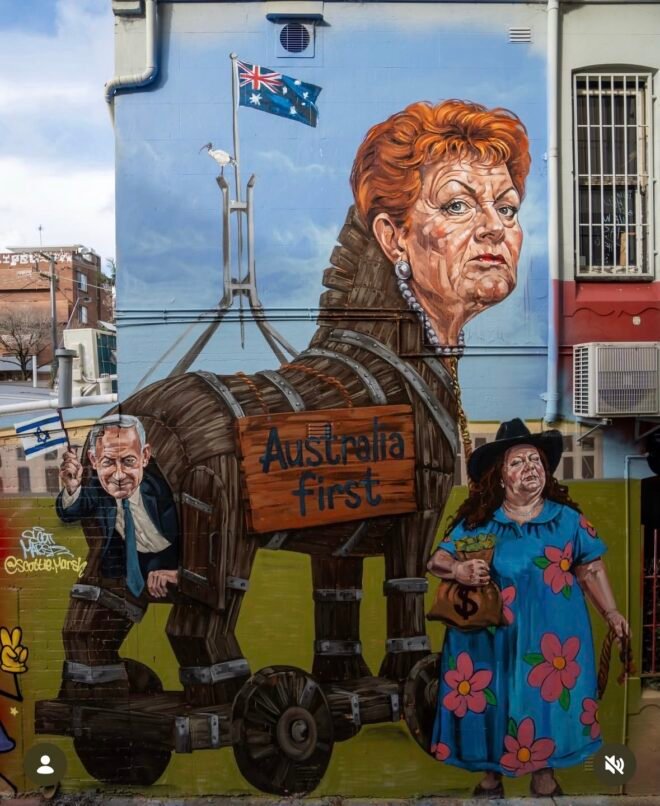
In August 2026, a new mural appeared on the exterior wall of the Sneaky Possum bar in Chippendale, Sydney. Painted by Scott Marsh – the artist Sydneysiders have taken to calling “Australia’s Banksy” – the piece was titled A Gift from Gina, though it was almost immediately nicknamed the “bogan horse” by locals and social media alike. The mural satirises Australian political dynamics and takes direct aim at mining magnate Gina Rinehart, continuing a long tradition in which Marsh uses a suburban brick wall as a kind of open-air op-ed page. It is a small, disposable-seeming thing – paint on masonry, exposed to weather, vandalism, and the whims of a landlord with a roller brush – and yet it says something large about how street art functions in a democracy: as a form of speech that is public, unsanctioned, immediate, and almost impossible to fully suppress.
This essay uses Marsh’s Chippendale mural as an entry point into a broader discussion of street art: what it is, why it matters, how it differs from other forms of political commentary, and why cities like Sydney have become unlikely incubators for some of the sharpest satire in the country.
What Street Art Actually Is
Street art is often lumped together with graffiti, and the two share a lineage – many of today’s most celebrated muralists, Marsh included, began as teenage taggers on train lines before moving toward large-scale, figurative public work. But the two forms have diverged. Graffiti, in its classic form, is largely about the artist’s name: stylised lettering, tags, and pieces whose primary audience is the graffiti subculture itself, legible mostly to insiders. Street art, by contrast, is usually representational and message-driven, aimed squarely at the general public. It wants to be understood by someone who has never heard of the artist and has no interest in art history – a commuter, a bar patron, a person walking their dog.
This distinction matters because it explains street art’s power as political commentary. A politician’s face rendered eight metres tall on the side of a pub doesn’t require translation. It works instantly, the way a newspaper cartoon works instantly, compressing argument into image. Where an op-ed needs to be read, a mural needs only to be seen, and it is seen by everyone who passes – not just the audience that opted in.
Scott Marsh And The Chippendale Wall
Chippendale, an inner-city Sydney suburb wedged between Redfern and the CBD, has become something like an open gallery for Marsh’s work over the past decade. It’s a fitting home. The area has long combined gentrifying bars and cafes with a still-visible history of working-class and Aboriginal Redfern next door, giving Marsh’s satire – which frequently punches at concentrated wealth and power – a setting that underscores its own argument.
Marsh’s body of work reads like an annotated history of Australian political controversy. He painted then-Prime Minister Scott Morrison in a Hawaiian shirt, cocktail in hand, with the caption “Merry Crisis!!” during the catastrophic 2019–20 bushfires, after Morrison had taken an overseas holiday while the country burned; the mural was painted over within days, but not before it had raised more than $15,000 for the Rural Fire Service through prints and shirts sold in its honour. He painted Tony Abbott passionately kissing another version of himself as a satirical jab during the same-sex marriage debate. He painted a Redfern police car spray-tagged with the name of TJ Hickey, a seventeen-year-old Kamilaroi boy who died in 2004 after a police pursuit, connecting an American image of police violence to an Australian one – a mural later censored, an act that generated its own controversy about who gets to police the story of a death in custody. He has taken aim at Cardinal George Pell, radio broadcaster Alan Jones, and News Corp chairman Rupert Murdoch, at one point painting Murdoch presiding over a dinner party of climate-denying power brokers – Rinehart among them – while the country burned beneath their ivory tower.
Rinehart, in other words, is not a new subject for Marsh. In an earlier mural he depicted her breastfeeding a grown Barnaby Joyce – a visual joke about the perceived closeness between the mining magnate and the National Party figurehead, staged in the manner of a classical Madonna-and-child composition, “with apologies to Raphael,” as one critic wryly put it. The “bogan horse” mural extends that established target into fresh territory, using the language of Australian vernacular culture – “bogan” being the self-deprecating, larrikin slang for unpretentious, often uncouth working-class identity – to skewer the gap between Rinehart’s vast private wealth and the everyday Australians whose politics she is often accused of trying to shape from behind the scenes, through media ownership, political donations, and sponsorship.
Why Rinehart, And Why Now
Gina Rinehart’s re-emergence as a lightning rod for satirical art is not incidental. As Australia’s richest person, with a fortune built on the iron ore empire founded by her father Lang Hancock, Rinehart occupies a singular place in the country’s public imagination: enormously wealthy, famously private, and increasingly associated with attempts to influence the institutions that shape public taste and opinion, from sports sponsorship to arts funding. In 2024, she became the subject of a much-publicised controversy when she lobbied the National Gallery of Australia to remove a portrait of her by Aboriginal artist Vincent Namatjira, part of his exhibition Australia in Colour. The painting, rendered in Namatjira’s signature exaggerated style, gave Rinehart a double chin and a startled expression; she found it unflattering and reportedly pressed the Gallery through associates to take it down. The Gallery refused, and the episode became a case study in the limits of a subject’s control over their own image – the more Rinehart pushed, the more attention the portrait received, drawing multiple copycat “Ginas” from other artists into the public conversation, Marsh’s own earlier mural among them.
That saga forms an important backdrop to the Sneaky Possum mural. It established, in the public mind, a recurring theme: a person of extraordinary wealth attempting to exercise control over how she is depicted in art, and consistently failing to do so, in a way that generates more publicity than the original artwork ever would have on its own. Marsh’s “bogan horse” arrives into a cultural moment already primed to read a satirical image of Rinehart as part of an ongoing, half-comic contest between concentrated private wealth and public representation – a contest street art, almost definitionally, cannot lose, because its home turf is the street itself, beyond the reach of gallery boards and corporate lawyers.
The Politics Of An Unsanctioned Medium
What separates a mural like this from, say, a political cartoon printed in a newspaper is its physical vulnerability and its physical permanence – a paradox that is central to street art’s meaning. A cartoon exists as many identical copies, safe from any single act of destruction. A mural exists once, on one wall, and can be erased with a tin of grey paint. Marsh has lived this vulnerability repeatedly: the Morrison “Merry Crisis!!” mural was painted over within three days; a Redfern mural referencing TJ Hickey’s death was censored in 2020; a 2026 mural referencing figures associated with the Jeffrey Epstein scandal was vandalised by someone objecting to one of its details. Marsh himself has spoken candidly about the risk this poses, noting that new state hate-speech laws in some jurisdictions increasingly threaten street artists with prosecution for political content that would have been unremarkable a decade ago.
And yet this fragility is also the source of the medium’s authority. A mural that can be destroyed at any moment, and frequently is, carries an urgency that gallery art does not. Its audience understands, implicitly, that they may be looking at something temporary – that the image in front of them might be gone by the following week – and that scarcity concentrates attention. When the Morrison mural was painted over, the erasure itself became a second news story, arguably amplifying the original message further than the mural could have on its own. Rinehart’s attempt to have her Namatjira portrait removed followed exactly the same logic in an institutional setting: censorship of image becomes publicity for image, again and again, whether the medium is a state gallery or a laneway wall.
This is part of why street art occupies such a distinct place in political speech. It cannot be pre-approved by an editor, cannot be softened by a legal team, and does not require the artist to seek permission from the person being satirised. It appears, fully formed, on a wall the public did not choose to visit for that purpose – a pub-goer heading to Sneaky Possum for a drink encounters the “bogan horse” mural whether or not they follow politics, whether or not they would ever click on a news article about Rinehart’s business interests. That involuntary audience is precisely what gives the form its democratic character: it reaches people who have not opted into political discourse, forcing a moment of confrontation – amusement, offence, recognition – into an otherwise ordinary errand.
Larrikinism As Rhetorical Strategy
Marsh has been explicit about the cultural register he works in, describing his approach as rooted in larrikinism – the distinctly Australian tradition of irreverence, of taking the piss, of using humour as a leveller against authority and self-importance. “Once you make people laugh, you’ve got them,” he has said. “They engage.” This is a deliberate rhetorical choice, and it distinguishes his work from more solemn traditions of political art. Where an artist might choose grief, outrage, or grandeur to make a political point, Marsh consistently chooses caricature and comedy – a Prime Minister in a Hawaiian shirt, a mining magnate as a “bogan,” public figures placed in scenarios so absurd they become instantly memeable.
This is not merely stylistic preference; it is strategic. Comedy travels. A mural that makes people laugh gets photographed, shared, and re-shared across social media far more readily than a mural that simply scolds. It also disarms a certain kind of critical response: dismissing an image as “just a joke” is harder when the joke has already made its political point stick in the public consciousness. The “bogan horse” nickname itself – assigned by the public rather than the artist – shows this mechanism working exactly as intended: the mural has already escaped Marsh’s own title and entered vernacular circulation, becoming shorthand for a broader critique of Rinehart’s outsized influence that will likely long outlive the physical paint on the Chippendale wall.
Street Art As Civic Infrastructure
It is worth asking what function this kind of art actually serves within a democratic society, beyond entertainment. One answer is that it operates as a form of civic infrastructure – a low-cost, high-visibility mechanism by which ordinary scrutiny of the powerful is maintained in public space, outside the control of the institutions (parliaments, courts, corporate boards, even galleries) that the powerful are more able to influence. Rinehart could lobby a national gallery, staffed by public servants operating within an institutional structure sensitive to political and financial pressure. She has no equivalent lever to pull against a muralist working on a privately owned pub wall with the owner’s blessing, executing the piece overnight with a can of spray paint and a scaffold. The asymmetry is the point: street art thrives precisely in the gaps that formal power cannot reach.
Chippendale’s transformation into something like an open-air gallery of political caricature – walking tours now exist specifically to guide visitors past Marsh’s various murals, from the “Ivory Tower” depicting Rinehart, Murdoch, Alan Jones and Morrison presiding over a burning country, to tributes to Aboriginal health advocate Naomi Mayers and the ubiquitous “bin chicken” ibis murals that puncture the seriousness of the political pieces with local, affectionate humour – suggests something durable about the form. It is not simply protest art in the narrow sense of a single placard raised at a single rally. It is accumulating civic commentary, laid down wall by wall over years, forming a kind of visual record of what a city’s residents found worth mocking, worth memorialising, worth refusing to let pass without comment.
The Global Context: Street Art As An International Language
Sydney’s tradition of political muralism does not exist in isolation. It belongs to a much wider international lineage that includes Bristol’s Banksy, whose stencilled satire of surveillance, war, and consumer culture made street art a globally recognised form of dissent; the political murals of Belfast, which have documented decades of sectarian conflict directly on residential walls; and the graffiti-turned-gallery movements that emerged from New York in the 1970s and 80s, when artists like Jean-Michel Basquiat and Keith Haring moved between subway cars and SoHo galleries, blurring the line between vandalism and fine art in ways that institutions eventually had to reckon with. Marsh’s comparison to Banksy, frequently made by Australian media, is instructive less because the two artists share a visual style – they don’t – than because both understand the same basic mechanism: that a wall in a public street commands an audience no gallery can match, and that anonymity or informality can be strategic rather than accidental, protecting the artist from exactly the kind of institutional pressure that Rinehart was able to bring, unsuccessfully, against the National Gallery.
This international context also helps explain why governments have periodically tried, and mostly failed, to legislate street art out of political relevance. Anti-graffiti statutes exist in most Australian states, and property owners retain the right to paint over unauthorised work at will. But the newer threat Marsh has identified – broad “hate speech” style laws capable of criminalising political slogans painted on walls – represents a different order of concern, one that moves street art from a property dispute into a free-speech one. When an artist can face custodial penalties for the content of a mural rather than simply for the act of painting on a wall without permission, the balance between public expression and state control shifts considerably. It is a live question in Australian public life right now, and Marsh has said openly that he expects to eventually face legal consequences for one of his pieces. That he continues to paint anyway is itself a kind of argument: that the civic value of the commentary is judged, by the artist at least, to outweigh the personal risk.
Ownership, Consent, And The Ethics Of Public Satire
There is a further question worth sitting with, one that Rinehart’s own objections to the Namatjira portrait raise directly: does a public figure have any legitimate claim over how they are depicted in art created about them, without their consent, for public display? Australian law generally answers no, at least where the work does not constitute defamation – satire and caricature of public figures acting in their public capacity enjoys wide latitude, on the reasoning that those who wield significant power, wealth, or influence over public life implicitly accept a heightened level of public scrutiny and commentary as the price of that influence. This is not a uniquely Australian principle; it underlies political cartooning traditions across most democracies, from the caricatures of Honoré Daumier in nineteenth-century France to contemporary editorial cartoons everywhere. Rinehart is entitled to dislike a portrait, or a mural, intensely. She is not, under Australian legal or artistic convention, entitled to have it erased simply because she finds it unflattering – and the public reaction to her attempts at the National Gallery suggests that most observers regard that distinction as an important one worth defending, almost independent of what they think of Rinehart’s politics.
Conclusion
A Gift from Gina will likely not last forever on the Sneaky Possum wall – Marsh’s own history suggests his murals are as often erased as they are preserved, whether by weather, by vandalism, or by a change of ownership uninterested in hosting controversy. But its impermanence is not a weakness; it is close to the entire point. Street art like this operates on a different register from the institutional art world that Gina Rinehart tried, and failed, to bend to her preference at the National Gallery of Australia. It does not ask permission, does not require funding approval, and does not depend on the goodwill of the person it depicts. It simply appears, does its work in the time it has, and – win or lose against the paint roller – leaves behind a photograph, a headline, and a nickname that outlives the wall itself. In an era when so much political communication is mediated, focus-grouped, and legally vetted before it reaches the public, the raw, unsanctioned immediacy of a mural like the “bogan horse” remains one of the few forms of political speech that a city’s most powerful residents still cannot fully
– – –
Bakchos is the founder of Blak and Black, an Australian media and advocacy platform established in 2010. Bakchos writes from the intersecting perspectives of Wiradjuri heritage, Jewish identity, and humanism.
© Bakchos, August 2026

An interesting aside, graffiti as propaganda is at least as old as the Roman Empire. They are quite a few examples of it found in Pompeii. It probably goes back further than that, graffiti is both an art form and a political statement that is millennia old.
Bet ya Gina already been on the phone to her lawyers. Great mural, I saw it a couple of days ago.
Bet ya right about that, Kelly.
Bakchos I think that we’re both right.
Street art is a powerful medium for expressing political dissent.
Fantastic mural. So expressive and informative. It wouldn’t be out of place in Rome, or Paris, or Barcelona.
I remember when I first visited Pompeii many many years ago reading the graffiti that was around the streets. It was a mixture of sexual innuendo and political statements. I suspect the authors of those statements had no idea that their work would be read by strangers, from continents that were unheard of in their day, and have lasted for over 2000 years.
Belfast’s murals were fascinating in the early 90s and remain so now as they evolve post the Good Friday Agreement. I have a small collection somewhere of the murals toward the end of The Troubles, taken on a long walk through the Falls and Shankill. I’ve been thinking of having them printed. Most (all?) will be gone now, but they are a snapshot in time of politics and society.
.
When I last visited, Belfast had made effort to remove much of the sectarian imagery, but throughout there have always been comments on international affairs, including South Africa and Palestine.
Street art is a powerful medium, for giving dissenting voices the power to be heard. Best of all, it’s largely out of the control of the powers that be, which makes the medium even more powerful.