
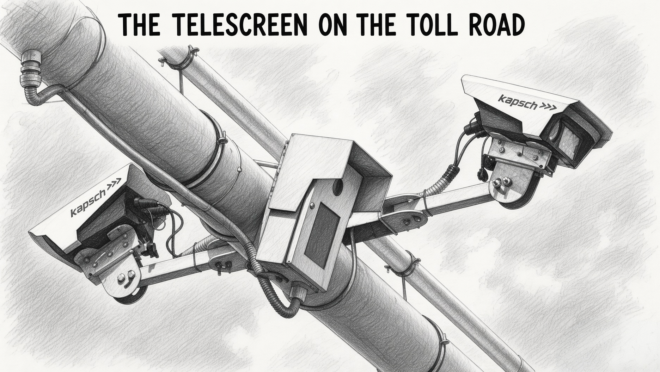
George Orwell’s Nineteen Eighty-Four contains no computers, no facial-recognition networks, no phone-extraction kits carried in a patrol car’s boot. Its instruments of control are posters, hidden microphones, and a two-way telescreen bolted to the wall of every room that matters. And yet the novel’s vocabulary of watching remains the language most of us reach for when a government proposes to see more of its citizens than it has seen before. That is not because Orwell foresaw silicon. It is because he described, with unmatched precision, what it feels like to live inside a system that can observe you at any time, that you can never confirm is switched off, and that treats the ordinary texture of human behaviour as potential evidence. New South Wales has just given that description a new and very local text to sit beside.
In August 2026 the NSW government introduced the Crimes and Other Legislation Amendment (Further Organised Crimes Reforms) Bill 2026 to State Parliament. Framed as a response to organised crime, identity fraud and the “evasive methods” of criminal networks, the bill does three things that matter far beyond the criminal syndicates it names as its target. It creates a framework for NSW Police to access unredacted images captured by cameras on public toll roads, beginning with the Sydney Harbour Bridge and the Harbour Tunnel. It allows Transport for NSW to share driver licence and photo card images through the Commonwealth’s National Driver Licence Facial Recognition Solution, making NSW the third state, after Western Australia and South Australia, to connect its citizens’ faces to that national system. And it introduces, in what the government calls an Australian-first, a new Digital Evidence Access Order (organised crime) that a judge of the Local Court can issue on sworn application without the device first being seized under a search or crime-scene warrant. Lawful seizure at the point of arrest or a roadside stop is enough to found the application.
Each of these measures is defensible in isolation, and the government has made the defensible case for each of them. Toll cameras already exist; the bill only asks that police be allowed to see clearly what those cameras have already recorded, and only, ministers say, in investigations into serious indictable offences or missing persons. The facial-matching database is sold as a shield against identity theft, a way of confirming that the person opening a bank account with your driver’s licence is actually you. The Digital Evidence Access Order is presented as a modernisation, a recognition that criminal syndicates now operate through encrypted apps and burner phones rather than through the kind of physical evidence a 1990s search warrant was written to reach. Taken piece by piece, this is how nearly every expansion of state power over the citizen has always been sold: narrowly, urgently, and against an enemy nobody is inclined to defend.
Orwell is useful here not because Oceania is a fair caricature of contemporary New South Wales – it plainly is not – but because he isolated the structural features of a watching state that survive any change of technology or any change of stated purpose. Five of those features are worth holding up against this bill: the normalisation of an instrument that watches even when serving you; the uncertainty that turns “they might be watching” into a permanent discipline; the shrinking of the space that belongs only to you; the conversion of ordinary presence into evidence; and the political question, prior to any of the technical detail, of who gets to plug in, on what terms, and with what memory.
Taking the Government’s Case Seriously
The government’s defence of the bill deserves to be stated in its strongest form before it is tested against Orwell, because the weakest version of an opponent’s argument is the easiest one to dismiss, and dismissing it proves nothing. Organised crime in New South Wales, as the Police Minister has argued in Parliament, has changed its methods faster than the law governing police access to evidence has changed. Encrypted messaging, disposable devices, layered intermediaries and stolen or synthetic identities are not hypothetical concerns invented to justify a power grab; they are the operating methods of the criminal networks the bill’s second-reading speeches describe, and a law written around the physical evidence of an earlier era genuinely may struggle to reach them. The facial-recognition database, on the government’s account, exists to defeat identity fraud, not to track lawful citizens. Its stated national design returns only a yes-or-no match against a submitted image, rather than handing over a browsable dossier, and Western Australia and South Australia have already connected to the same system without the kind of scandal that would suggest routine misuse. The toll-camera provisions are limited, in the government’s telling, to investigations into serious indictable offences or missing persons, with a staged rollout beginning at two specific crossings rather than a blanket switch-on across the state’s road network.
It is worth noting, without yet drawing a conclusion from it, that those limits are already wider than the press release. Under section 4 of the Crimes Act 1900, a serious indictable offence is any indictable offence carrying five years’ imprisonment or more, which reaches well past organised crime into fraud, larceny and a large share of the ordinary criminal calendar. The bill’s toll-image clauses also authorise use to prevent or lessen a serious threat to life, including a child at risk, and to support coronial investigations. None of this makes the government’s case a fringe argument. An essay that pretends otherwise is not making a serious case.
The difficulty is not that this account is dishonest. It is that every one of its reassurances – the narrow purpose, the yes-or-no response, the staged rollout, the “serious indictable offence” threshold – is a policy commitment rather than a legal guarantee written into a reporting structure the public can check. Orwell’s Party never announced an intention to watch everyone constantly either; it relied on citizens being unable to verify the difference between the stated limits of a power and its actual use. A government can mean every word of its own justification and still hand a future minister, a future police commissioner, or a future set of budget pressures a tool whose only real limits are the ones nobody is required to publish. Taking the government’s case seriously does not mean accepting that good intentions at the moment of drafting settle the question of how a power will be used a decade later, once the syndicates it was built for have moved on and the infrastructure remains.
The Instrument That Serves and Watches at Once
The most famous sentence in Nineteen Eighty-Four does two jobs simultaneously. BIG BROTHER IS WATCHING YOU announces an authority, and it trains a habit: assume you are seen. The telescreen that broadcasts Party propaganda into Winston Smith’s flat completes the picture, because it cannot be switched off and it receives as well as transmits. It serves the citizen – it is, notionally, part of the furniture of ordinary life – and it also generates a permanent, searchable record of that citizen’s conduct.
The toll camera occupies exactly this double role, and that is precisely why it is such an effective vehicle for expanding police access. Nobody designed the Harbour Bridge’s tolling infrastructure as a surveillance network; it was built to bill motorists. But a camera that already exists, already photographs every vehicle that passes, and already stores that image for administrative purposes is a far easier thing to redirect toward policing than a camera built for that purpose from the start, because the redirection can be described as merely “unlocking” data that was collected anyway. In the second-reading speech, the Police Minister put the point more plainly than the talking points do: unredacted images will help police “establish cultural links” in serious and organised crime investigations. That is not a description of a billing system. It is a description of a record being asked to identify people.
The same logic underwrites the facial-recognition database. The driver’s licence photograph was taken so that a police officer or a bottle-shop clerk could confirm you are who your card says you are. Folding that photograph into a national face-matching system does not require building anything new; it only requires deciding that a record kept for one purpose may now be searched for another. The government’s national story is a one-to-one check: a submitted image, a yes or a no. That is not the whole machinery. Transport for NSW has separately been building a licence-register system capable of one-to-many identification – comparing a face against the state’s customer base to find duplicate identities. A bank-account verification and a lineup are different tools. Once both sit on top of the same photograph, and once that photograph can be set beside an unredacted image from the Bridge, the distinction is easier to announce than to keep.
This is the telescreen’s real lesson for a debate about toll cameras and licence photos: the instrument does not need to be built as an instrument of control to become one. It only needs to already be watching, for some other reason, when the state decides that the watching is useful. New South Wales did not build a surveillance network to catch organised crime. It looked at a billing system and an identity-verification system it already had, and asked what else they could be made to do.
Uncertainty as a Method of Government
Orwell’s sharpest passage on this subject does not describe constant observation. It describes the impossibility of ever knowing whether you are being observed at a given moment, and the way that impossibility becomes a habit, then an instinct: you live as though every sound is overheard and every movement is watched, because the Thought Police could be listening on your particular wire at any time, and you have no way of finding out. The Party does not need the resources to watch everyone continuously. It only needs citizens to behave as if it might.
Nothing in the NSW bill, as currently drafted, requires the government to publish how often the new toll-camera access is used, how many devices are unlocked under a Digital Evidence Access Order, which categories of offence trigger a request, or how long the harvested images, biometric templates and extracted phone data are retained before deletion. The new device-order provisions do require an issuing officer to record the grounds relied on. An internal file is not a public count. Civil liberty observers have pointed to the gap directly: there is no statutory reporting obligation and no public data mandate attached to any of the three new powers. The public is asked to trust that access will be used only for the purposes ministers name, with no external mechanism to confirm that the promise is being kept.
This is Orwell’s guesswork, translated into administrative law. A motorist crossing the Harbour Bridge cannot know whether their unredacted image has been pulled for a database check, whether their face has been run against the national facial-recognition system for an unrelated inquiry, or whether a routine roadside stop will end with a device order that no longer needs a prior search warrant to reach their phone. The uncertainty is not a side effect of imperfect drafting. It is close to structural, because a reporting regime is precisely the thing that would let citizens replace “they might be watching” with a known figure – and it is precisely the thing the bill does not provide. Storage plus search plus the absence of a public audit trail turns “the cameras are there” into “the cameras could be looking at me, and I will never find out if they were.” That is not the same claim as “NSW Police are watching everyone all the time.” It is the older and, Orwell suggests, more corrosive claim: that nobody outside the system can tell the difference between an agency that never overreaches and one that does, because neither publishes the numbers that would let anyone check.
The Shrinking of What Is Yours
Winston Smith allows himself one piece of comfort as the walls close in around him: nothing is his own except the few cubic centimetres inside his own skull. The line still assumes a residual private territory. The rest of existence has already been made observable.
A phone is not a mind. It is, for most people, the closest thing that exists to an externalised archive of a life: search history, private messages, location trails going back years, photographs never meant to leave the device, banking apps, medical appointments, contacts kept in confidence. The Digital Evidence Access Order presses directly against that archive. The order is not warrantless. A Local Court judge still has to be satisfied, on oath or affidavit, that the device was lawfully seized, that data connected to an organised-crime offence is likely to be on it, and that the specified person has relevant knowledge of it. The more accurate word for what changes in 2026 is warrant-untethered. Previously, an order could only attach to a device already seized under a search or crime-scene warrant – a warrant that itself required a magistrate to have turned their mind to that specific search before the device was ever in police hands. The bill removes that precondition for offences connected to organised crime, so a lawful seizure incidental to an ordinary arrest or a roadside stop is now enough to ground the application. The judge’s sign-off has not disappeared. The independent check that used to sit in front of it, at the point the device was taken, has.
The toll-camera provisions extend a version of the same shrinkage to people who were never driving at all. New sections 261D to 261F of the Roads Act, inserted by the bill, authorise a toll camera to capture an image of the entire vehicle, not only its number plate. Every passenger in frame, including a child in a booster seat who holds no licence, has never consented to a photograph, and appears in no government identity database, is captured in the same unredacted image and held under the same access rules as the driver under investigation. Nothing in the bill’s exemption provisions carves passengers, or minors, out of that collection.
A face captured on the road, a face matched against a government photograph, and a device reached after a field seizure are three different technologies solving three different stated problems. Together they describe a citizen – and anyone travelling with that citizen – whose location, identity and private communications can each be reached through a chain of steps that is now one link shorter than it was.
Whose Ordinary Life Becomes Evidence
Orwell’s Party does not simply punish forbidden speech. It punishes “facecrime” – an unguarded expression, a nervous tic, a habit of muttering – because any sign of abnormality is treated as evidence of concealment. The demand is not obedience to a clear law so much as the continuous performance of a loyalty that can never quite be verified.
That is not what this bill does, and the difference is worth keeping precise. Facecrime still requires Winston to have done something, even if that something is only an unguarded flicker of expression. Nothing in the licence-photo database, the toll-camera framework, or the device order requires a citizen to look like anything in particular. A driver crossing the Harbour Bridge on an ordinary Tuesday has done nothing resembling suspicious behaviour and is captured in a record that becomes available to an investigation weeks or years later, for reasons that had nothing to do with them at the time the image was taken. The echo is not that ordinary behaviour is read as concealment. This bill makes no claim to detect concealment at all. It is that ordinary presence, with no behaviour attached to it, becomes searchable evidence by default.
The NSW Council for Civil Liberties has named the cultural shift that follows from that design. Its president has argued that the reforms move NSW from a system that treats citizens as citizens, entitled to move through public space and use their own devices without becoming data points in a police investigation, toward a system that treats them as automated suspects, whose movements, faces and devices are available to be checked by default and explained only if something goes wrong. The council has also pointed to the absence of independent safeguards around the national facial-recognition system, and to an accountability gap that leaves a driver on a toll bridge, or a person whose phone is unlocked during an unrelated stop, with no practical way of knowing whether they were treated as a person of interest or swept up as a byproduct of someone else’s search.
What the Ombudsman Already Knows
Nineteen Eighty-Four offers one genuine, if thin, consolation: the Party can watch continuously and still never master the secret of what another person is actually thinking. Correlation of traces is not the same as reading a mind, and it is worth resisting the more breathless claims made about what modern surveillance tools can actually do. The comfort is thinner than it looks. A state does not need to read minds if it can already watch a life closely enough, and act on the pattern it sees. Australia’s own oversight bodies have already documented what happens when police forces are given intrusive digital powers and the checking around them is left thin.
The Commonwealth Ombudsman inspects how agencies use telecommunications interception, data-access and industry-assistance powers. In 2023–24, NSW Police accounted for 53 of the 69 voluntary technical assistance requests issued nationally – by far the heaviest use of any agency. The Ombudsman did not find a conspiracy. It found that authorising officers had not adequately demonstrated they had weighed reasonableness and proportionality before issuing the requests, often adopting the applying officer’s own reasons and relying on pre-ticked boxes. Those findings were suggestions, not formal recommendations, and they concerned a request to a company rather than compelled access to a phone. They still describe a high-volume power whose internal checking was thinner than the statute required.
The same oversight regime has gone to purpose, not only paperwork, elsewhere. In its 2022–23 inspection of covert electronic surveillance powers, the Commonwealth Ombudsman found that a state police force had issued prospective telecommunications-data authorisations for offences that did not meet the statutory threshold Parliament had set for that power, and raised comparable non-compliance across three of the agencies it reviewed that year. NSW Police was not the force named in that particular finding. But it is inspected under the same regime, and, as the TAR figures above show, it was already that year’s heaviest user of a neighbouring surveillance power with compliance gaps of its own. The pattern the Ombudsman keeps finding, across whichever agency happens to be the year’s outlier, is not that any one police force is uniquely careless. It is that a “serious offence” threshold, once written into a statute, does not enforce itself. It requires active auditing to keep it from drifting toward whatever the case in front of an officer seems to require – and that is precisely the auditing this bill does not build in.
That is the warning this bill invites the public to set aside. Unredacted toll images, a national face search and a warrant-untethered device order are each a larger step than a technical assistance request or a metadata authorisation. Nothing in the bill is built to notice if the same pattern – thin demonstration of the legal test, then use below the purpose originally sold – repeats at that larger scale.
A National Pattern, Not a Local Experiment
New South Wales is not inventing this architecture. It is joining one already built. Western Australia and South Australia are already connected to the National Driver Licence Facial Recognition Solution, and the Commonwealth’s identity-matching framework was designed from the outset to expand state by state until national coverage was complete. Each state’s decision to join is presented, as NSW’s is, as a narrow local step: that state’s fraud problem, that state’s crime concern, that state’s toll network. Taken together, the individual decisions describe a national capacity to match a face against a government-held photograph, assembled through debates that treated the national system as if it did not already exist and were not already being built around them.
The same incrementalism applies to the powers themselves. The Digital Evidence Access Order does not appear from nowhere. It follows years of expanding access to stored communications and metadata, the powers with the compliance record described above. Each new measure is narrower, in the moment it is proposed, than the sum of the measures that will surround it. That is how a watching state is built in a jurisdiction that would reject the idea if it were ever put as a single, explicit proposal: not “police may now see everything,” but a toll camera here, a facial-recognition link there, a seizure precondition quietly uncoupled from a device order, each addition sold on its own terms and assessed as though it were the last one that would ever be needed.
The Political Question Underneath the Technical One
It would be a mistake, and the kind of mistake that empties Orwell’s warning of its force, to treat every camera or database as evidence that Macquarie Street has become the Ministry of Love. The Party’s aim in Nineteen Eighty-Four is not public safety. It is power maintained through fear, language and the erasure of history, sustained for its own sake. NSW’s stated aim – disrupting organised crime networks that genuinely do exploit encrypted technology, stolen identities and cross-border anonymity – is real. Flattening that distinction cheapens the comparison.
Underneath the technical detail sits an older question, and the novel states it more plainly than any policy paper: who may plug in, on what terms, with what memory of what they have seen, and with what power to act on what they find. This bill loosens the check at the point that used to matter most – not the judge’s sign-off on the access order, which remains, but the requirement that a magistrate have already weighed a specific search before the device was in police hands. A lawful seizure at arrest or a roadside stop now does the work that warrant used to do. Nothing in the bill replaces that removal with published counts, defined retention limits, or consultation before the architecture was brought to Parliament. The NSW Council for Civil Liberties makes the same argument when it says the community should have been asked first, and that the facial-recognition system lacks the safeguards needed to justify the trust being demanded of the public.
None of this requires believing that 2026 New South Wales is Oceania. It requires refusing to forget what Orwell took a novel to make vivid: that a watching system does not need to announce its purpose as control for it to function as control, and that the safest way to lose a freedom is to have it withdrawn one administratively reasonable step at a time, each step individually defensible, until the cumulative shape of the thing is one nobody would have voted for if it had been put to them all at once, in a single sentence, on the first day. The telescreen was fiction built around a political problem Orwell could describe but had no way to build. The unredacted toll camera, the national facial-recognition database and the warrant-untethered device order are not fiction. The question the novel leaves standing – on whose terms the watching happens, and who is answerable for it afterwards – is the one this bill has not yet answered.
– – –
Bakchos is the founder of Blak and Black, an Australian media and advocacy platform established in 2010. Bakchos writes from the intersecting perspectives of Wiradjuri heritage, Jewish identity, and humanism.
© Bakchos, August 2026



I’m thinking back to your post on the Permanent Emergency. Beware the seemingly benign legislation.
https://blakandblack.com/2026/08/26/the-permanent-emergency-how-temporary-powers-become-tools-of-domination/?unapproved=18249&moderation-hash=6d312ab63904585d0218e4ae02a7330f#comment-18249
Australia is beginning to look more and more like Putin’s Russia every day, beware the dictator lurking in the wings.