
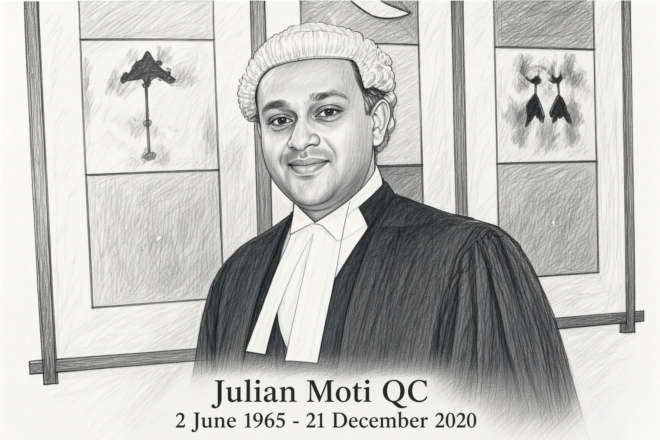
When Blak and Black first started sixteen years ago, one of the earliest subjects taken up on this blog was the Pacific Islands Forum and the late Julian Moti, the former Attorney-General of Solomon Islands and a good friend of the family. Julian understood the Forum, and Australia’s place inside it, better than almost anyone I have known, and it is worth returning to that friendship this week as the 55th Leaders’ Meeting concludes in Koror, Palau.
It was Julian, in fact, who first suggested I take a long-running Indigenous administrative-justice matter – concerning the former Indigenous Commissioner for ACT Revenue – to the UN Human Rights Committee. That submission is still pending, and it belongs properly to a different piece than this one; I mention it only because it is part of why the question of who gets heard by which international body has never stopped mattering to me.
What Julian also gave me, more directly relevant to what unfolded in Palau this week, was an early understanding of the mineral wealth beneath Pacific waters – the seabed reserves that now sit near the centre of both this year’s Forum communique and the wider, undeclared trade contest between Australia and China for regional influence. That is the thread this essay follows: what happened in Palau, who was missing and why it matters, how Australia’s own bilateral diplomacy sits beside the multilateral table it helped build, and how minerals, markets and missile tests now sit underneath all of it.
Consensus as Shield and Vulnerability
The Pacific Islands Forum was established in 1971 as the South Pacific Forum, renamed in 2000 to reflect growing membership north of the equator, and today comprises eighteen full members: Australia, New Zealand, Papua New Guinea, Fiji, Samoa, Tonga, Vanuatu, Solomon Islands, Kiribati, Tuvalu, Nauru, Palau, the Marshall Islands, the Federated States of Micronesia, the Cook Islands, Niue, French Polynesia and New Caledonia. Its founding purpose was modest but important: to give small, often newly independent, island states a collective political voice that no single one of them could muster alone against the interests of larger powers, including their former colonial administrators.
Australia’s membership has always sat awkwardly inside that founding logic. It is, on the one hand, a founding member with a genuine claim to Pacific identity through geography and history. On the other, it is one of the two largest economies and militaries at the table, and its interests – trade routes, fisheries, undersea cables, and increasingly the strategic contest with China – do not always align with the priorities of low-lying atoll states whose primary and existential concern remains climate change and sea-level rise. The Forum has managed that tension for half a century through what is known as “the Pacific Way”: a consensus-based diplomatic culture that privileges dialogue, patience and face-saving over binding votes or coercive pressure.
That culture is a genuine shield. China’s arrival as a serious regional actor has placed it under pressure it was never designed to absorb, but the shield has held before. Beijing’s interest in the Pacific snapped into focus in 2018, when reports emerged that it was seeking to establish a military base in Vanuatu, and hardened further in 2022, when a leaked draft security agreement with Solomon Islands raised the prospect of Chinese security forces being deployed inside the region. Later that year China’s foreign minister, Wang Yi, toured several Pacific capitals seeking support for a sweeping regional security and cybersecurity pact; he failed to secure it, largely because the Forum’s consensus requirement gave sceptical members room to withhold agreement without confronting China alone. But the same consensus requirement is also a vulnerability, because it can be worked from the outside as easily as it protects from within – a single absent or persuaded member can quietly change what the Forum is able to say. Which of those two tendencies dominated in Palau this year is the question the rest of this essay tries to answer.
What Happened in Palau
Palau’s President, Surangel Whipps Jr, opened the 55th Leaders’ Meeting by taking over the Forum chairmanship from Solomon Islands with a pointed call for Pacific unity and for the region to retain control of its own agenda. Partners were welcome to travel alongside the Pacific, he told delegates, but they did not get to choose where the region was headed. It set the tone for a meeting that spent much of its four days managing absence rather than presence.
By the opening ceremony on 1 September, it was already clear this would be a leaders’ meeting conspicuously short of leaders. Five of the bloc’s eighteen members sent deputy ministers or senior officials rather than heads of government: Kiribati, whose President Taneti Maamau stayed away; Vanuatu, whose Prime Minister Jotham Napat did not attend; Samoa, in the absence of Prime Minister La’auli Leuatea Schmidt; Fiji, whose Prime Minister Sitiveni Rabuka’s attendance remained uncertain right up to the opening; and New Caledonia. A sixth leader, Solomon Islands Prime Minister Matthew Wale, had actually arrived in Palau before turning around and flying home to Honiara to face a no-confidence motion against his own government – a domestic political emergency with nothing to do with Beijing or Canberra. New Zealand’s Foreign Minister, Winston Peters, described the run of absences as seriously disappointing, while allowing that the delegations that had arrived were of a high standard. Australia, by contrast, was fully represented: Prime Minister Anthony Albanese made his first official visit to Palau and his fifth Forum leaders’ meeting, accompanied by Climate Change and Energy Minister Chris Bowen and Pacific Island Affairs Minister Pat Conroy, and told reporters the gathering was, above all, a meeting of the Pacific family.
Layered on top of the absences was a sharper irritant: Palau is one of only three Forum members, alongside Tuvalu and the Marshall Islands, that maintain formal diplomatic relations with Taiwan rather than the People’s Republic of China. As host, Palau invited Taipei alongside China, the United States, Japan, the United Kingdom and Singapore as development partners, and Taiwan’s Foreign Minister, Lin Chia-lung, attended the opening ceremony in person. China’s special envoy for Pacific affairs, Qian Bo, warned there would be consequences without specifying what form they might take, and Beijing’s Foreign Ministry spokesperson, Guo Jiakun, told reporters Taiwan was not qualified to participate in the Forum’s activities in any capacity. A Pacific source at the meeting told wire reporters that Chinese officials had also privately warned other governments not to attend side events where Taiwan’s delegation was present. None of this was without precedent: at the 2024 leaders’ meeting in Tonga, a communique reference to the Forum’s 1992 position on Taiwan was briefly published before being quietly removed after China’s envoy objected, a sequence Taipei condemned at the time as a rude intervention in the Forum’s own processes.
Reading the absences honestly requires resisting a single tidy explanation. Wale’s departure had a clear and unrelated domestic cause. The other five are harder to explain away so cleanly, which is exactly why they have drawn attention. Alan Tidwell, director of the Centre for Australian, New Zealand and Pacific Studies at Georgetown University, told Radio Free Asia that a leaders’ meeting without leaders could not be regarded as fully productive as a political exercise. Winston Peters went further, calling the collective absence highly suspicious without making a direct accusation. Analysts writing for The Conversation have suggested it is plausible some of the missing leaders were influenced, directly or indirectly, by a China that has become one of the largest infrastructure lenders to several of the countries that stayed away. But governments in Suva, Port Vila and Apia each have their own coalition pressures and domestic calendars to manage, and collapsing every absence into an instruction from Beijing risks doing exactly what the Forum’s founders set out to resist: treating small Pacific states as passive instruments of great-power will rather than governments making their own, sometimes inconvenient, sovereign choices. What can be said with confidence is that the cumulative effect, whatever the individual causes, was a meeting that struggled to project the unity its own theme demanded.
Bilateral Success, Multilateral Cost
The Forum did not simply mark time despite the thin attendance. On 2 September, the United States and Australia jointly announced a combined 580 million US dollar package for Pacific nations. Washington’s 150 million dollar share, delivered by Deputy Secretary of State Christopher Landau, was mixed project funding – energy, ports, seabed mapping – and one of the clearest signals yet that Washington remains engaged in the region after last year’s disruption to US aid machinery. Canberra’s roughly 430 million dollars was something more specific: a counter-narcotics and maritime-surveillance package, built around the proposed “Waqa Moana” partnership, funding enhanced aerial surveillance, a transnational crime intelligence centre in Samoa, an interdiction coordination hub in Fiji, and expanded Australian Federal Police and Defence support for Pacific patrol boats, in response to a sharp rise in drug trafficking through the region. It is security spending, even without the language of a defence treaty attached to it, and neither government has published a fuller project-by-project breakdown beyond that. Leaders were due to consider, and reporting from Koror indicated they would affirm, a member-led approach to deep sea minerals along the lines set out in the previous year’s communique, which had already directed officials to bring back an implementation plan – a formulation that reflects the genuine split between Palau, a staunch opponent of seabed mining, and members such as the Cook Islands and Nauru that have licensed exploration in their own waters. The Forum Secretariat had not published this year’s leaders’ communique as this essay went to print, so the final wording should be treated as provisional until it appears. On fisheries, leaders endorsed the Vakamanu Regional Pacific Fisheries Strategy 2026–2035 as the bloc’s overarching framework.
Underneath those formal outcomes sits a quieter story about how Australia has actually chosen to pursue its Pacific interests over the past two years: less through the multilateral Forum process than through a rolling series of bilateral security treaties, with Tuvalu in 2023, Nauru in 2024, Papua New Guinea in 2025, and Vanuatu and Fiji in 2026. Fiji’s own case is the clearest illustration of the tension this creates. It was the Forum itself that endorsed the Blue Pacific Ocean of Peace Declaration at the 2025 Honiara leaders’ meeting, a collective statement of principle any member could stand behind. What followed in July 2026 was narrower: the “Ocean of Peace Alliance,” a mutual defence treaty signed in Suva as Fiji’s bilateral pact with Australia, alongside the separate Vuvale Union economic and security agreement – Fiji’s first such alliance and Australia’s fourth. It remains open for other Pacific states to join later, but it began life as a Forum-wide declaration and closed the year as a bilateral treaty with Canberra’s name on it. Many Pacific leaders have welcomed these bilateral treaties individually, which typically come with direct policing and infrastructure assistance a consensus-bound Forum struggles to match quickly. But the pattern sits awkwardly beside the Forum’s founding logic of collective voice, and Fiji’s declaration-turned-alliance is a concrete sign that Australia’s very success at bilateral diplomacy may be part of what is now straining the multilateral table it helped build.
Minerals, Markets, Missiles
None of this can be separated from the broader, non-military trade contest between Australia and China. In April 2025, Beijing suspended exports of a wide range of rare earth elements and magnets in response to the Trump administration’s tariff escalation, deploying its near-total dominance of global rare earth processing as leverage in a trade war that had nothing directly to do with the Pacific. Australia’s Trade Minister, Don Farrell, moved to position the country as a secure alternative supplier, and Canberra has since fast-tracked a 1.2 billion Australian dollar critical minerals reserve built around offtake agreements rather than physical stockpiling, alongside a dedicated rare earths agreement with Washington. The point, for this essay, is not to tour that whole allied supply-chain architecture again but to name the single sentence that binds it to Koror: large stretches of Pacific exclusive economic zones – precisely the seabed wealth Julian Moti first drew my attention to – are now understood to hold some of the same minerals at the centre of that contest. It is no accident that deep sea mining occupied so much of the Forum’s own attention this year, nor that Washington chose this same meeting to announce fresh funding.
That contest also has a harder edge, dated to earlier this year rather than to this week in Palau. In July, around the time Australia and Fiji were finalising their Ocean of Peace treaty in Suva, China test-fired an intercontinental ballistic missile into the Pacific Ocean. Solomon Islands Prime Minister Matthew Wale – the same leader who would return to Honiara from Palau to fight a no-confidence motion in September – said at the time that no power, China, the United States or anyone else, should be testing such missiles in Pacific waters, and that partnership must not come bundled with intimidation. Oliver Nobetau of the Lowy Institute wrote, in the same July commentary, that further testing risked reducing Pacific nations to spectators in their own waters, much as they were during the Second World War. Those words were not spoken in Palau, but they form the regional sentiment this year’s Forum met against, and they explain why deep sea minerals and diplomatic snubs both landed with more weight in Koror than they might have in a quieter year.
Close
Palau’s President Whipps opened this year’s Forum with a warning that the region’s partners were welcome to sail alongside it but did not get to choose its destination. Judged against that standard, the 55th Leaders’ Meeting was a mixed result: outcomes on fisheries, a member-led position on deep sea minerals that leaders were expected to affirm but which the Secretariat had not yet published as this went to print, a third of the membership absent, a furious China, and the Blue Pacific’s own Ocean of Peace Declaration – adopted collectively at Honiara in 2025 – arriving a year later as a bilateral mutual defence treaty between Fiji and Australia. Whoever controls the resources beneath these waters, and whoever gets to decide the terms on which they are extracted, will shape the sovereignty of Pacific peoples for a long time yet. Julian Moti understood that before most people were paying attention to it. Whether the Forum’s own member-led principle on deep sea minerals survives the next round of great-power courtship, once its actual wording is public, is a question this outlet intends to keep following, from Koror and wherever the story leads next.
– – –
Bakchos is the founder of Blak and Black, an Australian media and advocacy platform established in 2010. Bakchos writes from the intersecting perspectives of Wiradjuri heritage, Jewish identity, and humanism.
© Bakchos, September 2026


Australia versus China. Should be a quick and uneventful match.
I’ve spent the morning reading through your blog. You certainly have written a lot about Julian Moti and the Pacific Islands. I’m glad you’ve decided to update some of your work, I think the old stuff still has some validity.
So Trump‘s trying to stir up trouble with China in the Pacific using Australia is the United States gonna be their standing shoulder to shoulder with Australia if the Chinese proverbial hits the fan?
I had forgotten that you had a friendship with Julian Moti. It was sad the way he went, I guess that’s life.
Does the PIF actually still have any relevance?