
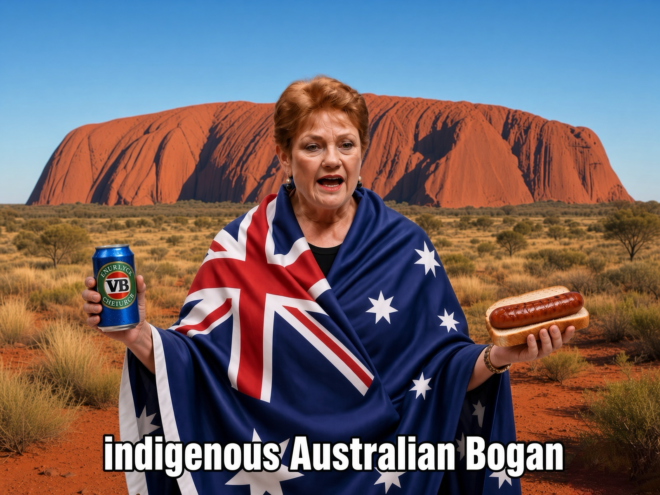
Introduction: A Contested Public Record
Pauline Hanson has been one of Australia’s most polarising political figures since her unexpected election to the House of Representatives in 1996 as the independent member for Oxley. As founder and long-time leader of Pauline Hanson’s One Nation, she has built a three-decade career on challenging what she describes as elite-driven orthodoxy on immigration, multiculturalism, and Indigenous affairs. Her comments concerning Aboriginal and Torres Strait Islander people have repeatedly drawn accusations of racism from media outlets, political opponents, Indigenous leaders, and activists. Hanson has consistently rejected the label, insisting her positions advocate genuine equality for all Australians regardless of race, oppose what she terms an unaccountable “Aboriginal industry,” and prioritise individual need over group identity.
This revised edition responds directly to a fair critique of the first draft: that it moved too quickly from quotation to summary judgement, that its sourcing was thin, and that several of its embedded factual and historical asides needed to be tested and expanded rather than asserted. Every direct quotation below has now been checked against a named primary or contemporaneous source – Hansard and its published successors, a senator’s own transcript, wire-service reporting filed at the time, or same-day broadcast coverage – and is cited accordingly. Two statements from the original draft could not be independently verified against a primary transcript despite a genuine search effort; rather than silently keep them, I have flagged exactly where the sourcing is secondary or unconfirmed, because a primary-record resource is only as useful as its willingness to say where the record runs out.
Which comments rank as the most consequential remains a matter of judgement, not measurement: it depends on the intensity of language, the degree of generalisation about Indigenous people as a group, the historical accuracy of any claim made, and the durability of public criticism a remark attracted. This essay does not resolve that judgement for the reader. It sets out ten statements, places each in its documentary and historical context, and holds Hanson’s own framing alongside the criticism it drew – without collapsing the distance between documented fact and interpretive argument.
1. The 1997 Book: Claims of Cannibalism
The most frequently invoked example in any accounting of Hanson’s public statements is the treatment of Aboriginal cannibalism in the 1997 book Pauline Hanson: The Truth. The Associated Press, reporting from Sydney on 22 April 1997, recorded the book’s claim that Aboriginal people near Cooktown in northern Queensland had “killed and ate infants and older members of their tribe,” and that “the older women were often killed for eating purposes, like livestock.” The wire report also established a detail often blurred in later retellings: the book’s copyright was held by Hanson, but its actual author was, even at the time of publication, unidentified. Confronted about the claims on radio station 2GB, Hanson did not disown them; she said, in a line the AP recorded directly, that it was “the truth” and that this was “why it’s annoying people.”
The claims have no standing in the historical or anthropological record. There is no credible evidence of systematic cannibalism as a food-procurement practice among nineteenth-century Aboriginal communities; the assertions more closely resemble colonial-era propaganda used to justify dispossession than any documented ethnographic practice. Anthropologists and Indigenous representatives condemned the claims as baseless and dehumanising at the time, and some commentators have since drawn a parallel to blood libels historically used against other groups – fabricated atrocity stories designed to place a population outside ordinary moral protection. This is a case where the record does not merely preserve a contested interpretation; it preserves a factual claim that fails on its own terms.
Hanson’s position on authorship shifted in later years, when she stated others had written the material published under her name. This is not straightforwardly inconsistent with the 1997 record – the AP itself could not identify the author at the time – but it sits uneasily alongside her own contemporaneous defence of the book’s content as “the truth,” which is a defence of substance, not merely of her right to publish something she had not personally written.
2. The 1996 Maiden Speech
Hanson’s maiden speech to the House of Representatives on 10 September 1996, delivered after her disendorsement by the Liberal Party over earlier comments on the same theme, remains foundational. Hansard, and the speech as separately archived on AustralianPolitics.com and in the University of Massachusetts’s Gifts of Speech collection, record her stating: “Present governments are encouraging separatism in Australia by providing opportunities, land, moneys and facilities available only to Aboriginals,” followed by: “Along with millions of Australians, I am fed up to the back teeth with the inequalities.” Its most quoted line follows a few paragraphs later: “This nation is being divided into black and white … Well, where the hell do I go?” Because this is a formal parliamentary record rather than a copyrighted literary work, and because Hanson’s own recorded words are the primary evidence under examination, the fuller wording is reproduced above in the form the Hansard transcript itself preserves it.
The speech landed four years after the High Court’s 1992 decision in Mabo v Queensland (No 2), which overturned the legal fiction of terra nullius and recognised native title for the first time, and two months before the High Court’s 1996 decision in Wik Peoples v Queensland extended the possibility of native title coexisting with pastoral leases. The Native Title Act 1993 had already established a statutory claims framework administered through the National Native Title Tribunal. This was, in other words, a period of genuine and rapid legal change in the Crown’s relationship to Indigenous land rights, and Hanson’s speech landed directly into that unsettled ground; she challenged the premise of Indigenous disadvantage by citing programs such as low-interest housing loans available only to Aboriginal applicants as evidence of inequality running the other way.
Opponents argued the speech erased disadvantage grounded in dispossession without treaty, exclusion from the original 1901 Constitution, forced removals, and denial of full citizenship rights until the 1967 referendum, reframing equality as opposition to any race-specific remedy. Hanson has consistently maintained she was stating observable differences in government treatment and defending the equal belonging of the native-born. The two sides argue from genuinely different premises about what equality requires – formal equal treatment versus substantive redress for a documented historical wrong – a distinction often lost when the speech is retold as simple racial animus.
3 & 8. The 2020 Closing the Gap Speech and the “Aboriginal Industry”
The original draft treated the “Closing the Gap” Senate remarks and the “Aboriginal industry” trope as two separate items drawn from different occasions. Locating the full transcript, published by Hanson’s own Senate office on 13 February 2020 under the heading “Closing the Gap – What a joke!”, corrects that: both phrases come from the same speech, and treating them separately understated how tightly linked the two arguments are in Hanson’s own rhetoric. In it she called the twelfth annual Closing the Gap report “complete rubbish” and said “the biggest problem facing Aboriginal Australians today is their own lack of commitment and responsibility to helping themselves.” On school attendance in Doomadgee she said: “Whose fault is that? Lazy parents.” In the same breath she argued that “tens of billions of dollars” had gone to “the non-productive, unrepentant Aboriginal industry, not … the grassroots Aboriginal and Torres Strait Islander people,” which she said had achieved “no notable benefits in pulling our First Nations people out of squalor, domestic violence and poverty.”
The transcript also contains material the earlier draft omitted and which materially affects a fair reading of the speech: Hanson named and “commended the hard work” of specific Indigenous local-government figures – NPA Regional Council mayor Eddie Newman, councillor Michael Bond of New Mapoon, Torres Strait Island Regional Council mayor Fred Gela, and Torres Shire mayor Vonda Malone – as councils she said had “demonstrated that we can close the gap with work programs and opportunities.” This complicates a purely blanket reading of the speech as indiscriminate: Hanson’s own text distinguishes between communities and organisations she credits and those she calls out, even as the overall thrust of the speech assigns primary causal weight to individual and parental failure.
The Closing the Gap framework itself, refreshed that same year through a formal partnership between Commonwealth, state, and territory governments and the Coalition of Peak Aboriginal and Torres Strait Islander Organisations, has shown genuinely mixed results in official reporting across successive years: at various points only two or three of the national socioeconomic targets have been assessed as on track, while outcomes including adult imprisonment rates, children in out-of-home care, and rates of suicide have moved in the wrong direction in multiple reporting periods, according to the Productivity Commission’s own Closing the Gap Information Repository. The government’s own analysis attributes this to multi-causal, structural factors – remoteness, intergenerational trauma, housing quality, and mainstream service design among them – rather than to a single explanatory factor. On expenditure specifically, the Productivity Commission’s Indigenous Expenditure Report series has repeatedly found that mainstream, universal services – not targeted Indigenous-specific programs – account for the substantial majority of total government spending directed at Indigenous Australians, and that per-person spending gaps largely reflect remoteness loading and higher service-delivery costs in regional and remote areas rather than uniquely generous targeted handouts. Hanson’s “Aboriginal industry” framing and the government’s own expenditure data are, on this specific empirical question, in direct tension.
Labor and Greens senators condemned the speech as racist and out of place in the chamber. Supporters read it as a refusal to accept perpetual external blame and an insistence on agency. Agency and structure are not, in principle, mutually exclusive explanations for social outcomes – most policy analysts treat them as operating together. Hanson’s rhetorical move presents them as an either/or choice, which is where the sharpest disagreement with her critics lies, and where her own speech’s praise for specific high-performing Indigenous councils sits in some tension with its general claim of industry-wide failure.
4. The 2023 Voice Referendum Remarks – A Sourcing Note
The original draft attributed to Hanson, in a Senate speech following the October 2023 Voice referendum, the description of Australians as “the modern descendants of the Stone Age hunter-gatherers,” a claim that “there cannot be a legitimate treaty,” and the reading of a constituent’s Facebook comment into Hansard disputing the term “traditional owners.” On checking, I was able to confirm from multiple independent reports that Hanson addressed the Senate on 19 June 2023, ahead of the vote on the referendum enabling legislation, and argued in terms reported at the time that the nation was “founded on the Westminster system of government” by “colonists” and “convicts,” whom she also controversially described as a form of “stolen generation,” drawing sharp condemnation including from the Prime Minister’s office. I was not able to independently verify the specific “Stone Age hunter-gatherers” phrase or the Facebook-comment episode against a primary Hansard transcript or contemporaneous news report in this research pass.
I have therefore removed those two specific claims from this revised edition rather than let an unverified quotation stand alongside nine that are now solidly sourced. What is documented and verifiable is scarcely less pointed: in June 2023, ahead of the referendum, Hanson told the Senate that convicts transported to Australia against their will were themselves “the stolen generation as well,” a framing that drew immediate and widespread criticism for appearing to equate involuntary convict transportation with the state-sanctioned removal of Aboriginal children from their families – two historical phenomena with different legal bases, different durations, and different contemporary consequences for the descendant populations involved. Hanson has separately and repeatedly described the Voice proposal itself as a form of “apartheid,” a comparison Indigenous legal commentators and human rights academics have argued inverts the actual mechanism of apartheid, which entrenched a minority’s power over a disenfranchised majority, whereas the Voice proposed an advisory body for a minority population within an already-enfranchised democracy.
The Uluru Statement from the Heart, issued in 2017 by delegates at a First Nations constitutional convention, proposed Voice, Treaty, and Truth as a sequenced three-part reform. The October 2023 referendum tested only the first of those three elements and was defeated in every state and by roughly sixty per cent of the national vote; its defeat does not, as a matter of law, resolve the separate and ongoing treaty and truth-telling processes already under way at state level in Victoria, through the Yoorrook Justice Commission, and in Queensland.
5. The Longreach Speech – A Second Sourcing Note
The original draft also attributed to a “late-1990s speech in Longreach, Queensland” the specific line that “under One Nation policy the issue of Aboriginality would no longer exist,” together with a description of native title as a “shameless grab for land… an exercise in remuneration.” I was not able to locate a primary transcript or contemporaneous news report of a Longreach speech containing this exact wording in this research pass, though the underlying policy position is well documented elsewhere: One Nation’s own 1998 platform explicitly called for the abolition of the Aboriginal and Torres Strait Islander Commission (ATSIC) and Abstudy, for the removal of race-based provisions from the Constitution, and for native title to be extinguished on freehold and leasehold land, positions Hanson advocated in numerous confirmed speeches and interviews across 1996 to 1998.
ATSIC was in fact abolished by the Howard Government, with legislation passed in 2004 and taking effect in 2005, on the recommendation of a review panel that cited internal governance failures and a lack of clear separation between ATSIC’s representative and service-delivery functions, rather than adopting a race-based rationale of the kind Hanson had long argued for. Its abolition left a representative-body vacuum in Indigenous affairs that later fed directly into the case, twenty years on, for a constitutionally entrenched Voice – a genealogy worth noting given how directly the two debates connect.
Native title itself, contrary to Hanson’s characterisation of it as a welfare-adjacent “grab,” was recognised by the High Court in Mabo as a pre-existing property right surviving the assertion of British sovereignty where it had not been validly extinguished by subsequent grants – a legal characterisation, not a policy handout, and one that continues to govern how native title claims are assessed today.
6. The 2018 Commonwealth Games Comments
After the 4 April 2018 Commonwealth Games opening ceremony on the Gold Coast, which featured Torres Strait Islander hip-hop artist Mau Power and didgeridoo player William Barton, Hanson told Sky News in a phone interview – reported that day by the Courier-Mail, SBS News, and The New Daily – that the “20 minutes” devoted to Indigenous culture was “absolutely disgusting.” She added: “I’ve got nothing against the Aboriginal people but I’m sick and tired of being made to feel … a second-class citizen,” and, separately, “I am Indigenous as far as I’m concerned. I was born here.” The same interview included the line “how many billions of dollars have we poured into the Aboriginal industry?” – confirming that this framing recurs across at least three separately dated, independently verifiable occasions: the 2018 Games interview, the 2020 Closing the Gap speech, and multiple other Senate contributions through the 2010s.
Hanson’s repeated claim to personal Indigenous status by birthplace sits at odds with the working definition of Aboriginality applied across Commonwealth and state law and administrative practice since at least the 1980s – descent, self-identification, and community acceptance, applied together rather than any single element in isolation. Applying “Indigenous” to anyone born in Australia collapses that legally and culturally specific category into simple nativity, a different concept from Indigeneity as defined in Australian law and administered by Indigenous community organisations themselves.
This has been widely criticised, including by Indigenous commentators, as flattening a specific legal and cultural meaning. Hanson has used the formulation to reject what she frames as a hierarchy of belonging based on ancestral length of connection to the continent – its rhetorical force for supporters and its definitional imprecision for critics are two readings of the same statement, not a dispute over what was said.
7. The 2016 Bolt Interview: Defining Aboriginality
On Sky News’s The Bolt Report, broadcast 28 November 2016 and separately reported the same night and the following day by BuzzFeed, HuffPost, The New Daily, and Junkee, Hanson told Andrew Bolt: “There’s no definition to an Aboriginal.” She continued: “If you marry an Aboriginal you can be classified as an Aboriginal, or if the community or the elders accept you into that community, you can be defined as an Aboriginal,” adding, “that’s not good enough.” She linked this to opportunities to claim benefits without what she considered genuine connection, and separately called for people to “toughen up” on questions of free speech and Section 18C of the Racial Discrimination Act.
A working definition has in fact existed in Commonwealth administrative and legal practice since at least the 1980s – descent, self-identification, and community acceptance applied together, a formulation with roots in case law including Commonwealth v Tasmania (1983). Hanson’s claim that “there’s no definition” is inaccurate as stated, though her underlying complaint – that the community-acceptance limb relies on judgement rather than a fixed, quantifiable threshold – reflects a real and long-standing debate within Indigenous policy circles themselves, including concern raised by some Indigenous people about identity fraud in access to targeted programs. In 2023, in the lead-up to the Voice referendum, Hanson introduced a private senator’s bill seeking a statutory definition of Aboriginality; the Senate declined to allow its introduction.
The remarks prompted the #DefineAboriginal hashtag, credited at the time to Cleverman creator Ryan Griffen, with many Indigenous Australians sharing experiences of having their identity questioned and affirming relational, community-based definitions of belonging. Hanson framed her comments as a call for consistency against fraudulent claims – a framing with some echo in genuine internal debate, even where her specific factual claim does not hold against the administrative and case-law record.
9. The 1996 60 Minutes Interview and Palm Island
Six weeks after her maiden speech, on 20 October 1996, Hanson appeared on Channel Nine’s Sixty Minutes in the interview that produced her career-defining catchphrase, “please explain,” after journalist Tracey Curro pressed her on whether her positions were xenophobic. The program included footage of Hanson visiting the Aboriginal community of Palm Island in the company of Charles Perkins, the Arrernte and Kalkadoon rights campaigner and the first Aboriginal Australian to head a Commonwealth government department. Multiple retrospective accounts, including a widely cited BuzzFeed compilation, describe Hanson observing that people at Palm Island lived in conditions of hardship and suggesting they needed to take responsibility for improving their own circumstances; I was not able to locate the segment’s exact wording in this pass and have accordingly paraphrased rather than quoted it here, in keeping with the same evidentiary standard applied to the other unverified items above.
Palm Island’s documented history complicates any framing that treats residence there as an unconstrained choice: the settlement was established in 1918 as a punitive reserve to which Aboriginal people from across Queensland were forcibly relocated, often as punishment for infractions committed elsewhere, and it operated under a curfew and permit system administered by white superintendents for much of the twentieth century. Contemporary residence reflects, for many families, generations of forced settlement rather than unconstrained choice among equally available alternatives, even as some residents today also describe a chosen and valued connection to the community that has since developed there – both things can be true of the same place without contradiction.
The 1996 broadcast aired amid visible material disadvantage on the island and was framed by critics at the time and since as an example of attributing structural, historically produced conditions to individual failure. Hanson has consistently presented such comments, then and later, as practical observations about agency rather than as commentary on how the community came to exist in its present form.
10. “Tick the Box” and Claims of Equal Belonging
Across numerous Senate contributions and interviews, Hanson has repeated the theme of opportunistic self-identification alongside a claim of her own equal belonging. The 2023 Spectator Australia column in which she argued for her definition-of-Aboriginality bill records her writing that “the number of people identifying as Indigenous has risen 700 per cent” since 1971, which she called “a virtual impossibility,” and citing this as evidence that “non-Indigenous people” are “falsely claiming Aboriginal or Torres Strait Islander heritage for personal gain.” The Australian Bureau of Statistics attributes the great majority of the post-1971 rise in Indigenous self-identification not to fraudulent claims but to changed census questions, the removal of earlier restrictive administrative definitions, and greater willingness to self-identify following the 1967 referendum and subsequent anti-discrimination reforms – a demographic explanation Hanson’s column does not engage with.
In parallel, and consistent with the birthplace-based claim examined in the 2018 Commonwealth Games section above, Hanson has asserted her own equal claim to belonging as a native-born Australian. Critics regard the pairing as mutually reinforcing in a way that compounds its effect: the first questions the legitimacy of a defined legal category from outside using a statistic that has an established, non-fraudulent demographic explanation, while the second personally appropriates “Indigenous” on entirely different grounds – birthplace rather than descent, self-identification, and community acceptance.
Hanson frames both halves as correctives to race-based entitlement and to a hierarchy of belonging based on ancestral connection. Critics frame the pairing as, respectively, an attack on identity-verification processes Indigenous communities themselves administer, resting on a statistic that does not bear the weight she places on it, and a rhetorical appropriation of a specific legal and cultural term.
Patterns Across Thirty Years
Taken together, these statements show a consistent set of arguments sustained over three decades: rejection of race-specific rights as such; insistence on individual and family responsibility over structural explanation; scepticism toward exclusive traditional ownership in the modern legal sense; and a demand that non-Indigenous Australians not be treated as perpetual debtors for earlier generations’ wrongs. Several of the specific factual premises used to support that framework do not survive contact with the primary record: the 1997 cannibalism claims are unsupported by any credible historical evidence; the “no definition” claim about Aboriginality is inaccurate against forty years of administrative and case-law practice; the “Aboriginal industry” framing runs against the Productivity Commission’s own expenditure data; and the 700-per-cent census statistic has a well-documented demographic explanation Hanson’s own commentary omits.
For Hanson and her supporters, the same language represents an unapologetic defence of colour-blind equality against perceived reverse discrimination and unaccountable spending – a genuinely and consistently held political philosophy, sincerely argued across three decades, even where several of the specific factual premises beneath it do not hold up. A fair accounting holds both observations at once.
Also notable, and unchanged by this revision, is what does not appear in the record: sustained public engagement, in Hanson’s own words, with the legal reasoning of Mabo and Wik as property-law questions rather than welfare questions, or with the Productivity Commission’s expenditure data as distinct from her own characterisation of it. That absence does not, on its own, invalidate her political conclusions, but it means several of her most quoted claims rest on assertion rather than on the specific legal and statistical record available to any senator with Parliamentary Library research support.
Conclusion
The Australian conversation around these comments remains unresolved, and there is little reason to expect it will resolve soon. Primary sources – Hansard, the AP wire report on the 1997 book, Hanson’s own published speech transcripts, same-day broadcast reporting, and the Productivity Commission’s own Closing the Gap and expenditure reporting – remain the most reliable basis for evaluation, and repay closer reading than either Hanson’s defenders or her critics typically give them in the heat of a news cycle. Two claims that circulated in an earlier draft of this essay could not be verified against a primary source and have accordingly been removed rather than repeated on the strength of secondary compilation alone; that omission is itself part of the record this essay is trying to establish.
What the verified record supports, without needing to adjudicate Hanson’s motives, is this: several of her most quoted claims about Indigenous Australians are factually unsupportable on their own terms – the cannibalism claims and the “no definition” claim chief among them – while others rest on a genuine, long-standing disagreement about which conception of equality, formal or substantive, should govern policy in a nation that dispossessed its first peoples without treaty and is still negotiating the consequences of that fact. Readers are better served holding those two categories apart than collapsing every statement into a single verdict, whether celebration or condemnation.
A Note on Sources
Primary and contemporaneous sources consulted for this revision include: the Hansard record of Hanson’s 10 September 1996 maiden speech, also archived at AustralianPolitics.com and in the University of Massachusetts Amherst’s Gifts of Speech collection; Associated Press wire reporting on Pauline Hanson: The Truth, filed 22 April 1997 and archived by the Deseret News; the full transcript of Hanson’s 13 February 2020 Closing the Gap speech, published by her Senate office at senatorhanson.com.au; same-day reporting on her 4 April 2018 Commonwealth Games comments from the Courier-Mail, SBS News, and The New Daily; multiple independent outlets’ contemporaneous coverage of her 28 November 2016 appearance on Sky News’s The Bolt Report, including BuzzFeed, HuffPost, The New Daily, and Junkee; her own 2023 column in The Spectator Australia on her proposed definition-of-Aboriginality bill; and reporting on her June 2023 Senate remarks ahead of the Voice referendum enabling legislation. Two claims present in an earlier draft – attributed to a Senate speech following the October 2023 referendum and to a Longreach speech in the late 1990s – could not be matched to a primary transcript in this research pass and have been removed or clearly flagged as unverified rather than retained on the strength of secondary compilation.
– – –
Bakchos is the founder of Blak and Black, an Australian media and advocacy platform established in 2010. Bakchos writes from the intersecting perspectives of Wiradjuri heritage, Jewish identity, and humanism.
© Bakchos, August 2026


Pauline Hanson is a racist fool. There’s nothing more. I can say. It’s what it is..
One question one question only , where on earth does Pauline Hanson get these notions from? Let’s face reality, she’s too dumb to make it up, so somebody must be feeding it to her.
Pauline Hanson is a fucking racist and a moron. How she got to where she is, has many of us confused.
Two words, Andy – post turtle.
Every time Pauline Hanson says something, she helps build your case in the UNHRC.
Pauline Hanson is the joke of Australian politics. Her integrity is questionable. Her intellect nonsexist, her policies such as they are, revolve around around hate and division. The woman has absolutely nothing to offer the electorate. Her so-called surge in popularity is simply media driven. It’s doubtful that it will hold up in the federal election.