
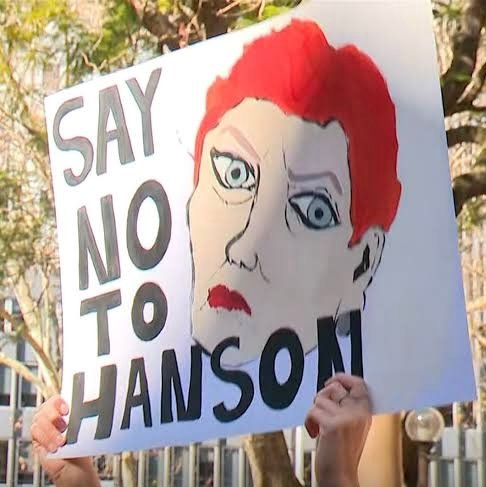
On Thursday afternoon, students walked out of classrooms in Melbourne, Sydney, Newcastle, Canberra, Brisbane, Adelaide, Perth and Wollongong, and gathered under banners reading Say No to Pauline Hanson. Organisers described their goal as building resistance to what they called the far right at a scale that could contest its growing influence in Australian public life – their term, not a classification this essay takes as settled before the record is examined. Within hours, Hanson had answered – not by defending her record on the ground where it was challenged, but by redirecting the students toward the cost of living and dismissing the protest as the product of manipulation. Her One Nation colleague Barnaby Joyce went further, suggesting the children had been turned into props by left-wing teachers. It is worth taking both halves of that day seriously: the students’ claim, and the response to it. That is the discipline this essay tries to hold to – a case argued from evidence, tested against what was actually said and done rather than against the target’s reputation, is worth more than one merely asserted.
A Day With A Precedent
This was not the first time Australian schoolchildren have organised themselves against Pauline Hanson. In July 1998, in the year after she founded One Nation, thousands of high school students staged a coordinated walkout across eight cities. Hanson lost her own seat at the election that followed, though One Nation held on in the Senate. The echo, twenty-eight years later, is not incidental. One Nation’s primary vote has climbed sharply over the past year, with the Roy Morgan poll in early August placing the party at roughly a quarter of the national vote and within a few points of Labor. RedBridge’s polling for the Australian Financial Review found One Nation narrowly ahead of Labor on first preferences, and – more strikingly for this argument – put support for the party among voters aged eighteen to twenty-nine at twenty-one per cent, trailing Labor but well ahead of anything One Nation has drawn from young Australians before. The students protesting Hanson this week are not simply reprising a decades-old script. They are responding to a movement that has, for the first time, begun to make real inroads among their own generation, which gives their walkout a different character: less an inherited grievance than an argument some of them are having with their own peers.
That inroad is not hard to explain, and it should not be waved off as false consciousness. Young Australians have watched housing move permanently out of reach on ordinary wages, watched rent and grocery bills outrun pay rises for years running, and watched Labor and the Coalition alternate in office without shifting either trend. A party that names that anger directly, however cynically it may then redirect it, is offering something the major parties largely have not: the sense of being spoken to rather than about. None of that requires One Nation’s account of who is to blame to be correct. It only requires the grievance underneath it to be real, which it plainly is.
The 1998 walkout and this one also differ in what made them possible. The earlier protest relied on student networks, union contacts, and word passed through common rooms and pay phones; this one was organised in part through the same platforms that have carried One Nation’s own polling surge – a fact each side of the argument can read to its own advantage. Hanson’s supporters can point to it as evidence of astroturfing, coordinated messaging arriving in a teenager’s feed rather than growing from lived conviction. Her critics can point to the same fact and note that it cuts both ways: if social media can manufacture outrage, it can equally well be the reason a movement most of these students were too young to remember from 1998 is nonetheless legible to them now, its history a search away rather than a matter of oral memory. Neither claim, on its own, tells you whether the underlying conviction is real. That has to be argued from the substance, not the medium.
What Hanson Actually Said
Hanson’s public response deserves to be read in full rather than summarised into caricature, because the summary is doing more work than the substance. She did not, in the statements attributed to her by AAP and reported across several outlets, call the students un-Australian. What she said was that schools should teach young Australians how to think, not what to think, and that if students wanted a cause, they should direct their energy at wage stagnation and the cost of living rather than at her. She followed with a line pitched squarely at the students themselves: that the Labor-Greens government was selling out their future, and that One Nation was fighting for them whether they knew it or not.
That is a coherent rhetorical move, and it is worth naming what it does. It does not engage with the protest’s central claim – that One Nation’s politics on immigration, multiculturalism and Islam constitute racism and bigotry. Instead it substitutes an economic grievance for the one the students actually raised, and casts Hanson as their unacknowledged advocate. It is deflection dressed as concern. A generous reading would say Hanson is genuinely trying to redirect youthful energy toward material conditions she believes matter more; a less generous one would say she is declining, again, to answer for statements she has made about Islam, immigration and Indigenous Australians because the record does not bear scrutiny. Both readings can be true at once, and neither requires inventing a quote she did not give.
The economic argument deserves to be engaged on its own terms rather than dismissed as pure sleight of hand, because on the facts of cost of living it is not wrong. Wage growth has lagged inflation for most of the past four years, and the RedBridge and Roy Morgan polling both outlets cited this month link One Nation’s rise directly to that squeeze. Where the argument breaks down is not in its diagnosis but in its author. Nagarajan’s point, made explicitly in defending the walkout, is that Hanson’s Senate voting record runs against the measures most directly aimed at the squeeze she now invokes – free TAFE, increased public school funding, relief on student debt. A senator can be right that wages have stagnated while having consistently opposed the policies most likely to address it; the claim to be fighting for students’ economic future has to be weighed against that record, not against the sincerity of the sentence in which it was made.
The cultural argument – that schools should teach students how to think rather than what to think – is harder to dismiss out of hand, because the underlying worry is not unique to Hanson’s supporters. Concern about political uniformity in classrooms, about teachers signalling a preferred conclusion rather than equipping students to reach their own, recurs across the political spectrum and has real substance behind it in a system funded to serve the whole public, not one faction of it. But the line does more work rhetorically than it can bear as applied here. Students who spend a term learning to read a voting record, a maiden speech and a poll are not being handed a conclusion; they are doing the thing civics education is meant to produce. The line functions less as a defence of open inquiry than as a way of not answering what the inquiry found.
The charge that the protest was manufactured by adults came instead from Barnaby Joyce, who told the Sydney Morning Herald that left-wing teachers were making a statement and using children as props, and asked rhetorically whether anyone believed a group of schoolchildren had independently decided, three weeks earlier, to organise a political protest rather than simply wanting to play soccer with their friends. Victorian One Nation MP Rickie-Lee Tyrrell made a related but distinct claim at a state parliament press conference, describing the accusation of racism against her party as false and accusing organisers of the Socialist Alliance of misleading children, while pointing to the diversity of One Nation’s own membership as evidence against the charge.
The Charge Of Manufacture
Joyce’s argument is not a foolish one, and it deserves to be met rather than waved away. Political organising among minors genuinely does involve adults – the protests were coordinated by the National Union of Students working with a group called the High School Anticapitalists, and flyers were distributed with explicit slogans rather than left for children to invent independently. Media commentary noted, fairly, that similar accusations of manipulation followed the School Strike for Climate movement, where students were frequently framed as ignorant pawns rather than political actors in their own right. It is reasonable to ask whether that framing is any fairer this time simply because the target is more obviously distasteful.
But the argument that organisation implies manufacture proves too much if applied consistently. Every mass movement of the young – the 1998 walkout against Hanson herself, the Vietnam moratorium marches, the climate strikes – involved networks, flyers, and adults willing to help teenagers reach a microphone. That fact alone does not tell you whether the conviction behind the placard is borrowed or genuine. Research on youth civic engagement, summarised this week by academics writing for The Conversation, points to something closer to the opposite of Joyce’s premise: entrants to civics competitions and surveys of adolescent political attitudes show that young Australians hold developed views on racism, inequality and social media regulation independent of any single campaign, and that participation in protest is one of the more reliable ways teenagers translate an inchoate sense of unfairness into an articulated political position. A Melbourne student told reporters there was nothing more important for her to do that Thursday than attend; a Canberra organiser, a twenty-three-year-old university student, said she hoped the day would be the beginning of a sustained movement rather than a single afternoon’s noise. Neither statement proves the protest was spontaneous in some pure and adult-free sense – no protest ever is – but neither does the presence of organisers prove the reverse.
It is also worth noting who did not join the chorus of dismissal. Education Minister Jason Clare, no natural ally of One Nation, took a studiously narrow position: he said plainly that he does not like One Nation either, but asked students to save their protest for the weekend so as not to miss school. That is a position about timing, not legitimacy, and it is a useful marker of how far outside the mainstream Joyce’s framing sits. When even the government minister most likely to sympathise with the protest’s content confines his objection to its scheduling, the claim that the whole exercise is an illegitimate, teacher-manufactured stunt looks less like analysis and more like a reflex.
Reading The Record The Protest Is Actually About
The argument about manufacture is a real one and deserves to be settled on its own merits, not folded silently into the question it sits beside. But it is a different question, running on a different axis, from whether the students identified Hanson’s politics correctly. A protest can be well organised by adults and still be right; it can also be spontaneous and still be wrong. Answering the process question – was this coordinated, was this developmentally appropriate, should school hours have been used – does not by itself answer the substantive one, which is what the record actually shows. Establishing that record requires far less inference than the replies that avoided it did.
In June this year Hanson used her first National Press Club address to call for a monocultural Australia, arguing that immigration had driven the country into a state of crisis. Pressed afterward, she clarified that she did not mean ethnic or racial homogeneity – she called Australia explicitly multiracial – but a single shared culture of law, language and civic expectation that newcomers are asked to adopt, comparing it to a national sporting team drawn from many backgrounds but playing to one set of rules. Taken alone, that is a defensible model of civic integration, not obviously different from versions of it practised in France or Singapore. It is the pattern around it that turns the term from an integration model into something narrower. Her rhetoric on Islam specifically has been consistent for years: in an earlier maiden Senate speech she argued Australia risked living under Sharia law absent significant policy change, and called for a ban on new mosque construction – a position that does not fit an integration model, since it targets religious practice itself rather than shared law or language, and applies to one faith rather than to conduct generally. In 2017, and again in November last year, she wore a burqa into the Senate chamber as a stunt aimed at legislation banning face coverings, and was censured for it on the second occasion. Last month she appeared, during a trip to the United Kingdom, on a podcast hosted by Tommy Robinson, founder of the English Defence League and a convicted criminal whose organising has centred for over a decade on anti-Muslim street mobilisation – the label far-right, applied to him, describes an organising record rather than functioning as a slur. Her public positions extend beyond religion and migration: she has called at various points for policies evoking the White Australia era, described domestic violence as a two-way street, and consistently opposed measures aimed at narrowing gaps in wages, education funding and student debt – a record Nagarajan, the National Union of Students’ general secretary, invoked directly this week in explaining why students see her as hostile to their material interests as well as to multicultural Australia.
None of this is contested by serious observers; it is a matter of public record, most of it delivered by Hanson in her own voice, on the floor of the Senate or at the National Press Club, not alleged by opponents. Tyrrell’s defence – that One Nation’s membership is diverse and therefore the party cannot be racist – mistakes the presence of individual exceptions for the absence of a pattern. A political movement can recruit members from within the communities it targets in its rhetoric without that recruitment answering for the rhetoric itself; the claim needs to be tested against the statements and the legislative record, not against a membership roll.
It is worth being precise about what that pattern amounts to, because precision is the difference between an accusation and an argument. A single intemperate remark, made once and regretted, is not evidence of a settled worldview; a consistent programme, repeated across three decades, restated in a formal Press Club address rather than walked back from one, and enacted through actual legislative proposals rather than left as talk, is something else. If monoculturalism stood alone as a claim about shared law and language, it would belong in the ordinary range of debate about immigration and integration policy, a position plenty of non-racist democracies have adopted in some form. It does not stand alone. The same senator who frames the model as civic rather than ethnic has also sought to ban a specific religious garment, block construction of a specific faith’s houses of worship, warn of that faith’s legal system displacing Australian law, and travel to appear alongside a foreign activist whose politics are organised around exactly that faith as target. A civic-integration argument does not need a face covering ban or a mosque moratorium to make its case; those measures single out one community’s religious practice rather than asking anyone, of any background, to adopt a shared law or language. That is what tips the pattern from integrationism into exclusion – not the word monoculture on its own, but what has consistently been built around it. Hanson’s monoculturalism, read against that fuller record, functions less as an aside in an otherwise unrelated policy platform and more as the connective idea running through her positions on immigration, Islam, Indigenous affairs and, at various points, gender and family violence – a single account of who properly belongs in Australia and on what terms. That coherence is precisely what makes the pattern a pattern rather than a collection of gaffes, and it is also what the cost-of-living deflection, however genuinely felt, leaves entirely untouched.
Why The Counter-Charge Fails As Rebuttal
This is where the shape of Hanson’s and Joyce’s response becomes its own evidence. Neither offered a defence of the substantive charge – neither disputed the Press Club speech, the burqa stunts, the Robinson appearance, or the voting record on education and wages that organisers cited. Instead the response substituted a different grievance (the cost of living), a claim about motive (socialist teachers, manufactured protest), and a claim about legitimacy (children who cannot vote should not be protesting politicians). Each of those moves has a name in the study of argument: the first is a subject change, the second is close to a genetic fallacy – dismissing a claim by pointing to its supposed origin rather than its content – and the third is a category error, since protest has never in Australian history been contingent on the franchise, and children too young to vote have organised against conscription, against apartheid sporting tours, and against Hanson herself in 1998 without anyone seriously suggesting their exclusion from the ballot disqualified them from the street.
None of this means every element of the students’ framing is beyond challenge, and process objections are not a lesser or illegitimate category of argument – they are simply a separate one, and this essay has tried to give Joyce’s version of it a fair hearing rather than dismiss it by association with its source. Reasonable people can disagree about whether missing school hours is the right vehicle for the message, whether linking Hanson to figures like Gina Rinehart clarifies or muddies the specific claims about her record, and whether a movement organised in part by explicitly socialist groups risks narrowing a broad-based objection to bigotry into a narrower partisan one that lets sympathetic conservatives opt out. Those are live questions, worth asking of any movement, including ones this writer supports. What they are not is a substitute for the substantive question, and it is that substitution – answering a question about tactics as though it settled a question about record – that Hanson’s and Joyce’s responses actually performed.
A Note On Standing
I write this as a Wiradjuri man, among the communities Hanson has returned to most often across three decades of public life, and I will not pretend to the clinical distance the rest of this essay has tried to maintain. Indigenous Australians have not been a footnote in Hanson’s career; we have been close to its organising preoccupation since her maiden speech in 1996. That history is long enough, and well enough documented, to stand on its own without needing the events of this particular week to make the case. I mention it here only to be honest about where I stand, and to note that the same instinct for dismissal on display this week – redirect, reframe, question the accuser’s standing rather than the accusation – is not new to those of us who have been its target for longer than most of these students have been alive.
What The Day Actually Showed
Strip away the argument about who organised Thursday’s protest and what remains is simpler than either side wants it to be. Thousands of Australian teenagers, in eight cities, looked at a political movement polling ahead of one major party and within reach of government, and said publicly that they found its record on race indefensible. The movement’s leader answered with a redirection to economics and an assertion – sincerely meant, perhaps – that she is fighting for them regardless of what they think. Her colleague answered by questioning whether the students meant what they said at all. Both responses avoided the only question that mattered, which is whether the record students pointed to is real. It is. A senator who has called for a monocultural nation, banned mosques, and worn a burqa into Parliament as provocation does not need her critics’ motives interrogated before her own conduct is; the conduct already speaks, in her own recorded words, more clearly than anything said about her this week.
Marcus Aurelius wrote that the object of life is not to be on the side of the majority, but to escape finding oneself in the ranks of the insane – a line that has outlasted the empire that produced it because it names something durable about the discomfort of public dissent. Whatever else can be said about Thursday’s walkout, the students who organised it were not confused about what they were protesting, and the answer they received, when it finally engaged with anything at all, engaged with everything except the substance of their claim. That, more than the walkout itself, is the story of the day.
– – –
Bakchos is the founder of Blak and Black, an Australian media and advocacy platform established in 2010. Bakchos writes from the intersecting perspectives of Wiradjuri heritage, Jewish identity, and humanism.
© Bakchos, August 2026



Notice that neither Pauline Hanson nor Barnaby Joyce bothered to directly respond to the students concerns. In fact, they spoke about everything but directly addressing the students concerns. What does that say about Hanson and Joyce? They don’t give a shit about what the people of Australia think about them, they’re simply Gina’s puppets.
Pauline Hanson is a racist bitch, the media should stop trying to normalise her hate.
Pauline Hanson is a hardcore racist, with low intelligence, zero empathy, and a poor work ethic. All in all she’s the most unAustralian person I’ve ever encountered.
Good on the kids, someone has to stand up to Pauline Hanson’s racism, lies, and stereotyping.
Pauline Hanson is a pig and a mindless race baiter.
Australia’s economic and housing problems are not driven by migrants. They’re driven by morons like Pauline Hanson..