
Introduction
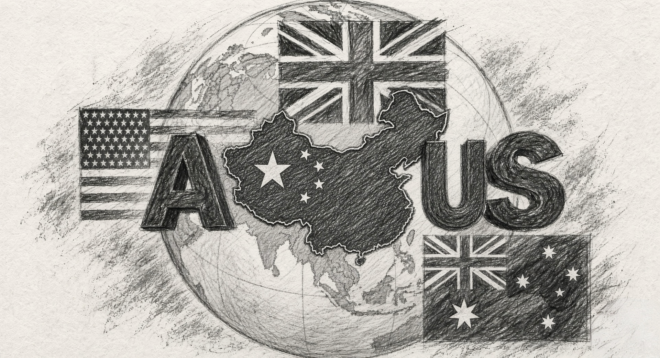
Australia’s defence establishment speaks fluently in the language of dollars – billions committed to AUKUS, percentages of GDP promised to Washington and NATO alike, timelines for submarines that will not arrive until the 2030s at the earliest. This is a comfortable vocabulary, because it is measurable and because it can be debated in the safely technical terms of budgets and procurement schedules. It is also an incomplete vocabulary. The true cost of Australia’s deepening military partnership with the United States is not primarily fiscal. It is strategic and economic, and it is borne not by the Commonwealth’s ledger but by the nation’s exposure to two compounding risks: the possibility of entanglement in a great-power war with China, and the near-certainty that Beijing will treat the security relationship and the trade relationship as connected, whatever Canberra prefers to believe. Two-way trade with China was worth roughly A$326 billion in 2025, equivalent to about 11.4 per cent of Australia’s GDP, with exports alone contributing around 6.9 per cent. An exposure of that magnitude does not sit quietly alongside a strategic bet of this size. Whether the alliance remains worth the risk it now carries is not a question that can be answered by pointing to submarine tonnage or interoperability statistics. It is a question about what kind of country Australia is prepared to become, and what it is prepared to lose.
There is also a temptation, on both sides of this debate, to treat the question as though it had already been answered by history – as though the American alliance were simply a fixed feature of the Australian strategic landscape, inherited rather than chosen, and therefore not properly a subject for renewed scrutiny each time its terms deepen. That temptation should be resisted. The ANZUS Treaty of 1951 was itself a specific historical bargain, negotiated in specific circumstances, and every subsequent expansion of the practical content of the alliance – the establishment of Pine Gap in 1970, the commitment of forces to Iraq and Afghanistan, and now AUKUS and the associated force posture initiatives – has been a fresh decision made by an Australian government of the day, answerable to the Australian public for the consequences. AUKUS and the force posture changes that have accompanied it since 2021 are no different in kind, whatever their scale. They deserve to be assessed on their own merits, against the specific strategic and economic environment of the mid-2020s, rather than waved through as the automatic continuation of a settled historical relationship.
This essay sets out to take that question seriously, in both directions. It examines how far the partnership with the United States has moved beyond the defence budget and into the physical geography of Australian territory; how that integration plausibly raises the risk that Australia would be drawn into, or targeted during, a US–China war; how exposed the trading relationship with China actually is, and what history says about Beijing’s willingness to use that exposure as a lever; and finally, whether – accounting honestly for the deterrent case and for the resilience Australia has already shown – the balance of costs and benefits still favours the course the government has chosen.
The Partnership Has Grown Far Beyond Dollars
The public conversation about AUKUS and the US alliance has largely been conducted through the defence budget, and on that measure alone the shift looks modest. Australian defence spending as a share of GDP has crept from around 2.0 per cent at the time of the AUKUS announcement in September 2021 to roughly 2.05–2.1 per cent in the mid-2020s, with official projections reaching about 2.23 per cent by 2028–29 under the traditional accounting method. The government has since begun promoting a broader, NATO-style definition of defence spending – one that folds in items such as military pensions – which produces a more politically useful figure near 2.8 per cent of GDP, with an announced target of 3 per cent by 2033–34. In raw dollar terms the growth is real: the consolidated Defence portfolio, including the Australian Signals Directorate and the Australian Submarine Agency, has climbed from the mid-$40 billions around the time of the AUKUS announcement toward $59 billion and beyond. A meaningful share of that new money is being spent on infrastructure that will double as support for American operations – the upgrade of HMAS Stirling in Western Australia ahead of the Submarine Rotational Force–West from 2027, airfield improvements at RAAF Base Tindal and elsewhere in the north, and the pre-positioning of fuel, munitions and other stocks. It is worth being precise about what this spending is: these are Australian sovereign investments, funded from the Australian budget, not rent paid to Washington for the privilege of American protection. That distinction matters, because it is often elided in both directions – critics sometimes imply Australia is simply bankrolling American strategy, while proponents imply the spending is cost-free because it strengthens Australian capability. Both simplifications obscure the more important point.
The more consequential change is not fiscal but operational, and it has proceeded with far less public debate than the submarine program itself. The United States now has meaningful, growing access to a significant number of Australian facilities. Marine Rotational Force – Darwin, which began in 2012 with a company-sized contingent of around 200 personnel, has been built up toward a planned dry-season peak of roughly 2,500 – though actual deployed numbers have varied year to year and the presence remains seasonal, typically April to October, rather than a standing garrison. Rotations of B-52 and other bomber aircraft through northern Australia occur on an increasingly routine basis. From 2027, American and British nuclear-powered submarines will begin operating from Western Australian waters under the Submarine Rotational Force–West arrangement, well before Australia takes delivery of its own Virginia-class boats. Long-standing joint facilities – Pine Gap chief among them – have for decades already integrated Australia into American intelligence collection and, by extension, into American targeting cycles. Taken together, the practical effect of this decade’s changes is that Australian territory has become substantially more useful as a staging, logistics and sustainment hub for American forces in the event of a high-end regional conflict. This is the change that the dollar figures do not capture, and it is the change that does the analytical work in everything that follows.
It is also worth noting how this shift has occurred largely outside the ordinary channels of public parliamentary debate that one might expect to accompany a change of this strategic magnitude. Force posture agreements, status-of-forces arrangements, and the operational details of rotational deployments are negotiated at the level of the Australia–US Ministerial Consultations (AUSMIN) and through bilateral defence cooperation frameworks that are not, as a rule, subject to the kind of parliamentary ratification that would apply to a formal treaty. Individual elements – a new wharf at HMAS Stirling, an expanded taxiway at Tindal – are typically announced and funded as discrete infrastructure projects, each unremarkable in isolation. It is only when the projects are considered cumulatively, over the five years since the AUKUS announcement, that the scale of the transformation in Australia’s strategic geography becomes apparent. This is not evidence of concealment; the individual decisions have generally been publicly announced. It is, however, evidence that the aggregate strategic consequence of many individually modest decisions can outpace the public and parliamentary scrutiny that any one of them, alone, would attract.
Integration Raises the Conditional Risk Of War
None of this is to say that Australia has volunteered for war. It has not, and no serious analyst suggests the government intends to. The argument is narrower and more troubling: that this deeper physical and operational integration increases the conditional risk that Australia would be drawn into, or deliberately targeted during, a war between the United States and China – most plausibly a war fought over Taiwan, though other flashpoints in the South China Sea or the East China Sea cannot be ruled out. This is a claim about probability conditional on a US–China war occurring, not a claim that such a war is likely or imminent. But conditional risk is still risk, and it is precisely the kind of risk that a serious strategic ally is entitled – indeed obliged – to interrogate before it accepts more of it.
The first strand of evidence is a matter of military logic rather than observed behaviour, and it should be assessed on its own terms. Targeting doctrine treats infrastructure by its function, not by the political relationship of the country that hosts it: facilities that would materially support American operations in a Pacific conflict – submarine bases, bomber staging points, intelligence and targeting infrastructure – acquire military value as targets by that fact alone, independent of anything Beijing has said or done. Some former Australian officials and independent strategic analysts have argued more pointedly still: that AUKUS and the expanded American force posture are converting Australian bases into forward operating locations for the United States without giving Canberra anything resembling a reciprocal guarantee. Australia receives no NATO-style Article 5 commitment from Washington, no formal veto over how or when the facilities on its soil are used in a crisis, and no assurance that consultation would precede rather than follow an American decision to act. This is an inference about structure and function, not a claim about Chinese intent, and it would hold even if Beijing said nothing at all.
The second strand is different in kind and conflating it with the first overstates the case: it is China’s own political signalling, which speaks to intent and posture rather than to targeting logic. China has repeatedly and explicitly characterised AUKUS as an act of “bloc confrontation” incompatible with regional stability. In 2025 the People’s Liberation Army Navy conducted a circumnavigation of Australia that included live-fire exercises. This was a demonstration of reach and of political messaging – a signal that China is both willing and increasingly capable of projecting force into Australia’s near approaches – but it is not itself evidence of a targeting decision, and it should not be read as such. Signalling and doctrine point in a broadly similar direction, but they are different categories of evidence, established through different methods, and a careful reader should be able to tell which claim is being made at any point in this argument. Taken together, they suggest – without proving – that from Beijing’s perspective, Australia is no longer regarded as a distant and comparatively peripheral American ally, safely removed from the central Indo-Pacific contest, but is increasingly regarded as a component of American warfighting architecture in the Pacific.
It would be intellectually dishonest, however, to present only one side of this ledger, and any essay produced under the editorial discipline this publication holds itself to must resist that temptation. The deterrence case is not a fig leaf; it is a coherent strategic argument made in good faith by people who take the risk of war at least as seriously as its critics do. Australia’s own official strategic assessments – beginning with the 2020 Defence Strategic Update and reaffirmed in subsequent reviews – concluded, independently of AUKUS, that China’s rapid military modernisation had already eroded the ten-year strategic warning time that had underpinned Australian defence planning for decades. On this view, the American force posture in northern Australia is not what creates the danger; it is a response to a danger that Australian planners judged was already growing, and its purpose is to complicate Chinese military calculations enough that a war over Taiwan or elsewhere becomes less likely to be attempted in the first place, not more. Australia, moreover, retains the formal sovereign authority to decide whether and how it would participate in any American-led conflict; nothing in the current arrangements compels automatic Australian involvement, whatever the practical pressures of alliance politics might turn out to be in the event. It is also true that a degree of entanglement with American strategy is not new – Pine Gap has operated since 1970, and Australia’s intelligence and targeting integration with the United States predates AUKUS by half a century. And geography, though it now offers less insulation than in the past, still offers some: Australia sits further from the likely first-order battlespace than Japan, South Korea, or the Philippines. Both readings of the evidence contain truth. The expanded American presence simultaneously raises the stakes if a war does occur and is intended, by design, to make that war less likely to occur at all. A fair assessment cannot collapse this tension in either direction; it can only weigh it.
It is also worth situating Australia’s position within the broader regional picture, since the risk it has assumed is not unique even if it is newly significant. Japan, South Korea, the Philippines and, in a different sense, Taiwan itself all host or would host American forces in a Pacific conflict, and each faces a materially higher probability of direct attack than Australia does, given proximity alone. Australia’s distinctive vulnerability is not that it faces the highest absolute risk of attack among America’s Pacific partners – it plainly does not – but that its risk profile has shifted disproportionately given how peripheral its geography and, historically, its force posture had previously kept it. A country that moves from the periphery toward the centre of an alliance structure experiences the largest proportional increase in exposure, even if its absolute risk remains lower than that of the frontline states. This is the sense in which the AUKUS-era changes matter most: not because they make Australia the most exposed state in the Indo-Pacific, but because they represent the largest single change in Australia’s own risk profile in at least half a century.
The Economic Relationship that Would Be Put at Risk
If the security question is inherently uncertain – a matter of probabilities, deterrence theory and contested intelligence – the economic exposure that sits alongside it is not. It is measurable, current, and concentrated in specific, identifiable sectors, and it is worth starting there rather than with the national totals, because it is at the sector level that any retaliation would actually land. China has already demonstrated, within living memory, both the willingness and the institutional capacity to use economic pressure as a tool of political and security signalling against Australia specifically. Between 2020 and 2024, Beijing imposed tariffs and a range of formal and informal restrictions on Australian wine, barley, coal, lobster, timber, cotton and other exports, in the wake of the Morrison government’s call for an independent international inquiry into the origins of COVID-19 and its decision to ban Huawei from Australia’s 5G telecommunications network. Those measures were not subtle, and they were not disguised as ordinary trade disputes; Chinese officials and state media were explicit that the restrictions were a response to specific Australian political and security decisions. The pain was real and concentrated: wine exporters lost access to what had been their largest market virtually overnight, barley growers faced tariffs exceeding 80 per cent, and lobster exporters watched shipments left to spoil on the tarmac at Chinese airports. For the industries and regions directly affected, this was not an abstract geopolitical episode; it was a livelihood-level shock, and it is these same sectors – agriculture, wine, seafood, and, on the services side, education and tourism – that would most plausibly absorb the first and heaviest impact of any renewed measures.
This sector-level exposure sits inside a much larger aggregate relationship, and the scale of that larger relationship is what makes the sector-level risk worth taking seriously rather than dismissing as marginal. China remains Australia’s dominant trading partner by a wide margin, and no other market comes close to offering a substitute at anything like the same scale. In 2025, two-way goods and services trade between the two countries reached approximately A$326 billion, or about a quarter of Australia’s total trade with the world – equivalent to roughly 11.4 per cent of Australia’s GDP, with exports alone contributing around 6.9 per cent. Exports to China alone were worth around A$196 billion. Iron ore, natural gas, coal and other commodities form the structural core of a relationship that has been, in narrow economic terms, remarkably complementary: China’s manufacturing and construction sectors have needed precisely what Australia’s mining regions produce in abundance, at a scale and reliability few other suppliers can match. Education and tourism add further layers of interdependence – Chinese students and visitors have for two decades been among the largest single contributors to those sectors of the Australian economy. This is not, by any reasonable measure, a marginal or easily substitutable market. It is a relationship that has underpinned two decades of Australian prosperity, uninterrupted economic growth through the Global Financial Crisis, and a resource-export boom that few other developed economies could match. But it is worth being precise about where within that large aggregate figure the actual political risk sits: not evenly across the whole trading relationship, but concentrated in the specific sectors named above.
At the same time, intellectual honesty requires acknowledging that the aggregate macroeconomic impact of that episode was considerably smaller than many feared at the time, and this matters for how the current risk should be weighted. Iron ore – by far Australia’s largest single export to China and the commodity most exposed on paper – was conspicuously left untouched throughout the entire dispute, because Chinese industry’s dependence on Australian iron ore was, and remains, structural rather than discretionary; there was and is no comparably reliable alternative supplier at the volumes China’s steel industry requires. Because iron ore was spared, and because global commodity prices were unusually high through much of the period, independent estimates have generally put the net cost to the Australian economy at well under 1 per cent of GDP – painful for the specific sectors and regional communities affected, but not something that showed up as a visible dent in national growth figures. Affected exporters also proved more adaptable than expected, diverting significant volumes of wine, barley and other products to alternative markets in Europe, Southeast Asia and the Middle East, even if at lower prices and thinner margins. Trade between the two countries subsequently recovered and substantially stabilised from 2023 onward, following a resumption of high-level diplomatic contact under the Albanese Government. The episode, in other words, demonstrated real Chinese willingness to weaponise the trading relationship – but it also demonstrated real limits on how much damage Beijing was able, or perhaps willing, to inflict without harming its own economic interests in the process.
Linking the Two: A Fair and Significant Risk
Taken together, these two strands of evidence support a specific and defensible conclusion, one that avoids both alarmism and complacency: further tightening of Australia’s military integration with the United States plausibly increases the probability of renewed, and potentially more severe, Chinese economic retaliation, without making such retaliation certain or automatic. Beijing has already made clear, through its own official statements, that it regards AUKUS and the expanded American force posture in Australia as components of a broader containment strategy directed at China’s rise. A future crisis over Taiwan – even one that stops well short of open war – or a sharper deterioration in the broader US–China relationship, could plausibly produce a new and more severe round of sanctions, informal import restrictions, tourism and education advisories, or restrictions on Chinese investment into Australia. Because the underlying trade relationship is so large, the potential downside of such a response is economically significant in absolute terms even if it does not threaten the overall stability of the Australian economy. Specific export sectors – again most likely agriculture, wine, seafood, and possibly education and tourism rather than the iron ore trade that both sides have strong incentives to protect – would bear the initial and most concentrated cost. The national accounts would only register a serious effect if the disruption proved unusually broad, prolonged, or if it coincided with a downturn in global commodity prices that removed the cushion that softened the previous episode.
This conclusion should not be mistaken for a prediction that disruption is inevitable, and a publication committed to evidentiary precision over rhetorical force has an obligation to state the countervailing evidence with equal clarity. The two governments have, since the low point of 2020–22, generally managed to keep the security and economic relationships in separate diplomatic compartments, resuming ministerial-level trade dialogue even as strategic competition and military signalling have continued in parallel. The underlying commodity complementarity between the two economies remains structurally strong and is not something either government can simply legislate away. Australia has pursued a genuine, government-backed diversification strategy since 2020 – deeper trade ties with India, Indonesia, Japan, South Korea and the European Union among them – though with only limited success so far in meaningfully reducing China’s overall share of Australian trade, which remains close to a quarter of the total. Previous Chinese economic coercion did not succeed in altering Australian security policy in any of the areas it targeted; Australia neither reversed the Huawei ban nor withdrew its position on the COVID-19 inquiry, and the AUKUS announcement itself came only months after the trade dispute was at its most intense. Australian markets and policymakers, in the event, proved considerably more resilient than many analysts predicted in 2020. These facts meaningfully weaken the case that catastrophic economic retaliation is a likely or proportionate response to continued alliance deepening. They do not eliminate the risk; they discipline the estimate of its size.
Is the Alliance Worth It?
The American alliance delivers Australia capabilities that it could not plausibly generate on its own, on any realistic timeframe or budget: nuclear-powered submarines and the industrial and training base that comes with them, access to advanced military technology that Australia’s own defence industrial base could not independently develop, an intelligence-sharing relationship of extraordinary depth through the Five Eyes partnership, and – most fundamentally – the strategic backstop of the world’s most powerful military in a regional environment that Australia’s own government has assessed, through successive strategic reviews conducted by governments of both political persuasions, to be deteriorating. These are not trivial or symbolic benefits. They represent capability that genuinely could not be replicated through a more independent defence posture within any timeframe relevant to current strategic circumstances.
But the alliance also imposes costs that extend well beyond the additional billions committed in each federal budget, and this essay has tried to state them without either inflating or minimising them. It creates greater and more visible operational entanglement with American strategy in the Pacific than Australia has experienced at any point since the Vietnam War. It raises – conditionally, not certainly, but genuinely – the probability that Australian territory would be targeted in the event of a US–China war, because Australian territory would by then have become materially more useful to American war-fighting capability than it has been in previous decades. And it elevates the risk of economic coercion from the trading partner on which a substantial share of Australian national income still depends, a partner that has already shown, within the past five years, both the willingness to impose costly retaliation and – just as importantly – the practical limits of how much retaliation it is prepared or able to sustain. None of these costs is theoretical or speculative in the way that, say, a purely hypothetical future risk might be. Each of them has already been glimpsed directly: in the concentrated pain of the 2020–24 trade measures, and in the live-fire signalling of China’s 2025 naval circumnavigation of the continent.
“Worth it?” is not a question that can be answered against an atmosphere of vague alternatives; it requires a comparator with the same three elements as the AUKUS path itself – a force, a timeline, and a residual risk. The most seriously argued alternative on offer is not withdrawal from the alliance but a shift in emphasis toward a denial-based posture built around what Australia already knows how to build and buy. The force: an expanded fleet of conventionally-powered submarines rather than a wait for nuclear boats – whether an extended and enlarged Collins-class program or an off-the-shelf design from Japan, South Korea or Europe – paired with long-range land-based and maritime strike missiles, an enlarged mine-warfare capability, and a hardened, dispersed northern airbase network designed to survive rather than merely host a first strike. The timeline: such a force is broadly buildable within ten to fifteen years using existing shipyards and known technology, against the mid-2030s to early-2040s horizon before Australia’s own Virginia-class and SSN-AUKUS boats are realistically operational in numbers. That ten-to-fifteen-year estimate should itself be treated with some scepticism rather than taken as a clean advantage over AUKUS: Australia’s own submarine procurement history, from the Collins-class build to the collapsed Attack-class contract with France, is a history of schedule slippage and cost overrun, and there is no strong reason to assume a conventional build/buy program would run to time any more reliably than the nuclear one it replaced – while the boats themselves, whatever the timeline, would still carry a fraction of a nuclear submarine’s submerged range and endurance, a genuine operational shortfall for a navy that has to cover the distances the Australian and Indo-Pacific theatre demands. The residual risk: this posture forfeits the nuclear submarine’s endurance and the deep interoperability, intelligence access and extended deterrence that come bundled with hosting American forces, meaning Australia would carry more of its own regional deterrence burden with less powerful tools and a thinner intelligence picture. Nor does the reduced-target-value claim follow from the hull choice alone: swapping to conventional submarines while continuing to host the Submarine Rotational Force–West, the Marine rotations through Darwin, and the bomber and intelligence infrastructure elsewhere would leave Australian territory just as valuable to American operations as it is now, and just as exposed by the doctrine argument set out earlier in this essay – the lower targeting value this alternative promises is a function of hosting less American capability on Australian soil, not of which submarines Australia itself happens to operate, and a government pursuing this path would have to be honest about winding back SRF-West and the rotational presence, not merely about which shipyard builds its own boats. And the transition period would not be cost-free in the interim: stepping back from SRF-West and from the planned Virginia-class transfer represents a real reduction in Australia’s available underwater capability through the 2030s, when the conventional alternative would not yet be at scale and the current AUKUS boats would already be gone from the plan – a capability cut during the most strategically uncertain decade in this assessment, not simply a sovereignty gain deferred to a later, safer date. Neither path is free of risk; the honest comparison is between a higher-capability, higher-entanglement posture and a lower-capability, lower-entanglement one, not between a real option and an imagined one.
A genuinely balanced assessment does not require Australia to choose between the security relationship and the economic relationship, discarding one to protect the other, and it would be a mistake for this essay to pretend that such a clean choice is realistically available. Both relationships are simultaneously real, both are currently indispensable to Australian prosperity and security as those things are presently understood, and the honest conclusion is that they cannot be perfectly insulated from one another no matter how skilfully Canberra’s diplomats attempt the compartmentalisation. The expanding military partnership with the United States is, in the end, a strategic choice – one made openly by successive Australian governments, with full knowledge of the trade-offs involved – and it carries economic consequences that are neither hidden nor, on the evidence to date, disguised. Whether those consequences represent an acceptable price for the additional security the partnership provides depends on a set of judgments that reasonable, well-informed people can weigh differently: how one estimates the underlying probability of a US–China conflict occurring at all; how much genuine deterrent effect one attributes to the expanded American presence, as against the risk that the presence itself becomes a provocation; how resilient one judges Australian exporters and policymakers to be, based on their demonstrated performance in the 2020–24 episode; and how one weighs the denial-based alternative set out above against the current path, given that a more accommodating diplomatic stance toward Beijing is a third option that a great many Australians, across the political spectrum, would regard as riskier than either.
The debate over Australia’s alliance with the United States has too often been conducted as though the size of the defence budget were the only fact that mattered, or as though critics of the relationship were merely counting dollars while its supporters spoke of higher strategic principle. Neither framing survives close examination. The debate is properly settled – to whatever extent debates of this kind are ever settled – not by the budget line but by a harder and more honest question: whether the security gains that the alliance plausibly delivers are large enough, and certain enough, to outweigh the trade risk and the war risk that now sit, permanently and visibly, alongside it. That is a legitimate question. It remains, on the evidence available in 2026, an unresolved one – and Australians are entitled to have it debated as such, rather than settled by default through the accumulation of infrastructure, rotations and joint facilities that make the underlying choice progressively harder to reverse.
– – –
Bakchos is the founder of Blak and Black, an Australian media and advocacy platform established in 2010. Bakchos writes from the intersecting perspectives of Wiradjuri heritage, Jewish identity, and humanism.
© Bakchos, September 2026




Australia needs to exit AUKUS now!
We talk about AUKUS in terms of dollars and delivery dates. This essay argues the real story is elsewhere — in the quiet, cumulative build-up of American access to Australian bases, and in what that build-up means for Australia’s exposure to both a US–China war and Chinese economic retaliation.
Time for Australia to leave AUKUS.